


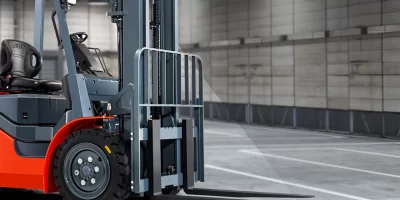







A reach truck BMS is the specialized battery management system regulating the lithium-ion pack in an electric reach truck. It protects lithium cells against extreme warehouse operational stresses. These stresses include multi-stage hydraulic mast lift surges, dynamic regenerative braking, and sub-zero cold storage operations.
Modern narrow-aisle logistics facilities demand maximum equipment uptime and round-the-clock shift efficiency. Electric reach trucks transport heavy pallets across narrow warehouse aisles and lift loads over ten meters high. These intensive operations place severe electrical demands on industrial battery systems governed under OSHA standard 1910.178 for powered industrial trucks.
A standard lithium battery management board cannot survive these harsh operational profiles. A dedicated industrial reach truck BMS provides real-time cell telemetry, active cell balancing, and robust thermal protection. It links directly to the vehicle traction controller through industrial CAN bus networks.
As an integrated engineering manufacturer, AYAA TECH designs and manufactures complete power ecosystems. Our vertical production spans custom PCB hardware, intelligent Smart BMS units, industrial battery packs, and matching chargers. We deliver standard off-the-shelf modules, semi-custom solutions, and full turnkey battery systems for modern warehouse fleets.

Figure 1: Electric reach truck lifting heavy palletized cargo in high-bay narrow-aisle warehouse with active lithium battery telemetry.
Distinct Operating Demands of Electric Reach Trucks
Electric reach trucks operate differently from standard horizontal pallet jacks or light counterbalanced forklifts. Their operating cycles involve continuous acceleration, sharp mast reach maneuvers, and rapid hydraulic elevation.
High Hydraulic Surge Currents and Dynamic Load Swings
Lifting multi-ton pallets to elevated rack locations requires enormous instantaneous hydraulic power. The hydraulic pump motor creates massive inrush current spikes. These current spikes frequently reach 300A to 500A within fractions of a second.
Standard battery protection circuits might misinterpret these legitimate load spikes as short circuits. An industrial reach truck BMS must support high peak current thresholds for defined time windows. It maintains system stability without tripping nuisance safety cutoffs during heavy lifting sequences.
Simultaneously, mast lowering generates dynamic regenerative energy. Hydraulic fluid back-drives the pump motor, feeding charge current back toward the battery pack. The BMS must safely absorb these rapid charging transients without triggering overvoltage alarms.
Cold Storage Operation and Thermal Shock Resilience
Many electric reach trucks operate inside refrigerated distribution centers and blast freezers. Ambient temperatures in cold storage facilities typically drop between -20°C and -30°C.
Sub-zero temperatures dramatically increase cell internal resistance. Charging lithium cells below freezing risks hazardous metallic lithium plating on graphite anodes. This condition accelerates capacity loss and causes internal short circuits.
A heavy-duty reach truck Smart BMS integrates low-temperature charge lockouts and multi-zone heating controls. It drives internal heating elements before allowing current flow from the industrial fast charger. This automated thermal preparation preserves cell health and ensures reliable winter shift cycles.
Essential Functions of an Industrial Reach Truck Smart BMS
Warehouse reach trucks rely on sophisticated BMS hardware to maintain safety across continuous multi-shift operations.
Multi-Level Overcurrent and Regenerative Surge Safeguards
Industrial reach trucks require multi-tiered protection strategies within both hardware and firmware layers. An analog front-end circuit continuously measures pack current across low-temperature-coefficient shunt resistors.
Hardware comparators provide instant short-circuit isolation within 100 microseconds. Firmware algorithms manage secondary overcurrent tiers. These tiers permit short hydraulic motor surges while preventing sustained thermal overload across wiring harnesses.
Engineering Note:
Abrupt contactor opening during full-height pallet elevation can cause catastrophic mast tip-over. A professional reach truck BMS prioritizes progressive CAN bus power limiting before executing complete contactor disconnection.
Bidirectional transient voltage suppression arrays protect internal circuitry against inductive switching spikes. When hydraulic valves close suddenly, inductive kickback is safely clamped before reaching sensitive electronic components.
Active Cell Balancing for Heavy-Duty High-Capacity Packs
Reach truck battery packs generally feature large cell capacities ranging from 200Ah to 600Ah. Traditional passive balancing circuits bleed excess energy through small resistive heat sinks at merely 50mA.
Bleeding 50mA on a 400Ah industrial cell pack takes days to correct minor cell drift. Uneven cell degradation quickly reduces usable pack capacity during heavy warehouse shifts.
Modern reach truck battery management systems implement active balancing architectures. Inductive or capacitive active balancing shuttles 1A to 2A of charge between cells. This dynamic transfer operates during both operation and opportunity charging without generating harmful localized heat.

Figure 2: Quality technician inspecting solid copper busbars and active balancing Smart BMS on an industrial reach truck lithium pack.
Multi-Point Temperature Monitoring and Thermal Shock Control
Industrial battery packs for reach trucks contain dense arrays of prismatic lithium iron phosphate cells. Localized hotspots can develop deep within the pack core during rapid acceleration and continuous lifting.
An industrial reach truck BMS deploys between eight and sixteen high-precision NTC temperature sensors. These sensors monitor individual cell terminals, internal busbars, and power semiconductor heat sinks.
The firmware monitors thermal gradients between adjacent cells. If temperature variance exceeds 5°C, the BMS initiates corrective cooling protocols or throttles discharge rates. This proactive thermal surveillance prevents localized accelerated cell aging across multi-shift warehouse duties.
Optimize Your Reach Truck Fleet with Industrial Smart BMS
Explore Industrial Smart BMS SolutionsIndustrial Communication Protocols and Truck Controller Integration
Seamless integration between the battery management system and the vehicle controller ensures uninterrupted vehicle performance.
Dual-CAN Architecture and Controller Handshake
Modern warehouse fleets deploy material handling trucks from various global manufacturers. These brands include Jungheinrich, Linde, Crown, Toyota, and Raymond. Each equipment manufacturer relies on distinct communication parameters.
Industrial reach truck units utilize dual-channel CAN bus architectures. One dedicated CAN channel communicates internally with slave monitoring units and the industrial charger. The secondary CAN interface connects directly to the main vehicle control unit.
Standard implementations support CAN 2.0B hardware running CANopen CiA 413 profile or SAE J1939 protocol standards. The BMS broadcasts pack voltage, discharge limits, cell temperatures, and diagnostic fault codes. The vehicle display shows clear operating data to the forklift driver.

Figure 3: Multi-channel CAN bus communication validation and dynamic 48.2V pack telemetry testing on industrial test rack.
Preventing Sudden Power Cutoffs at High Lift Elevations
Unexpected power loss while lifting three-ton pallet loads poses serious warehouse safety hazards. A sudden contactor disconnect leaves heavy pallets suspended without powered lowering capabilities.
To eliminate this operational danger, the Smart BMS transmits multi-stage warning frames across CAN bus lines. When cell voltage approaches lower discharge limits, the BMS notifies the truck controller.
The vehicle controller initiates an intelligent limp-home mode. It restricts mast lift speeds and travel velocity while preserving sufficient power for safe hydraulic lowering. This coordinated protection prevents abrupt shutdowns and keeps warehouse personnel completely safe.
Cloud Telematics and Predictive Fleet Diagnostics
Modern automated and manned warehouses rely on continuous telematics telemetry to manage material handling assets. Smart BMS electronics feature integrated RS485 or 4G IoT communication interfaces.
Operating parameters such as cycle counts, amp-hour throughput, and thermal history upload to centralized fleet dashboards. Maintenance supervisors track real-time battery degradation across dozens of operational trucks simultaneously.
Predictive algorithms detect abnormal cell impedance increases weeks before an actual cell failure occurs. Maintenance teams schedule pack servicing during planned facility maintenance windows. This connected architecture eliminates unexpected equipment breakdown during peak seasonal dispatching periods.
Thermal Architecture and High-Precision SOC Estimation
Warehouse shifts demand rapid opportunity charging during operator lunch breaks. High charging rates create substantial internal thermal energy that demands rigorous thermal management.
Heavy-Current Heat Dissipation and Hardware Layout
Continuous operation under 200A loads generates severe thermal stress across switching MOSFETs and current sensing shunts. Thermal bottlenecks degrade electronic components and trigger false over-temperature shutdowns.
AYAA TECH optimizes heat dissipation through symmetrical component placement across multi-layer heavy copper printed circuit boards. We separate power MOSFET arrays from sensitive analog measurement circuitry to minimize thermal coupling.
High-grade thermal interface silicone pads transfer heat directly into thick extruded aluminum alloy heatsinks. In high-demand applications, copper heat spreaders dissipate thermal spikes rapidly. This mechanical design maintains low surface temperatures even during continuous heavy lifting cycles.

Figure 4: AYAA TECH MODEL: AY-24S300A-ES001 industrial Smart BMS (24S 300A with CAN, RS485, and Bluetooth) in heavy-duty aluminum chassis.
Temperature-Compensated SOC Algorithm for Fleet Uptime
Accurate State of Charge tracking is essential for modern warehouse fleet dispatching. Simple voltage-based estimation fails with LiFePO4 batteries due to their flat discharge curves.
Ambient warehouse temperatures fluctuate wildly between outdoor loading docks and refrigerated storage racks. These temperature shifts alter cell impedance and electrochemical reaction rates.
AYAA TECH deploys advanced adaptive extended Kalman filter algorithms combined with precision Coulomb counting. Our firmware dynamically adjusts internal battery resistance models according to real-time cell temperatures. AYAA TECH maintains an SOC estimation error rate of ≤ 5%. Warehouse managers rely on precise runtime projections without premature battery exhaustion.
Technical Comparison: Standard Forklift BMS vs Heavy-Duty Reach Truck BMS
Choosing the right battery management hardware depends heavily on operational duty cycles and mechanical lifting requirements.
| Feature Specification | Standard Walkie Stacker BMS | Heavy-Duty Reach Truck BMS |
|---|---|---|
| Nominal System Voltage | 24V (8S LiFePO4) | 36V, 48V, or 80V (12S – 25S LiFePO4) |
| Continuous Discharge Current | 100A – 150A | 200A – 350A |
| Peak Hydraulic Surge Current | 200A (3 seconds) | 450A – 600A (10 to 30 seconds) |
| Cell Balancing Architecture | Passive resistive (50mA – 100mA) | Active inductive/capacitive (1A – 2A) |
| Vehicle Communication | Basic RS485 or single CAN bus | Dual CAN bus (CiA 413, J1939, custom) |
| Operating Temperature Range | 0°C to +45°C ambient | -30°C to +55°C (integrated heating control) |
| Enclosure Ingress Protection | IP54 dust resistant | IP67 sealed aluminum enclosure |
The data above shows that reach truck battery management demands superior continuous power and transient capabilities. While light walkie stackers operate well with compact boards, heavy-reach trucks require reinforced current paths and sealed metal enclosures.
Retrofitting Lead-Acid Reach Trucks to Lithium with Smart BMS
Many warehouse operations replace outdated lead-acid batteries with high-efficiency lithium packs. A well-engineered Smart BMS simplifies this conversion while maintaining structural truck stability under ISO 3691-1 industrial vehicle safety standards.
Ballast Balancing and Mast Stability Safeguards
Lead-acid battery packs provide substantial physical counterweight inside electric reach trucks. Lithium battery packs weigh approximately one-third of equivalent lead-acid units.
During conversions, technicians must install certified steel ballast plates inside the battery compartment. Proper ballast placement preserves original mast center of gravity ratings and prevents truck tip-over accidents.
Failure to install adequate ballast severely compromises chassis stability when reaching heavy loads forward. Technicians must verify total combined weight against manufacturer chassis plate requirements before commissioning retrofitted trucks.
Electrical Interlocks and Closed-Loop Fast Charger Matching
The replacement Smart BMS must integrate with vehicle key switches and emergency stop interlocks. The BMS controls the main contactor pre-charge circuit to prevent welding contactor tips during startup.
Inrush currents from large motor controller capacitor banks can damage contactor contact faces without proper pre-charge sequencing. The BMS energizes a current-limiting pre-charge resistor until intermediate DC bus voltage matches pack voltage.
Furthermore, it communicates directly with fast chargers to control current output according to real-time cell temperatures. This closed-loop synchronization allows safe opportunity charging from 20% to 80% capacity in under two hours.
Conclusion: Key Decision Factors for Reach Truck Fleet Uptime
Selecting an industrial reach truck BMS involves evaluating peak current handling, thermal resilience, and CAN communication flexibility. High mast elevations and intensive opportunity charging demand robust electronics that withstand continuous warehouse punishment.
A reliable Smart BMS eliminates unexpected warehouse stoppages, protects battery capital investments, and ensures absolute operator safety. By partnering with an experienced hardware manufacturer, fleet operators achieve seamless vehicle integration and maximum daily operational throughput.
Need Custom Reach Truck BMS Hardware or Firmware?
Consult an AYAA Battery ArchitectFAQ
What nominal battery pack voltages do electric reach trucks commonly use?
Most electric reach trucks operate on 48V systems using 15S or 16S LiFePO4 cell configurations. Larger heavy-duty reach trucks use 80V architectures, while smaller narrow-aisle models occasionally deploy 24V or 36V packs.
Why is active cell balancing necessary for reach truck lithium batteries?
Reach truck batteries feature high capacities between 200Ah and 600Ah. Traditional passive balancing bleeds only 50mA, which fails to correct cell drift. Active balancing moves 1A to 2A between cells without generating excess heat.
How does the BMS absorb hydraulic mast regenerative braking currents?
When lowering heavy loads, the hydraulic motor functions as an electrical generator. The Smart BMS monitors pack voltage and absorbs reverse current surges within safe overvoltage thresholds.
Can an electric reach truck operate in blast freezers with a lithium BMS?
Yes, industrial reach truck BMS units operate reliably down to -30°C. They feature automatic low-temperature charge cutoffs and control internal thermal heating pads before permitting charge current flow.
Which communication protocols connect the BMS to the reach truck dashboard?
Industrial reach truck battery management units typically use CAN bus communication. They support CANopen with CiA 413 forklift profiles, SAE J1939 protocols, or customized OEM proprietary CAN matrices.
What happens when battery charge drops low during high pallet lifts?
The Smart BMS broadcasts progressive warning frames across CAN bus lines. Instead of abruptly opening contactors, it commands the vehicle controller to enter limp mode for safe load lowering.
Which industrial standards apply to reach truck lithium battery management systems?
Reach truck battery packs and BMS electronics should comply with UL 2580, IEC 62619, and ISO 3691-1 safety standards. These specifications govern electrical safety, vibration resistance, and functional safety controls.


