
- Industries

Home Backup & Garden BMS
View More >Electric Forklift BMS
View More >Golf Cart BMS
View More >Electric Two-wheeler BMS
View More >Aviation & UAV BMS
View More >BMS For Power Tools
View More >Medical Equipment BMS
View More >





Home About Us EVENTS & NEWS Top Electric Stacker Battery Suppliers: 2026 Fleet Guide
Finding a dependable electric stacker battery supplier is essential for warehouse productivity and fleet safety. Material handling operations rely heavily on walkie stackers, straddle trucks, and reach stackers. Choosing the right partner requires balancing cell chemistry, cycle longevity, dynamic ballast integration, and intelligent battery management.
A professional electric stacker battery supplier provides more than just standard cells. Leading industrial partners deliver complete power systems with integrated battery management systems (BMS) and matching high-frequency chargers. They also offer custom metal fabrication to match chassis ballast specifications. This engineering guide reviews the top electric stacker battery suppliers in 2026 and outlines essential sourcing criteria.
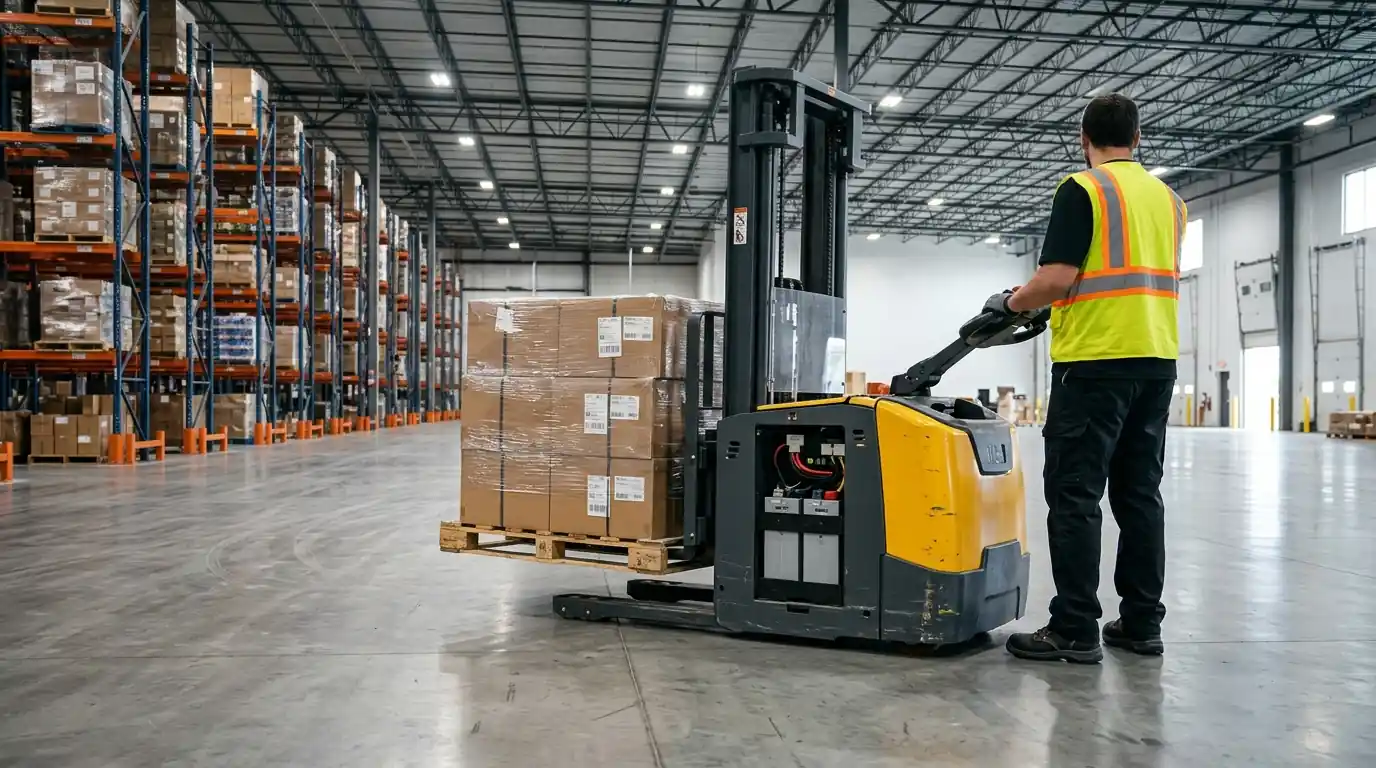
Heavy-duty electric walkie stacker lifting a loaded pallet in an industrial warehouse facility.
Selecting a motive power supplier requires looking beyond superficial catalog specifications. Warehouse duty cycles place severe thermal and mechanical stresses on battery assemblies. Fleet managers must evaluate cell construction, control electronics, and physical mechanical safety.
Lithium Iron Phosphate (LiFePO4) has become the dominant chemistry for modern stacker fleets. LiFePO4 chemistry provides exceptional thermal stability and eliminates the risk of catastrophic thermal runaway. Prismatic cells offer superior mechanical durability compared to cylindrical cells in mobile material handling equipment.
Top-tier suppliers utilize automotive-grade cells rated for over 3,500 full charge cycles at 80% depth of discharge. In contrast, conventional flooded lead-acid batteries rarely exceed 1,200 cycles under single-shift usage. Furthermore, lithium allows opportunity charging during 15-minute operator breaks without causing permanent plate sulfation. Sourcing teams should always verify cycle life test data from reputable international testing laboratories.
The Battery Management System acts as the primary safety brain for any industrial lithium pack. An industrial Smart BMS monitors individual cell voltages, pack temperatures, and current flow in real time. It automatically disconnects current during over-voltage, deep discharge, or short circuit events.
Modern material handling equipment demands intelligent communication between the battery pack and the vehicle motor controller. Leading suppliers support standardized industrial communication interfaces, including CANopen protocols, RS485, and Modbus. These protocols transmit accurate runtime metrics directly to operator dashboard displays. Advanced telemetry logging also assists fleet supervisors in diagnosing intermittent electrical faults across multi-shift facilities.

Industrial Smart BMS communication architecture connecting lithium cells to motor controllers and operator consoles.
Electric stackers rely on the physical battery pack weight to counterbalance elevated pallet loads. Lithium battery cells weigh roughly one-third of equivalent capacity lead-acid packs. Without proper mechanical engineering, replacing lead-acid with lithium creates severe forward tipping hazards during mast lift.
A capable manufacturer designs custom steel battery trays fitted with integrated steel ballast plates. This fabrication ensures replacement packs satisfy minimum vehicle data plate ballast under OSHA standard 1910.178 guidelines. Additionally, reliable suppliers provide turnkey wire harnesses with heavy-duty REMA or Anderson connectors for plug-and-play installation.
The global market features specialized engineering manufacturers, multinational motive power corporations, and industrial distributors. Below are the leading suppliers delivering dependable energy storage solutions for electric stacker fleets.
AYAA TECH stands out as an integrated engineering manufacturer specializing in custom motive and energy storage solutions. We operate complete in-house manufacturing lines. Our capabilities cover PCB design, industrial Smart BMS development, battery packs, and matching chargers. This full manufacturing loop supports off-the-shelf standard packs, semi-custom adaptations, and complete turnkey OEM solutions.
Our engineering team addresses critical material handling performance challenges through proprietary electronic control architectures. Our industrial Smart BMS incorporates a high-precision state of charge (SOC) algorithm. This proprietary calculation maintains an SOC error below 5%. It ensures accurate runtime predictions across cold storage and ambient docks.
Thermal management represents another core engineering advantage at AYAA TECH. We utilize an optimized physical layout for power MOSFETs and precision current shunt resistors. Heavy copper busbars, industrial thermal silicone pads, and high-conductivity aluminum enclosures rapidly conduct heat away from sensitive electronic components. This robust thermal design ensures continuous high-current hydraulic lifting without triggering premature thermal throttling.
AYAA delivers custom 24V, 36V, and 48V battery trays equipped with CANopen, RS485, and custom telemetry protocols. Whether your application requires custom steel ballast trays or specialized vehicle controller handshakes, AYAA delivers fully certified, turnkey energy solutions.

AYAA TECH test engineer conducting voltage and quality validation on an industrial 24V LiFePO4 stacker battery assembly.
EnerSys is a multinational leader in industrial motive power solutions with an extensive global distribution network. The company offers both traditional lead-acid systems and advanced lithium-ion products under the NexSys brand family. Their NexSys PURE line utilizes thin plate pure lead (TPPL) technology to provide low-maintenance operation for medium-duty fleets.
For intensive multi-shift applications, the NexSys iON series provides integrated lithium-ion systems with ruggedized mechanical packaging. EnerSys maintains an expansive field service network across North America and Europe. This extensive presence makes them a dependable option for large logistics enterprises needing standardized regional fleet replacement programs.
Green Cubes Technology engineers high-performance lithium energy systems designed specifically for material handling machinery. The company has established strong relationships with original equipment manufacturers of walkie stackers and pallet trucks. Their modular Lithium SAFEFlex architecture supports 24V to 80V motive applications with standardized mechanical form factors.
Green Cubes equips its battery modules with integrated multi-layer safety electronics and IoT cloud telemetry. Their systems offer seamless plug-and-play installation into major OEM battery compartments. While their pricing reflects a premium tier, their proven integration pedigree appeals to high-throughput distribution hubs.
BSLBATT (Wisdom Industrial Power) is an established manufacturer of industrial lithium-iron phosphate battery solutions. The company maintains a comprehensive catalog of drop-in replacement batteries engineered for standard Chinese, European, and American stacker models. Their designs focus on simplifying the transition from legacy lead-acid batteries to lithium technology.
Each BSLBATT pack features an integrated steel enclosure, external state-of-charge display, and pre-wired Anderson power connectors. Their products cover popular 24V and 48V configurations with capacities ranging from 100Ah to 300Ah. BSLBATT serves as a practical sourcing partner for aftermarket equipment dealers seeking cost-effective retrofit kits.
Flux Power develops and manufactures advanced lithium-ion energy packs tailored for Class III material handling machinery. Based in the United States, the company focuses on walkie stackers, walkie pallet trucks, and end-riders. Their LiFT series delivers UL-listed power solutions that meet stringent North American industrial safety standards.
Flux Power designs its battery enclosures with heavy-gauge steel ballast to fulfill vehicle stability requirements directly. Their onboard battery management systems communicate critical telemetry to warehouse fleet management platforms. The company provides strong domestic technical support for regional supply chain and distribution operations across North America.
Triathlon Batteries Solutions is a prominent European manufacturer specializing in heavy-duty traction batteries for industrial trucks. The company produces conventional lead-acid batteries alongside their advanced Quasar and lithium-ion product lines. Their multi-voltage systems are engineered to withstand continuous 24/7 material handling schedules across European logistics terminals.
Triathlon packages their lithium systems inside standardized European DIN and British Standard (BS) steel battery boxes. Their intelligent charging infrastructure interfaces seamlessly with their battery management electronics. This synchronized communication minimizes electrical losses and maximizes overall energy efficiency throughout heavy multi-shift warehouse cycles.
OneCharge specializes in heavy-duty lithium-ion motive power solutions for industrial forklift and stacker fleets. The company provides over 600 distinct battery models covering virtually every major lift truck brand and compartment specification. Their proprietary battery architecture emphasizes robust modular construction paired with cloud-connected fleet management software.
The OneCharge management platform continuously streams operating data, including discharge depths, temperature profiles, and opportunity charging intervals. Facility directors can monitor battery health across geographically dispersed logistics centers from a central software dashboard. This predictive diagnostic capability helps maintenance teams preempt operational bottlenecks before costly downtime occurs.
Selecting the right partner requires comparing manufacturing capabilities, technical features, and delivery models. The following engineering matrix summarizes key operational attributes across the top electric stacker battery suppliers:
| Supplier | Primary Chemistry | BMS Communication | SOC Accuracy | Customization Model | Ideal Fleet Application |
|---|---|---|---|---|---|
| AYAA TECH | LiFePO4 (Automotive Prismatic) | CANopen, RS485, Modbus, Custom | ≤ 5% Error (Temp Compensated) | Full Turnkey, Semi-Custom, Standard | Custom OEM, Extreme Duty, Retrofits |
| EnerSys | TPPL & Li-ion (NMC / LFP) | Proprietary CANbus | Standard (± 8%) | Standard Catalog & Retrofit Trays | Global Fleets, Traditional Warehousing |
| Green Cubes | LiFePO4 (Modular Prismatic) | CANbus, Cloud IoT | High Precision (± 5%) | Modular Standard Trays | OEM Integration, High-Throughput Hubs |
| BSLBATT | LiFePO4 (Prismatic) | CANbus, RS485 | Standard (± 8%) | Standard Replacement Trays | Aftermarket Drop-In, Budget Upgrades |
| Flux Power | LiFePO4 (Prismatic) | CANbus, Telematics | Standard (± 7%) | Pre-Engineered Class III Models | North American Distribution Centers |
| Triathlon | Lead-Acid & Li-ion | CANopen, Proprietary | Standard (± 8%) | European DIN/BS Standard Trays | Heavy European 24/7 Logistics |
| OneCharge | LiFePO4 (Prismatic) | CANbus, Cellular IoT | High Precision (± 5%) | Broad Catalog Drop-In Packs | Telematics-Driven Multi-Site Fleets |
While catalog distributors supply standardized drop-in units, full-spectrum manufacturers like AYAA deliver complete engineering flexibility. Sourcing teams requiring specialized mechanical dimensions, tailored communication protocols, or integrated ballast should prioritize vertically integrated manufacturers.
Industrial procurement teams frequently encounter costly technical setbacks when upgrading their stacker power systems. Overlooking critical electromechanical interface details can lead to equipment downtime or severe safety hazards.
The most critical mistake in lithium conversions is ignoring the vehicle’s counterweight balance. Traditional lead-acid batteries provide fundamental ballast at the rear of the walkie stacker chassis. Stackers require this weight to balance rated loads at full mast height per ISO 3691-1 stability specifications.
Installing an unballasted lithium battery shifts the center of gravity forward toward the load wheels. Under heavy braking or high-lift travel, this weight deficiency can cause the truck to pitch forward uncontrollably. Experienced suppliers address this hazard by welding heavy steel ballast plates into the bottom of the battery tray. Sourcing teams must verify that the total battery assembly weight satisfies the minimum manufacturer requirement stamped on the truck nameplate.

Engineering cross-section comparing unballasted lithium packs against solid steel ballasted battery trays.
Electric stackers exhibit distinct electrical power demands between horizontal transport and vertical lifting. While horizontal driving draws steady current between 30A and 60A, hydraulic pump activation creates severe current spikes. Lifting a maximum rated load causes an instantaneous current surge reaching 200A to 350A within milliseconds.
Inadequate battery packs or low-grade battery management systems can experience severe instantaneous voltage sag during these surges. When voltage dips below the controller cut-off threshold, the stacker shuts down unexpectedly mid-lift. Quality suppliers select low-impedance cells. They program BMS transient current thresholds to absorb pump motor startup inrush.
Always request transient pulse discharge curves from your battery supplier before finalizing procurement contracts. The battery assembly and BMS must sustain 300A inrush current for five seconds. Pack voltage must stay above 21.0V on 24V architectures without shutdown.
Choosing the right electric stacker battery supplier hinges on your facility’s operational intensity and customization needs. Off-the-shelf catalog suppliers offer convenience for standard single-shift aftermarket replacements. However, intensive multi-shift logistics hubs and equipment manufacturers require deeper engineering collaboration.
Partnering with an integrated manufacturer ensures perfect mechanical fitment, accurate ballast calculation, and seamless vehicle controller communication. Evaluating cell chemistry, thermal dissipation architecture, and verified BMS safeguards will protect your capital investment. Prioritizing engineering depth over the lowest initial price tag maximizes warehouse throughput and ensures long-term operational safety.
Most light-duty and semi-electric stackers use 12V electrical systems. Standard walkie stackers and straddle trucks operate on 24V architectures. Heavy-duty reach stackers and high-capacity industrial lift trucks typically utilize 36V or 48V battery systems.
Yes, you can replace lead-acid batteries with lithium packs. However, you must ensure the lithium pack includes adequate steel ballast to match the original battery weight. The vehicle requires this ballast to maintain operational stability and prevent tip-over accidents during high lifting.
A Smart BMS actively monitors individual cell voltages, temperature, and current in real time. It communicates with the vehicle motor controller via CANopen or RS485 protocols. This connection prevents deep discharge, regulates charging current, and displays accurate remaining runtime on the operator console.
Cold temperatures slow electrochemical reactions, temporarily reducing usable capacity and discharge voltage. In charging mode, sub-zero temperatures can cause dangerous lithium plating if internal heaters are absent. Advanced suppliers integrate heated blankets and temperature-compensated SOC algorithms to preserve winter performance.
Standard lead-acid batteries last between 1,000 and 1,500 charge cycles when properly maintained. LiFePO4 lithium batteries deliver between 3,500 and 4,500 cycles at 80% depth of discharge. Lithium batteries also support fast opportunity charging without suffering damage from partial state of charge.
Lithium batteries require dedicated high-frequency intelligent chargers programmed with a constant current and constant voltage (CC/CV) profile. Never use legacy lead-acid chargers on lithium packs. Lead-acid charging profiles can over-voltage lithium cells or trigger emergency BMS high-voltage protection shutoffs.
Verify independent third-party compliance, including UN 38.3 transport standards, CE, and UL 2580. Ensure the manufacturer also holds certified IEC 62619 safety standards. Review their engineering capabilities, including in-house BMS design, thermal testing data, and customized steel tray fabrication. Reliable manufacturers provide comprehensive warranty coverage and direct engineering consultation.


