- Industries

Home Backup & Garden BMS
View More >Electric Forklift BMS
View More >Golf Cart BMS
View More >Electric Two-wheeler BMS
View More >Aviation & UAV BMS
View More >BMS For Power Tools
View More >Medical Equipment BMS
View More >





Home About Us EVENTS & NEWS How to Choose a Reach Truck Battery: Specs, Price, and ROI
A reach truck battery powers narrow-aisle forklifts that lift heavy pallets up to forty feet high. These motive power packs operate at 36V or 48V nominal voltages. They deliver high discharge currents to drive traction motors and hydraulic lift pumps.
Choosing the right pack directly dictates your warehouse throughput and equipment uptime. Acquisition prices range from $3,500 for standard lead-acid packs to $18,000 for high-capacity lithium-ion systems. However, purchase price tells only part of the story.
Modern material handling demands deep scrutiny of energy efficiency, maintenance labor, and cycle life. Fleet managers must evaluate both upfront capital expenditure and multi-year operating costs. This engineering guide breaks down technical specifications, real-world pricing structures, and total cost of ownership.

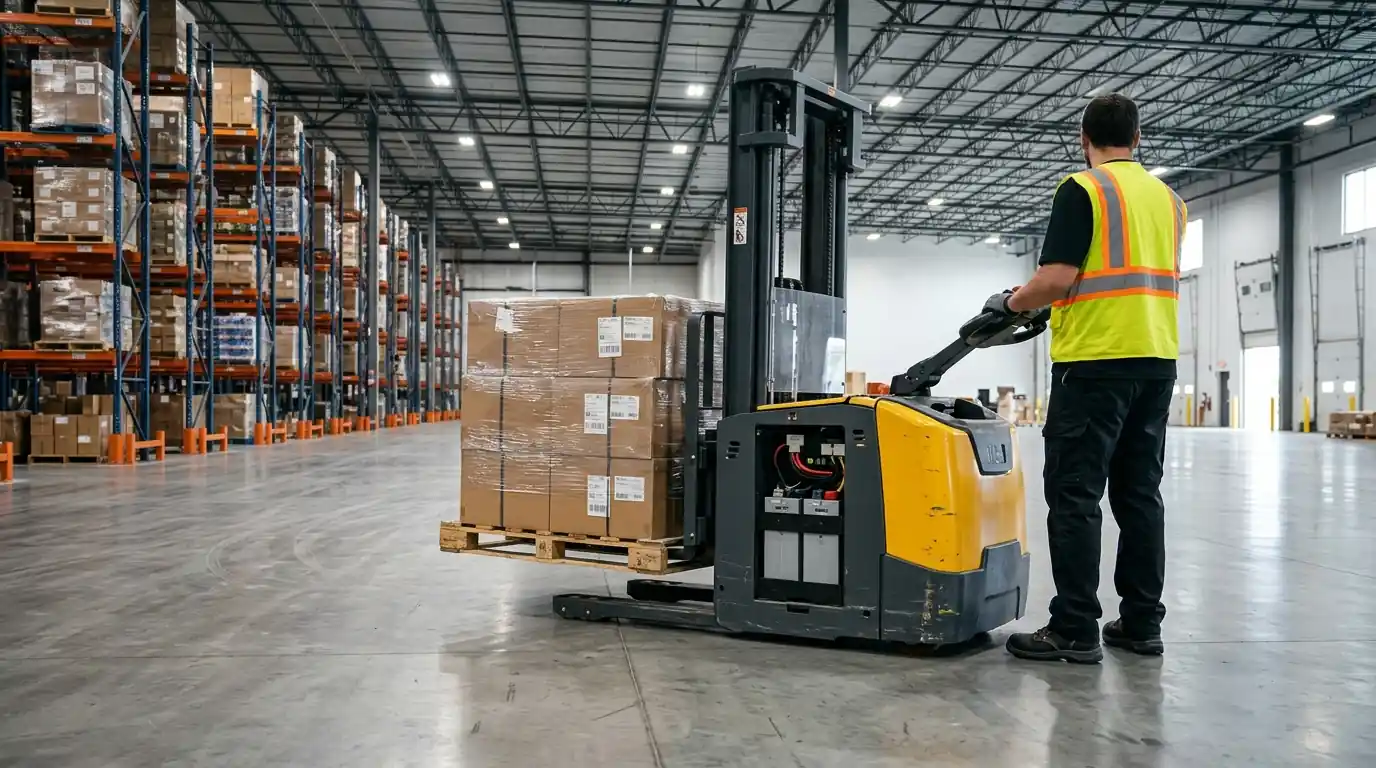
Electric narrow-aisle reach truck retrieving high palletized freight in an industrial logistics facility.
Reach trucks operate in tight warehouse aisles where space optimization is critical. The electrical powertrain requires consistent voltage to maintain full mast lifting speeds.
Most narrow-aisle reach trucks utilize a 36V or 48V electrical architecture. Smaller walkie reach units occasionally run on 24V systems. Heavy-duty pantograph trucks lifting over 4,500 pounds frequently mandate 48V platforms.
Higher voltage reduces the current draw required for identical mechanical power output. Lower amperage generates less heat across motor windings and power cabling. This thermal advantage protects internal electronics during repetitive high-rack lifting cycles.
Always verify your forklift data plate before purchasing any replacement pack. Installing mismatched voltage can burn out drive controllers or trigger permanent low-voltage lockouts.
Industrial reach truck batteries are rated in ampere-hours, typically between 500Ah and 1,200Ah. However, nominal capacity does not equal usable capacity across all battery chemistries.
Conventional lead-acid packs suffer from the Peukert effect under heavy hydraulic loads. Discharging flooded lead-acid beyond 80% depth of discharge causes rapid plate sulfation. As a result, an 800Ah lead-acid unit yields roughly 640Ah of usable energy.
Modern lithium iron phosphate packs allow 95% to 100% depth of discharge without cell degradation. A smaller 600Ah lithium pack often delivers identical runtime to an 800Ah lead-acid unit.
Choosing cell chemistry determines your charging workflow, facility space utilization, and staffing overhead.
Flooded lead-acid batteries have served material handling equipment for decades. They use heavy lead plates submerged in a liquid sulfuric acid electrolyte bath.
These packs require eight hours of continuous charging followed by eight hours of cooling. Warehouses running two or three shifts must purchase two to three batteries per truck, requiring battery rooms compliant with NFPA 855 fire safety standards. Workers must swap depleted packs weighing over 2,500 pounds using specialized extraction cranes.
Weekly distilled water replenishment is mandatory to avoid dry cell burnouts. Equalization charging must be performed periodically to balance specific gravity across cells.
Lithium iron phosphate has rapidly emerged as the premier chemistry for class II industrial trucks. LiFePO4 cells are hermetically sealed, eliminating acid fumes, corrosive spills, and watering chores entirely.
These packs support rapid opportunity charging during scheduled operator breaks. A reach truck can recharge from 20% to 80% in under one hour. Fast charging eliminates battery room swap infrastructure completely.
A single lithium pack remains inside the chassis throughout multi-shift daily operations. LiFePO4 cells also deliver superior thermal and chemical stability under IEC 62619 industrial lithium safety standards compared to cobalt-based lithium formulations.
Engineering Note: When switching to lithium, verify your facility AC electrical service. Fast chargers draw high peak utility power. Upgrading transformer capacity may be required before installing multiple high-output chargers.

Operational comparison between traditional lead-acid battery rotation and LiFePO4 opportunity charging.
Pricing is often the primary evaluation gate for warehouse directors and procurement specialists. Evaluating cost requires separating initial capital expenditure from ongoing operating expenses.
Upfront prices fluctuate based on voltage, ampere-hour capacity, and raw material index rates. A standard 36V 600Ah flooded lead-acid pack generally costs between $3,500 and $5,500. A larger 48V 1,000Ah heavy-duty lead-acid battery sells for approximately $6,000 to $8,000.
In contrast, a comparable 36V LiFePO4 battery pack ranges from $9,000 to $13,000. High-capacity 48V industrial lithium systems command prices between $14,000 and $18,000.
High-frequency industrial chargers add roughly $1,500 for lead-acid and $2,500 to $4,000 for lithium. While lithium demands two to three times higher initial capital, hardware acquisition tells only part of the financial story.
Operating lead-acid batteries introduces substantial recurring overhead that many fleet balance sheets overlook. Watering maintenance requires skilled labor hours every single week.
Acid spills corrode battery trays, reach truck chassis frames, and warehouse concrete floors. Facilities must maintain eye-wash stations, acid neutralization kits, and dedicated mechanical ventilation under OSHA standard 1910.178 battery handling regulations.
Furthermore, swapping multi-ton batteries consumes fifteen to twenty minutes of productive driver time per shift. The square footage dedicated to battery storage racks represents expensive lost warehouse racking space. Lithium eliminates these recurring labor tasks, safety hazards, and real estate allocations.
Total cost of ownership calculations prove that lithium delivers lower lifetime cost in intensive applications. The following table compares five-year operating expenses for a two-shift warehouse reach truck:
| Cost Element (Two-Shift Operation) | Traditional Lead-Acid (2 Packs) | Industrial LiFePO4 (1 Pack) |
|---|---|---|
| Initial Battery Hardware Cost | $11,000 (Two 36V Packs) | $12,500 (One 36V Pack) |
| Industrial Charger Cost | $3,000 (Two Chargers) | $3,500 (One Fast Charger) |
| 5-Year Maintenance Labor & Water | $8,500 (Watering & Equalizing) | $0 (Zero Maintenance) |
| Battery Swap Labor Loss | $12,000 (Downtime per shift) | $0 (Opportunity Charging) |
| 5-Year Electrical Energy Cost | $7,800 (~72% Energy Efficiency) | $5,800 (>95% Energy Efficiency) |
| Battery Replacement at Year 3 | $5,500 (Degraded Pack) | $0 (Rated for 3,500+ Cycles) |
| Estimated 5-Year Total Cost | $47,800 | $21,800 |
High round-trip energy efficiency lowers annual electric utility bills by nearly 25 percent. Warehouses running double shifts generally reach full capital payback on lithium within 12 to 18 months. Single-shift operations with low daily runtime may take three to four years to break even.

Five-year Total Cost of Ownership (TCO) breakdown comparing lead-acid and lithium iron phosphate systems.
Upgrading warehouse machinery involves rigorous mechanical and thermal integration requirements. Battery engineering extends beyond simple cell chemistry.
Forklift manufacturers design reach trucks to use the battery as a structural counterweight. When the pantograph mechanism extends a heavy pallet forward, physical leverage shifts.
The reach truck data plate stamps a mandatory minimum and maximum battery weight. A standard 36V lead-acid battery often weighs between 2,200 and 3,200 pounds. Lithium cells have three times the gravimetric energy density of lead.
Consequently, a bare lithium pack weighs significantly less than its lead-acid predecessor. Reputable pack builders integrate heavy laser-cut steel ballast plates inside the outer tray. This ballast restores OEM center of gravity and prevents dangerous forklift tip-overs during high-altitude turns.

Quality inspection of an industrial 36V LiFePO4 battery pack integrated with heavy steel ballast plates and AYAA TECH Smart BMS.
Cold storage and refrigerated logistics present hostile environments for electrochemical storage. Operating in temperatures as low as -30°C causes internal cell resistance to spike dramatically.
Lead-acid batteries lose up to 50% of effective capacity in sub-zero freezers. Charging lithium cells below freezing causes lithium metal plating, causing permanent short circuits.
Industrial cold-storage packs must incorporate internal thermodynamic heating blankets. These heaters pre-condition cells using external charger power prior to accepting charge current. Robust weather-sealing prevents condensation from shorting internal electronic circuit boards.
Modern reach trucks utilize high-pressure hydraulic pumps that demand massive instantaneous electrical power. A resilient battery management system is essential.
Lifting a two-ton load to a high racking bay draws severe transient current spikes. A 36V system can easily draw momentary inrush currents exceeding 400A to 600A.
Poorly engineered battery packs trigger nuisance overcurrent fault trips during abrupt acceleration. The battery management system must distinguish between short-circuit faults and legitimate motor starting surges.
Industrial contactors and high-capacity copper busbars must withstand repetitive thermal cycles. Low-impedance busbar interconnects prevent localized resistive hot spots within the battery enclosure.
Accurate state of charge monitoring prevents unexpected truck stalls inside narrow storage aisles. At AYAA TECH, our Smart BMS utilizes an advanced SOC algorithm with adaptive temperature compensation. This algorithm maintains an error rate of 5% or less, ensuring reliable shift endurance forecasting.
Thermal reliability requires disciplined hardware layout engineering. In every AYAA battery assembly, power MOSFETs and current sampling resistors are distributed uniformly across heavy-gauge copper heat sinks. We employ high-thermal-conductivity silicone gap pads to conduct heat directly into the outer structural casing.
Where operating conditions demand extreme duty cycles, we utilize aerospace-grade aluminum alloy or copper enclosures. As an integrated manufacturer, AYAA TECH delivers end-to-end motive power solutions. We engineer custom PCB hardware, intelligent firmware, complete battery packs, and matching industrial chargers.
Selecting a reach truck battery requires balancing upfront acquisition capital, operational workflow, and chassis mechanical safety. While lead-acid batteries offer lower purchase prices, their recurring labor and energy losses penalize multi-shift fleets.
Lithium iron phosphate packs eliminate hazardous maintenance chores and unlock flexible opportunity charging. Matching exact voltage ratings, maintaining minimum counterweight ballast, and integrating advanced Smart BMS safeguards protect equipment longevity. Investing in engineered motive power systems maximizes warehouse throughput and minimizes five-year operating expenses.
Most warehouse reach trucks operate on 36V or 48V electrical architectures. Smaller light-duty units occasionally utilize 24V systems. High-capacity pantograph reach trucks lifting heavy loads to extreme racking heights frequently mandate 48V platforms. Always check your reach truck specification data plate to verify correct operational voltage.
Replacement prices depend heavily on battery chemistry, capacity, and voltage specifications. New flooded lead-acid reach truck batteries typically cost between $3,500 and $8,000. Upgrading to a modern LiFePO4 lithium battery pack costs between $9,000 and $18,000. Fast industrial chargers cost an additional $1,500 to $4,000 depending on output amperage.
A properly sized battery delivers six to eight hours of continuous operation per charge. Real-world runtime depends on lifted load weights, mast elevation heights, and travel distances. Lithium batteries maintain steady lifting speeds throughout the discharge curve. Lead-acid batteries experience significant voltage drops when depleted past 50% capacity.
Yes, most electric reach trucks can readily transition to lithium power packs. The lithium pack must provide identical nominal voltage and physical tray dimensions. Furthermore, the pack must integrate custom counterweight ballast to satisfy OEM minimum weight requirements. Matching CAN bus or dashboard discharge indicators ensures smooth operational compatibility.
Yes, counterweight ballast is mandatory when converting reach trucks to lithium. Because lithium cells are lightweight, a bare lithium pack is too light to balance heavy mast loads. Reputable manufacturers add heavy steel ballast inside the battery enclosure. This structural weight guarantees chassis stability and prevents tip-overs during high-rack lifting maneuvers.
Lithium iron phosphate packs fully recharge within one to two hours using industrial fast chargers. In contrast, conventional lead-acid packs require eight hours of charging plus eight hours of cool-down time. Lithium packs support quick opportunity charging during fifteen-minute breaks without damaging internal cell chemistry.
Lithium reach truck batteries are completely maintenance-free during daily warehouse operations. They require zero water refilling, no acid spill cleaning, and no scheduled equalization charging. Operators only need to plug in the charging cable during downtime. Periodic visual inspections of cables and connectors ensure reliable electrical contact.