


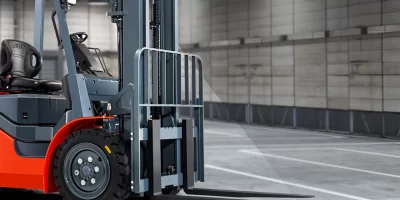







A man-up truck is an electric VNA lift with an elevating cab; choose by floor flatness and ballast. Formal industry classification designates this machine as a man-up turret truck. The vehicle operates in guided aisle clearances between 1.6 and 1.8 meters. Its operator compartment ascends synchronously with the fork carriage via a heavy-duty mast.
This kinematic architecture maintains the operator at eye level with the load. Working heights reach up to 19 meters above finished floor level. Operators execute full pallet retrieval alongside single-carton piece picking efficiently. Direct line-of-sight visual handling improves load positioning accuracy and overall cycle times.
Deploying man-up equipment reduces storage aisle footprints by more than 50 percent. Concurrently, vertical cubic storage density expands by up to 200 percent. Realizing these spatial gains requires superflat floor flatness under international standards. Chassis ballast and powertrain engineering must also satisfy stringent dynamic stability envelopes.

Man-Up Truck Mechanical Architecture and Kinematic Principles
Maximizing high-density cubic storage requires kinematics that decouple load rotation from chassis steering. A man-up turret truck resolves geometric constraints through synchronous vertical travel and lateral handling. These mechanical systems allow seamless pallet movements without turning the vehicle chassis.
Synchronous Cab Lift and High-Elevation Sightlines
The defining feature of a man-up platform is cab and fork integration. Both assemblies ride upon heavy-duty leaf chains and multi-stage hydraulic cylinders. They ascend in rigid unison throughout the lifting stroke. Positioning the operator adjacent to the pallet eliminates parallax distortion and depth errors.
Ground-level cabs suffer from visual latency and obstructed sightlines above 10 meters. In contrast, elevated operators inspect pallet condition and verify barcode data directly. Technicians align fork tips with rack openings without relying exclusively on remote cameras. Cycle times drop significantly during mixed-case fulfillment workflows.
Elevated positioning also boosts operational safety during high-bay warehouse operations. Drivers detect rack upright damage or packaging overhangs before lifting loads. Direct visual feedback reduces accidental product collisions in tight rack apertures.
Three-Way Turret Head and Micro-Aisle Kinematics
Navigating aisles barely wider than the chassis requires a specialized three-way turret head. This assembly incorporates a 180-degree rotating fork carriage coupled to a lateral shift mechanism. The truck chassis travels in a straight line along the aisle floor. Meanwhile, forks rotate smoothly to access left or right rack faces.
Standard counterbalanced forklifts demand turning clearances between 3.2 and 3.8 meters. In contrast, the turret mechanism traverses pallets across the aisle axis. This transverse motion compresses transfer aisles down to 1.65 to 1.85 meters. Warehouses gain valuable floor space for supplementary storage rack rows.
Proportional hydraulic valving ensures smooth fork positioning within selective racking beams. Operators maintain total control over delicate pallet transfers at extreme heights.
3. Facility Infrastructure: Aisle Tolerances and Superflat Floor Standards
Turret trucks operate as high-precision vertical cantilevers during elevated handling cycles. Millimeter-scale surface irregularities at ground level propagate into severe displacements aloft. Rigorous civil infrastructure preparation dictates operational safety and allowable travel speeds.
DIN 15185 and F-min Floor Flatness Specifications
Operating a 15-meter rigid mast amplifies minor floor imperfections into dynamic deflections. A one-millimeter variation across wheel tracks induces several centimeters of sway aloft. Dynamic sway triggers safety interlocks or causes impacts against rack uprights.
Facility design must satisfy strict superflat standards such as German DIN 15185. Facilities may also follow American Concrete Institute ACI F-min 75 to F-min 100 specifications. These criteria mandate continuous profile grinding within defined wheel tracks. Targeted grinding eliminates cross-aisle tilt and longitudinal floor waviness.
Floors graded only to standard ACI FF/FL metrics cause severe mast shudder. Rough surfaces also induce premature hydraulic seal wear and nuisance sensor shutdowns.
Mechanical Rail Guidance vs Inductive Wire Guidance
Dedicated guidance systems steer the truck inside narrow aisles automatically. Automated steering allows safe travel at full rated travel speeds. Mechanical rail guidance uses structural steel angle iron anchored along rack bases. Polyurethane guide rollers on the truck chassis contact the steel rails directly.
Physical rails deliver positive tracking and permit rapid vehicle acceleration. However, bottom pallets must remain elevated to clear the structural rail profile. Inductive wire guidance embeds a copper conductor into a 10-millimeter floor saw cut. The floor wire carries an alternating current between 5 kHz and 10 kHz.
Dual onboard sensor antennas track the electromagnetic flux to control electro-hydraulic steering. Wire guidance leaves warehouse floors completely flush and unobstructed for pallet staging.

4. Machine Sizing Parameters and High-Lift Capacity Derating
Specifying a turret truck requires balancing rated capacities with elevated load physics. Structural mast deflection, carriage mass, and shifting load centers impose mathematical boundaries. Proper fleet engineering prevents structural overload during full-height cycles.
Mast Deflection Curves and Residual Capacity at Elevation
Nameplate capacities reflect base ratings calculated at ground level up to 6 meters. These base calculations assume a standard 600-millimeter load center. As lift elevation exceeds 14 meters, steel deflection and inertia reduce allowable payload. Engineering capacity derating curves establish safe operational limits.
A chassis rated for 1,500 kilograms at floor level loses significant capacity aloft. Approved residual capacity may drop to 800 or 1,000 kilograms at 14 meters. Warehouse managers must audit pallet weights against residual capacity tables at peak elevation. Ignoring residual derating risks structural mast fatigue and hazardous tipping accidents.
Transfer Aisle Clearance and Turnaround Geometries
Turret trucks maximize storage density inside racking aisles efficiently. However, navigating between aisles requires substantial turning clearance. Transfer aisles require widths between 3.5 and 4.2 meters. This buffer accommodates the extended turning radius and diagonal chassis swing.
Facility layouts incorporate automatic aisle-end deceleration zones. Floors feature embedded RFID transponders or permanent magnetic markers. Sensors enforce vehicle braking before steer wheels exit the guidance track. Coordinated aisle transitions preserve steady pallet throughput across shifts.
Engineering Assessment: Optimize Your VNA Power Architecture
Request Custom 80V Powertrain Engineering Consultation5. OEM Engineering and Retrofit: 80V Powertrain and Counterbalance Architecture
Transitioning narrow aisle equipment to lithium powertrains requires rigorous mechanical and electrical balancing. Engineers must resolve counterweight mandates, hydraulic current surges, and harmonic vibration. Proper component integration guarantees reliability across thousands of demanding work cycles.
Counterbalance Physics and BVI Ballast Integrity
Lifting operator cabs and loads to 16 meters shifts the center of gravity upward. Elevated masses generate severe lateral tipping moments during turret rotation. The chassis power pack serves as foundational ballast. Lead-acid batteries traditionally provided this ballast, weighing 1,500 to 2,500 kilograms.
Installing lightweight lithium batteries without compensation compromises machine stability. Uncompensated weight loss violates ANSI/ITSDF B56.1 safety envelopes. To satisfy Battery Weight Indicator (BVI) rules, AYAA TECH designs heavy-gauge steel enclosures. The team welds precision-machined solid cast-steel ballast plates directly into the structural frame.
Finished assemblies match or exceed OEM minimum battery weight specifications down to the kilogram. This engineering lowers the chassis center of gravity and maintains mechanical safety. AYAA provides fully custom battery systems and integrated Smart BMS assemblies. Custom manufacturing supports flexible fleet engineering with no minimum order quantity (MOQ: 1 unit available).

Suppressing Dynamic Voltage Sag Under 600A Hydraulic Inrush
Lifting multi-ton carriages via 20kW to 30kW AC hydraulic motors demands high current. Hydraulic pumps draw transient spikes between 400A and 600A. High internal cell resistance drops DC bus voltage below motor controller cutoffs. Voltage sag triggers main contactors to open, stranding operators aloft.
AYAA resolves this issue using automotive-grade prismatic lithium iron phosphate (LiFePO4) cells. Each cell exhibits direct current internal resistance (DCR) below 0.35 milliohms (<0.35mΩ). Under full 600A surges, 80V bus voltage sag remains strictly below 1.5 percent. Stable voltage delivery prevents controller fault tripping during peak lifts.
Critical thermal regulation relies on uniform layouts of power MOSFETs and shunt resistors. Assemblies incorporate premium thermal silicone gap pads alongside heavy copper busbars. Effective thermal dissipation protects components during continuous high-rate lifting cycles. Consistent operating temperatures extend semiconductor lifespan and battery operational durability.
Mitigating Mast Resonance with Dual CANbus and Laser Welding
Travel over guide rail seams generates continuous low-frequency chassis vibration. Vibrations typically register between 2 Hz and 10 Hz. Sustained mechanical resonance loosens traditional bolted terminals over time. Loose connections cause micro-arcing and dangerous contact resistance spikes.
AYAA TECH applies continuous high-power laser penetration welding across all terminal interconnects. Weld integrity passes rigorous ISO 16750-3 swept-sine vibration testing. Telemetry lines utilize an isolated dual-channel CANbus architecture. The Smart BMS integrates communication protocols for Crown, Jungheinrich, and Raymond trucks.
Hardware-level short-circuit disconnection activates within microseconds during fault conditions. Millivolt-level cell monitoring eliminates dropped telemetry frames during abrupt mast reversals. Uninterrupted data logging provides complete diagnostic transparency for fleet service technicians.
6. Severe Operating Conditions: Fast-Charge Thermals and Cold Storage
Demanding distribution centers operate continuously across multiple shifts. Batteries face rapid opportunity charging and sub-zero cold storage thermal shocks. Advanced thermal management safeguards fleet uptime under harsh warehouse operating environments.
Opportunity Charging Thermals in Multi-Shift Operations
Multi-shift operations eliminate traditional eight-hour charging schedules. Fleets use 15-minute breaks for opportunity charging at 0.5C to 1C rates. Frequent high-lift cycles push internal cell temperatures above 40 degrees Celsius. Charging hot cells without regulation accelerates lithium plating and degradation.
AYAA integrates multi-stage temperature-dependent charge control in each Smart BMS. The system throttles current dynamically according to internal core temperature sensors. Proprietary temperature-compensated algorithms maintain SOC accuracy within ≤ 5% error. Accurate telemetry provides operators with dependable remaining runtime figures.
Dynamic throttling prevents cell overheating while maximizing energy throughput during short shift breaks. Fleet managers achieve true continuous 24/7 multi-shift operations without battery swapping.
Extreme Cold Storage and Anti-Condensation Hermetic Sealing
Cold storage warehouses maintain continuous temperatures between -25 and -30 degrees Celsius. Freezing ambient conditions increase electrolyte viscosity and reduce available capacity. Direct charging at sub-zero temperatures damages battery chemistry irreparably. AYAA packs feature positive temperature coefficient (PTC) ceramic heating elements.
Heating elements are encased within high-efficiency nano-insulation thermal blankets. Incoming charge current warms cells to 10 degrees Celsius before full-rate charging starts. Controlled pre-heating safeguards cell health during freezing shifts.
Transferring trucks from cold storage to warm loading docks creates rapid surface condensation. AYAA battery enclosures deliver IP67 hermetic sealing against ambient moisture ingress. Bi-directional micro-porous membrane breather valves vent pressure while blocking liquid water. This sealing prevents internal droplet accumulation and hazardous high-voltage tracking.
7. Conclusion: The Man-Up Specification Decision Triangle
Selecting a man-up turret truck requires an integrated systems perspective. Warehouse managers must balance aisle geometries, civil floor flatness, and chassis powertrain dynamics. Floors must conform to DIN 15185 or ACI F-min standards. Powertrains must deliver stable voltage under severe hydraulic draw.
Specifying an 80V lithium pack with verified BVI steel ballast ensures operational safety. Integrated Smart BMS architecture and dual-channel CANbus provide reliable performance. Fleet operators maximize vertical warehouse storage and minimize total operating costs.
Investing in tailored lithium technology transforms narrow aisle material handling operations. Facilities achieve higher pick rates and lower maintenance expenses across multi-shift schedules. Reliable power architectures ensure continuous high-elevation productivity and peace of mind.
Upgrade Your Fleet: Lead-Acid to 80V High-Density Lithium Retrofit
Evaluate Fleet TCO and Custom Battery SizingFAQ
The following answers address operational, mechanical, and electrical inquiries regarding man-up turret trucks and battery systems.
Q1: What is the difference between a man-up truck and a man-down turret truck?
A man-up truck elevates the operator cab synchronously with the forks. The driver remains at eye level with the load up to 19 meters. This elevated position enables precise pallet placement and piece picking. A man-down truck keeps the driver at floor level, relying on cameras.
Q2: What aisle width and floor flatness specifications are required for a man-up truck?
Man-up trucks operate in very narrow aisles measuring 1.65 to 1.85 meters. Warehouses must meet superflat floor specifications such as DIN 15185 or ACI F-min 75 to 100. Superflat floors prevent ground irregularities from amplifying into mast sway at high elevations.
Q3: Why is battery weight critical when retrofitting a man-up truck with lithium?
Battery weight serves as essential ballast countering tipping forces when the mast elevates. Original lead-acid batteries weigh 1,500 to 2,500 kilograms. Upgrading to lighter lithium requires internal solid steel ballast to satisfy OEM BVI limits and OSHA 1910.178 safety mandates. Proper ballast preserves machine balance and prevents rollovers during high-elevation turns.
Q4: How high can a man-up truck lift, and what causes capacity derating?
Standard units reach heights between 10 and 16 meters. Heavy-duty models can reach lift heights of 19 meters. Capacity derating occurs because of structural mast deflection and lateral inertia. A 1,500-kilogram base capacity may derate to 800 kilograms at peak reach.
Q5: How does dynamic voltage sag affect high-mast hydraulic lift operations?
Starting hydraulic pump motors draws sudden current surges between 400A and 600A. High battery internal resistance triggers dynamic voltage drops below controller thresholds. Voltage drops cause contactor disconnects that strand technicians at elevated heights. Cells with low internal resistance keep voltage drops below 1.5 percent.
Q6: Can a man-up turret truck operate in cold storage facilities without condensation risks?
Safe cold storage operation requires IP67 sealed battery enclosures. Enclosures feature waterproof, breathable membrane breather valves. Integrated PTC heating elements warm cells prior to charging. Sealed designs stop moisture condensation and prevent internal electrical short circuits.
Q7: How does opportunity charging benefit multi-shift man-up truck fleets?
High-rate 80V lithium charging at 0.5C to 1C allows fast top-offs during 15-minute breaks. Batteries recover 80 percent charge within one hour. Opportunity charging eliminates battery swap rooms and spare batteries. Fleet operators reduce total operating costs by more than 35 percent.


