


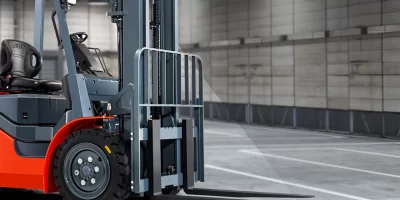







To choose the right man-up truck battery, match OEM voltage, certify chassis ballast, and weigh TCO. Very narrow-aisle (VNA) turret trucks and high-level order pickers never use automotive starter batteries. These demanding material handling platforms require 24V, 36V, 48V, or 80V industrial traction deep-cycle batteries engineered for severe hydraulic surges.
While flooded lead-acid batteries present lower upfront capital expenditure, industrial lithium iron phosphate (LiFePO4) chemistry delivers superior five-year total cost of ownership (TCO). Industrial lithium packs support continuous opportunity charging during breaks, cut charging electricity losses by 20% to 25%, and eliminate daily watering maintenance routines and hazardous acid washrooms entirely.
Crucially, the battery pack functions as essential counterweight ballast for the elevating chassis. Any lithium conversion must strictly match OEM minimum service weight specifications through integrated laser-cut steel ballast plates. Failing to maintain certified counterweight ballast shifts the vehicle center of gravity upward, creating catastrophic tip-over hazards when masts elevate cabins up to 18 meters.

Engineering Demands of Man-Up Operations on Battery Systems
Operating a cab-elevation warehouse truck places intense stresses on the motive power system. The battery must handle high mechanical, thermal, and electrical loads during every work cycle.
High-Lift Vertical Elevation and Hydraulic Surge Loads
Elevating the cabin and pallet to 18 meters draws transient current surges. Hydraulic lift pumps routinely pull 400A to 600A from the traction pack. Conventional lead-acid batteries suffer from rising internal resistance past 50 percent depth of discharge.
This internal resistance triggers dynamic voltage sag during simultaneous drive and lift operations. Severe voltage drops cause the vehicle controller to trip undervoltage faults. When faults trip, mechanical safety brakes lock and strand operators high in the air. Industrial traction batteries must deliver ultra-low internal resistance and flat discharge curves.
Non-Negotiable Minimum Service Weight and Counterweight Ballast
In man-up warehouse equipment, chassis stability directly protects operator life. As the mast elevates the cabin and payload, the vehicle center of gravity shifts upward. The battery tray sits at the chassis base to act as primary physical ballast.
Engineering Note:LiFePO4 cells deliver three times the energy density of lead-acid. An unballasted lithium pack weighs 50 to 60 percent less than lead-acid units. Installing an unballasted battery reduces pack weight from 1,800 kilograms to 800 kilograms. This massive weight loss violates ANSI/ITSDF B56.1 and OSHA 1910.178 stability standards.
Certified lithium conversions must integrate precision laser-cut solid steel ballast plates inside the enclosure. These steel ballast plates match OEM data plate minimum service weights within strict tolerances.
Multiplexed CAN-Bus Communication and OEM Controller Handshake
Modern order pickers and turret trucks rely on multiplexed digital vehicle architectures. Leading manufacturers like Crown, Raymond, Jungheinrich, and Linde utilize CAN-Bus or CANopen communication links.
The vehicle controller exchanges encrypted operational telemetry across these high-speed digital networks. If a replacement battery lacks a compatible digital handshake, the controller locks out lifting functions. The vehicle cannot verify pack health, cell temperatures, or safe discharge limits without digital integration.
Industrial battery systems require isolated dual-channel CAN-Bus interfaces. These systems stream individual cell voltages, true state of charge, and temperatures to the operator cabin.

Choosing a Man-Up Truck Battery:Lead-Acid vs Lithium Iron Phosphate
Selecting the right motive power chemistry requires comparing baseline electrochemistry, thermal limits, and service life.
Flooded Lead-Acid and Sealed AGM/Gel Constraints
Flooded lead-acid remains common in legacy fleets, but its chemistry enforces rigid operating limits. Flooded units require an inflexible 8-8-8 cycle:8 hours work, 8 hours charge, and 8 hours cooling. Technicians must inspect deionized water levels weekly and clean corrosive terminal blooms.
Sealed AGM and Gel formats eliminate watering routines, but cycle life caps at 1,200 cycles. Furthermore, sealed lead-acid cells face severe electrolyte dry-out risks under fast charging profiles.
Industrial Lithium Iron Phosphate Mechanics
Industrial LiFePO4 cells utilize an olivine crystal lattice that resists thermal runaway. The cathode structure remains thermally stable at temperatures exceeding 270 degrees Celsius. This chemical stability provides superior fire safety compared to volatile cobalt chemistries.
Prismatic LiFePO4 cells deliver 3,500 to over 5,000 cycles at 80 percent depth of discharge. They maintain 95 to 98 percent round-trip electrical efficiency throughout their operational life.
Because LiFePO4 accepts fast charging rates, warehouse fleets charge batteries during short operator breaks. This opportunity charging strategy eliminates spare battery inventories, overhead cranes, and swap downtime entirely.
The following engineering comparison highlights key operational metrics between conventional lead-acid options and industrial LiFePO4 systems.
| Metric | Flooded Lead-Acid | Sealed AGM / Gel | Industrial LiFePO4 |
|---|---|---|---|
| Usable DoD | 50% to 60% | 50% to 60% | 80% to 90% |
| Cycle Life | 1,200 to 1,500 | 800 to 1,200 | 3,500 to 5,000+ |
| Efficiency | 70% to 75% | 75% to 80% | 95% to 98% |
| Fast Charge | Unsupported | Unsupported | Supported (0.5C-1.0C) |
| Maintenance | Weekly watering | Terminal checks | Maintenance-free |
These parameters confirm that LiFePO4 provides continuous productivity with minimal degradation. Lead-acid imposes heavy maintenance overhead and rigid shift schedules.
Explore Smart Industrial BMS Solutions
Explore Smart Industrial BMS SolutionsInitial Capex vs 5-Year TCO:Lead-Acid vs Lithium Analysis
Evaluating motive power investments solely through purchase invoices overlooks massive ongoing expenses. True operating costs include maintenance labor, spare battery inventory, and dedicated facility space.
Purchase Price Disparity and Battery-to-Truck Ratios
A standard 48V or 80V heavy-duty flooded lead-acid battery costs 6,000 to 9,000 USD. An industrial LiFePO4 battery with integrated ballast plates costs 14,000 to 20,000 USD upfront.
However, multi-shift warehouse operations reveal the hidden equipment multiplier of lead-acid systems. Because flooded units require 8 hours of charging and cooling, facilities need two or three batteries per truck.
Purchasing extra batteries and chargers pushes hardware investments to 22,500 USD per vehicle. A single LiFePO4 battery running opportunity charging powers continuous 24/7 operations, establishing equipment parity immediately.
Maintenance Labor, Infrastructure Footprint, and Acid Hazards
Flooded batteries create substantial ongoing maintenance expenses throughout their service life. Technicians spend nearly two hours weekly per truck checking electrolyte levels and filling water manifolds. This routine maintenance labor costs 2,700 to 3,600 USD per truck each year.
Furthermore, lead-acid fleets require a dedicated battery room with exhaust fans and eyewash stations. Transitioning to lithium eliminates centralized charging rooms and hazardous acid spill risks. Warehouses reclaim valuable square footage for revenue-generating pallet racking.
Downtime Elimination, Electrical Efficiency, and ROI Timeline
Swapping a 1.5-ton lead-acid battery takes 15 to 25 minutes per shift. In three-shift operations, daily changes waste over an hour of operator productivity. This downtime equals 200 hours of lost vehicle throughput annually per truck.
Additionally, lithium batteries deliver 20 to 25 percent higher electrical efficiency, lowering utility bills. Combining utility savings, zero watering labor, and eliminated downtime yields rapid investment recovery. Multi-shift facilities achieve full capital payback within 10 to 14 months.
The five-year cost model below contrasts total ownership expenditures for a single 48V turret truck.
| Category (5 Years) | Flooded Lead-Acid | Industrial LiFePO4 | Net Savings |
|---|---|---|---|
| Initial Hardware | 18,000 USD | 18,500 USD | -500 USD |
| Maintenance Labor | 15,000 USD | 0 USD | 15,000 USD |
| Swap Downtime | 24,000 USD | 0 USD | 24,000 USD |
| Grid Electricity | 9,200 USD | 6,900 USD | 2,300 USD |
| Battery Replacement | 7,500 USD | 0 USD | 7,500 USD |
| Total 5-Year Cost | 73,700 USD | 25,400 USD | 48,300 USD |
Eliminating changeover losses and maintenance generates significant five-year operational savings that far outweigh purchase prices.
Engineering Checklist for Man-Up Truck Battery Sizing
Specifying an industrial battery requires careful verification across electrical specifications, physical enclosure fit, and operational environments.
Electrical Sizing:Voltage Architecture, Usable Capacity, and Cabling
Industrial forklift electrical architectures require precise nominal voltage matching based on the truck data plate:
- 24V Systems:12 lead-acid cells or 8S LiFePO4.
- 36V Systems:18 lead-acid cells or 12S LiFePO4.
- 48V Systems:24 lead-acid cells or 16S LiFePO4.
- 80V Systems:40 lead-acid cells or 25S to 26S LiFePO4.
Because LiFePO4 discharges to 90 percent safely, a 48V 400Ah lithium battery delivers ample run time. It matches the usable output of an oversized 600Ah lead-acid unit limited to 50 percent discharge. Power cabling requires genuine REMA DIN or Anderson SB connectors with heavy-gauge flexible copper leads.
Mechanical Enclosure, Counterweight Calibration, and Retention
The physical battery compartment dimensions must be measured with millimeter precision before ordering. Technicians must record length, width, height, and lifting clearance, leaving a 10-millimeter clearance buffer.
Engineering Note:Check the truck data plate for the specified Minimum Battery Service Weight. If the manufacturer specifies 1,450 kilograms, the replacement lithium enclosure must meet or exceed 1,450 kilograms. Qualified suppliers integrate solid steel ballast slabs bolted inside the structural container to preserve chassis dynamics.
The compartment must also include adjustable side retention clamps and heavy-duty dampening pads. These mechanical restraints withstand intense lateral shocks during high-speed wire-guided travel.
Severe Operating Environments:Cold Chain Storage and Moisture Defense
Automated high-bay cold storage facilities operate at -20 to -30 degrees Celsius. Extreme freezing temperatures increase internal cell resistance and reduce temporary usable capacity.
Charging a lithium battery below freezing without preheating causes irreversible lithium plating on anode surfaces. Plating causes severe internal short circuits and permanent cell damage. Specialized cold-storage packs integrate internal silicone PTC heating blankets to warm cell cores to +5 degrees Celsius.
To combat condensation from temperature transitions, enclosures must achieve IP65 or IP67 ingress protection. Hydrophobic Gore valves vent internal pressure while sealing out external moisture and frost.

Safety Compliance and Operational Best Practices
Industrial motive power systems must comply with strict workplace health regulations and machine safety codes.
OSHA 1910.178 and ANSI/ITSDF B56.1 Regulations
OSHA standard 1910.178(g) establishes mandates for battery charging rooms, spill containment, and technician protection. Facilities using flooded lead-acid batteries must provide acid neutralizing stations, eye washes, and protective gear.
Under OSHA 1910.178(a)(4), modifications affecting vehicle stability require prior written manufacturer approval. Installing an unballasted lightweight battery breaches ANSI/ITSDF B56.1 stability guidelines, exposing operators to high-lift tip-overs.
Once an engineered ballasted lithium pack is installed, the truck data plate must display a revised rating label in accordance with UL 583 / UL 2580 motive power safety criteria. This label details certified battery weight and updated electrical specifications.
Multi-Tier BMS Protection and Active Fire Safety
Modern industrial lithium traction batteries rely on multi-layer safety architectures validated under IEC 62619 industrial safety standards. Hardware protection includes automotive-grade DC contactors, high-speed pyrofuses, and active pre-charge circuits designed to suppress inrush currents.
The smart battery management system monitors individual cell voltages, current, and module temperatures in real time. It executes progressive mitigation from charge throttling to complete circuit disconnection.
High-tier packs incorporate micro-encapsulated aerosol fire suppression units and ceramic aerogel barriers between cells. These physical barriers contain localized thermal events and prevent thermal runaway propagation.
Conclusion:The Man-Up Battery Decision Triangle
Selecting the right motive power system for man-up equipment relies on three core engineering pillars:
- Compatibility and Stability:Matching system voltage, maintaining low impedance against hydraulic sag, and integrating certified steel ballast for ANSI/ITSDF B56.1 chassis stability.
- Operational Demands:Supporting multi-shift schedules with fast opportunity charging, CAN-Bus vehicle communication, and cold-storage thermal management.
- Total Economic Return:Evaluating five-year TCO to secure rapid payback by eliminating maintenance labor, swap downtime, and energy losses.
Engineering Excellence by AYAA TECH
As an integrated manufacturer with physical production facilities, AYAA TECH delivers end-to-end industrial power solutions. Our manufacturing scope spans premium cell selection, custom BMS engineering, pack assembly, and matched chargers.
Our Smart BMS natively supports bidirectional CAN-Bus and CANopen protocols. The system executes seamless digital handshakes with controllers from Crown, Raymond, Jungheinrich, and Linde.
Our proprietary SOC algorithm incorporates dynamic temperature compensation. This engineering ensures exceptional estimation accuracy with an error rate of 5% or less across severe thermal variations.
Thermal safety remains central to our engineering methodology. AYAA designs scientific heat dissipation layouts for MOSFETs and current-sensing shunt resistors. We combine thermal silicone pads with high-conductivity aluminum alloy heat sinks to rapidly dissipate heat.
Furthermore, AYAA offers standard inventory and full OEM/ODM customization with no minimum order quantity (No MOQ). We deliver single-piece custom prototypes and complete fleet deployments with equal engineering rigor.
Consult AYAA for Tailored Sizing and Ballast Engineering
Configure Custom Battery SolutionsFAQ
What type of battery is used in a man-up truck?
Man-up industrial trucks use industrial traction deep-cycle batteries in 24V, 36V, 48V, or 80V configurations. These vehicles never use automotive starter batteries. Modern fleets are shifting to zero-maintenance lithium iron phosphate (LiFePO4) packs for greater operational efficiency.
Why is battery weight considered a non-negotiable safety red line on man-up trucks?
On a man-up truck, the operator cab elevates 10 to 18 meters, shifting the center of gravity upward. The heavy battery compartment serves as essential counterweight ballast. An unballasted lightweight battery disrupts vehicle balance, creating a severe tipping hazard during high-lift travel.
Can I replace my existing lead-acid battery with lithium on an OEM man-up truck?
Yes, provided two essential technical requirements are met. The lithium battery must incorporate internal solid steel ballast to match OEM minimum service weight. Additionally, the BMS must support compatible CAN-Bus protocols to handshake properly with vehicle controllers.
How does opportunity charging benefit 24/7 multi-shift warehouse operations?
Industrial LiFePO4 batteries accept fast charging, allowing rapid top-offs during 15-minute operator breaks. This eliminates traditional 8-hour charging and cooling cycles needed by lead-acid. Facilities achieve continuous multi-shift operations with a single battery per vehicle without battery swaps.
What is the realistic ROI payback period when upgrading a man-up fleet to lithium?
In multi-shift facilities, lithium conversions achieve full capital payback within 10 to 14 months. This rapid return comes from eliminating 200 hours of swap downtime. Facilities also remove watering labor expenses and cut electricity consumption by 20 to 25 percent.
How do cold storage environments affect man-up truck battery performance?
Temperatures below -20 degrees Celsius reduce lead-acid capacity by up to 50 percent and risk condensation damage. Industrial lithium batteries resolve this with integrated PTC heating blankets that warm cells before charging. Furthermore, IP65/IP67 sealed enclosures block moisture intrusion completely.
Does switching to lithium require renovating our battery room or warehouse grid?
No. Switching to lithium allows facilities to decommission dedicated battery rooms completely, converting floor space into storage racking. Fast opportunity chargers mount conveniently at aisle ends, running on standard connections without costly grid upgrades.


