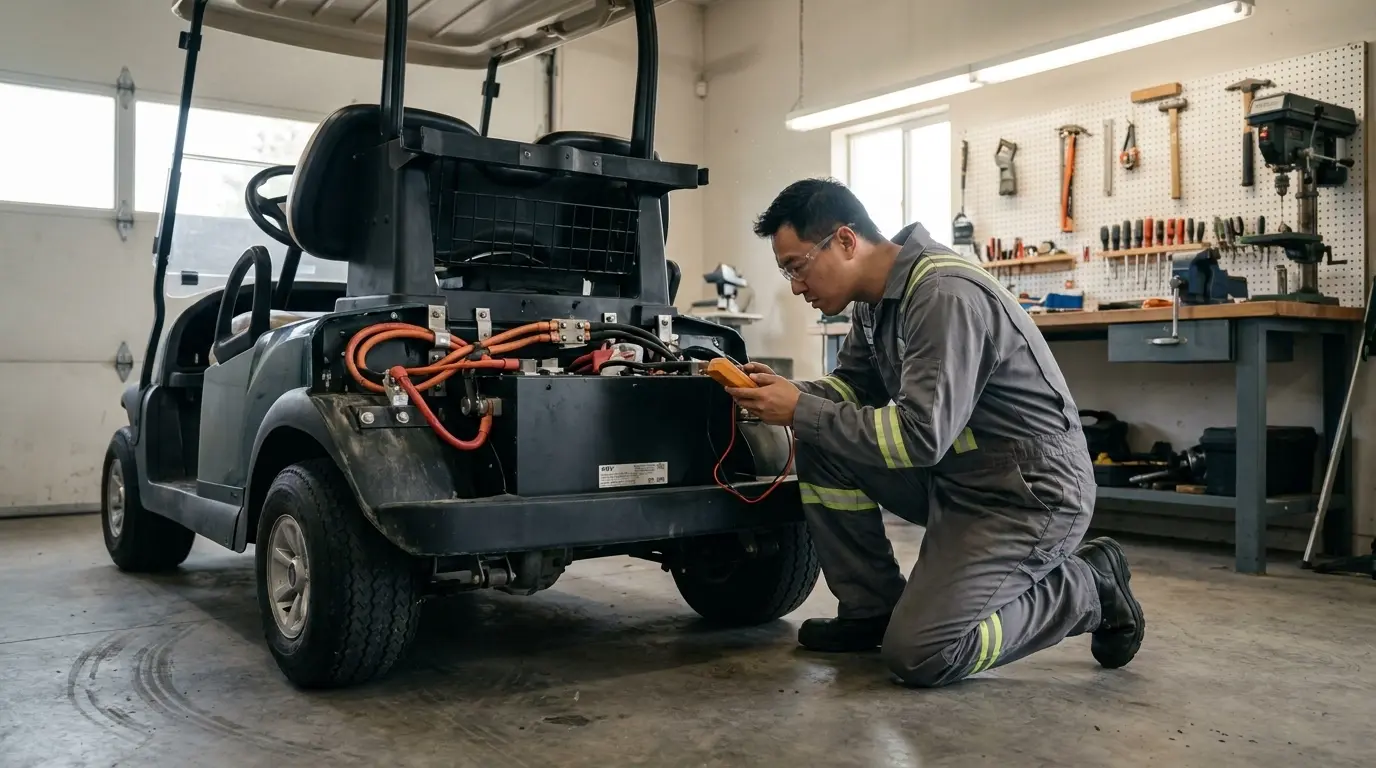





In a LiFePO4 vs. lead-acid golf cart batteries comparison, LiFePO4 is better and delivers 10x longer life. It is technically and financially superior for most owners. It weighs 250 pounds less and provides constant speed on hills. Lead-acid only wins on upfront purchase price.
A drop-in 48V LiFePO4 pack costs between $2,000 and $2,800. A fresh lead-acid set costs $1,100 to $1,400. However, LiFePO4 delivers over 3,500 charge cycles. Flooded lead-acid sets usually fail after 300 to 500 cycles.
Over ten years, LiFePO4 cuts your total cost of ownership by 35%. You avoid buying two or three replacement packs. You also eliminate weekly watering labor and terminal acid corrosion.

How They Actually Perform on the Course
Spec sheets are easy to write. What matters is how the battery behaves when the motor demands peak current on a hill, when the pack has been running for three hours, and when the temperature outside is not ideal.
Why your cart slows down before the battery is empty
Lead-acid has a fundamental electrochemical problem: its terminal voltage drops continuously as the pack discharges. At full charge, a healthy 48V lead-acid pack sits at around 51–52V. By the time it reaches 75% depth of discharge, voltage has already sagged noticeably. That sag translates directly into reduced motor torque and slower hill-climbing speed.
LiFePO4 behaves differently. Its discharge curve is nearly flat. Voltage stays within a tight band from roughly 95% SOC all the way down to about 10%, then drops quickly. In practical terms, your cart accelerates just as hard on the 18th hole as it did on the 1st.
【Engineering Note】 Lead-acid voltage sag is not just a comfort issue — it is a motor controller issue. When voltage sags under heavy load, the controller draws higher current to maintain the same power output. Higher current means more heat in the motor windings and the controller MOSFETs. On carts running older series-wound DC motors, sustained voltage sag can cause premature brush wear and armature damage. If you see a cart that “always needs a new motor” on a fleet with lead-acid packs, check the resting and loaded voltage before replacing the motor.

How much weight you’re actually removing
A standard 48V lead-acid configuration using six 8V batteries weighs approximately 300–390 lbs. A 48V LiFePO4 pack of equivalent usable capacity weighs 95–110 lbs. The difference shows up in two places: suspension and frame wear over years of operation, and handling on slopes.
Less unsprung weight also reduces the load on the front axle for rear-mounted battery trays. Fleet operators often overlook this when calculating maintenance cycles on steering components. For a single owner, removing roughly 250 lbs from the rear of the cart is a noticeable handling improvement — not just a weight spec on a data sheet.
What “fast charging” actually means in a fleet context
Lead-acid demands a multi-stage charge cycle: constant current, then constant voltage, then float, then periodic equalization. A full charge from depleted to 100% takes 8–12 hours. If a cart comes off a morning round and needs to be ready for an afternoon tee time, it won’t be.
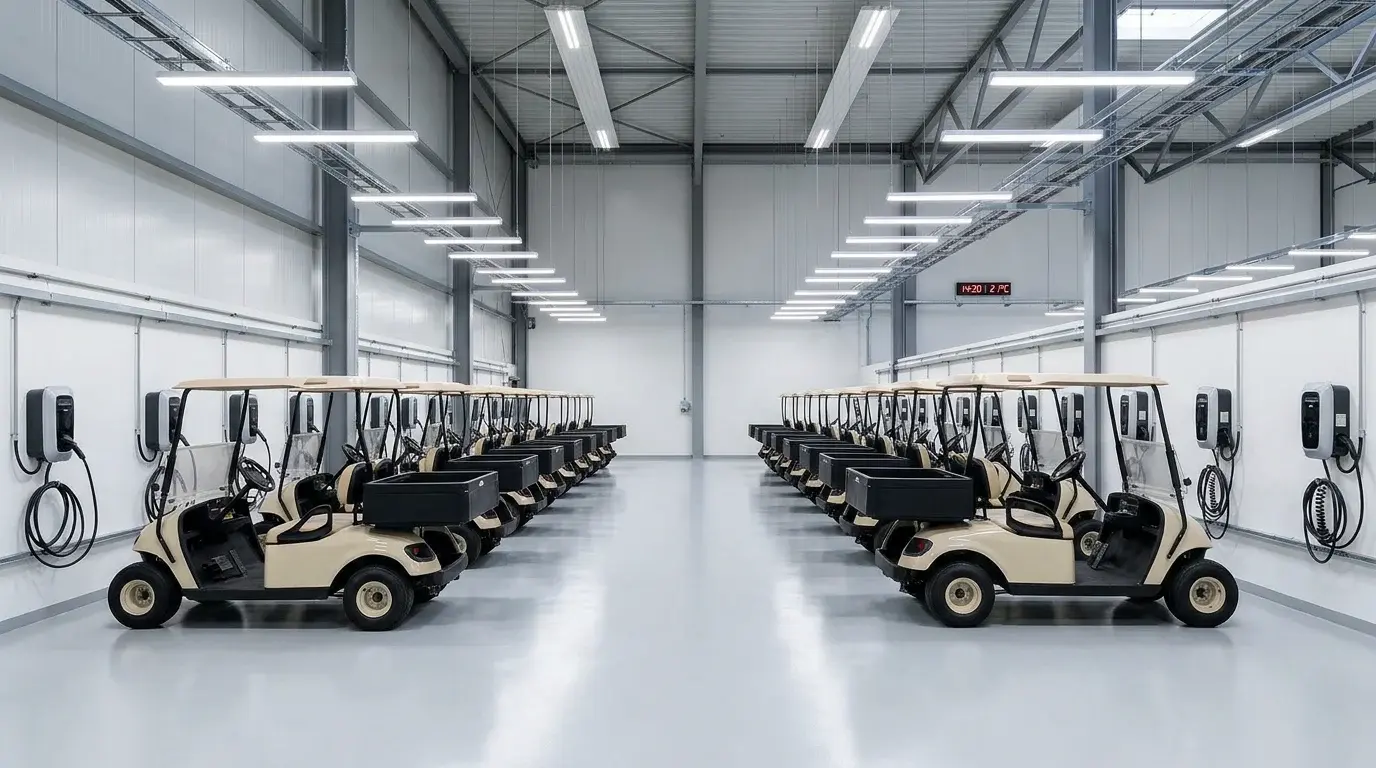
LiFePO4 charges in 1.5–3 hours depending on the charger’s output rating. A 30A charger on a 100Ah pack finishes in about three hours; a 50A charger cuts that to under two. For a golf course managing 20–30 carts, the turnaround math changes entirely. You can run a cart through two full rounds in a single day with a midday charge window.
The Amp-Hour Number on the Label Is Not the Whole Story
The most common mistake when comparing battery specs is treating labeled Ah capacity as usable capacity. For lead-acid, it is not.
Why 225Ah lead-acid does not beat 105Ah LiFePO4
Lead-acid batteries have a hard rule: discharge below 50% depth of discharge repeatedly, and you destroy the plate’s sulfation resistance. Every manufacturer’s spec sheet includes this, though not always prominently. In practical terms, a 225Ah lead-acid battery has approximately 112Ah of usable energy before capacity fade accelerates.
LiFePO4 chemistry can be discharged to 95–100% depth of discharge without meaningful degradation. A 105Ah LiFePO4 pack gives you approximately 100–105Ah of usable energy. So the actual comparison is:
- 225Ah lead-acid → ~112Ah usable
- 105Ah LiFePO4 → ~100–105Ah usable
They are roughly equivalent in range. The lead-acid pack is heavier, slower to charge, and will degrade significantly if anyone accidentally runs it past 50% DoD — which happens constantly in fleet use.
| Spec | 225Ah Lead-Acid | 105Ah LiFePO4 |
|---|---|---|
| Labeled capacity | 225Ah | 105Ah |
| Safe usable capacity | ~112Ah (50% DoD limit) | ~100–105 Ah (95% DoD) |
| Coulombic efficiency | 75–80% | ~98% |
| Weight (48V pack) | ~350 lbs | ~100 lbs |
| Cycles to 80% capacity | 300–500 | 2,000–5,000 |
| Charge time (full) | 8–12 hours | 1.5–3 hours |
The table above uses real-world DoD limits, not rated capacities. Before quoting these numbers in a procurement spec, verify them against the specific cells and BMS configuration in the pack you’re evaluating — not just the label.
The Peukert effect and why your range estimate is always wrong for lead-acid
Lead-acid capacity is rated at a slow discharge rate, typically C/20 (full discharge over 20 hours). When you draw current faster — say, a golf cart climbing a slope with a 200A motor demand — effective capacity drops. This is the Peukert effect. A 225Ah lead-acid battery delivering 200A of peak current doesn’t give you 225Ah of energy. The exact shortfall depends on the Peukert exponent of the specific cells, which most consumer-grade labels don’t publish.
LiFePO4 cells have a Peukert exponent much closer to 1.0. Their capacity stays nearly constant across a wide range of discharge rates. The range estimate you calculate from a LiFePO4 spec sheet is the range you actually get.
What You’ll Spend Over 10 Years
The upfront price gap between LiFePO4 and lead-acid is real — roughly $1,000–$1,500 per cart. The question is whether that gap holds over a full ownership cycle, and it does not.
Where the cumulative cost difference comes from
Lead-acid packs on a daily-use golf cart typically last 3–5 years. Over 10 years, you’re buying the pack 2–3 times. Each replacement brings installation costs, equalization charging equipment, and, in a fleet context, ongoing labor for weekly watering and cell inspection.
LiFePO4 packs last 8–10+ years under the same conditions. One purchase. No watering. No equalization charge. No acid spill cleanup.
The table below uses conservative estimates for both sides:
| Cost Category | Lead-Acid (10 years) | LiFePO4 (10 years) |
|---|---|---|
| Initial pack cost | $1,250 | $2,500 |
| Installation | $250 | $500 |
| Replacement packs | $2,500 (2× replacements) | $0 |
| Watering/maintenance labor | $800–$1,200 | $0 |
| Charger equipment (equalization) | $150–$300 | $0 |
| Total estimated 10-year cost | $5,000–$5,500 | $3,000–$3,500 |
These numbers are per cart. On a 20-cart fleet, the difference compounds to $40,000–$50,000 in favor of LiFePO4 over a decade. That is why the ROI case for fleet operators closes faster than most people expect.
Maintenance savings that don’t show up in battery price comparisons
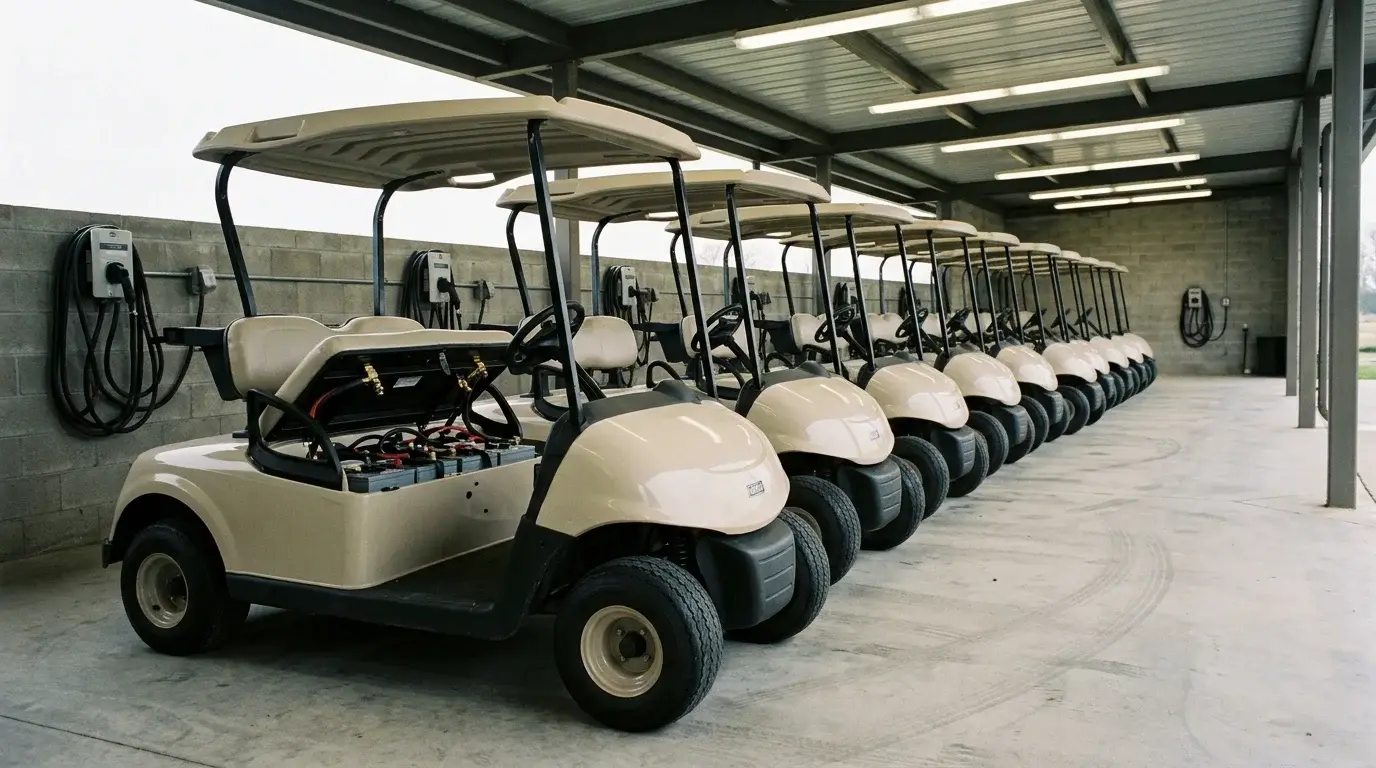
Lead-acid in a fleet context requires scheduled watering — distilled water added to each cell every 1–2 months. On a 48V bank of six 8V batteries, each with three cells, that’s 18 inspection and fill points per cart. For a 20-cart fleet, that is 360 cell inspections per maintenance cycle.
Lead-acid batteries also produce hydrogen gas during charging, particularly during equalization. That requires a ventilated charging area and fire suppression awareness. LiFePO4 does not off-gas under normal conditions, which simplifies charging infrastructure considerably.
🔋 Running a Golf Course Fleet or Managing a Multi-Cart Upgrade?
Explore the AYAA TECH Product Catalog →Engineering Details You Need to Get Right Before the Upgrade
Swapping lead-acid for LiFePO4 is not always plug-and-play. The chemistry swap is straightforward; the system integration is where mistakes happen. Getting these details right before the swap costs nothing. Getting them wrong can cost a motor controller.
BMS peak current must match your motor controller’s inrush demand
The BMS is not just a protection circuit — on LiFePO4, it is the gatekeeper between the cells and the drivetrain. Every BMS has a continuous current rating and a peak current rating. The peak current spec matters more for golf carts, because motor controllers produce large inrush spikes when starting from rest, particularly on uphill starts.
A typical 48V golf cart motor controller can demand 300–600A for 1–5 seconds during an uphill launch. If your BMS’s peak current rating is only 150A, it trips its overcurrent protection on a hard start, and the cart cuts out. Many people who report their lithium upgrade “not working” are actually running a BMS rated for sustained loads, not inrush transients.
Before specifying a pack, confirm three things:
- The motor controller’s peak (inrush) current rating — not just the continuous rating
- The BMS peak current window (how many seconds it sustains peak current before tripping)
- Whether the BMS supports a pre-charge resistor circuit to limit capacitor inrush on the controller’s input stage

Replacing individual 12V batteries in series is not the same as a single integrated pack.
Many lead-acid upgrades used four 12V batteries wired in series to achieve 48V. Swapping each 12V lead-acid for a 12V LiFePO4 battery with its own BMS seems straightforward. The problem is that four independent BMS units do not communicate. Each one manages only its own cell voltages.
Over time, small differences in self-discharge rate and internal resistance accumulate cycle by cycle. Eventually, one pack drifts further down than the others. When its cells hit the undervoltage protection (UVP) threshold, that BMS disconnects its pack — and the 48V string is broken. The whole cart stops, even though the other three packs still have capacity remaining.
【Engineering Note】 This is the most common silent failure mode in DIY lithium golf cart builds using individual 12V drop-ins. The symptom — cart suddenly stops with no warning — is identical to a single failed cell. Diagnosis requires measuring each 12V pack’s open-circuit voltage individually. Prevention requires either a single integrated 48V pack with one unified BMS, or a balancing solution that allows the BMS units to communicate. For fleet upgrades, individual 12V drop-ins increase long-term maintenance complexity significantly.

Regen braking can spike your DC bus voltage above the controller’s safe limit.
Electric golf carts with regenerative braking — common on newer AC drive systems from Club Car and E-Z-GO — feed energy back into the battery pack when decelerating. Under normal conditions, the BMS accepts this return current and the pack absorbs it.
The dangerous scenario: battery SOC is at or near 100%, and the BMS has already closed the charge path to prevent overcharge. The motor controller tries to push regen current into the pack. The BMS blocks it. The energy has nowhere to go, so DC bus voltage spikes. On some controllers, this spike exceeds the MOSFETs’ voltage rating and destroys the controller.
This is not a theoretical risk. It is a documented failure mode among golf cart technicians. LiFePO4 packs designed for regen-equipped carts need a BMS with configurable charge-disconnect hysteresis — or an external shunt/bleed resistor circuit to absorb the spike.
【Engineering Note】 If you’re upgrading a regen-equipped cart to LiFePO4, do not assume the existing charger algorithm is safe for lithium. Club Car’s OBC (On-Board Computer) and E-Z-GO’s DCS were designed around lead-acid charge profiles. Some versions will attempt an equalization cycle that pushes voltage above LiFePO4’s safe charging ceiling. Either disable the OBC or replace the charger with a lithium-specific charge profile. We’ll cover this in a separate article on OBC bypass and charger compatibility, linked at the end.
Cold temperatures change the charging rules — and ignoring them destroys cells.
LiFePO4 handles cold discharge well — capacity loss is modest down to about -20°C. Charging in cold is a different matter entirely.
Below 0°C (32°F), charging a lithium cell causes lithium plating on the graphite anode instead of proper intercalation. Plated lithium forms metallic dendrites — needle-like structures that grow through the separator and cause an internal short. The result is irreversible capacity loss, potential thermal runaway, and in the worst case, a cell fire inside a sealed pack.
A quality BMS includes low-temperature charge cutoff, typically set to 0°C or slightly above. Verify that the BMS in your chosen pack has this protection, and check sensor placement — a BMS that reads ambient temperature at the board, not at the cell surface, may respond too slowly. For operations in regions with regular sub-freezing overnight temperatures, a pack with integrated self-heating is worth the premium.
When LiFePO4 Makes Sense — and When It Doesn’t
Most articles treat LiFePO4 as the universal upgrade. It usually is. But the ROI calculation changes under specific conditions, and knowing when lead-acid still wins saves you from an unnecessary capital outlay.
The clearest cases for switching
- Daily-use fleet carts running 27 holes or more per day: charge turnaround time and cycle life both point toward LiFePO4 with no ambiguity.
- Hilly terrain courses: consistent voltage under load matters significantly when motor demand spikes repeatedly.
- Carts stored in indoor facilities: weight reduction extends floor life and reduces structural wear from repeated parking over years.
- Commercial operations requiring compliance documentation: LiFePO4 packs certified to UL 2271, IEC 62619, or UN 38.3 provide the insurance and fleet compliance documentation that lead-acid packs cannot match on paper.
- Operators with recurring maintenance cost pressure: eliminating watering, equalization, and acid containment has measurable labor cost savings at scale.
When lead-acid is still a reasonable choice
- Short, flat routes with low daily usage (fewer than 9 holes equivalent per day): the cycle-life advantage of LiFePO4 only pays off if you use the cycles. Light usage means a lead-acid pack may outlast the ROI assumptions.
- Seasonal carts operating only 3–4 months per year: calendar aging is the dominant degradation mode here. Lead-acid’s lower upfront cost is harder to justify overriding.
- Carts mid-cycle with 40–50% capacity remaining: sometimes finishing the lead-acid pack’s remaining life before switching is the right economic decision.
AYAA TECH’s SOC estimation algorithm accounts for one factor that generic state-of-charge gauges cannot: ambient temperature variation. Temperature affects internal resistance and open-circuit voltage, which throws off voltage-based SOC estimates by 10–15% in extreme conditions. AYAA’s algorithm compensates for this, holding SOC error to ≤5% across operating temperatures — so the remaining-range readout on the dash is a number you can trust.
🔧 Need a Custom Pack Spec for Your Cart Model or Fleet Size?
Request a Custom Engineering Consultation →Preguntas frecuentes
Can I mix LiFePO4 and lead-acid batteries in the same cart?
No. The two chemistries have fundamentally different charge profiles and voltage curves. A charger calibrated for lead-acid will either undercharge LiFePO4 or — if it runs an equalization cycle — push voltage above LiFePO4’s safe ceiling. The BMS will protect the cells, but repeated charge-cutoff events shorten BMS component life and can damage the charger. Run one chemistry or the other.
Do LiFePO4 golf cart batteries work in cold climates?
For discharge, yes — LiFePO4 handles cold reasonably well. For charging, the BMS must include a low-temperature cutoff (typically 0°C / 32°F) to prevent lithium plating on the anode. In climates with regular overnight sub-freezing temperatures, look for packs with integrated cell heating. Without it, charging a cold pack risks permanent capacity loss and, in severe cases, dendrite growth through the separator.
How long does a LiFePO4 golf cart battery last?
Under normal daily-use conditions, LiFePO4 is rated for 2,000–5,000 charge cycles to 80% of original capacity. In a fleet running one full charge per day, that translates to 5–14 years of service life. Real-world results vary based on temperature exposure, charge depth consistency, and BMS quality. Lead-acid in the same scenario typically reaches end-of-service in 3–5 years.
Is LiFePO4 safe — can it catch fire like other lithium batteries?
LiFePO4 is the most thermally stable of the common lithium chemistries. Its cathode does not release oxygen under decomposition, which eliminates the primary driver of thermal runaway seen in NMC and NCA chemistries. LiFePO4 can still overheat from external abuse — physical damage, severe overcharge, or cell-to-cell short — but it does not sustain combustion the way NMC does. For commercial fleet use, look for packs certified to UL 2271 or IEC 62619.
What charger do I need for a LiFePO4 golf cart?
You need a charger with a LiFePO4-specific charge profile: constant current to approximately 3.65V per cell, then constant voltage until current drops below a cutoff threshold, then stop. No equalization. No float. Match the voltage output to your pack’s cell count (e.g., 58.4V for a 16-cell 48V pack). Do not use a charger that only supports lead-acid profiles. If your cart has an OBC (Club Car, E-Z-GO), verify charger compatibility before installation.
Can I replace just some of the batteries in my 48V cart with LiFePO4?
Technically possible; practically problematic. Mixing chemistries in series creates a system where neither chemistry’s charge profile is correct for both simultaneously. Voltage mismatch means the pack’s real state of charge is ambiguous. In almost all cases, replacing the full bank at once is the right approach.
How do I know if my current motor controller is compatible with LiFePO4?
The main compatibility question is the BMS peak current rating versus the controller’s inrush demand. Most 48V golf cart motor controllers operate safely with a LiFePO4 pack, as long as the BMS is rated for the controller’s peak current. Also confirm whether your controller has regen braking — if it does, the BMS must support charge-disconnect hysteresis to manage bus voltage spikes during regeneration. When in doubt, share your controller’s model number and peak current spec with your battery supplier before ordering.