





The best batería para carrito de golf type for most people is LiFePO₄ lithium — longer life, faster charging, zero maintenance. But if upfront cost matters most, flooded lead-acid still delivers.
There are four chemistries to choose from: Plomo-ácido, Absorbed Glass Mat, Gel Lead-Acid, and LiFePO₄. Each uses a different electrolyte, and that choice drives lifespan, maintenance demands, and real-world cost.
Flooded lead-acid costs the least upfront but demands the most upkeep. AGM and Gel are sealed and maintenance-free but still carry the full weight of lead. Lithium costs more to buy, but it outlasts two or three lead-acid sets over a decade.
The sections below break down each type — with the engineering details most buying guides skip.

A Quick Comparison of Golf Cart Battery Chemistries
Before going deeper into each type, it helps to see everything side by side. The numbers below reflect real-world fleet data and manufacturer specs for standard 48V packs. These are not best-case lab figures.
| Plomo-ácido inundado | AGM | Gel | LiFePO₄ Lithium | |
|---|---|---|---|---|
| Electrolyte | Liquid sulfuric acid | Acid absorbed in glass mat | Silica-thickened acid gel | Lithium iron phosphate |
| Usable DoD | 50% | 50–60% | 50–60% | 80–100% |
| Cycle Life (@ 80% DoD) | 300–500 | 400–600 | 400–600 | 3,500–5,000+ |
| Lifespan (Years) | 3–5 | 4–5 | 4–5 | 8–10+ |
| Mantenimiento | Monthly water top-off | None | None | None |
| 48V Pack Weight | ~280–320 lbs | ~240–280 lbs | ~240–280 lbs | ~65–90 lbs |
| Charge Time (Full) | 8–12 hrs | 6–10 hrs | 8–12 hrs | 2–4 hrs |
| Upfront Cost (48V System) | $400–$900 | $700–$1,200 | $700–$1,300 | $1,200–$2,500 |
| 10-Year Est. Total Cost | $1,500–$3,000+ | $1,800–$3,200 | $1,800–$3,200 | $1,200–$2,500 |
A few things stand out right away. The lithium column shows a lower 10-year cost than any lead-acid option, despite the higher upfront price. That happens because a lead-acid pack typically needs replacing two to three times over the same period.
Depth of discharge (DoD) tells a similar story. Lead-acid chemistries are limited to around 50% usable capacity to protect plate life. LiFePO₄ can be discharged to 80–100% without meaningful cycle degradation. In practice, a 100Ah lithium pack delivers more usable energy than a 100Ah FLA battery — before cycle life even enters the equation.

The Four Main Golf Cart Battery Types Explained
Flooded Lead-Acid Batteries: The Original Workhorse
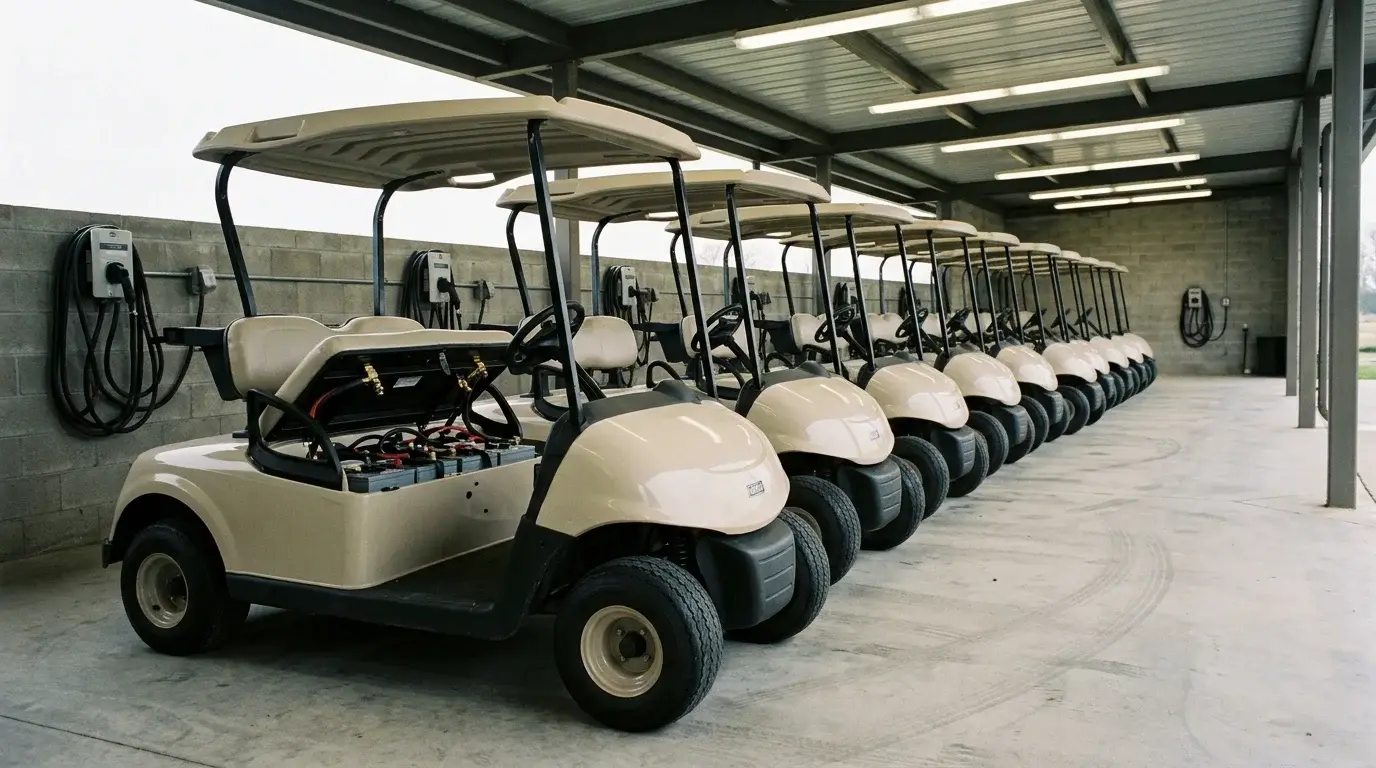
Flooded lead-acid is how almost every golf cart was powered for the first six decades of the industry. Lead plates sit submerged in a liquid sulfuric acid electrolyte. During charging, water splits into hydrogen and oxygen gas. FLA batteries need open vent caps and regular refilling to safely release those gases.
The case for FLA comes down to price and familiarity. A full 48V bank of six 8V deep-cycle batteries can be had for under $600. The technology is well understood by mechanics, and the lead recycling chain is mature and widely available.
The case against it is just as clear. Monthly water checks are not optional — they’re chemistry. Skip them, and the plates above the electrolyte line sulfate and die early. The weight is significant: a typical 48V FLA bank runs 280–320 lbs, affecting ride comfort, turf compaction, and braking.
When charge drops past 50%, voltage sag becomes noticeable. The cart feels sluggish on inclines, which many owners mistake for a wiring or motor problem. Best suited for: low-frequency users, tight upfront budgets, and situations where a local battery shop is nearby. Do not choose FLA if the cart runs daily, operates in enclosed spaces, or the owner has no interest in hands-on maintenance.
AGM Batteries: Lead-Acid Without the Watering Can
AGM uses the same core lead chemistry but fixes the messiest part of it. The acid is absorbed into tightly wound fiberglass mats, creating a fully sealed, valve-regulated (VRLA) cell. It cannot spill, needs no water, and can be mounted in any orientation.
Corroded terminals from acid vapor are one of the leading causes of premature pack failure in FLA setups. AGM eliminates that failure mode. Self-discharge rate is also lower. An AGM battery left in a garage over winter holds its charge better than a comparable FLA unit.
The limitations are worth understanding. AGM costs 30–50% more than FLA for equivalent capacity. The sealed design has no safety valve for overcharge events, so excessive voltage causes internal pressure to build until the cell vents permanently.
【Engineering Note】 AGM batteries have a tighter charge voltage window than FLA. The absorb phase must not exceed 14.4–14.7V per 12V unit (2.40–2.45 V/cell). Using a charger with an equalization mode can push voltage to 15.5–16V per unit. That can destroy an AGM pack in a single session. Always verify charger compatibility before installation.
Best suited for: enclosed storage environments, users who want zero maintenance without switching to lithium, and applications where mounting orientation is non-standard.
Gel Cell Batteries: A Niche Solution With a Narrow Window
Gel batteries share the sealed, maintenance-free advantage of AGM. Instead of glass mats, fumed silica is blended into the acid to form a thick gel. This gel stays in place even when the case is cracked, making gel cells highly resistant to vibration and stable in sustained heat.
Deep cycle resilience is a genuine strength. Gel batteries handle occasional deep discharge events better than flooded or AGM units. That matters on a course where someone forgets to charge overnight.
The charging voltage window is even narrower than AGM. Gel requires a reduced absorption voltage — typically 13.8–14.1V per 12V unit (2.30–2.35 V/cell). Charging at standard AGM voltages will gas the gel, create voids in the electrolyte structure, and permanently reduce capacity. Recharge times are also longer than AGM due to the lower voltage ceiling.
Availability in golf cart group sizes (GC2, Group 27) is more limited than FLA or AGM. Best suited for: hot climate operation and outdoor storage with no reliable charging oversight. Do not use Gel if you cannot guarantee a charger with an explicitly dedicated Gel profile. An incorrect profile degrades a Gel pack faster than neglected FLA maintenance.
Lithium Iron Phosphate (LiFePO₄): The Engineering Case for Going Lithium
LiFePO₄ is a lithium chemistry chosen for EVs and energy storage because of its thermal stability. Unlike cobalt-based lithium cells, LiFePO₄ does not go into thermal runaway under abuse conditions. The phosphate chemistry holds the cathode structure stable at high temperatures, which is why it has become the dominant choice for golf cart, marine, and light EV applications.
Every lithium golf cart battery includes an onboard Battery Management System (BMS). The BMS monitors cell voltages, state of charge, current, and temperature in real time. It disconnects the pack if any parameter goes outside safe bounds. A properly designed BMS is what separates a reliable lithium conversion from a liability.
The performance advantages are real in everyday operation. Full charge takes 2–4 hours instead of overnight. Voltage stays flat from 100% to near-empty — the cart climbs the same hill at day’s end as it does on a fresh charge. A 48V 100Ah lithium pack weighs 65–90 lbs versus 280–320 lbs for an equivalent FLA bank.
The initial cost is higher — quality 48V packs run $1,200 to $2,500. But a lithium pack likely outlasts two full lead-acid replacements. Over 10 years, that eliminates replacement labor costs, disposal fees, and the time embedded in every water-check cycle. Best suited for: daily-use carts, commercial fleets, steep terrain, and anyone who wants battery maintenance permanently off their list.

How Golf Cart Voltage and Battery Configurations Work
Chemistry is only half the picture. The other half is how individual batteries combine to reach your cart’s required system voltage.
Most golf carts operate at 36V or 48V. Some performance or utility carts run 72V. The system voltage is not adjustable — it is set by the motor, controller, and wiring harness from the factory.
Here is how the common configurations add up:
- 36V systems: Six 6V batteries in series.
- 48V systems: Six 8V batteries in series, or four 12V batteries in series.
- 48V lithium: A single consolidated 48V drop-in pack (e.g., 48V 105Ah), or — with important caveats — four 12V lithium batteries in series.
Physical sizing matters too. Most golf cart battery bays are designed around the GC2 footprint (about 10.25″ × 7.06″ × 10.86″). Twelve-volt drop-in lithium replacements commonly come in Group 27 and Group 31 sizes. Verify that dimensions and terminal orientation match your cart’s tray before ordering. A few centimeters of difference in terminal position creates cabling problems that add unnecessary cost to an otherwise straightforward swap.
What to Think Through Before Switching to Lithium
Considering a lithium upgrade? Four engineering questions deserve an honest answer before anything gets ordered.
Making Sure Your Motor Controller and BMS Are Compatible
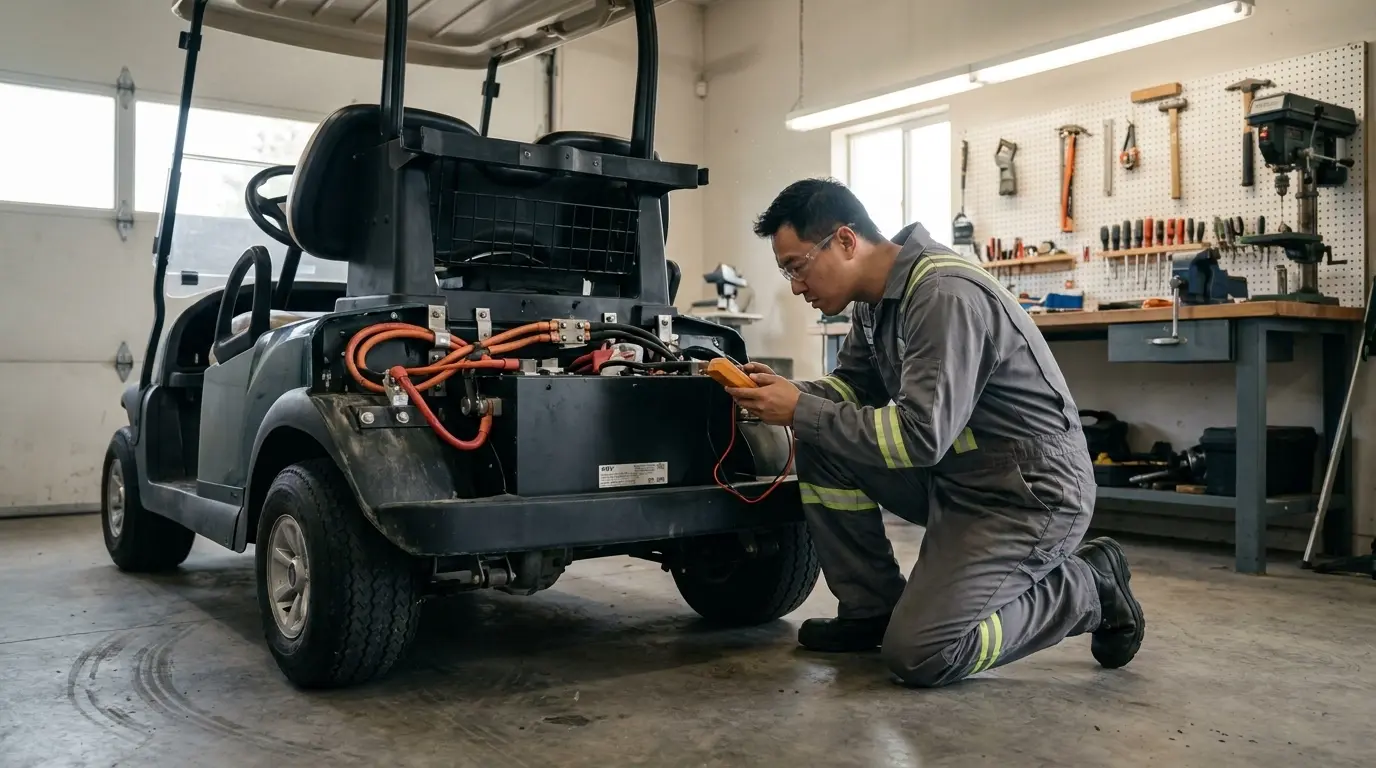
Golf cart motors draw very high current in short bursts. A loaded cart starting from rest on a 10-degree slope can pull 300–500A for 3–5 seconds. This inrush is normal. Lead-acid batteries absorb it passively because they have no self-protection against overcurrent.
A lithium BMS works differently. It monitors current continuously and disconnects the pack if discharge exceeds its rated protection threshold. Most budget 12V lithium batteries are rated at 100A continuous and 200A peak. That is not enough headroom for a loaded 48V cart on steep terrain.
【Engineering Note】 Nuisance tripping — where the BMS cuts power mid-acceleration — is the most common complaint in poorly matched lithium conversions. The fix is not resetting the BMS. Select a pack with a BMS rated for at least 300A continuous. The peak rating should be 400–500A for 5+ seconds. Verify these figures in the datasheet, not the marketing copy.
Why Four 12V Lithium Batteries in Series Is Riskier Than It Looks
The obvious approach is buying four 12V lithium batteries and wiring them like the lead-acid set they replace. It works initially. The problem builds over months of cycling.
Each 12V lithium battery has its own independent BMS. Those units cannot communicate with each other. As the four packs age at slightly different rates, their state of charge and voltage begin to diverge.
The weakest pack reaches its low-voltage cutoff first and disconnects from the string. The other three can no longer complete the circuit. The cart shuts down completely.
Diagnosing which pack tripped — then equalizing all four — is a recurring process that gets frustrating fast. A single 48V integrated pack with one centralized BMS eliminates this. There is no partial-failure mode that requires individual diagnosis.
Charger Compatibility Is Non-Negotiable
Standard lead-acid chargers include a desulfation or equalization mode. That mode pushes voltage above normal absorption levels to break down lead sulfate crystals. For a lithium pack, the same voltage spike triggers BMS protection or accelerates cell aging.
LiFePO₄ requires a dedicated CC/CV algorithm. The target is 3.65V per cell — 14.6V for a 12V pack, or 58.4V for a 48V pack. Some lithium packs in deep discharge will present 0V at the terminals. A charger that reads this as an open circuit, rather than a sleeping BMS, will refuse to charge.
Replace the charger when you replace the battery. This is not an optional part of the upgrade.
Cold Weather Charging Has a Hard Limit
Lithium cells can deliver power in cold conditions. Discharge performance is reduced but functional down to around -20°C (-4°F). Charging below 0°C (32°F) is a different matter.
Charging a lithium cell below freezing causes lithium ions to plate onto the graphite anode in metallic form. Those deposits — called lithium dendrites — do not dissolve. They grow with each cold-temperature charge cycle until they pierce the separator and create an internal short.
A quality BMS includes a hardware-enforced low-temperature charge cutoff. This prevents charging when cell temperature is below 0–5°C. If your cart lives in a cold-climate garage, this feature is a requirement — not a bonus. Verify it is in the specification sheet before purchase.

How to Find the Best Golf Cart Battery Type for Your Situation
By now the technical picture is clear enough that the selection decision becomes fairly direct.
If you drive once or twice a week and want to minimize upfront spend, flooded lead-acid is a rational choice. The total cost of ownership only stays low if the monthly maintenance is actually done.
If you want sealed, maintenance-free operation without replacing the charger, AGM is the cleanest middle ground. Confirm charger compatibility first.
For daily-use carts, passenger loads, steep terrain, and commercial fleets, LiFePO₄ is where the math lands. The higher purchase price is recovered through eliminated replacement cycles and zero maintenance labor. The 70% weight reduction changes how the cart drives too. On wet turf, reduced rear-wheel load meaningfully lowers grass compaction — something grounds crews at well-maintained courses notice quickly.
Ready to find the right lithium battery for your cart or fleet?
How to Match Your Battery to Your Cart’s Electrical System
Chemistry selection alone does not answer every question. What matters next is whether the battery integrates cleanly with your cart’s existing electrical system. Here is a practical checklist:
- Confirm system voltage: Count cells or check the controller nameplate. Do not assume.
- Measure tray dimensions: GC2 is standard for most 6V and 8V slots. 12V drop-ins typically use Group 27 or 31. Measure terminal orientation too.
- Check motor controller current limits: Most OEM controllers are rated 300–500A. Select a lithium BMS with headroom above that figure.
- Identify charger model and algorithm: Check the manufacturer’s compatibility list or contact the supplier directly.
- Verify BMS low-temperature cutoff: Especially important for cold climate storage.
- For fleet applications: Ask whether the BMS supports SOC data output via CAN or RS485.
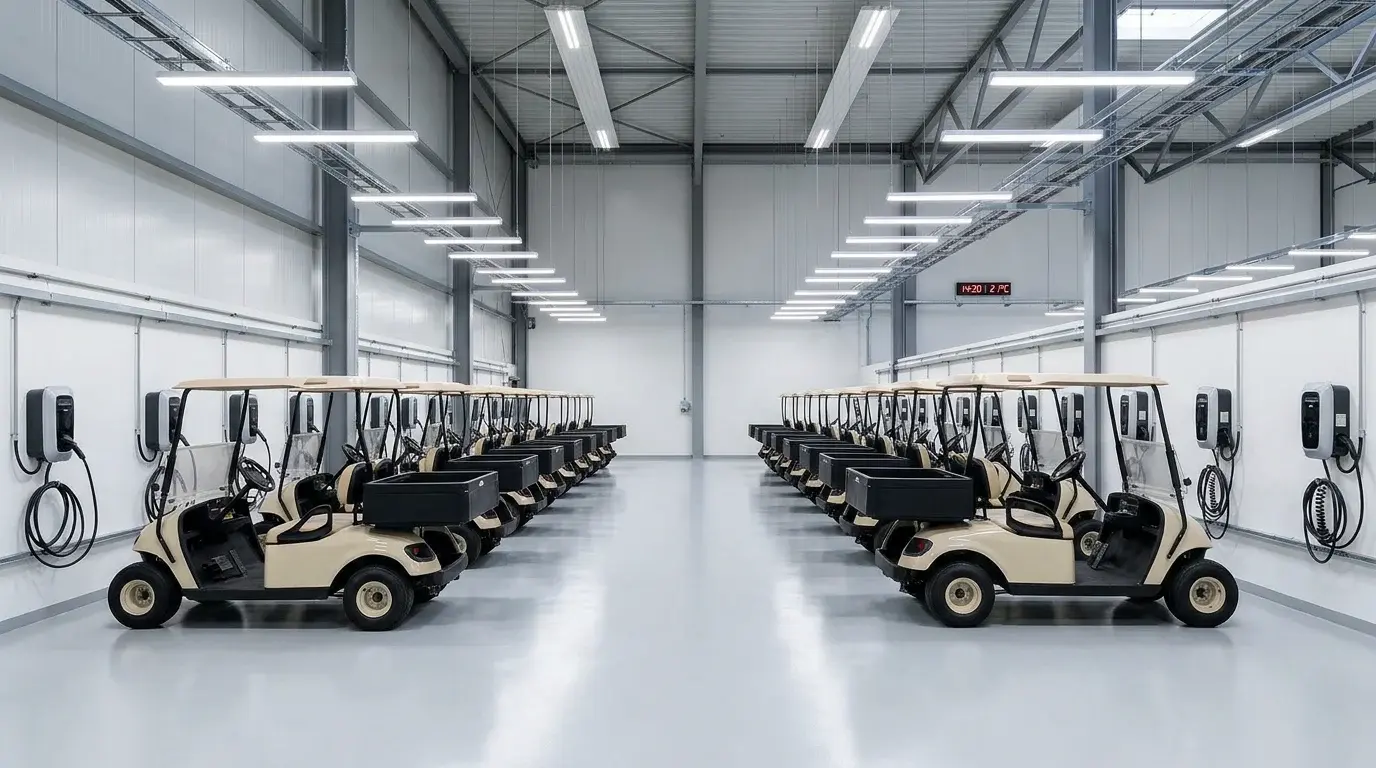
That last point matters for fleet operators. Manual range estimation across a 50-cart fleet is inherently inaccurate. A BMS that outputs precise state-of-charge data allows dispatch software to assign carts based on actual available energy. No more guessing from indicator lights. This is where the gap between a basic lithium retrofit and a properly engineered battery system becomes operationally significant.
Running a fleet or managing a custom integration project?
Frequently Asked Questions
Can I charge my lithium golf cart battery with a regular lead-acid charger?
No — and this is one of the most common mistakes made during a lithium conversion. Standard lead-acid chargers include an equalization or desulfation phase. During that phase, output voltage is pushed above normal absorb levels — often to 15.5V or higher on a 12V-rated output. A LiFePO₄ cell’s maximum charge voltage is 3.65V per cell (14.6V for a 12V pack). Feeding it an equalization pulse triggers the BMS cutoff at minimum and accelerates capacity degradation at worst. Use only a charger with a dedicated LiFePO₄ CC/CV profile matched to your pack voltage.
Is a single 48V lithium battery better than four 12V lithium batteries in series?
In most cases, yes. Four separate 12V lithium batteries each carry their own independent BMS, and those systems cannot share cell data. Over time, capacity differences cause state of charge to diverge between packs. The weakest pack trips its undervoltage protection first, breaking the series circuit and shutting the cart down. A single 48V pack with one centralized BMS actively balances every cell as a unified system. Failures are clean and simple to interpret. If your tray has space for a 48V drop-in, that is the better engineering choice.
How do I know if my golf cart is 36V or 48V?
Count the fill holes across all batteries in the pack. Each hole on a lead-acid battery represents approximately 2 volts. Six batteries with three holes each gives you 6 × 6V = 36V. Six batteries with four holes each give you 6 × 8V = 48V. If the batteries are already removed, check the motor controller nameplate — it lists the rated input voltage directly. EZGO, Club Car, and Yamaha all publish voltage specifications by model and year.
Have a specific application in mind or a sourcing question?