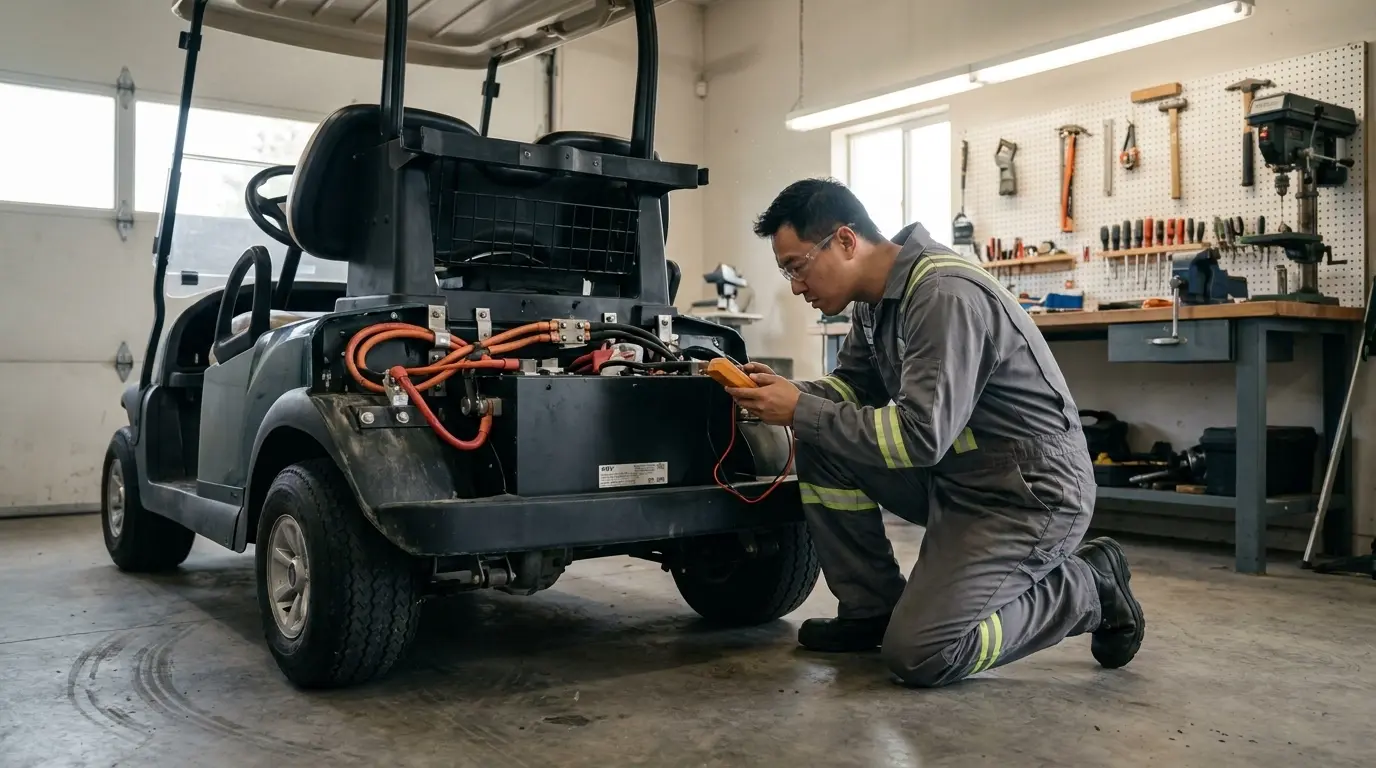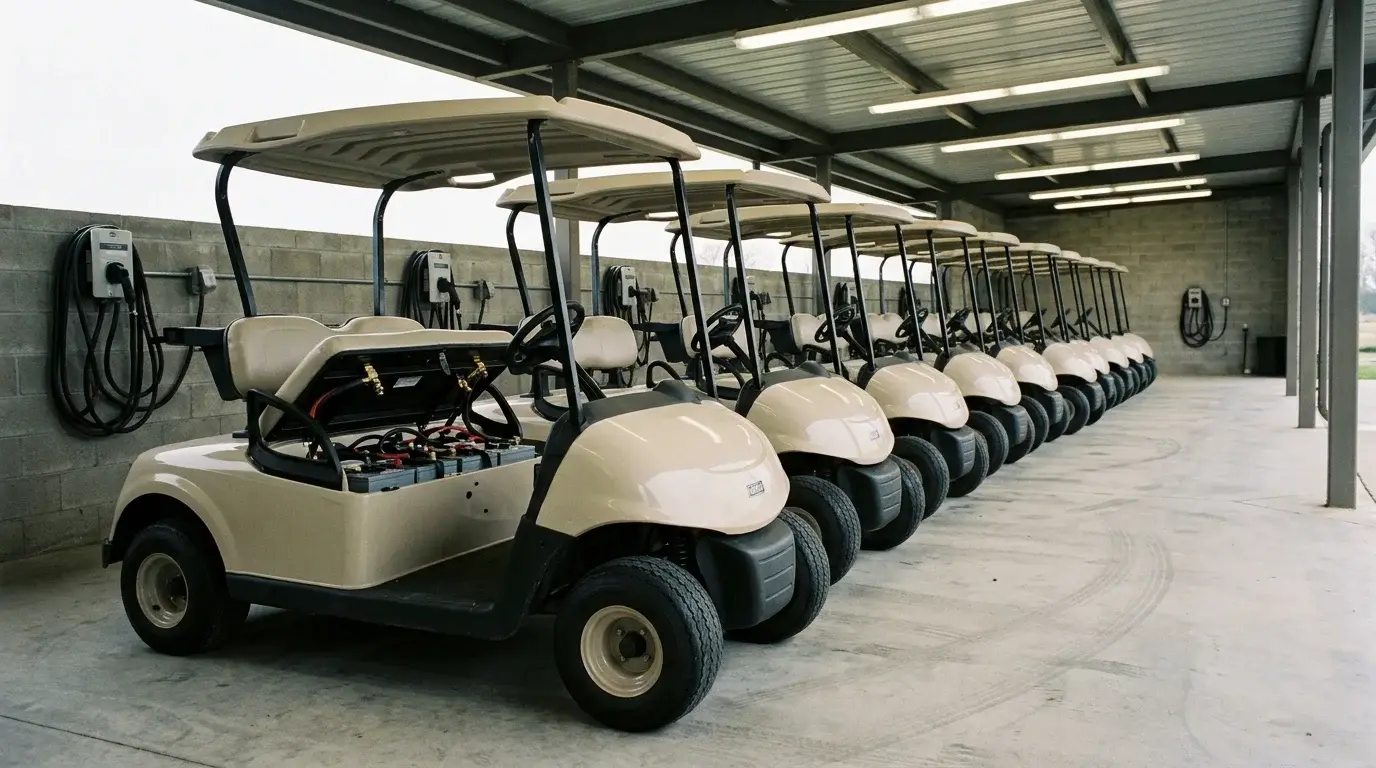


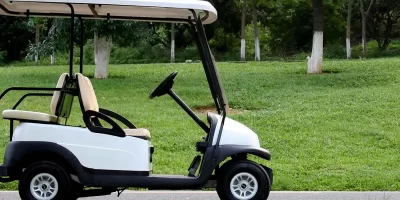





To choose the right lead-acid batería para carrito de golf, match the chassis voltage, BCI size, and capacity. Most commercial carts run on 36V or 48V deep-cycle flooded systems. Selecting higher-cell packs like 6V or 8V units ensures longer run-time under heavy loads. With disciplined watering and proper charging, a quality battery pack reliably lasts three to five years.

Sizing Your Lead-Acid Golf Cart Battery System: 36V vs. 48V
Always verify your system voltage before requesting quotes. Ordering the wrong voltage pack remains a very common mistake in fleet maintenance.
Checking Pack Voltage and Series Layouts
Check the motor controller plate to find your system voltage. You can also count the water fill caps on your batteries. Each lead-acid cell delivers roughly two volts. Multiply the total cell count by two to verify your voltage.
The table below outlines common commercial battery setups:
| System Voltage | String Setup | Battery Count | Standard Capacity (C/20) | Best Application |
|---|---|---|---|---|
| 36V | 6 × 6-Volt | 6 | 210–225 Ah | Flat courses, legacy carts |
| 48V | 6 × 8-Volt | 6 | 165–180 Ah | Standard passenger fleets |
| 48V | 8 × 6-Volt | 8 | 210–225 Ah | Heavy utility, hilly terrain |
| 48V | 4 × 12-Volt | 4 | 140–150 Ah | Light duty, small battery bays |
Why Battery Choice Changes Run-Time
A 4 × 12V battery pack uses fewer cables. However, it sacrifices long-term cycle life. Manufacturers must use thinner plates inside 12V cases. Thinner plates shed material quickly under heavy acceleration.
In contrast, 6V and 8V cases hold thicker lead plates. These heavier plates resist grid corrosion much better. They deliver longer run-time during heavy commercial shifts.
Avoid 4x12V flooded packs for hilly courses or all-day rental use. Heavy loads cause severe voltage drop on 12V units. This cuts expected battery life down to under two years.
Technical Specifications That Dictate Performance
Spec sheets often look identical across brands. However, two metrics determine real performance under load.
Ampere-Hours vs. Reserve Capacity at 75 Amps
Most brands advertise the 20-hour rate, such as 225Ah. This test uses a very light 11-amp load. In real operation, golf cart motors pull 70 to 180 amps.
Heavy current draws deplete battery capacity quickly. Because of this, engineers evaluate Reserve Capacity at 75 amps under standardized traction battery testing defined by IEC 60254-1. This rating measures runtime in minutes under a continuous 75-amp load.
- Group GC2 (6V, ~225Ah): Delivers 110–135 minutes @ 75A.
- Group GC8 (8V, ~170Ah): Delivers 85–105 minutes @ 75A.
- Group GC12 (12V, ~150Ah): Delivers only 60–75 minutes @ 75A.
Pick models with higher 75A reserve minutes for hilly tracks or heavy cargo use.
BCI Group Sizes and Terminal Selection

Battery tray dimensions leave very little clearance. Standard commercial dimensions published in the BCI technical standards incluir:
- Group GC2 (6-Volt): 264 mm L × 181 mm W × 279 mm H
- Group GC8 (8-Volt): 264 mm L × 181 mm W × 279 mm H
- Group GC12 (12-Volt): 330 mm L × 173 mm W × 240 mm H
GC2 and GC8 share the same tray footprint. This allows easy upgrades from 36V to 48V.
Avoid standard round automotive posts for commercial duty, which are typically sized for cranking applications under SAE J537 standards. Instead, specify embedded low-profile terminals or universal terminals. These styles create a broader contact area with cable lugs. Larger contact areas stop terminal posts from melting during steep climbs.
Flooded vs. AGM: Selecting the Chemistry
Flooded lead-acid and AGM share similar chemistry. However, their daily maintenance and costs differ sharply.
Flooded Lead-Acid: Proven Fleet Economics
Flooded batteries remain the top commercial standard. They deliver the lowest upfront capital cost per kilowatt-hour. Facilities with regular maintenance routines get steady multi-season service.
However, flooded batteries require distilled water every two to four weeks. Plates must stay submerged at all times. Exposed plates oxidize quickly and lose capacity permanently.
AGM Batteries: Sealed Operation
AGM batteries hold electrolyte in glass fiber mats. They prevent acid leaks and remove watering tasks completely. They also release no fumes during charging.
The downside is the purchase cost. AGM units cost 30% to 50% more than flooded units. They also need strict charge limits to avoid dry-out.
(Looking to eliminate watering labor and cut maintenance costs? Read our full guide on Lithium vs Lead-Acid Golf Cart Batteries: Which Is Better?).
Need Heavy-Duty Commercial Power for Your Fleet?
Explore Our Battery Pack SolutionsCharging Profiles and Pack Balance
Improper charging causes more early battery failures than factory defects.
Checking Charger Voltage Profiles

Always check your charger settings before connecting new batteries. Flooded units typically need an absorption charge of 2.45 volts per cell. They then drop to a float level of 2.25 volts, aligning with maintenance benchmarks in IEEE 450 recommendations.
AGM batteries require lower absorption voltage limits. Using a flooded profile on AGM will boil away electrolyte. This destroys an AGM pack within months.
The Single-Battery Replacement Trap
Never swap just one weak battery in an older pack. This common practice wastes maintenance budget.
A new battery has lower internal resistance than older units. During driving, it takes an uneven load. During recharging, it reaches full voltage too early. The charger then cooks the new unit while trying to top off older batteries.
If one battery fails after 12 months of service, inspect the entire string. Replace the complete set if cell variation exceeds 15%. Single-unit replacements in older strings fail very quickly.
Fleet Replacement Costs and Lifespan
Real-World Service Life
Commercial flooded packs last 3 to 5 years under good care. That equals roughly 300 to 500 charge cycles.
Poor operating habits will shorten this lifespan to two years. Never drive carts below 20% state of charge. Keep plates covered with distilled water. Finally, recharge batteries right after every shift to prevent plate sulfation.
Budgeting for Full Pack Replacements
Commercial deep-cycle batteries cost between $140 and $250 each. A full 48V pack using eight 6V batteries costs $1,120 to $2,000.
Do not overlook peripheral hardware when budgeting. Replace corroded interconnect cables with 4 AWG or 2 AWG copper wire. Corroded cables create electrical resistance and trigger early charger shutoff. Also inspect steel tray brackets for acid damage.
Scaling Your Fleet or Designing Custom Light EVs?
Consult an AYAA Battery Systems ArchitectPreguntas frecuentes
Is a lead-acid golf cart battery still worth buying for a fleet?
Yes. Deep-cycle flooded batteries offer the lowest upfront cost for commercial fleets. They provide dependable power when backed by disciplined watering routines. Recycling networks for lead batteries are also widely available.
Which 48V configuration lasts longest: 6x8V or 4x12V?
Six 8-volt packs outlast 4x12V setups consistently. The 8-volt batteries feature heavier, thicker internal lead plates. These thicker plates resist damage from deep discharges much better.
How much does it cost to replace a lead-acid golf cart battery set?
A full 48V battery set costs between $800 and $2,000 for batteries alone. Adding new heavy-duty cables and labor brings total costs to $1,000–$2,200 per cart.
Can I replace just one dead battery in my cart?
No, avoid doing this on packs over six months old. The new battery will overcharge and degrade rapidly to match surrounding aged units. Always replace the full set on older packs.
How many years does a lead-acid golf cart battery typically last?
A quality pack lasts 3 to 5 years under commercial duty. This timeline requires routine watering and prompt overnight recharging. It also requires keeping discharges above 50% depth of discharge.
What kills a lead-acid golf cart battery most quickly?
Chronic undercharging and low water levels destroy packs fastest. Leaving batteries uncharged hardens lead sulfate crystals on the plates. This permanently cuts battery capacity and runtime.
Where should fleet managers buy replacement batteries?
Fleet buyers should establish accounts directly with authorized commercial battery distributors. This route ensures volume discounts, fresh production date codes, and simple core trade-in credits that comply with EPA universal waste regulations.