- Industries

Home Backup & Garden BMS
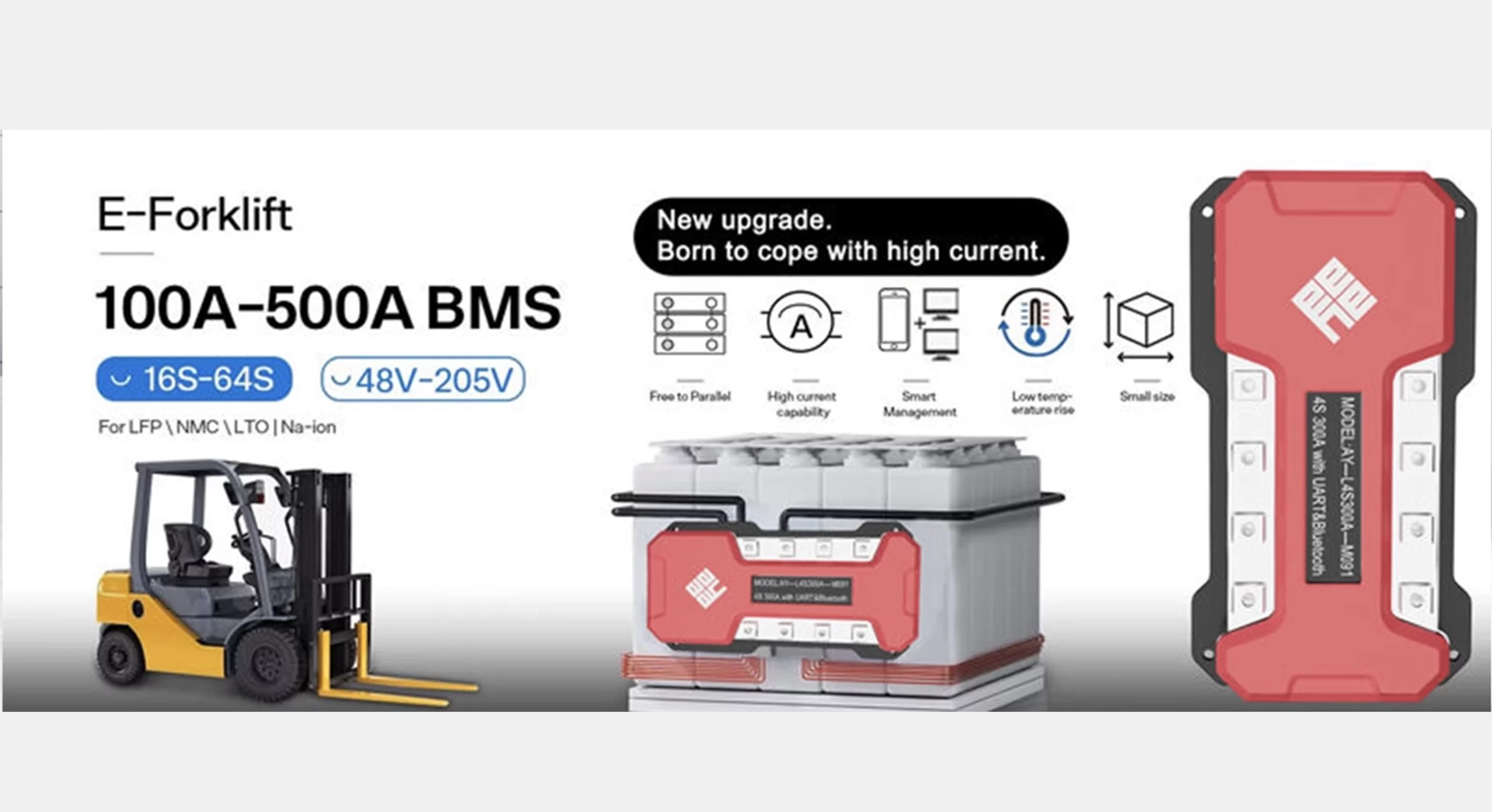
View More >Electric Forklift BMS
View More >Golf Cart BMS
View More >Electric Two-wheeler BMS
View More >Aviation & UAV BMS
View More >BMS For Power Tools
View More >Medical Equipment BMS
View More >








Home About Us EVENTS & NEWS Best lifepo4 bms 4s vs 24v bms: Choosing the Right Governance
Choosing the right power architecture is the cornerstone of industrial and household reliability in the quickly evolving energy market of 2026.
The dispute between a lifepo4 bms 4s (12V) and a 24v bms frequently boils down to the particular efficiency and scale needs of the application.
Because of its higher energy density, the 24V standard has made great progress in automated logistics and off-grid storage, despite 12V systems being the conventional option for localized power.
The Battery Management System (BMS) continues to be the “brain” of the operation regardless of the voltage, guaranteeing that each cell in the pack—whether a 4-cell series or an 8-cell string—is controlled with millivolt precision.

A lifepo4 bms 4s is a specialized management circuit made especially for lithium iron phosphate battery packs with a nominal voltage of 12.8V.
1. Four-Series Configuration: To obtain the typical 12V output, four separate 3.2V batteries are connected in series, hence the “4S” designation.
2. Voltage Boundary Control: Each cell is kept within a rigid operating window by the BMS, usually between 2.5V and 3.65V.
3. Modular Safety Gateway: If a malfunction is found, it functions as a fast electrical switch that can cut off the load in a matter of microseconds.
4. Standardized 12V Integration: This architecture is made to work seamlessly with DC appliances, chargers, and 12V inverters.
A lifepo4 bms 4s operates on a cycle of proactive electrical adjustment and real-time surveillance.
● Constant Voltage Sampling: To identify any variation, the board continuously samples the electrical potential of each of the four cell strings.
●Current Flow Modulation: To avoid excessive heat buildup in the wiring, it keeps track of how many amperes are leaving the pack.
●Internal Resistance Tracking: Before aged cells fail in the middle of a task or flight, the system monitors how the cells react to heavy loads.
●State of Charge (SOC) Reporting: Using digital communication protocols, advanced equipment provide the user with precise energy percentage statistics.
Any BMS smart controller’s main goal is to prevent the chemical deterioration that causes hardware failure.
1. Over-Charge Interruption: To avoid swelling and gas accumulation, the BMS cuts the current when a charger pushes a battery beyond its maximum capacity.
2. Over-Discharge Lockout: The system halts energy output before the cells reach a dangerously low voltage in order to prevent permanent capacity loss.
3. Short-Circuit Defense: In the event of an external electrical short, the BMS functions as a digital fuse, rapidly cutting the circuit.
4. Thermal Stability Management: During rapid charging or high-load situations, built-in sensors cause a shutdown if the pack temperature rises above 65°C.
The decision between a 12V, 24V, or even a 16s lifepo4 bms (48V) is critical since different sectors have varied voltage requirements.
●12V (4S) Applications: Perfect for portable power plants, leisure vehicles, and small maritime boats where 12V equipment are common.
●24V (8S) Applications: The best option for floor scrubbers and automated guided vehicles (AGVs) that need higher torque and efficiency.
●48V (16S) Applications: To reduce current loss over long cable lines, it is widely used in residential energy storage and telecom backups.
●bms smart Integration: Applied in all high-stakes situations where fleet management requires digital diagnostics and remote monitoring.
The demanding energy requirements of contemporary 2026 industrial operations are frequently not met by conventional or non-smart battery boards.
●Lack of Digital Transparency: Because legacy units don’t give input, operators are “blind” to the condition of each individual lithium battery.
●Slow Response Architecture: High-density cells may not be sufficiently protected against a high-current short circuit by analog protection.
●Inaccurate Cell Balancing: Conventional boards frequently employ passive balancing, which can put additional strain on the battery by wasting energy as heat.
●Fixed Performance Thresholds: Non-programmable devices cannot be modified for certain conditions, such as intense desert heat or frigid arctic temperatures.
Custom Smart BMS 7S–24S 300A–500A | CAN, RS485, UART, BLE
The contemporary lifepo4 bms 4s transforms a raw battery into a safe energy asset by using sophisticated digital signal processing.
1. High-Speed Digital Switching: With ultra-low internal resistance, modern MOSFETs offer protection almost instantly.
2. Integrated BMS Smart Capabilities: Real-time adjustments and predictive maintenance warnings are made possible by built-in Bluetooth and CANbus.
3. Active Power Redistribution: To maintain ideal balance, smart units can transfer charge between cells rather of squandering heat.
4. Customizable Safety Limits: To prioritize either maximum power or maximum cycle life, operators can design particular cutoff voltages.
A professional lifepo4 bms 4s operated a 12V LFP array at an environmental research station in a distant forest in 2026.
The solar panels were covered in snow during a violent winter storm, which pushed the battery to its limit.
The researchers received a low-voltage notice on their tablets prior to the system shutting down because it was a BMS smart unit.
Because of the intense cold, they observed that one of the four cells was falling more quickly than the others.
In order to sustain the 12V output for vital sensors, the BMS’s active balancing logic instantly gave that cell priority and redistributed charge from the healthier cells.
The station’s data logging continued until the sun came back thanks to this exact governance, demonstrating that astute management is the best defense against environmental stress.
Without a management system, using a high-energy lithium pack is risky and could result in dangerous situations or quick hardware deterioration.
1. Uncontrolled Overcharging: When cells are overcharged, internal pressure and possible fire may result.
2. Catastrophic Overheating: In the absence of thermal sensors, a pack may overheat to a point where the shell melts or the surrounding area catches fire.
3. Accelerated Cell Imbalance: The life cycle is significantly shortened by tiny variations in cell capacity compounding until the pack is worthless.
4. No Short-Circuit Buffer: In the absence of a BMS’s microsecond safety, a straightforward wiring mistake could result in an explosive energy release.
Professional maintenance and astute responsiveness are essential if you want to maximize the performance of your energy infrastructure.
| Feature | 12V (4S) System | 48V (16S) System |
|---|---|---|
| BMS Type | lifepo4 bms 4s | 16s lifepo4 bms |
| Max Efficiency | High for low-power DC | Ultra-high for large inverters |
| Wiring Complexity | Low (fewer cells) | High (requires precise balancing) |
| Typical Use | Marine/RV | Home Storage/Telecom |
| Safety Logic | Cell-level monitoring | System-wide thermal coordination |
The intelligence found in battery packs will determine the success of the energy transition as the globe turns toward 100% electrification by 2026.
The objective is the same whether you are managing a high-voltage array with a 16s lifepo4 bms or deploying a lifepo4 bms 4s for a small-scale project: complete stability.
Operators can turn their batteries from basic storage devices into proactive energy partners that react to every alert and malfunction with technical accuracy by adopting BMS smart technology.
Industry leaders rely on Ayaa Technology’s advanced management systems because of their commitment to energy integrity and technical resilience, guaranteeing that your 12V, 24V, and 48V assets are managed with the sovereignty needed for the contemporary industrial era.
Q1:What does 4S mean in BMS?
A1:The battery comprises four cells that combine their voltages to produce a larger power than a single cell could, as shown by its “4S,” which stands for “S for Series.”
For demanding applications like RC drones, automobiles, and airplanes, this arrangement offers higher power and voltage.
Q2:What is the best BMS setting for LiFePO4?
A2:We recommend setting the BMS discharge cutoff voltage to 2.5 V per cell and the charge voltage to 3.65 V per cell.
These settings are critical for maintaining battery lifespan and health.
Q3:What is the difference between 3s and 4S BMS?
A3:Three battery cells are controlled by a 3s battery formation BMS, whereas four battery cells are controlled by a 4s BMS.
Higher voltage can be obtained from the 4s arrangement because of the additional cell.
For instance, a 3s system yields roughly 11 in a lithium-ion battery.
Q4:What is the best BMS for LiFePO4 batteries?
A4:Thanks to its built-in Bluetooth functionality and high active balancing current (0.6–2 A), the AYAA SMART BMS has become a popular choice.
Q5:Do I need a 4S BMS for my battery pack?
A5:Basic battery pack protection requires a 4S BMS.
When there is a short circuit (fire hazard) or an overdischarge (damage to the battery cell), the BMS simply switches off the electricity.
It is neither a charger nor a discharger.
High-performance smart BMS solutions for energy storage, EVs, robotics, and drones.
✔ High Efficiency & Active Balancing
✔ Smart Monitoring & Protection
✔ Global Certifications
✔ Customizable for Any Application
⚡ Engineers respond within 12 hours
🔒 Your information is safe and confidential