





Choosing the right smart BMS for a turret truck battery depends on more than battery voltage or current rating.
For VNA warehouse operations, accurate SOC estimation, reliable thermal protection, cell balancing, configurable current protection, and low-temperature management all play an important role in battery safety and productivity.
Modern battery management systems are designed to monitor and protect lithium battery packs, but their effectiveness depends on whether their functions match the demanding operating conditions of turret trucks.
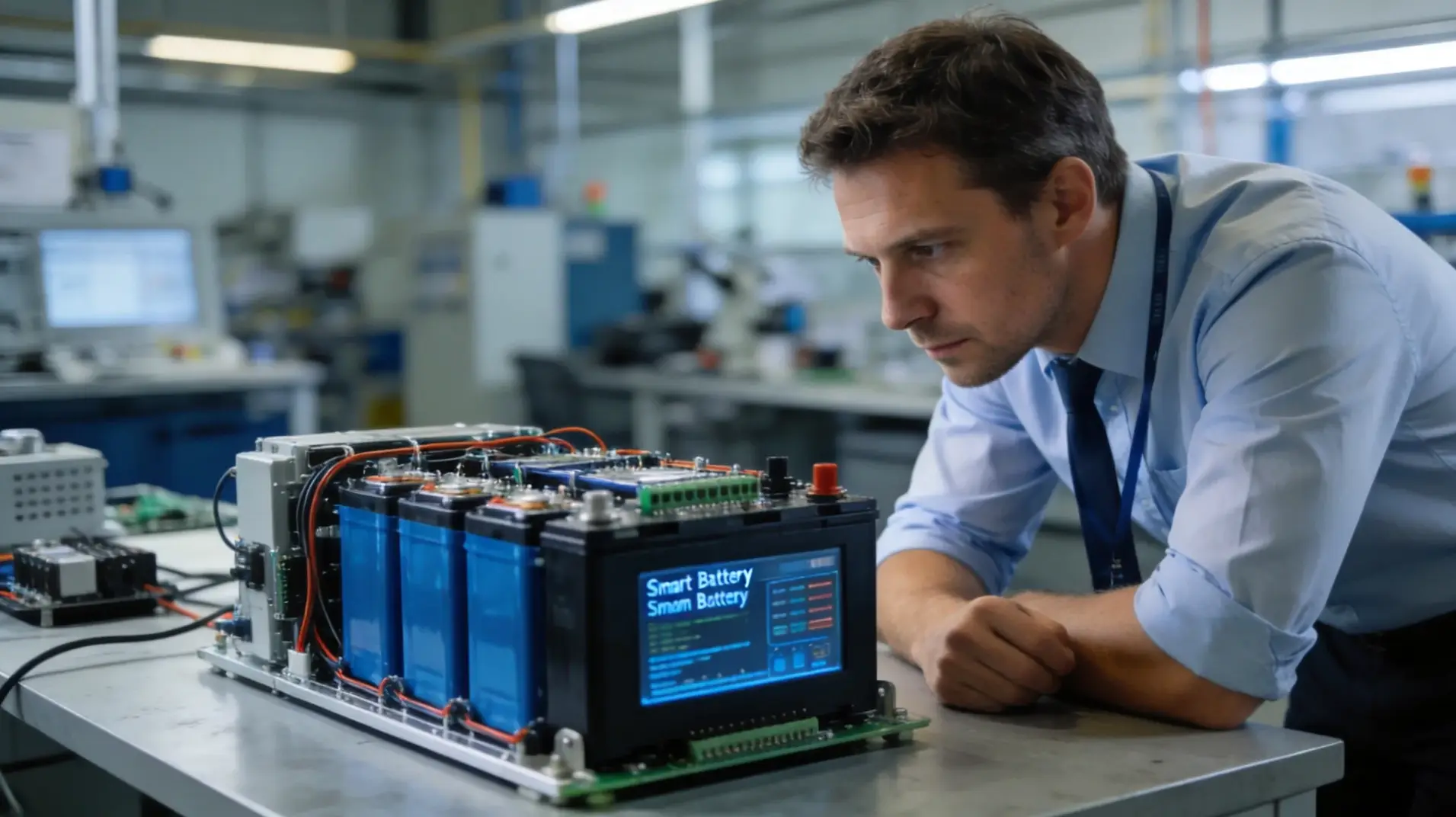
1. Challenges of Turret Truck Battery and How a Smart BMS Helps
Unlike standard electric pallet trucks, turret truck forklifts often work in very narrow aisles, lift loads to significant heights, and complete hundreds of repetitive operating cycles each shift.
A single work cycle may combine driving, lifting, steering, and fork rotation at the same time, creating much higher electrical demands than many other warehouse vehicles.
While battery chemistry determines how much energy the pack can store, a smart battery management system (BMS) determines how safely and efficiently that energy can be used.
It cannot increase the energy density of lithium cells, but it can improve battery protection, operating visibility, and maintenance planning throughout the battery’s service life.
1.1 Inaccurate SOC Causes Unexpected Downtime
Many turret trucks run continuous, high-intensity shifts, where even small errors in battery indication can disrupt operations—especially during pallet retrieval at height or movement in narrow aisles.
Conventional SOC estimation typically depends on voltage-based models, which are significantly affected by load fluctuations and therefore tend to drift under real working conditions. More advanced smart BMS approaches improve accuracy by combining voltage, current, temperature, historical usage data, and adaptive capacity models.
Within this context, AYAA’s SOC estimation achieves an accuracy of ≤3%, compared with the industry’s common level of around ≤5%. This tighter precision translates into a more reliable view of remaining runtime, giving operators and warehouse management systems a clearer basis for scheduling charging and planning battery swaps—reducing unexpected downtime risk and improving overall fleet utilization.
1.2 Combined Lift and Drive Operations Can Cause Voltage Sag
A turret lift truck often performs several power-hungry actions simultaneously. Driving, lifting, steering, and rotating the forks may all occur within a few seconds, producing short but significant current peaks.
These rapid load changes can cause temporary voltage sag, especially when battery capacity is already low or cells have aged. Severe voltage drops may trigger battery protection or interrupt truck operation.
A battery management system continuously monitors pack voltage, individual cell voltage, current, and voltage differences between cells. When abnormal voltage behavior appears, it can generate warnings or communicate with the vehicle controller before conditions become critical.
1.3 Frequent Peak Current May Trigger Protection Too Early
Warehouse equipment rarely operates at constant current. Acceleration, heavy lifting, climbing ramps, or rapid fork movement all create brief current spikes.
If overcurrent protection is configured too aggressively, the battery may disconnect during normal operation instead of only during fault conditions, reducing productivity.
A smart BMS allows manufacturers to configure continuous current limits, peak current duration, protection delays, and warning thresholds according to the application.
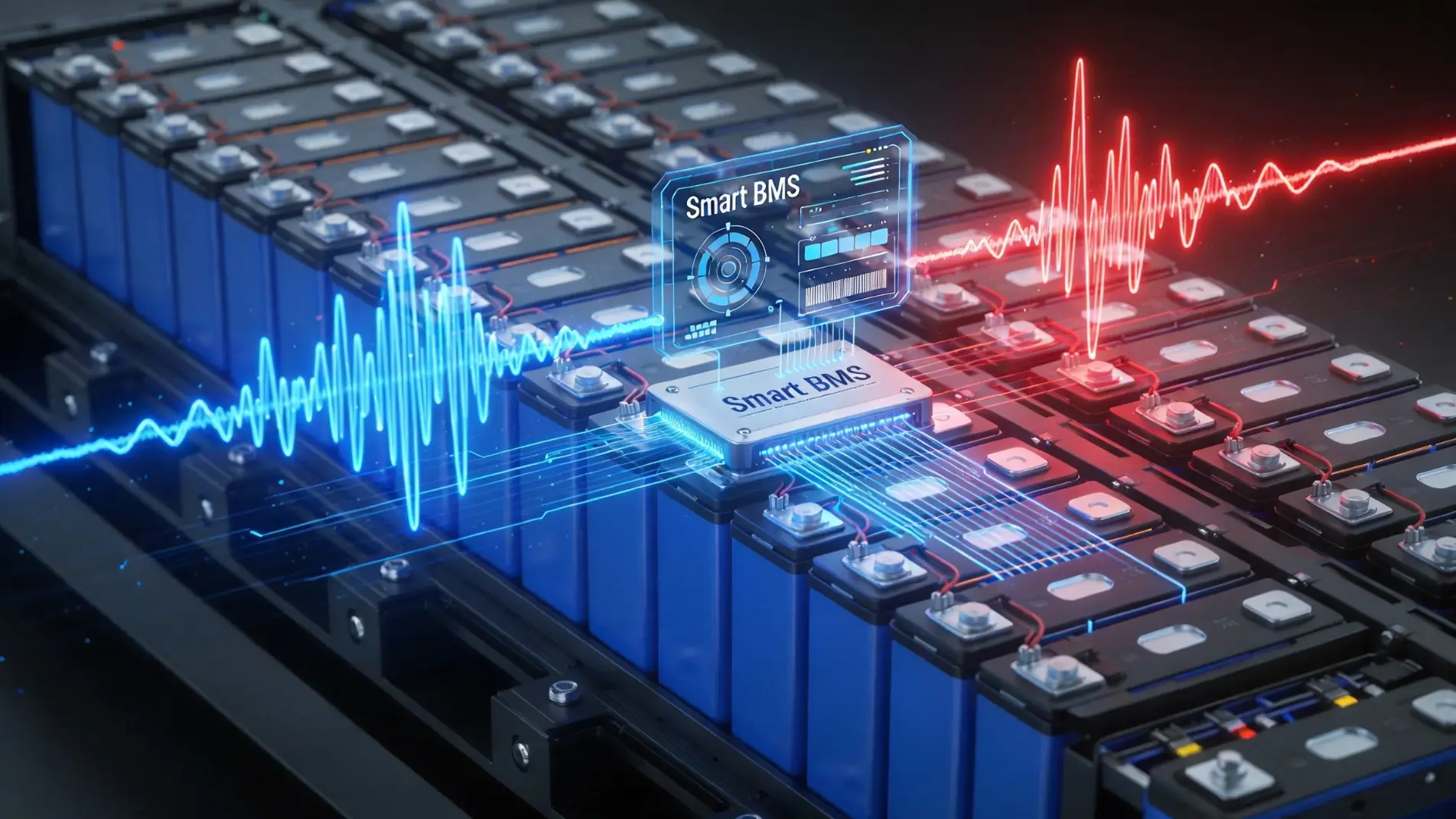
1.4 Continuous Heavy Operation Increases Battery Temperature
High lifting frequency and multi-shift warehouse operations generate heat inside battery cells, MOSFETs, busbars, connectors, and cables.
An industrial smart BMS can monitor multiple temperature sensors placed around the battery pack and respond when limits are exceeded.
It does not cool the battery directly but provides data and protection logic for thermal management.
1.5 Cold Warehouses Reduce Battery Performance
Cold storage environments reduce lithium battery discharge capability and charging efficiency.
A smart BMS can restrict charging current at low temperatures, support heating systems, and adjust SOC estimation algorithms.
These functions help protect battery life in low-temperature operations.
1.6 Cell Imbalance Reduces Available Capacity
Large battery packs contain many series-connected cells. Over time, small differences between cells increase.
A smart BMS performs passive balancing and records SOH, cycle count, voltage, temperature history, and fault events.
This helps maintenance teams detect aging batteries early and plan replacements.
2. Common Turret Truck Battery Voltages and Specifications
Battery voltage depends on truck design, lifting height, and duty cycle rather than the battery supplier alone.
Lithium batteries are increasingly replacing lead-acid systems due to better efficiency and opportunity charging.
| 電圧 | Lead-acid | LiFePO₄ | NMC | アプリケーション |
|---|---|---|---|---|
| 36V | 18 × 2V | 11S / 12S | 10秒 | Light-duty turret trucks |
| 48V | 24 × 2V | 15S / 16S | 13S | Mainstream VNA trucks |
| 72V | 36 × 2V | 23S / 24S | 20S | High-performance models |
| 80V | 40 × 2V | 25S / 26S | 22S | Heavy-duty turret trucks |
| 96V | 48 × 2V | 30S / 32S | 26S | Special industrial platforms |
3. Choosing the Best Smart BMS for Turret Truck Applications
Selecting a smart BMS is not only about voltage compatibility but also real operational performance under warehouse conditions.
- Stable SOC and SOH estimation under dynamic load
- Fast response to voltage sag and peak current
- Multi-sensor thermal protection
- Flexible communication with forklift controllers
- Compatibility with LiFePO₄ and NMC systems
Industrial solutions like the AYAA ES-001 platform are designed for forklift and logistics applications.
In 48V–80V systems, it helps stabilize SOC calculation, reduce false shutdowns, and improve thermal monitoring.

4. Conclusion
For most turret truck applications, the ES-001 Smart BMS is a reliable and widely applicable choice.
If your application requires a more customized power solution, you can contact our battery engineering team for a free consultation and system evaluation.
よくある質問
What kind of battery does a turret truck use?
Most turret trucks use lead-acid batteries, but lithium systems (especially LiFePO₄) are increasingly common due to faster charging and lower maintenance.
What is the voltage of a turret truck?
Common systems are 48V and 80V, with some models using 36V or 72V configurations.
What happens if you don’t water a lead-acid battery?
Low electrolyte levels cause sulfation and capacity loss. Lithium batteries do not require watering but still need proper BMS protection.
認定OEM/ODMメーカー
あなたが望む力、,
あなたに必要な誠実さ。.
カスタムリチウム電池BMS
エネルギー貯蔵、電気自動車、ロボット、ドローン向けの高性能スマートBMSソリューション。.
✔ 高効率&アクティブバランシング
✔ スマートな監視と保護
✔ グローバル認証
✔ あらゆる用途に合わせてカスタマイズ可能
1500+
クライアント
3万以上
月間ユニット数
20+
経験年数.
お客様に最適なBMSソリューションをご提供いたします。
⚡ エンジニアが12時間以内に対応します
✔ 無料のBMS設計コンサルティング
✔ 迅速な対応と競争力のある価格設定
✔ 迅速な対応と競争力のある価格設定
🔒 お客様の情報は安全かつ機密に保たれます
最新ニュース
- Why FPV Battery for World Cup-Level Outdoor Filming Still Needs Custom Smart BMS
- Final Guide for Order Picker Battery & Smart BMS Upgrade
- Smart BMS for Automated Forklift Batteries: Solving 6 Key Challenges
- How to Choose a Smart BMS for a Turret Truck Battery: Challenges & Solutions
- Smart BMS for Stacker Battery: How to Improve Runtime, Charging, and Safety
共有
ニュースおすすめ
-

BMS接続図の理解:MOSFET制御からセルバランシングまで
08/19/2025 -
リチウム鉄リン酸 BMS ブランド トップ 5 比較: あなたに最適なのはどれ?
05/16/2025 -
スマートBMSの仕組み-総合ガイド。
03/11/2025 -
なぜ従来の電力源ではなく太陽エネルギー・システムを選ぶのか?
03/31/2025 -