






Most electric forklifts run on one of two options. These are lead-acid or lithium-ion. Choosing the right forklift battery affects daily uptime, charging routines, and operating costs. Lead-acid costs less up front. Lithium costs more initially, but it demands less daily maintenance.
Before you compare chemistries, check your truck nameplate. Inspect the label on your current battery as well. Voltage, capacity, physical size, weight, and connectors must all match. Once the specs fit, the choice depends on your shifts, charging setup, and site limits.
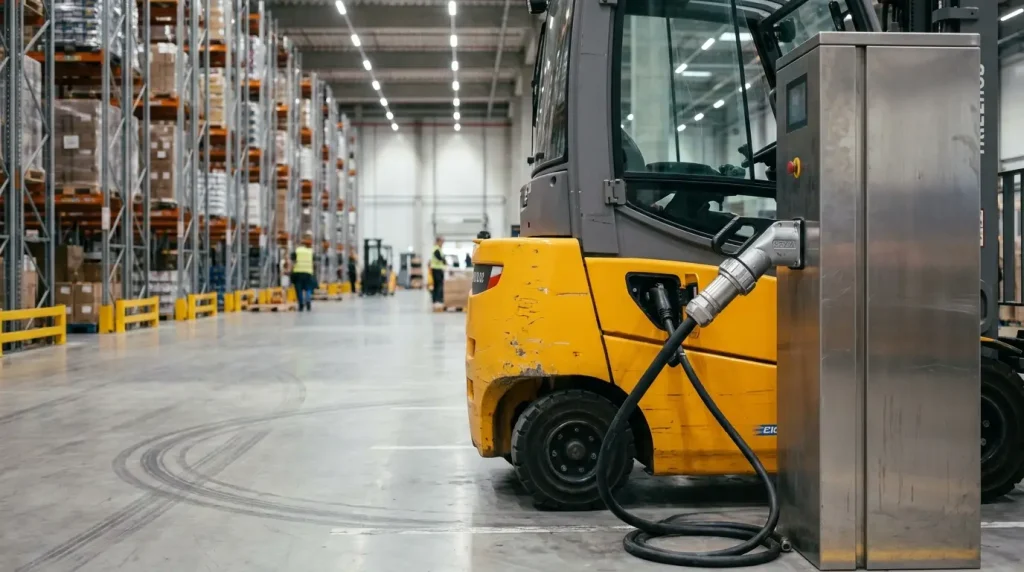
What Types of Batteries Are Used in Forklifts?
Lead-acid has powered electric forklifts for decades. Many fleets still rely on it today. The battery is a heavy steel tray of lead plates in liquid electrolyte.
That massive weight is actually useful. The truck relies on it as a counterweight. Lead-acid is also familiar to most technicians. Replacement packs are widely available.
Lithium-ion is the modern alternative. Most lithium packs use lithium iron phosphate (LiFePO4) chemistry. Every lithium pack requires a battery management system (BMS). The BMS monitors individual cells and keeps them safe.
The real differences show up in daily operations. How you charge, maintain, and budget over time will decide the winner. The table below compares the two options side by side.
| 特徴 | Lead-Acid Forklift Battery | Lithium-Ion Forklift Battery |
|---|---|---|
| Upfront cost | Lower | Higher |
| Charging | Full charge followed by a cool-down period | Supports short opportunity charges |
| Daily upkeep | Regular watering, cleaning, and equalizing | Minimal routine upkeep, but not zero |
| Multi-shift use | Often requires spare packs and battery swaps | Often runs multiple shifts without swaps |
| Charging space | Requires ventilated charging rooms | Flexible needs, defined by manufacturer |
| 重さ | Heavy; acts as truck counterweight | Lighter; may require added ballast |
| 互換性 | Matches most older trucks and chargers | Requires checks for truck, charger, and BMS |
Read this table as a set of operational trade-offs. Lead-acid sacrifices daily convenience. Your team must water it, follow rigid charge cycles, and handle swaps. Lithium sacrifices low entry cost. You pay more up front and must verify truck and charger compatibility.
When should you skip each option? Do not buy lithium if your truck runs one light shift. If your lead-acid pack is paid for and working, keep it. You may wait years to see a return on investment.
Conversely, avoid lead-acid for multi-shift facilities. Buying spare packs and paying for labor-intensive swaps adds up fast. In high-throughput sites, lead-acid maintenance costs become too high.

[Engineering Note]
Lithium is never completely “maintenance-free.” Terminals still require inspection. Chargers wear out over time. Always verify that your BMS matches your pack design certified to standards like UL 2580, and follow manufacturer storage guidelines.
How to Select the Right Forklift Battery Voltage and Capacity
Voltage and capacity measure two different things. Confusing them is a frequent, costly mistake.
Voltage reflects the electrical requirements of the forklift drive system. Capacity, measured in amp-hours (Ah), indicates total stored energy. A pack with correct voltage can still fail if capacity or dimensions do not fit.
Common forklift battery voltages include 24V, 36V, 48V, and 80V. Never guess voltage based on truck size or class alone. The same forklift model line can support multiple voltages. Always check the truck nameplate and the original battery label.
Capacity offers more flexibility, but physical limits apply. Higher Ah ratings provide longer runtimes per charge. However, the battery must still fit the compartment. It must also satisfy the truck’s weight range.
Check these six specifications before placing an order:
- Rated voltage on the truck nameplate
- Capacity in Ah compared to your current pack
- Compartment length, width, and height
- Minimum and maximum allowable battery weight
- Cable connector type (such as DIN 43589-1 standards) and polarity
- Charger profile and power compatibility
Industrial lead-acid packs often feature alphanumeric model codes. These codes describe dimensions, plates, and capacity. However, coding systems vary by region and brand. Ask your local supplier to decode their specific part numbers.
[Engineering Note]
Never match a forklift battery by voltage alone. A battery that is too light compromises truck stability and lifting capacity. An improper connector or charger can destroy electronics. Always match the complete OEM specification.
How Should You Choose a Forklift Battery for Your Operation?
Start with how your truck actually works each day. Do not start with chemistry preferences. Four key operational questions will guide your choice.
1. How Many Shifts Do You Run?
On a single shift, lead-acid works well. It charges overnight and cools down by morning.
Across two or three shifts, trucks rarely sit idle. You must either swap heavy packs or use opportunity charging. Lithium handles fast top-up charges during breaks without damage.
2. Who Handles Battery Upkeep?
Lead-acid demands disciplined watering and regular terminal cleaning. If your technicians follow a strict schedule, lead-acid functions reliably.
If maintenance is inconsistent, battery life drops quickly. Under-watering causes plate damage and premature failure. That hidden replacement cost adds up fast.
3. What Is Your Work Environment?
Cold storage environments introduce unique battery challenges. Freezing temperatures reduce available capacity. They also alter safe charging parameters.
Performance varies significantly by chemistry and manufacturer. Always request cold-temperature discharge and charging data before buying.
4. What Is Your Total Cost of Ownership?
Lead-acid offers a lower purchase price today. However, total cost includes spare packs, ventilation rooms, water systems, and swap labor.
Lithium carries higher initial equipment costs. Yet it can lower operating expenses over five to ten years. Calculate your internal labor and energy numbers, along with evolving battery lifecycle regulations like EU 2023/1542, before deciding.
In summary, lead-acid fits predictable, single-shift work with dedicated maintenance teams. Lithium pays off in high-hour, multi-shift fleets where battery swaps hurt productivity.
Once you decide on lithium, the cells are only part of the solution. The internal BMS determines system reliability and safety.
What Does a BMS Do in a Lithium Forklift Battery?
Lead-acid chemistry tolerates minor overcharging and voltage drift. Lithium cells do not. The BMS keeps each cell operating within safe thresholds.
A BMS continuously tracks cell voltage, current, and temperature. It disconnects the pack if operating limits are breached. Advanced units balance cells, estimate State of Charge (SOC), and communicate with the truck via CAN bus using industrial profiles like CiA 413.
Feature sets vary widely across BMS suppliers. At AYAA TECH, we engineer Smart BMS and custom battery packs. Our algorithms calculate SOC across diverse ambient temperatures with under 5% error.
Accurate fuel gauges prevent costly warehouse disruptions. Operators avoid premature charging or sudden power loss in active aisles.
Your chosen battery layout dictates BMS engineering requirements. The table below links pack parameters to BMS specifications.

| Battery Parameter | Technical Requirement for the BMS |
|---|---|
| Series cell count and pack voltage | Dictates channel count and voltage sensing range |
| 連続放電電流 | Sets thermal design and power MOSFET/contactor sizing |
| Peak current and pulse duration | Determines overcurrent trip delays and surge handling |
| Cell chemistry (e.g., LiFePO4) | Sets overvoltage, undervoltage, and safety thresholds |
| Operating temperature range | Sets low-temp charge cutoff and high-temp limits |
| Charger communication protocol | Dictates CAN bus or RS485 communication logic |
For example, a 48V LiFePO4 pack typically uses 16 cells in series. A 48V lead-acid battery uses 24 cells.
This difference changes the charging profile and voltage windows. That is why lithium retrofits require dedicated engineering. Chargers, software parameters, and harness pinouts must all align.
[Engineering Note]
A BMS is an essential safety barrier, but not the only one. Cell quality, pack structural design, and charger matching are equally critical. Never rely on the BMS alone to compensate for improper pack construction.
Ready to Compare Smart BMS Options?
Explore Product CatalogWhat Should You Check Before Replacing a Forklift Battery?
Most expensive replacement errors happen during ordering. Many buyers treat batteries like simple off-the-shelf commodities. Review this checklist before issuing a purchase order.
- Verify nominal voltage: Match the truck nameplate rating exactly.
- Measure compartment dimensions: Confirm physical width, length, and height clearances.
- Confirm weight constraints: Check minimum and maximum counterweight specs.
- Inspect connectors: Match connector color, amp rating, and cable lead lengths.
- Review charger specs: Ensure your charger profile supports the battery chemistry.
- Confirm OEM truck approval: Verify that lithium retrofits are approved for your truck model.
Weight requires special attention during conversions. Lead-acid batteries provide essential ballast for fork counterweight. Lithium packs are substantially lighter.
Installing an underweight battery reduces lifting safety and truck stability under safety standards like ANSI/ITSDF B56.1. Many retrofits require certified steel ballast plates to meet minimum weight limits.
Review regional safety standards for your facility. In the United States, OSHA 1910.178 regulates industrial truck battery charging and changing zones.
If you design a custom lithium pack, specify the BMS early. Match the BMS to your cell count and peak currents from day one.
Need a BMS Built Around Your Pack?
Talk to Our Engineers About a Custom BMSよくある質問
What types of batteries are used in forklifts?
Electric forklifts rely primarily on lead-acid or lithium-ion batteries. Lead-acid offers lower initial cost with higher maintenance needs. Lithium offers faster charging and lower maintenance, but requires an integrated BMS.
What voltage does a forklift battery use?
Common nominal voltages are 24V, 36V, 48V, and 80V. Voltages vary across walkie pallet jacks, reach trucks, and sit-down counterbalance forklifts. Always verify the voltage listed on your truck nameplate.
How long does a forklift battery last?
Service life depends on chemistry, daily operating temperatures, depth of discharge, and maintenance habits. Lead-acid typically provides 1,000 to 1,500 cycles with proper watering. Quality lithium packs often deliver 3,000 or more cycles.
How much does a forklift battery cost?
Pricing depends on voltage, Ah capacity, chemistry, and charger requirements. Lead-acid costs less at initial purchase. However, lithium can deliver lower long-term operating costs across demanding, multi-shift applications.
How do you choose a 48V forklift battery?
First, confirm your truck requires 48V on its data plate. Measure the compartment dimensions and confirm the minimum counterweight requirements. Then choose between lead-acid or lithium based on shift hours and available maintenance staff.
Can you jump-start an electric forklift battery?
No, never attempt to jump-start an industrial electric forklift. Forklifts lack automotive 12V starter circuits; the traction battery powers the entire truck. Deeply discharged lead-acid packs require dedicated shop chargers. Locked-out lithium packs require specific BMS wake-up protocols.