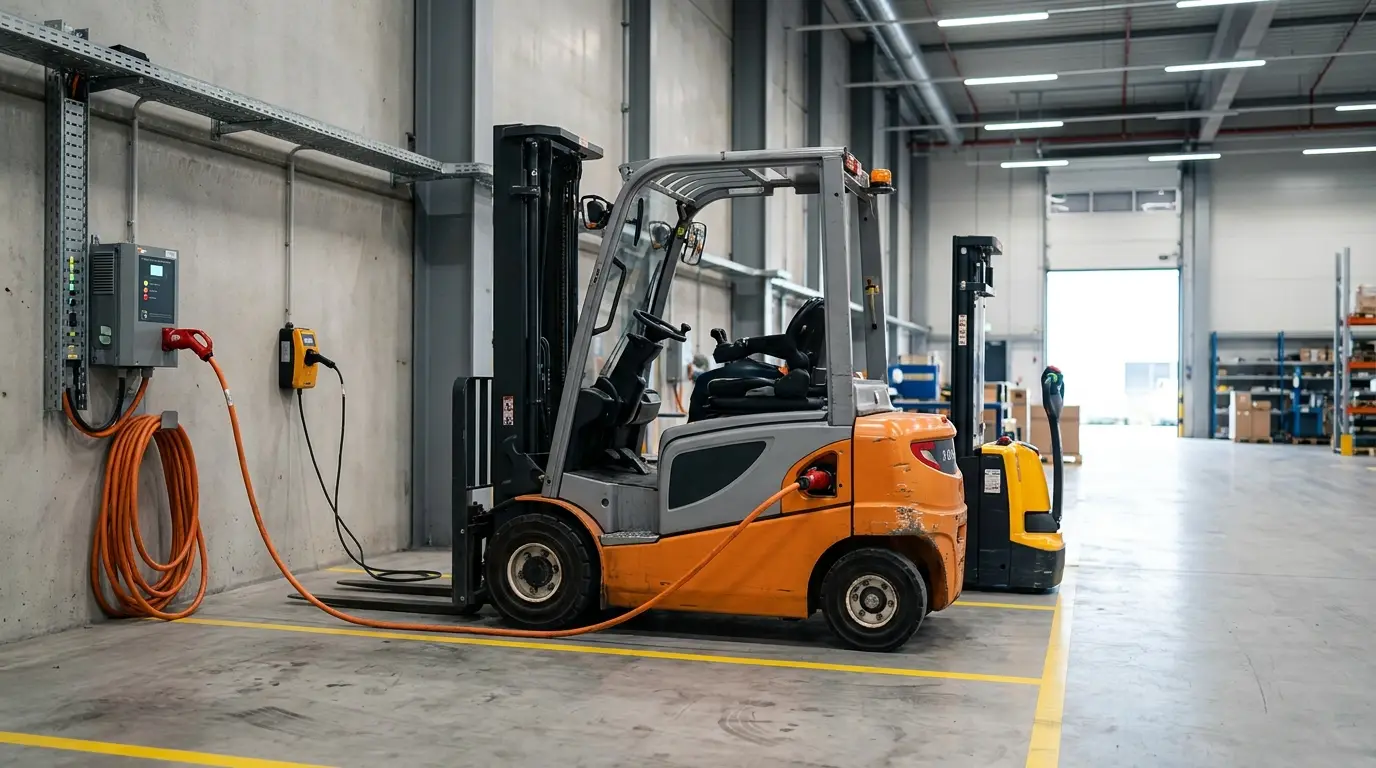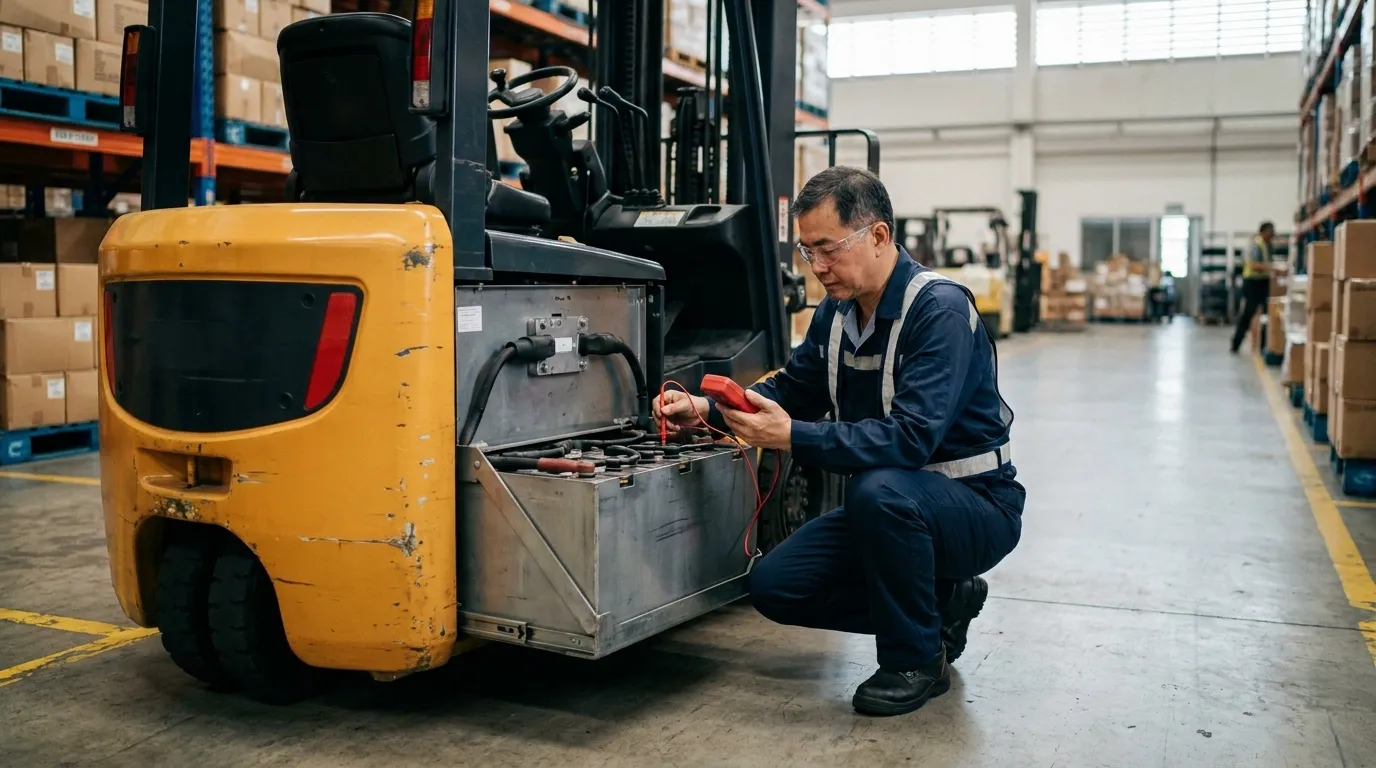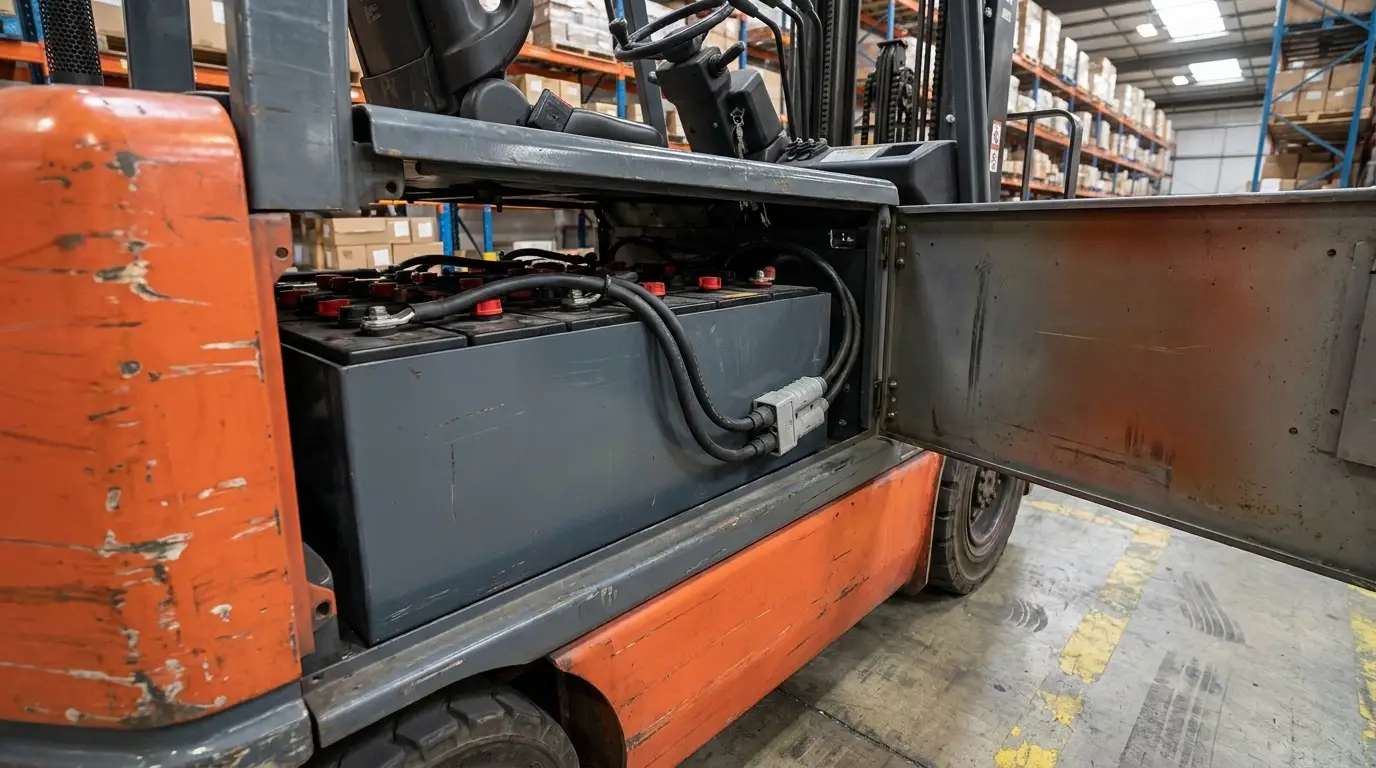

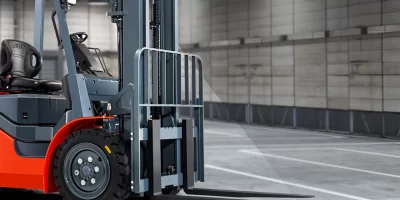





Choose a cold storage forklift battery by matching operating temperatures, validated charging limits, and integrated heating to your shifts. A reliable pack must deliver consistent power during heavy lifts and charge safely without causing lithium plating.
Success requires the battery, BMS, heater, and charger to operate as one unified system. Always verify usable capacity at your lowest freezer temperatures before selecting a pack.

How Does Cold Storage Affect Forklift Battery Performance?
Why Low Temperatures Reduce Battery Performance
Cold slows down internal chemical reactions. Ions move sluggishly, and internal cell resistance climbs rapidly. As a result, the pack drops voltage whenever the truck accelerates or lifts.
Operators quickly notice reduced runtime and weaker lift capability. Heavy lifts suffer most because high current meets high internal resistance. Exact losses vary by cell chemistry, pack geometry, and workload.
Why Charging Below Freezing Requires Special Attention
Charging and discharging carry very different risks in the cold. Lithium cells often discharge safely where charging would destroy them.
Charging below freezing prevents lithium ions from diffusing smoothly into graphite anodes. Instead, metallic lithium forms on the anode surface. This dangerous process is known as リチウムめっき.
Plating permanently destroys capacity and creates severe short-circuit risks. Worse, a battery may look normal while this damage silently builds. Safe charging limits must always come from validated cell specifications.
[Engineering Note]
A low-temperature discharge rating does not allow cold charging. Always check the charging limit as an independent specification.
How Warehouse Conditions Influence Battery Selection
Always record your true operating parameters first. Note your lowest freezer setpoint and total hours spent inside per shift.
Count how often forklifts transit between cold rooms and warm docks. Frequent doorway shuttling creates heavy condensation stress. By comparison, steady operation deep inside a freezer presents sustained thermal soak.
What Should You Look for in a Cold Storage Forklift Battery?
Check the Charging and Discharging Temperature Ranges
Always request three distinct temperature ratings: discharging, charging, and storage. A generic “operating temperature” claim hides vital limitations.
Suppliers often quote low discharge ratings while charging still demands pack warming. Confirm whether stated numbers refer to ambient air or internal cell cores. Furthermore, verify the test currents used for those ratings. Finally, compare these thresholds with your actual charging dock conditions.
Evaluate Usable Capacity and Power Under Load
Nominal capacity is rated at warm room temperature. What counts is usable energy at your actual operating temperatures.
Ask for temperature-specific discharge curves under heavy loads. Pay close attention to voltage sag during maximum acceleration or high-rack lifting. If voltage drops below the truck cutoff, the forklift shuts down prematurely.
Choose a Battery Chemistry and Design for the Application
Neither lead-acid nor lithium wins in every facility. Lead-acid costs less initially and accepts cold charging better at reduced currents. However, it requires acid watering, lengthy charges, and risks freezing if discharged.
Lithium-ion—especially LiFePO4—enables fast opportunity charging and needs zero maintenance. Yet, lithium demands strict thermal management and integrated heaters. If trucks charge in unheated cold rooms, choose lithium packs with validated heating.
Confirm Compatibility with the Forklift and Charging System

Chemistry and amp-hours do not guarantee truck compatibility. Check the physical dimensions, tray weight, mounting bracket, and connector type.
Verify that your charger profile matches the battery chemistry perfectly. Where CAN communication is required, the charger and BMS must talk seamlessly. Always match the entire pack to your shift schedules.
Need a BMS or battery pack for your forklift?
Explore Product CatalogHow Does a BMS Protect a Cold Storage Forklift Battery?
Monitor Cell Temperature and Electrical Conditions
The BMS continuously monitors cell voltages, system currents, and temperatures. Every safety decision depends directly on these sensor inputs.
Sensor placement is critical inside cold storage packs. Ambient air tells you very little about inner cell core temperatures. Heavy packs cool down and warm up slowly from the inside out. Ensure the BMS uses the coldest sensor reading before authorizing charge current.
Prevent Charging Outside the Permitted Temperature Range
Temperature interlocks are the most crucial BMS defense in freezers. If cells are too cold, the BMS immediately locks out charging.
It disconnects the charge path or commands the charger to pause. Once heating elements bring cells to a safe temperature, charging resumes. Premium BMS units also taper current gradually near lower boundaries. Never rely on hard contactor cutoffs for daily charging routines.
Manage Cell Balancing, Fault Protection, and Battery Data
The BMS provides cell balancing, short-circuit protection, and low-voltage cutoffs. Detailed fault logs help technicians troubleshoot cold-induced truck stalls.
Standard state-of-charge (SOC) algorithms drift significantly in freezing environments. AYAA TECH integrates temperature-compensated SOC tracking with error margins under 5%. Dependable SOC readings prevent unexpected truck shutdowns inside freezers.
Is Battery Self-Heating Necessary for Cold Storage Forklifts?
How Battery Heating Systems Work

A BMS controls heating logic, but it requires dedicated thermal hardware. Systems use silicone heating pads, PTC elements, or internal warming films.
The BMS detects low cell temperatures and activates the heaters. It permits charging only after all cells reach a safe threshold. AYAA TECH distributes MOSFETs and sense resistors evenly across the board. We pair them with thermal pads and aluminum heat spreaders to manage heating loads.
Compare Charger-Powered and Battery-Powered Heating
Charger-powered systems warm the pack using mains electricity after plugging in. This saves internal battery energy for pure lift operations. However, it requires compatible charging stations and warms only while connected.
Battery-powered heating draws power directly from the pack itself. It can preheat cells anywhere before a shift starts. However, internal heating drains runtime and demands sufficient remaining battery charge.
Evaluate Heating Time and Operational Impact
Preheat durations depend heavily on starting temperature, heater wattage, and thermal insulation. No manufacturer can promise warm-up speeds without knowing pack mass.
Request verified warm-up test data with clear starting temperatures. Calculate how heating delays affect truck turnaround times between shifts. Ensure your opportunity-charging windows still fit your daily schedule.
How Can You Prevent Cold Storage Battery Problems?
Reduce Condensation and Moisture-Related Risks
Driving from a cold room onto a warm dock causes instant condensation. Moisture collects rapidly on cold terminals, wire harnesses, and BMS enclosures.
Over time, trapped moisture causes electrical leakage and terminal corrosion. Insist on sealed enclosures, conformally coated electronics, and waterproof connectors.
[Engineering Note]
IP ratings only evaluate liquid ingress, not freeze-thaw condensation cycles. Require thermal-shock test data and inspect cable boots regularly.
Check Low-Temperature Cable and Connector Performance
Severe cold stiffens standard PVC cable jackets, causing them to crack during bending. Inspect flexible cables, rubber terminal boots, and high-current connectors regularly. Ensure all wiring harnesses carry low-temperature arctic ratings.
Establish a Practical Charging and Maintenance Routine
Follow the manufacturer’s specified charge temperature windows strictly. Review BMS event logs regularly to catch intermittent low-temperature cutoffs early. Never bypass BMS heating interlocks to speed up delayed shifts.
How Do You Evaluate a Cold Storage Forklift Battery Supplier?
Request Temperature-Specific Test Data
Marketing claims about minimum operating temperatures are meaningless without test data. Ask for discharge curves measured under realistic freezer temperatures.
Verify the test current, load profile, and starting state of charge. Ensure the test pack was fully cold-soaked before testing began. Steady room-temperature bench tests cannot simulate harsh freezer duty cycles.
Verify Safety, Environmental Protection, and System Compatibility
Review essential industry safety certifications:
- IEC 62619:2022 establishes industrial lithium battery safety standards.
- IEC 62485-6:2021 specifies traction battery safety requirements for industrial vehicles.
- UL 2580 covers electrical vehicle battery system safety and thermal failure containment.
These standards confirm structural safety, but not cold performance. Always request test reports verifying thermal insulation and moisture resistance.
Compare Total Cost of Ownership, Not Just Purchase Price
Purchase price represents only a fraction of total lifecycle costs. Factor in heating electricity, dedicated charging stations, and scheduled battery maintenance.
Account for operator downtime caused by pack preheating delays. A reputable supplier builds financial payback models based on your actual shift patterns.
Use a Supplier Evaluation Checklist
Review these technical checkpoints before placing your next battery order:
- Independent temperature ratings for discharge, charge, and storage
- Usable capacity and voltage sag curves at sub-zero temperatures
- Heater design, preheat duration, and power consumption
- BMS temperature interlocks and low-temperature protection logs
- Complete electrical compatibility with your forklift and charger
- Environmental validation for severe condensation and thermal shock
- Model-specific safety certificates (IEC 62619 / IEC 62485-6 / UL 2580)
- Warranty terms covering cold-storage commercial operations
Cold-room integration problems?
Request a Custom Battery Solution結論
The best cold storage forklift battery matches your actual warehouse temperatures, charging setups, and shift rhythms. Never rely on a single datasheet minimum temperature claim.
Demand verified low-temperature test data, robust internal heating, and intelligent BMS charge protection. A properly engineered thermal system keeps your forklift fleet running smoothly through every cold-chain shift.
よくある質問
Can a Lithium Forklift Battery Work at -20°C or -30°C?
Yes, but performance depends on the specific battery design. Packs often discharge easily at -20°C or -30°C. However, they almost always require preheating before charging. Always verify separate discharge and charge temperature specifications.
Can You Charge a LiFePO4 Forklift Battery Below 0°C?
Never charge standard LiFePO4 cells below 0°C without active heating. Sub-zero charging causes permanent lithium plating on the anode. The BMS must lock out charging until internal heaters warm the cells safely.
Does a Cold Storage Forklift Battery Always Need Self-Heating?
Not always. Self-heating is unnecessary if trucks charge inside warm rooms and pack temperatures stay above freezing. However, continuous freezer shifts and cold-dock charging require integrated heating systems.
What Does a BMS Do in a Cold Storage Forklift Battery?
The BMS monitors cell voltages, current levels, and internal temperatures. It blocks charging when cells are freezing and activates heating circuits. It also balances cells, provides fault protection, and logs temperature events.
How Long Does It Take to Warm Up a Cold Storage Forklift Battery?
Preheat times vary widely based on ambient cold, pack mass, and heater power. Most insulated packs warm up within 30 to 90 minutes. Always ask suppliers for verified warm-up curves under your specific freezer conditions.
Does an IP67 Rating Make a Forklift Battery Suitable for Freezer Environments?
No. An IP67 rating tests only against liquid immersion and dust ingress. It does not certify protection against recurring freeze-thaw condensation. Freezer batteries need specialized insulation, sealed terminals, and anti-condensation designs.
How Much Does a Cold Storage Forklift Battery Cost?
Pricing depends on pack voltage, capacity, internal heating options, and BMS customization. Cold-storage packs cost more than standard ambient batteries due to thermal engineering. Always evaluate total cost of ownership across your fleet’s lifespan.