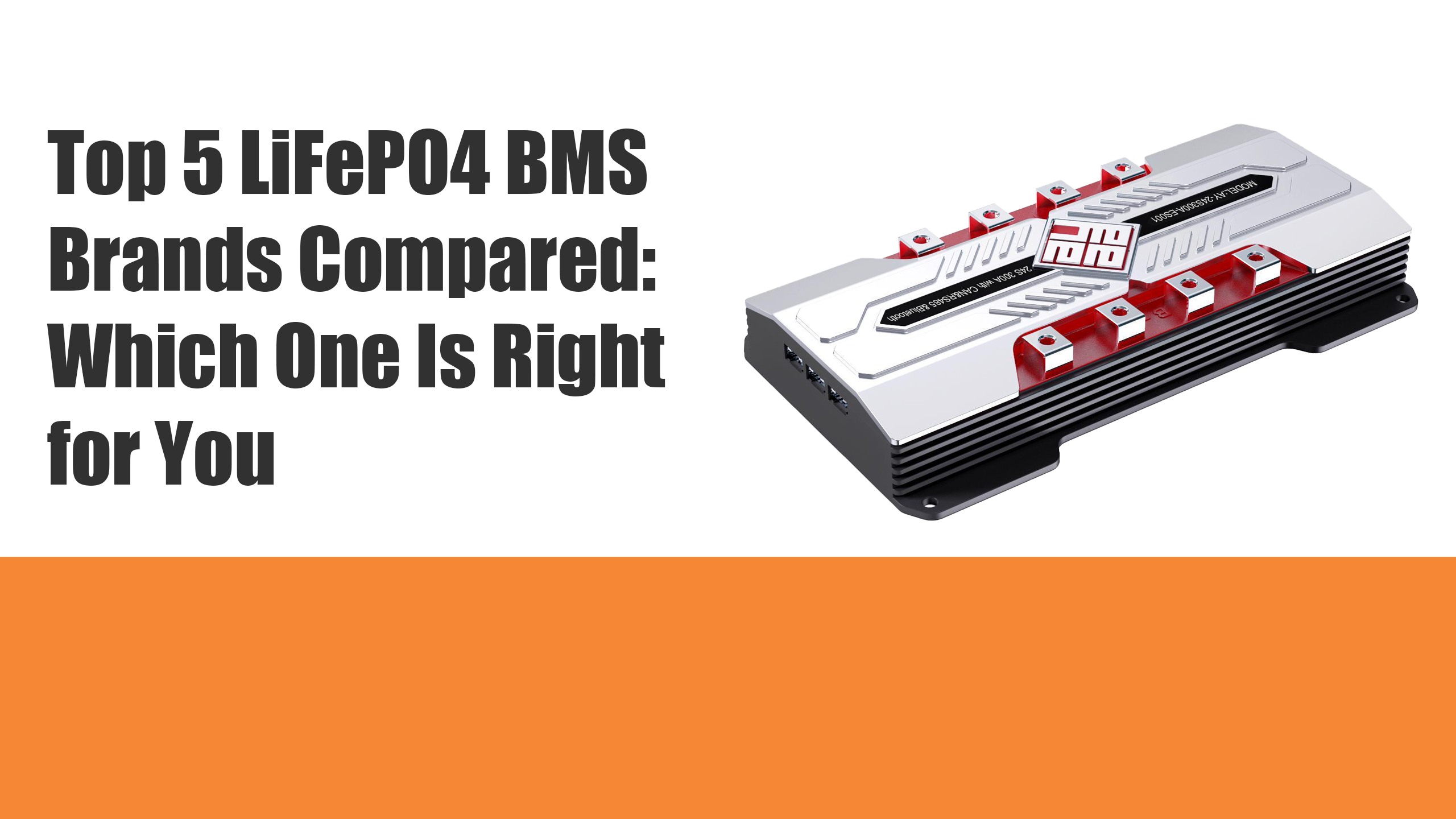
Custom BMS vs Standard BMS: Why Custom BMS Is the Smarter Choice for Advanced Battery Systems
804
Custom BMS vs Standard BMS: Why Custom BMS Is the Smarter Choice for Advanced Battery Systems
Lithium battery technologies are driving everything from véhicules électriques and robotics to industrial automation and stockage d'énergie in today’s quickly changing energy landscape.
Le système de gestion de la batterie (BMS) is the central component of every dependable battery pack.
But not every BMS solution is made equally.
Custom BMS systems are superior to standard, off-the-shelf options when performance, safety, scalability, and long-term ROI are crucial considerations.
Advanced battery systems require precise engineering, adjustable architecture, and intelligent monitoring capabilities that can only be provided by a custom BMS, whilst ordinary BMS devices are used for general applications.
What Is the Difference Between Standard BMS and Custom BMS?
What Is a Standard BMS?
A pre-made battery management board (BMS) for general-purpose uses is called a standard BMS.
Usually, it offers predetermined protective parameters, restricted cell layouts, and fixed voltage ranges.
Advantages:
Lower upfront cost
Fast deployment
Suitable for low-to-moderate power systems
Limitations:
Limited scalability
Restricted communication protocols
Fixed firmware settings
Minimal customization for unique battery chemistry or layout
Standard BMS systems are suitable for small battery packs or consumer devices, but they are not flexible enough for high-performance industrial settings.
What Is a Custom BMS?
A custom BMS is designed with the intended battery pack and application in mind.
Every characteristic is adjusted to match voltage range, capacity, discharge rate, thermal profile, and communication needs, from cell configuration to firmware logic.
Advantages:
Tailored voltage and current limits
Expanded series/parallel configuration options
Advanced data monitoring
Optimized balancing strategy
Long-term system scalability
Potential Consideration:
Higher development cost initially
However, the lifecycle savings, enhanced safety, and performance optimization make Custom BMS a far more strategic solution for advanced battery systems.
How Does Custom BMS Adapt to Different Cell Configurations?
One of the most critical strengths of a Custom BMS lies in its cell configuration flexibility.
How Do Different Applications Require Unique Battery Formats?
Battery systems vary significantly depending on industry requirements:
Energy storage systems require high-capacity arrays.
Electric mobility applications demand compact high-density packs.
A properly designed Custom BMS can support multiple lithium cell types, including:
Large Prismatic Cells
Ideal for energy storage and heavy-duty systems due to their high capacity and stable structure.
Small Cylindrical Cells
Common in modular systems where flexible pack design is required.
Large Cylindrical Cells
Used for high-discharge industrial applications.
Pouch Cells
Lightweight and adaptable, often used in compact or weight-sensitive systems.
What Is the Maximum Series Capability of Custom BMS?
Unlike standard BMS boards with limited scalability, Custom BMS solutions can be engineered to support high series counts depending on application requirements.
Advanced systems can handle:
Medium-voltage configurations
High-voltage battery arrays
Modular stackable systems
This scalability ensures that battery systems can grow without redesigning the entire management architecture.
What Core Functions Does Custom BMS Provide?
The true value of Custom BMS lies in its intelligent functionality.
How Does Cell Balancing Improve Battery Longevity?
Cell imbalance is one of the primary causes of premature battery degradation.
A Custom BMS integrates precise balancing algorithms that:
Equalize voltage across cells
Prevent weak-cell bottlenecks
Maximize usable capacity
Extend overall battery lifespan
Both passive and active balancing strategies can be tailored depending on application requirements.
How Does Custom BMS Control Charging?
Charging mismanagement leads to overheating and chemical stress.
A Custom BMS:
Regulates charge current
Controls voltage thresholds
Monitors temperature during charging
Adjusts parameters dynamically
This intelligent control significantly enhances battery safety and operational reliability.
Why Are SOH and SOC Readings Critical?
État de santé (ES)
A Custom BMS continuously evaluates battery degradation levels, allowing predictive maintenance and replacement planning.
État de charge (SOC)
Accurate SOC readings enable:
Reliable runtime prediction
Efficient energy planning
Reduced risk of over-discharge
Advanced algorithms within Custom BMS improve SOC accuracy under dynamic load conditions.
What Protection Mechanisms Are Integrated?
Safety is non-negotiable in advanced battery systems.
A Custom BMS includes protection against:
Overcharge
Over-discharge
Overcurrent
Short circuit
Overtemperature
Undervoltage
These protections are programmable and optimized for the exact chemistry and operational profile of the battery pack.
What Data and Documentation Come with Custom BMS?
Transparency and technical clarity are essential for system integration.
What Is Included in a Complete Data Package?
Un professionnel Custom BMS solution includes:
Full specification documentation
Firmware logic description
Electrical performance data
Communication protocol details
Why Are Gerber Files and Schematics Important?
Gerber files and circuit schematics allow customers to:
Understand PCB layout
Review trace routing and component placement
Validate safety design
Integrate with larger system architecture
Why Is the Bill of Materials (BOM) Essential?
A detailed BOM provides visibility into:
Component quality
IC selection
Protection device specifications
Thermal management components
This level of documentation ensures customers fully understand every element within their Custom BMS.
How Is Custom BMS Tested for Reliability?
Testing ensures real-world reliability under diverse conditions.
What Scenarios Are Simulated During Testing?
A comprehensive Custom BMS undergoes testing for:
Overcharge conditions
Deep discharge cycles
High-current stress
Thermal extremes
Short circuit events
What Are the Detailed Testing Steps?
Functional verification of voltage detection
Calibration of current sensing accuracy
Thermal sensor validation
Protection trigger threshold testing
Communication protocol verification
Long-duration cycling tests
Each step ensures the Custom BMS performs reliably in real-world industrial scenarios.
Why Custom BMS Is the Strategic Advantage for Advanced Battery Systems
Precision, scalability, and intelligent protection are necessary for advanced battery applications.
Standard BMS solutions could be adequate for entry-level applications, but they don’t have the long-term performance optimization and configurability required for systems with high demand.
A well-engineered Custom BMS offres :
Optimized cell configuration
Accurate SOC and SOH monitoring
Advanced balancing algorithms
Comprehensive protection mechanisms
Detailed technical documentation
Rigorous validation testing
Custom BMS is not just an option for companies looking for high dependability, longer battery life, increased safety, and scalable architecture—it is a strategic requirement.
Working with a skilled engineering supplier guarantees that your battery systems are effective, secure, and prepared for the future as battery technologies continue to advance in the industrial, mobility, and energy storage sectors.
Intelligent Custom BMS systems made for performance, accuracy, and long-term value are provided by Ayaa Technology for Système de gestion de bâtiments sophistiqué suited to demanding applications.
FAQ
Q1 : Qu'est-ce que la règle des 80/20 pour les batteries au lithium ?
A1:The 80/20 rule, which recommends keeping lithium batteries charged between 20% and 80% for daily use, is a recommended practice.
To lessen stress and increase battery life, deep discharges (near 0%) and prolonged full charges (100%) should be avoided as these extremes hasten degeneration.
This method protects the battery’s internal chemistry by keeping wear from being completely stretched (100%) or completely slack (0%), much like a rubber band loses its elasticity with prolonged use.
Q2:How much does a BMS system cost?
A2:Large commercial BMS systems can cost tens or even hundreds of thousands of dollars per square foot, depending on the building’s size, complexity, features, and level of integration, as well as ongoing software and maintenance costs.
In contrast, small DIY battery systems (like those for RVs or e-bikes) can be bought for less than $100.
Q3:Is it cheaper to build your own battery?
A3:In fact, building your own battery pack is sometimes significantly less expensive per kWh than buying parts that have already been constructed.
Because markups and assembly costs are eliminated, this can save hundreds or even thousands of dollars, especially for larger systems.
But these cost savings come with a lot of trade-offs: if you include time and tools, sturdy do-it-yourself builds can cost as much as less expensive pre-builts.
They also require specialized tools (heat guns, crimpers), a lot of time, technical skills, and the risk of failure or fire because there are no warranties or quality control.
Q4:Can a 10kW battery run a whole house?
A4:Yes, a 10kWh battery can power a whole house, but how long it lasts depends depend on how much energy your home needs.
It struggles to power high-demand devices like central air conditioning or EV chargers, but it often lasts a day or two, or longer with careful management and solar integration.
A 10kWh battery can power essential loads (such the router, lights, and refrigerator) for a day or more.
But intermittent usage of high-wattage appliances would soon drain it, requiring the use of solar panels for recharging or a larger battery for full off-grid operation.
Q5:Can a 400Ah battery power a house?
A5:A house can be powered by a 400Ah battery, but how long it lasts will depend on the system voltage (12V, 24V, or 48V), the amount of energy your home needs (kW), and the number of items you use.
Large appliances like air conditioners and heaters require careful energy management and often require numerous batteries or solar power to function continuously.
But they are perfect for off-grid living or important backups.