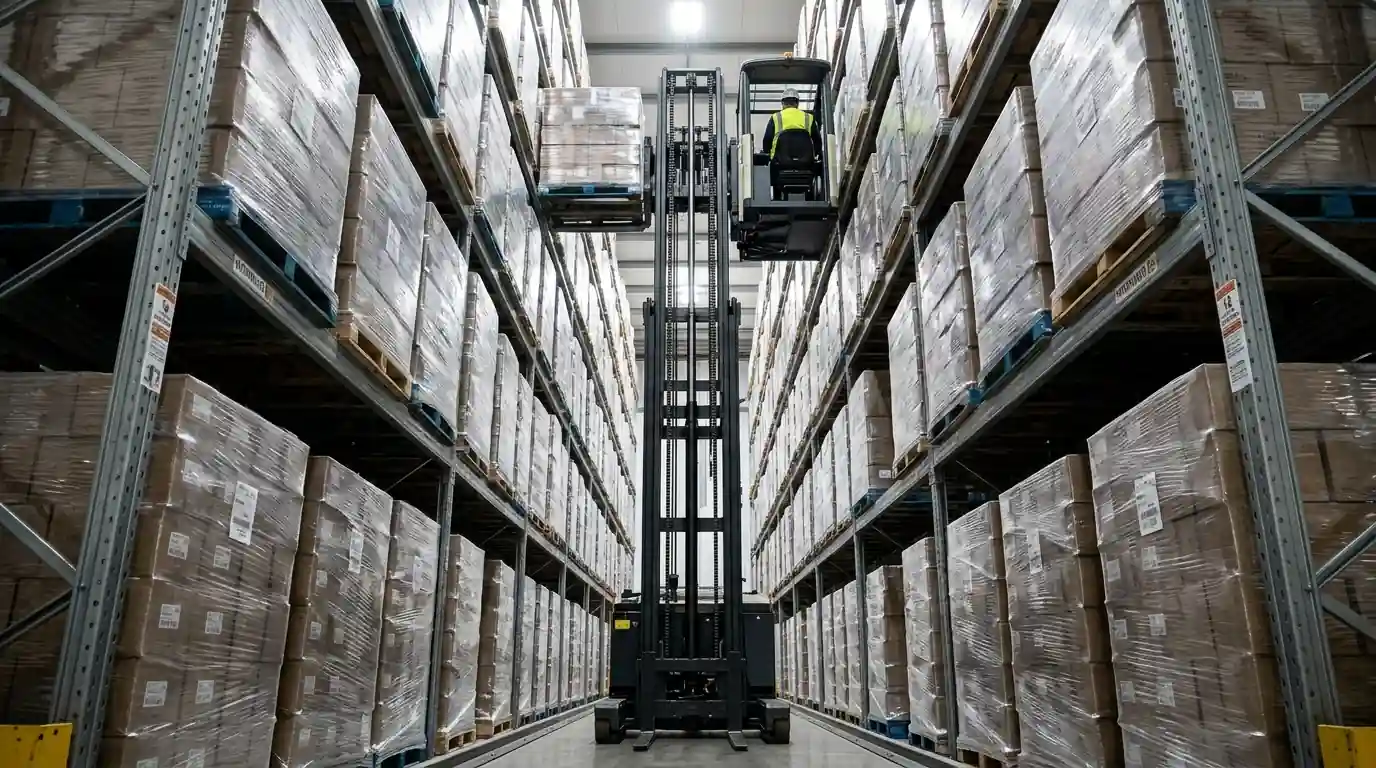







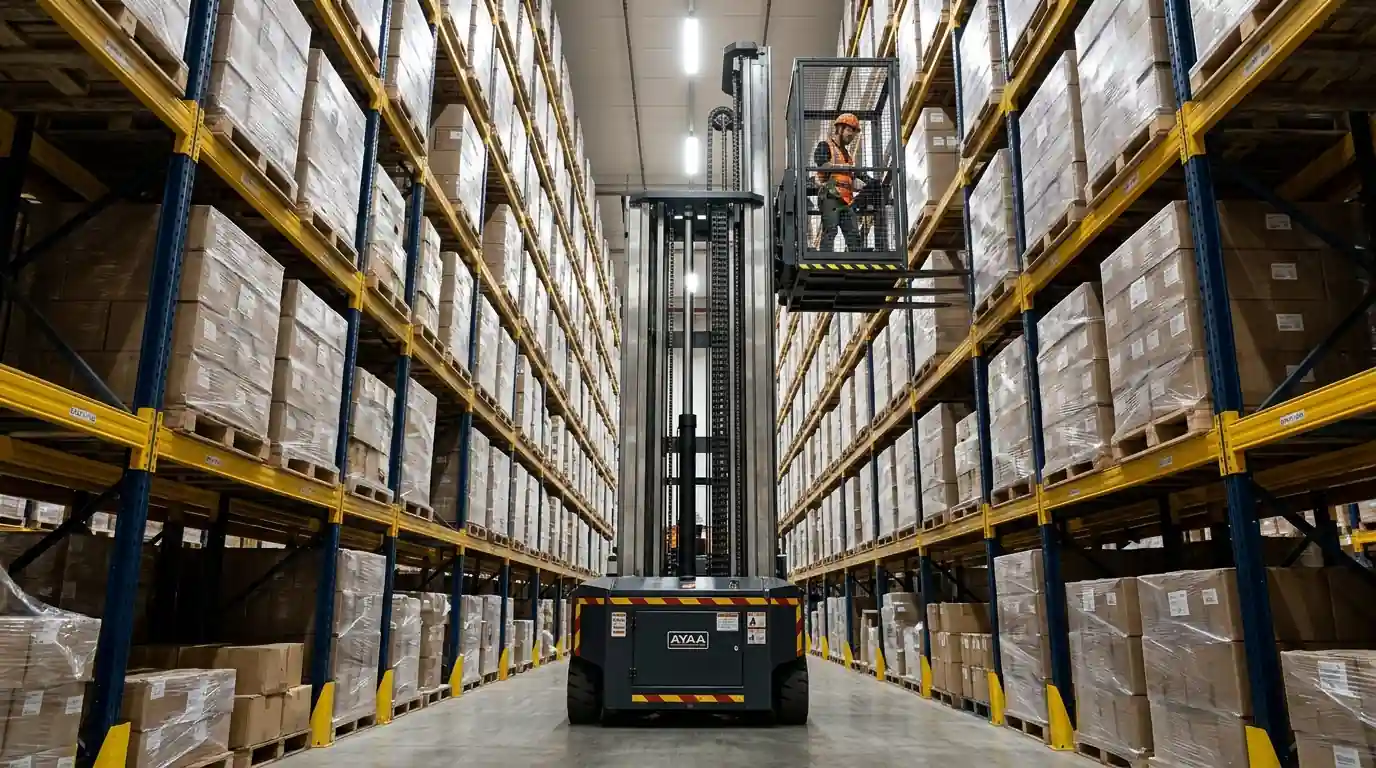
Selecting the right Man-Up Truck BMS requires multi-stage fail-safe derating, active cell balancing, and native CANbus protocol integration. Unlike standard counterbalanced forklifts, vertical very narrow aisle (VNA) man-up turret trucks elevate the operator cabin and payload up to 17 meters. In these narrow high-bay corridors, an advanced man-up truck bms cannot function as a basic on-off disconnect switch. Sudden traction contactor trips at maximum elevation trigger severe hydraulic shock, mast sway, and life-threatening operator stranding.
Engineering a dedicated man-up truck bms demands departing from generic traction architectures. High-throughput VNA fleets deploy 48V or 80V LiFePO4 packs rated from 600Ah to 900Ah across intensive multi-shift schedules with frequent opportunity charging. Specialized control loops dampen massive hydraulic current spikes during simultaneous lift and rotation, provide bi-directional active equalization across industrial cells, and maintain an isolated auxiliary power reserve for emergency cabin descent. Evaluating these core safety and communication protocols ensures optimal retrofit selection, protecting operator lives while sustaining continuous warehouse throughput.
Understanding Electrical Demands in High-Lift VNA Trucks
High-Elevation Cabin Lifting and Extreme Hydraulic Spikes
Vertical very narrow aisle (VNA) turret trucks generate harsh dynamic stress across lithium battery assemblies. Lifting operator cabins and 1,500 kg loads up to 17 meters demands immense hydraulic power. Simultaneous lift, turret rotation, and lateral fork movement drives transient current spikes between 300A and 500A.
Heavy inductive motor draws cause sharp DC bus voltage dips. Standard protection boards often misinterpret this temporary voltage drop as cell depletion, tripping main contactors.
A specialized man-up truck bms uses high-frequency voltage sampling and digital filtering. This logic distinguishes inductive motor starting dips from true cell depletion. Stable voltage monitoring during current transitions guarantees uninterrupted hydraulic flow. This eliminates sudden decelerations that compromise operator safety and mast alignment.
Multi-Shift Duty Cycles and Opportunity Charging Profiles
High-throughput logistics hubs run VNA fleets across consecutive shifts without overnight charging windows. Fleet managers rely on fast opportunity charging during operator breaks, applying charge rates from 0.5C to 1.0C. A 15 to 30 minute break routinely transfers 150Ah to 300Ah directly into an 80V 800Ah pack.
Continuous partial-state cycling challenges basic coulomb counting. Without full saturation rest periods, state calculation drifts significantly after multiple shifts.
AYAA TECH solves this by incorporating a high-precision dynamic state-of-charge (SOC) algorithm. It calculates battery capacity across ambient temperature differences with an error margin within 5%. Precise state tracking provides elevated operators with dependable runtime metrics. Reliable tracking eliminates unexpected power drop-offs during high-bay picking runs.
Fail-Safe Safety Architecture: Eliminating High-Altitude Cut-Off Risks

Multi-Stage Limp-Home Derating Versus Hard Contactor Trips
Standard forklift protection logic trips contactors immediately when limits are exceeded. In a turret truck elevated 15 meters, sudden contactor disconnect halts hydraulic valves. This causes violent mast whip and strands the operator aloft.
Dedicated man-up architectures replace binary cutoffs with four-stage progressive power derating. This control logic aligns with ISO 13849-1 Performance Level d (PL-d) standards:
- Level 1 (Warning Alert):CAN alerts signal high temperature or low voltage.
- Level 2 (Dynamic Current Limiting):Limits restrict top speed while maintaining hydraulic pump output.
- Level 3 (Limp-Home Restriction):Locks out high lift, preserving hydraulic lowering and slow maneuvering.
- Level 4 (Ground Level Shutdown):Contactor disconnect occurs only after the truck safely docks at ground level.
Engineering Note:Never configure a man-up turret truck BMS with immediate contactor disconnection on primary low-voltage thresholds. Instant open-circuit events at full mast elevation cause violent hydraulic deceleration and operator stranding. Always utilize progressive throttle derating while maintaining full hydraulic lowering circuit power.
Dedicated Auxiliary Power Reserve for Emergency Cabin Descent
Protecting human life requires an independent electrical backup system when primary traction lines suffer catastrophic faults. Robust man-up power architectures implement galvanic isolation between high-current traction lines and secondary 24V auxiliary control circuits.
When primary contactors open during faults, internal capacitors and redundant DC-DC channels sustain 24V rails. This backup line maintains auxiliary control power for at least 30 minutes. This isolated reserve powers emergency descent proportional valves, electromagnetic brake releases, and cabin intercoms.
Operators or ground crews can actuate gravity descent controls. The mast descends smoothly to floor level without waiting for external rescue equipment.
Pack Stability Under Shock: Heavy Capacity and Vibration Control
Active Balancing for 600Ah to 900Ah LiFePO4 Form Factors
VNA turret trucks deploy 48V or 80V packs built from 600Ah to 900Ah prismatic LiFePO4 cells. Standard circuits rely on passive bleeding dissipating only 35mA to 50mA, which cannot equalize 800Ah industrial cells.
AYAA TECH resolves this by integrating bi-directional DC-DC active balancing delivering 1A to 5A of equalization current. Active circuits shuttle charge from high-voltage cells to lagging cells during charge, discharge, and rest. Maintaining cell variances below 15mV across the pack releases full nameplate capacity and extends service life beyond 4,000 cycles.
Engineering Note:Do not rely on passive resistor bleeder circuits for lithium iron phosphate cells above 400Ah. In partial-state opportunity charging, passive bleeding creates internal hot spots while failing to equalize cell divergence, accelerating capacity loss.
Ruggedized Vacuum Potting and Anti-Vibration Reinforcement
Operating in narrow aisles, man-up trucks travel up to 12 km/h guided by floor rails or wire tracking. Tolerances under DIN 18202 and VDMA 15251 cannot eliminate repetitive micro-vibrations transmitted into the chassis and battery compartment.
To survive continuous shock, control assemblies undergo vacuum potting with thermally conductive resin, achieving IP67 sealing. Internal power paths utilize laser-welded copper busbars rather than threaded studs that loosen over time. External harnesses employ heavy-duty Deutsch and Amphenol industrial locking connectors, verified through ISO 16750-3 vibration testing.
Facing High-Elevation Shutdowns or Contactor Trips?
Explore Industrial Smart BMS SolutionsVehicle Controller Integration: CANopen and J1939 Protocols
Proprietary Handshake Broadcasts and Dashboard Fault Prevention
Converting legacy lead-acid man-up trucks to lithium power requires overcoming OEM electronic handshakes. Major manufacturers like Crown, Raymond, Jungheinrich, Linde, and Toyota utilize specialized communication protocols. Vehicle control units continuously verify battery presence through CANopen or SAE J1939.
Connecting an off-the-shelf BMS lacking dedicated OEM protocol stacks triggers immediate vehicle fault codes, disabling hydraulic lift circuits. AYAA TECH eliminates communication barriers by integrating validated vehicle communication profiles directly into our smart BMS firmware.
Our control units support CANopen, SAE J1939, and RS485 interfaces. They adapt directly to leading vehicle controllers while supporting custom OEM commands. The system transmits authenticated heartbeat packets, temperatures, current limits, and error mappings. Factory displays show accurate metrics without nuisance lockouts.
Real-Time Dynamic Current Limiting (CCL and DCL)
Digital integration extends beyond displaying battery percentages. Vehicle controllers require continuous updates governing maximum charge current limits (CCL) and discharge current limits (DCL). Lowering a turret truck carriage from 16 meters pushes regenerative hydraulic power into the battery. These surges reach hundreds of amperes within seconds.
AYAA smart battery systems transmit dynamic CCL values to motor controllers and fast chargers every 10 milliseconds. Cell voltages can rise near absorption thresholds during regenerative braking. The BMS coordinates with the inverter to route excess energy into braking resistors, preventing overvoltage trips.
Thermal Management in Harsh Cold Storage Environments
Automated PTC Pre-Heating to Prevent Lithium Plating
Cold storage facilities operate between -20°C and -30°C. Sub-zero temperatures increase electrolyte viscosity and cell impedance. Fast-charging cold lithium cells forces ions to deposit as metallic dendrites on graphite anodes rather than intercalating safely. This lithium plating causes irreversible capacity degradation and risks separator piercing.
AYAA thermal architecture prevents freezer hazards using automated PTC heating elements between cell rows. Connecting a fast charger triggers an automatic charging interlock. Power directs into heating elements until core cell temperatures reach +5°C. The system then enables full charging current, preventing lithium plating and protecting cell longevity.
Engineering Note:Never bypass low-temperature charge lockouts in sub-zero freezers. Charging LiFePO4 cells below 0°C without PTC pre-heating triggers metallic lithium plating on graphite anodes. This causes rapid capacity loss and internal short circuits.
IP67 Enclosures and Condensation Mitigation
Man-up order pickers frequently move between -25°C freezer zones and +20°C ambient transfer docks. Rapid temperature fluctuations produce heavy moisture condensation across metallic battery cases and wiring harnesses. Moisture ingress into sensitive electronic circuit assemblies degrades electrical insulation resistance, triggering false ground-fault alerts and nuisance shutdowns.
Preventing moisture damage requires comprehensive environmental sealing. Beyond applying multi-layer conformal coating, AYAA TECH houses control electronics inside rugged IP67 aluminum enclosures. These sealed housings incorporate ePTFE membrane breather valves (Gore vents). Membrane vents equalize rapid internal air pressure variations caused by thermal swings while blocking liquid water droplets and airborne humidity.
Man-Up Truck BMS Selection Matrix for MHE Retrofitters and Fleet Managers
System Architecture and Feature Comparison
Retrofit engineers and fleet managers evaluate power systems across physical, electrical, and communicative boundaries. The following engineering matrix contrasts standard industrial battery management modules with dedicated man-up turret truck architectures:

| Feature Parameter | Standard MHE BMS | Dedicated Man-Up BMS (AYAA Standard) | Engineering Impact |
|---|---|---|---|
| High-Altitude Safety | Binary contactor trip | 4-stage limp-home derating (ISO 13849-1 PL-d) | Prevents mast whip and operator stranding |
| Auxiliary Descent | Shared traction bus | Dedicated 24V auxiliary reserve line | Powers descent valves for 30 min in faults |
| Active Balancing | Passive bleed (35mA-50mA) | Bi-directional active DC-DC (1A-5A) | Preserves 600Ah-900Ah capacity for 4,000+ cycles |
| CANbus Protocol | Generic basic CAN | Pre-mapped CANopen & SAE J1939 OEM stacks | Prevents dashboard error lockouts on major OEMs |
| Thermal Dissipation | Random PCB layout | Uniform MOSFET layout, thermal silicone, aluminum | Prevents hotspots under sustained 300A-500A loads |
| Freezer Protection | Low-temp charge cutoff | Closed-loop PTC heating with interlock | Prevents permanent metallic lithium plating |
| Vibration Defense | Conformal dipping | Vacuum resin potting, IP67, Deutsch locking | Endures continuous DIN 18202 guide rail vibrations |
Selecting a system satisfying these parameters prevents costly equipment downtime. It safeguards elevated operators and maximizes usable battery capacity over heavy shifts.
Ballast Packaging and Thermal Sizing in Retrofit Trays
Retrofit projects require careful ballast engineering. Man-up turret trucks require 1.0 to 2.5 metric tons of steel ballast. This mass balances high-elevation load moments in narrow aisles. When replacing lead-acid blocks with lithium packs, engineers must retain massive counterweights inside the battery tray.
AYAA engineers design compact BMS footprints with high-conductivity aluminum enclosures. Power MOSFETs and precision shunt resistors sit across high-grade thermal silicone pads. Symmetrical layouts dissipate heat efficiently into external heatsinks, even within packed ballast compartments.
Conclusion: The Engineering Decision Triangle
Specifying battery systems for man-up turret trucks demands balancing operator safety, native vehicle controller integration, and pack durability. Multi-stage derating, validated CAN protocols, active balancing, and automated thermal management form an essential foundation.
AYAA TECH operates specialized manufacturing facilities and precision lines to deliver standard and customized energy storage solutions. We supply smart BMS platforms, custom lithium packs, and matched chargers worldwide. AYAA TECH supports MHE retrofitters with no minimum order quantity, shipping in-stock models from 1 piece. Dedicated high-lift engineering ensures maximum VNA fleet uptime and uncompromised operator safety across every high-elevation cycle.
Need Custom CANbus Protocols or Retrofit Engineering?
Request Custom BMS Engineering SupportЧасто задаваемые вопросы
1. What happens if a BMS trips while a man-up truck is elevated at 15 meters?
Standard commercial BMS units execute abrupt contactor disconnects during faults. This drops hydraulic pressure and strands the operator aloft. An industrial man-up truck BMS eliminates this hazard through multi-stage limp-home derating. It preserves hydraulic descent controls, backed by an isolated 30-minute auxiliary reserve.
2. Why is CAN-bus protocol matching essential for man-up truck lithium retrofits?
Turret trucks from Crown, Raymond, and Jungheinrich require digital handshakes via CANopen or SAE J1939. The replacement BMS must broadcast proprietary heartbeat frames, dynamic current limits, and authentic SOC data. Missing communications trigger severe dashboard trouble codes and disable hydraulic lift functionality.
3. How does active cell balancing protect high-capacity 600Ah to 900Ah man-up truck batteries?
Heavy VNA batteries under opportunity charging develop cell voltage divergence. Traditional passive bleeder circuits dissipate merely 35mA to 50mA as heat, failing on massive 800Ah cells. Active balancing supplies 1A to 5A of bi-directional transfer current, equalizing cells dynamically and maintaining divergence below 15mV.
4. Can a man-up truck lithium BMS operate safely in a -25C cold storage warehouse?
Operating in deep-freeze environments requires automated thermal management and condensation defense. An industrial man-up BMS commands integrated PTC heating elements before charging. Warming cell cores above +5°C prevents destructive lithium plating. Sealed IP67 enclosures with breathable Gore vents eliminate condensation ground-fault errors.
5. How does physical ballast weight impact BMS wiring and thermal management?
High-lift turret trucks require 1.0 to 2.5 metric tons of ballast for stability. This massive counterweight severely confines available battery tray space. A purpose-built BMS features compact packaging and automotive flame-retardant wiring. Uniform heatsink layouts transfer heat through aluminum enclosures without trapped internal hot spots.
6. What functional safety standards should an industrial man-up truck BMS comply with?
Due to elevated human operators, the safety architecture must align with ISO 13849-1 Performance Level d (PL-d). This functional safety standard governs safety-related electronic control circuits. Systems should also meet ISO 16750-3 for mechanical vibration endurance, alongside UL 2580 and CE compliance.
7. What is the recommended charging rate supported by a man-up truck BMS during opportunity breaks?
Industrial man-up lithium systems support 0.5C to 1.0C continuous opportunity charging rates. Fleets replenish approximately 30% pack capacity during routine 15 to 30 minute operator breaks. Fast opportunity charging enables continuous 24/7 productivity without battery swapping.