
- Industries

Home Backup & Garden BMS
View More >Electric Forklift BMS
View More >Golf Cart BMS
View More >Electric Two-wheeler BMS
View More >Aviation & UAV BMS
View More >BMS For Power Tools
View More >Medical Equipment BMS
View More >





Home About Us EVENTS & NEWS The Evolution of 48 Volt Forklift Battery and the Critical Role of Advanced BMS
The demand for reliable, high-performing energy sources has never been greater as internal combustion engine models are gradually being replaced by electric forklifts in factories, warehouses, and logistics hubs. For mid-power industrial trucks, 48-volt lithium-based batteries—specifically, LiFePO4 (Lithium Iron Phosphate) chemistries—have become a popular choice among the several alternatives. However, the incorporation of sophisticated Battery Management Systems (BMS) has completely changed how these batteries function, guaranteeing safety, maximizing performance, and prolonging lifespan, going beyond simply the chemistry.
The evolution of 48V forklift battery systems, the rising need for intelligent power solutions, and the fundamental role that Smart BMS technologies play in contemporary forklift energy systems are all covered in this article.
Usually seen in mid-sized electric forklifts, a 48V forklift battery is a rechargeable battery pack that delivers a nominal voltage of 48 volts. To obtain the necessary voltage and capacity, these batteries can be made up of LiFePO4, Li-ion, or older lead-acid cells connected in series and parallel.
Forklifts with medium-to-heavy lifting requirements are best suited for 48V batteries because they provide superior energy density, more torque support, and enhanced power delivery as compared to conventional 24V or 36V batteries.
Because of its advantages, the move to 48V power has become a logical advancement in forklift technology:
Higher energy efficiency: Delivers power with less current, reducing I²R (heat) losses.
Better compatibility with modern electric drive systems.
Reduced maintenance (especially for LiFePO4-based versions).
Improved power-to-weight ratio, increasing maneuverability.
Faster charging, particularly with lithium battery technologies.
When combined with a smart BMS, these benefits make the 48V system a potent substitute for more complicated but higher-voltage systems (such as 72V or 80V setups).
Early models of 48V batteries, particularly those that used lead-acid or uncontrolled lithium cells, had a number of issues despite their attractive features:
Thermal instability during high-current discharge or charging.
Unbalanced cells, leading to early degradation or safety risks.
Overcharging and deep discharging, which reduce battery life.
Lack of system-level visibility (e.g., SOC, SOH, temperature).
Due to these problems, it was challenging to safely implement lithium chemistries in industrial settings without active control. This is where the Smart BMS comes in.
Smart Battery Management Systems (Smart BMS) are now a crucial component of contemporary forklift battery design in order to address the aforementioned issues. An electronic control unit called a Smart BMS actively keeps an eye on and regulates every single cell in the battery pack.
Key functionalities include:
Real-time voltage, temperature, and current monitoring
Cell balancing (active or passive) to prevent drift
Over-voltage, under-voltage, short-circuit, and over-temperature protection
SOC/SOH estimation for predictive maintenance
CAN/RS485/UART communication for integration with vehicle control systems
In addition to making 48V batteries safer, a Smart BMS turns them into intelligent power modules that communicate with the forklift in real time.
Lithium batteries’ inherent potential is transformed into extremely reliable power systems by Smart BMS, allowing:
Enhanced safety: Continuous diagnostics and protection mechanisms reduce the risk of thermal runaway or system failure.
Lifecycle extension: By avoiding overcharge/over-discharge and managing balancing, battery lifespan is increased significantly.
Predictive maintenance: Data logging and health reporting help operators perform maintenance before issues arise.
Fleet management: In large deployments, centralized monitoring becomes possible, allowing for usage optimization.
The BMS is the lifeblood of a contemporary 48V battery system and is no longer optional.
Fleets of forklifts are increasingly being assessed not only on performance but also on environmental impact and cost of ownership. Here are two benefits of a 48V battery with Smart BMS functionality:
Lower operational costs through improved efficiency and reduced maintenance.
Fewer replacements due to extended battery life.
Energy savings with precise charging control and regenerative braking integration.
Environmentally safer through reduced use of lead-acid batteries and less electronic waste from failed cells.
A 48V battery system with a Smart BMS greatly exceeds conventional choices in terms of return on investment over a five-year period.
When choosing the best 48 volt forklift battery for your forklift, consider the following important aspects:
Cell chemistry: LiFePO4 offers superior thermal stability and cycle life.
Current capacity: Ensure continuous and peak discharge rates match your application.
BMS capabilities: Look for multi-level protection, cell balancing, and communication protocols.
Physical size and integration: It should fit seamlessly into the forklift’s battery compartment.
Certifications and compliance: Safety and transportation certifications like UN38.3, UL, or CE matter.
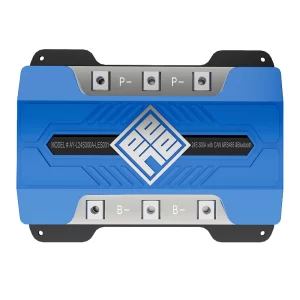
Forklifts and industrial vehicles are among the high-demand applications for the AY-L24S300A-LES001.
Voltage support: Covers 7 to 24 series cells (up to 86.4V max charging voltage).
Current handling: Supports up to 300A continuous discharge.
Smart monitoring: Built-in CANBUS/RS485 communication for integration.
Thermal protection: Advanced temperature detection and cutoff.
Use case: Ideal for pallet trucks, counterbalanced forklifts, AGVs, and logistics systems.

The AY-L24S300A-ES001, another high-performance choice, has an industrial-grade BMS architecture.
Material quality: Automotive-grade MOSFETs and PCB design.
Communication: CAN/RS485/UART enabled, compatible with smart control systems.
Safety protocols: Supports short-circuit protection, overcurrent cutoff, and voltage balancing.
Application: Heavy-duty warehouse forklifts, robotic lift platforms, and off-road equipment.

The AY-LS20S90A-H150 is designed for modular and scalable deployments and is flexible.
Parallel support: Multiple packs can be safely connected.
Protocol compatibility: Supports various CAN-based communication formats.
Voltage: Designed for 16–20S packs (51.2V to 64V nominal).
Ideal for: Large-scale forklifts, hybrid industrial machines, or construction transporters.
| Product Model | Voltage Range (S) | Max Current | Communication | Parallel Support | Application |
|---|---|---|---|---|---|
| AY-L24S300A-LES001 | 7S–24S | 300A | CAN/RS485 | Yes | Forklifts, logistics, AGVs |
| AY-L24S300A-ES001 | 7S–24S | 300A | CAN/RS485/UART | Yes | Warehouse lifts, robotic trucks |
| AY-LS20S90A-H150 | 16S–20S | 90A | CAN | Yes | Heavy-duty forklift fleets |
Q:What is the life expectancy of a 48V battery?
A:With the right maintenance and use, a good 48V lithium battery can last three to five years for the majority of users. However, this lifespan may be on the lower end of the range for batteries in systems or cars that are used frequently.
Q:Are forklift batteries lithium-ion 48 volt?
A:The main functions of shipping, receiving, warehousing, and manufacturing are carried out by sit-down counterbalanced vehicles.
Q:How much time does it take to charge a 48V battery?
A:For a 48V 100Ah lithium battery: A 48V lithium battery can be fully charged in 4–5.2 hours using a 25A charger. A 48v lithium battery may be fully charged in 1.67 to 2.17 hours using a 60A charger.
Q:Can I use a car battery for a forklift?
A:You can transport a dead electric forklift with a series of car batteries, but please be aware that you should only use the car battery option to carry the forklift to a charging station.Do not use car batteries to powerlifting a load, play forklift basketball, etc.
Q:How many amps do I need to charge a 48V battery?
A:The charger should be sized at roughly 25% of the battery’s capacity (ah = amp hour capacity), according to the majority of battery manufacturers. Thus, a 25 amp 48 volt charger (or less) would be required for a 100 ah 48 volt battery pack. While larger chargers can shorten charge times, they may also shorten battery life.
The combination of 48 volt forklift battery and Smart BMS will become the de facto standard in forklift power systems as industrial logistics moves toward electrification. These technologies provide the intelligence, security, and scalability that contemporary operations require in addition to raw performance.
Smart BMS integration is now required for forklift manufacturers and operators looking for long-lasting, dependable, and future-proof energy systems.
Explore advanced Smart BMS solutions, all available from Ayaa Technology—your partner in next-generation battery systems.
Contact Us