





In 4 12V lithium golf cart batteries vs 48V setups, a single 48V battery is the superior choice. While wiring four 12V batteries in series delivers the nominal 48 volts your motor controller requires, it creates an unmanaged system with four separate, disconnected Battery Management Systems (BMS). None of these independent 4S boards share telemetry, clock signals, or state data.
This distributed architecture creates severe operational vulnerabilities. Manufacturing tolerances cause uncoordinated protection trips, where one sensitive BMS cuts power during hill climbs and stalls the entire cart. Over successive charge cycles, internal resistance variations lead to chronic State of Charge (SOC) drift and premature high-voltage charging cutoffs that permanently reduce usable driving range. In contrast, an integrated 48V (51.2V nominal) pack uses a unified 16S master BMS. This centralized architecture monitors all 16 cells simultaneously, integrates active pre-charge protection against inrush current, and communicates directly with the motor controller via CAN bus to ensure predictable, long-term fleet reliability.

Architectural Breakdown: 4 12V Lithium Batteries vs 48V Golf Cart Battery Systems
Isolated Control vs Centralized Logic
Four 12V batteries in series place four separate Battery Management Systems (BMS) in the same power loop. Each board monitors only four individual LiFePO4 cells.
None of these boards share data or clock signals. Each board acts alone.
A single 48V lithium battery golf cart pack uses an integrated 16S architecture. Sixteen cells wire directly to a single analog front-end. The central processor monitors all cell voltages and temperatures simultaneously.
The Series Connection Illusion
Lead-acid batteries handle series wiring easily. They dissipate extra charge as heat and self-balance.
Lithium cells cannot self-equalize this way. When you run 12V lithium batteries in series golf cart setups, equal current passes through every cell.
Yet, four separate BMS units make uncoordinated decisions. If one pack drifts in internal resistance, the other three cannot compensate. The system quickly becomes unstable.
Common 4 12V Lithium Batteries Golf Cart Problems in the Field
1. Uncoordinated BMS Shutdowns
Each independent BMS has its own protection thresholds. Manufacturing tolerances mean these limits never match perfectly.
One board might cut low voltage at 10.0V. Another might trip at 10.4V.
The same problem happens with current limits. Under heavy throttle, the most sensitive BMS trips first. That single trip cuts power to the entire cart instantly.
2. Progressive State of Charge (SOC) Drift
Series packs drift apart over 30 to 50 charge cycles. Tiny differences in self-discharge rates compound over time.
LiFePO4 discharge curves stay extremely flat between 20% and 80% capacity. A multimeter might show 13.2V across all four batteries at rest.
Yet, actual stored energy can differ by 20%. Resting voltage hides this imbalance completely.

3. Current Surges and Hill-Climbing Stalls
Golf cart motors draw 200A to 300A when accelerating uphill. Standard 12V drop-in packs usually carry a continuous limit of 100A.
Their short-term current limits trip in milliseconds under heavy load. When Battery #1 hits its limit, its internal switches open.
Because the batteries sit in series, opening one switch breaks the entire circuit. The cart stops dead on the hill. It gives the driver zero warning.
4. Charging Asymmetry and Usable Range Loss
Standard chargers cannot balance four separate 12V batteries. The pack with the lowest capacity fills first during recharging.
Its internal BMS triggers an over-voltage disconnect to protect its cells. This action halts current flow to the entire string.
The other three batteries remain undercharged at 85% to 90% capacity. With every cycle, your total driving range drops further.
5. Terminal Resistance and Cable Wear
Using 4 12V batteries to make 48V golf cart systems requires three heavy jumper cables. That adds six mechanical connection points.
Golf carts vibrate constantly on turf and rough pavement. That vibration loosens terminal bolts over time.
Loose connections add electrical resistance. Under a 100A draw, a loose terminal creates intense heat. This burns terminal plastic and creates a genuine fire hazard.
Engineering Note: When an individual BMS trips under motor load, inductive energy spikes back into the circuit. This surge combines with the remaining 36V string voltage. The spike hits the open MOSFET switches inside the tripped BMS. Generic 12V packs use switches rated for low voltages. This surge can permanently destroy the MOSFETs.
Tired of Nuisance BMS Trips and Cable Clutter?
Explore Motive Battery Packs & Smart BMS PlatformsWhy a Single 48V Lithium Battery Golf Cart Setup Eliminates System Drift
Centralized 16S Cell Balancing
A dedicated 48V pack uses one master board connected to all 16 cells. Balancing circuits equalize all cells during every charge cycle.
Pack-to-pack drift never starts. This architecture dramatically extends overall cycle life.
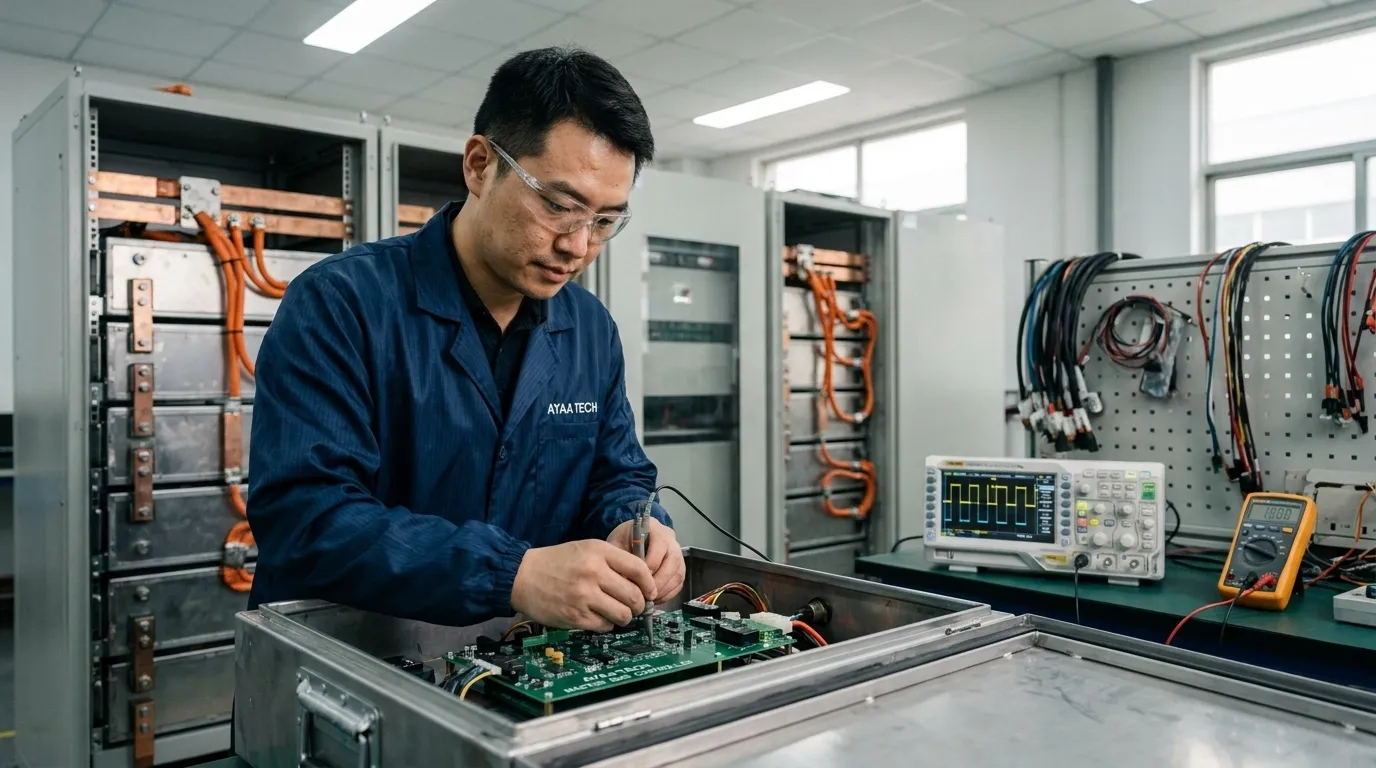
Voltage-based fuel gauges fail on lithium systems. AYAA TECH eliminates this blind spot by combining precision shunt hardware with proprietary tracking algorithms. This ensures State of Charge (SOC) tracking error stays ≤ 5% across demanding duty cycles.
Engineered Thermal Management
Heavy hill climbs and regenerative braking push high currents through internal switches. Trapped heat degrades cells and risks thermal runaway.
To maintain low operating temperatures, AYAA TECH uses balanced component layouts for MOSFETs and current shunts. Critical heat sources are spaced evenly across the board.
High-grade thermal silicone pads and conductive gels transfer heat away from key electronics. Heavy aluminum alloy enclosures and pure copper conductors shed heat quickly. This prevents hot spots and protects critical semiconductors.
Motor Controller Inrush Protection
Golf cart controllers use massive capacitor banks. Connecting a battery directly to these empty capacitors creates an electrical spark.
Inrush current can easily top 500A. This burst welds mechanical switches and damages electronics.
Dedicated 48V packs integrate hardware pre-charge circuits. A resistor limits initial current for 200 to 500 milliseconds. Once the capacitors charge, the main contactor engages safely.

Direct Vehicle Communication via CAN bus
Integrated systems replace guesswork with live digital data. The master BMS talks directly to Curtis, Navitas, or Sevcon controllers via CAN 2.0B.
The battery broadcasts real-time current limits. When energy drops, the controller scales back power smoothly. You never get stranded by a sudden shutdown.
Fleet Procurement: 48V Golf Cart Battery vs 4 12V Batteries Economics
Procurement teams often buy 12V packs to keep inventory simple. Yet, replacing one failed battery in an aged series string causes serious problems.
A fresh battery has lower internal resistance than worn ones. The older batteries hit cutoffs early during charging and discharging.
This imbalance degrades the replacement unit rapidly. The initial purchase savings disappear through high labor costs and warranty claims.
Review this five-year lifecycle breakdown to understand the true cost difference between both approaches:
| Evaluation Metric | 4 × 12V Series Lithium System | Single Dedicated 48V Pack |
|---|---|---|
| Initial Hardware Cost | Lower ($800 – $1,500) | Moderate ($1,200 – $2,200) |
| BMS Architecture | 4 Disconnected 4S Boards | 1 Centralized 16S Master BMS |
| High-Current Cable Joints | 8 Mechanical Studs | 2 Main Terminals |
| Inrush Current Suppression | Rarely Present | Integrated Pre-Charge Resistor |
| Vehicle Controller Telemetry | Open-Loop (Voltage Cutoff Only) | Closed-Loop CAN 2.0B / RS485 |
| Routine Service Labor | High (Balancing & Retorquing) | Zero Maintenance |
| 5-Year Failure Rate | 15% – 30% Field Failures | Under 2% Stable Degradation |
| Safety Certifications | Basic UN38.3 Shipping Spec | UL 1973, UL 2580, CE, UN38.3 |
Initial savings from series setups vanish quickly. Downtime, service calls, and pack replacements cost far more over five years.
Need Custom 48V Battery Packs for Your Fleet?
Request Custom Engineering ConsultationFrequently Asked Questions
Can I use four 12V lithium batteries in a 48V golf cart?
Yes, you can wire them in series if the maker approves it. However, this creates four separate control systems. The packs will drift apart over time. This leads to shorter runtimes, charging issues, and sudden cutoffs on hills.
Why does my cart shut down climbing hills with four 12V batteries?
Motors pull 200A to 300A when working hard. If one battery hits its safety limit, its BMS opens. Because the packs sit in series, opening one battery shuts down the entire car.
Will an external battery balancer fix series pack drift?
Only partially. External balancers move 1A to 5A between batteries. That helps while the cart sits parked. It cannot correct major imbalances during heavy 100A driving loads.
Can I use my original 48V charger on 4 12V lithium batteries?
Only if the batteries are balanced and the charger matches LiFePO4 charge profiles. When cells drift, the fullest battery trips its high-voltage cutoff early. This stops the charging cycle, leaving the other batteries half-empty.
Why are dedicated golf cart batteries rated at 51.2V instead of 48V?
A 16-cell series LiFePO4 pack runs at 51.2V nominal (16 × 3.2V). Old lead-acid batteries run at 48V (24 × 2.0V). The 51.2V system holds higher voltage under acceleration, giving you better motor speed and torque.
Can I replace just one bad 12V lithium battery in my series string?
No. Mixing a new battery with three older ones creates severe resistance mismatches. The older packs drain faster and trigger early shutdowns. This damages the new battery quickly.
What certifications should commercial fleet managers demand?
Require UL 1973 for stationary and light EV use, alongside UN38.3 for transport safety. Verify an ingress protection rating of IP67. This prevents field failures from water spray and dirt.