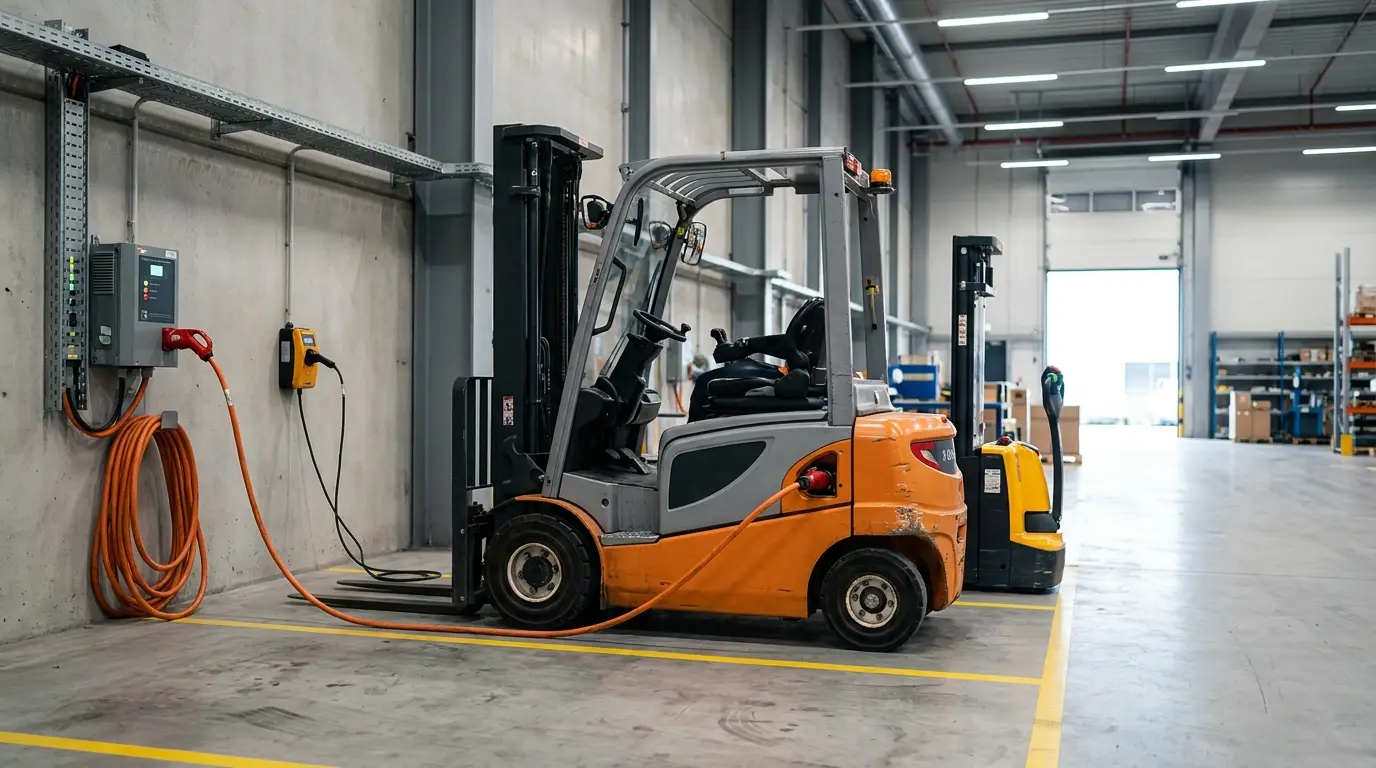









For a lithium vs lead-acid forklift battery, neither wins every time—your duty cycle decides. Lithium-ion leads in busy, multi-shift warehouses, where fast charging and low upkeep save real money. Lead-acid still fits lightly used trucks, tight budgets, and sites with an existing battery room.
So the real question is which battery fits your trucks, shifts, and charging setup. A battery price tag tells you very little on its own. What counts is the complete power system: the battery pack, BMS, charger, and forklift. This guide compares each part in plain terms so you can evaluate options fairly.

How Lithium-Ion and Lead-Acid Forklift Batteries Work
How Lead-Acid Batteries Store and Deliver Energy
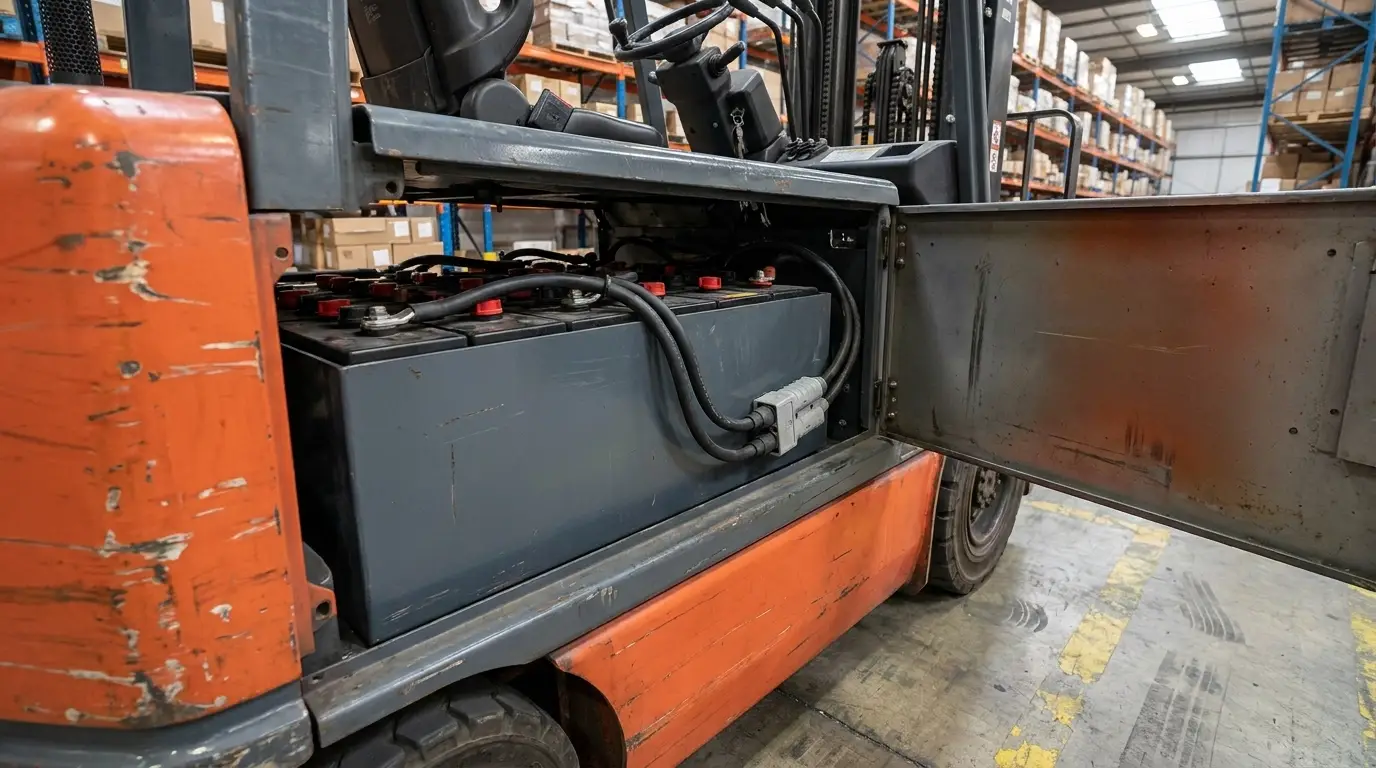
A lead-acid forklift battery holds lead plates in a bath of sulfuric acid and water. When you discharge it, a chemical reaction turns the plates and acid into lead sulfate and releases electricity. Charging reverses the reaction.
The design is old, simple, and well understood. Most flooded lead-acid batteries need regular watering because charging splits water into hydrogen and oxygen. They also need a ventilated charging area for the same reason.
The heavy lead plates are not only a drawback, either. On many trucks, that mass acts as the counterweight that keeps the forklift stable.
How Lithium-Ion Batteries Work in Forklift Applications
Lithium-ion cells move lithium ions between two electrodes through an electrolyte. There is no liquid acid to top up, and cells emit no gas during normal charging. Most industrial forklift packs use lithium iron phosphate (LFP) for its stable chemistry and long life.
However, “lithium” is a family, not a single product. NMC and other chemistries trade energy density, cost, and thermal behavior differently. Do not treat LFP and “lithium” as the same thing.
A lithium pack also cannot run on its own. It needs a battery management system (BMS) to monitor cell voltage and temperature. The BMS cuts power whenever any reading goes out of range.
Why Battery Chemistry Is Only Part of the Decision
Chemistry gets most of the attention, but it is only one layer. A great lithium pack paired with the wrong charger will underperform. A well-priced lead-acid battery that is too small for a three-shift schedule will cost you in downtime. You are buying a system, so judge the system.
Lithium vs Lead-Acid Forklift Battery: Key Differences at a Glance
The table below sums up the main differences. Treat these figures as typical ranges, not promises. Real numbers depend on the product, duty cycle, and operating temperature. Always check the datasheet for the exact battery you are considering.
| Factor | Lead-acid | Lithium-ion (commonly LFP) |
|---|---|---|
| Purchase price | Lower upfront | Higher upfront, often by a wide margin |
| Usable capacity | Often limited to about 80% depth of discharge to protect life; voltage sags as it empties | Typically a larger share of rated capacity is usable; voltage stays flatter |
| Cycle life | Commonly around 1,000–1,500 cycles under good care | Commonly several thousand cycles, depending on chemistry and DoD |
| Charging | Long full charge plus cool-down in many setups | Much faster; accepts partial charges well |
| Opportunity charging | Generally discouraged; can shorten life | Designed for it, within the charger and BMS limits |
| Energy efficiency | Lower, with more energy lost as heat during charging | Higher, so less energy wasted per cycle |
| Power delivery | Drops as the battery empties | Steadier through most of the discharge |
| Maintenance | Watering, cleaning, equalizing charges | No watering; still needs inspection |
| Weight | Heavy, often useful as counterweight | Lighter for the same energy, so ballast may need adding |
| Safety focus | Acid, hydrogen gas, heavy lifting | Electrical, thermal, and physical-damage risks |
| Temperature | Capacity falls in the cold | Charging often restricted at low temperatures; heating may be needed |
| Infrastructure | Battery room, ventilation, watering gear, spare batteries | Charger and power supply upgrades; usually no spare battery |
How to Read Cycle Life Claims on a Datasheet
A few of these rows deserve a closer look, because the headline numbers hide the conditions behind them.
Cycle life is the number people misuse most. A “3,000-cycle” claim means little without knowing depth of discharge, temperature, charge rate, and end-of-life criteria. Many makers define end of life as 80% of original capacity, but not all do. Cycle life, calendar life, and warranty years are also three different things.
[Engineering Note] Never compare cycle counts from two datasheets until you have matched the test conditions. A battery rated at 50% DoD and one rated at 80% DoD are not measured the same way. The same applies to the end-of-life threshold. If a supplier will not state these, treat the number as marketing.
Which Forklift Battery Costs Less Over Its Service Life?
Compare the Purchase Price of Complete Battery Systems
Lithium costs more to buy. That part is not in dispute. But quoted prices are hard to compare, because suppliers often mix different voltages, capacities, and scope. One quote may include the charger and installation, while another covers only the battery.
Before you compare, line up the basics: voltage, rated capacity, usable energy, charger, and any fitment work. Then compare like with like. If you can’t make the quotes match, say so in your evaluation rather than forcing a false precision.
Calculate the Total Cost of Ownership
Total cost of ownership (TCO) is where the picture often changes. A fair calculation counts more than the battery itself:
- Battery and charger purchase, plus installation and any truck modifications
- Electricity, including charging losses
- Maintenance labor (watering, cleaning, inspections)
- Battery changeovers, spare batteries, and the space they take up
- Downtime and lost productivity
- Replacement during the study period
- Battery room upgrades, or their removal
- Disposal and recycling
Choose a study period, such as the truck’s expected life or a fixed number of years. Write down all of your assumptions clearly. If you use a discount rate or financing cost, state it. A TCO model with hidden assumptions is just an opinion in a spreadsheet.
When Can a Higher Initial Investment Pay Off?
The payback comes from the calendar and the shifts. Lithium usually earns back its premium when a truck works hard. Avoiding replacements, skipping battery changeovers, and eliminating watering rounds all add up quickly. Multi-shift schedules, busy trucks, and high labor costs all push the math toward lithium.
It is a different story for a truck that runs a few hours a day. With low use, a lead-acid battery lasts for years. The lithium price premium may never be recovered in that time. You pay more upfront, and you might not earn it back.

[Engineering Note] Do not assume lithium wins on TCO everywhere. Run the numbers for each truck group in your fleet. A single-shift truck and a 24/7 truck can need different answers inside the same warehouse.
How Charging and Daily Operations Differ
Full Charging Versus Opportunity Charging
Lead-acid batteries typically follow a full cycle: discharge, charge, and rest. Topping them up in short bursts tends to wear them faster, so many fleets avoid it. That is why multi-shift operations often keep spare batteries and swap them by hand.
Lithium handles partial charges well, so a driver can plug in during breaks. Charging time still depends on battery capacity, charger power, and BMS current limits. Do not assume every lithium pack fills in one or two hours. Some do, and many do not, depending on the specification.
Opportunity charging only pays off if your workflow has real pauses, and your site can supply the power. A warehouse with no breaks and a weak electrical feed gets little from fast-charge capability.

Why the Charger Must Match the Battery
A charger is not a generic box. It sets voltage, current, and the charging curve, and those must suit the battery’s chemistry and the BMS. Some lithium systems also use communication between charger and BMS to control the process.
[Engineering Note] Using a lead-acid charger on a lithium pack is a common and costly mistake. Lead-acid charging profiles hold voltages and stages that do not suit lithium cells. This mismatch can stall charging, bypass protection, or damage the pack. Always confirm charger compatibility in writing with the battery supplier.
How Charging Strategy Affects Fleet Availability
Think of charging as a scheduling problem. Lead-acid fleets spend labor and floor space on swaps. Lithium fleets spend on chargers and electrical capacity.
If twenty trucks plug in at once, your power supply must handle the load. Check your site’s electrical demand before you commit.
Which Forklift Battery Is Better for Your Operation?
Single-Shift Warehouses With Lower Utilization
If your trucks run one shift and sit overnight, lead-acid is often the practical choice. There is enough time for a full charge and cool-down, and the lower price keeps your capital free. If you already own a good battery room and chargers, the case for switching gets weaker.
Where not to go lithium: a low-hours truck with a healthy lead-acid battery and a paid-off charging room. You would spend a lot to solve a problem you do not have.
Multi-Shift Warehouses and High-Utilization Fleets
This is where lithium makes its strongest argument. Skipping battery swaps saves labor and floor space, and the truck stays available. Steadier voltage also helps trucks hold performance late in the shift.
The sacrifice is upfront money and electrical work. You may need charger and power supply upgrades. Avoid lithium if your site cannot upgrade its power supply. Also avoid it if no pack fits your truck properly.
Heavy-Duty Forklifts and Demanding Work Cycles
Heavy lifting and high peak current put stress on any battery. Check continuous and peak discharge ratings against the truck’s draw, and size the pack with margin.
A lead-acid battery can suffer from deep discharge and voltage drop in tough work. A properly designed lithium pack handles high current well. However, a pack with limited current ratings will trip its protection.
Automated Guided Vehicles and Other Automated Equipment
Automated equipment cannot wait for a battery swap. Opportunity charging and communication between the battery, BMS, and vehicle controller fit well here. Lithium is often the natural choice when integration and communication protocols are planned from the start.
Cold Storage and Other Temperature-Sensitive Environments
Cold hurts both chemistries in different ways. Lead-acid loses available capacity as temperatures drop. Lithium can discharge in the cold, but many packs restrict low-temperature charging to protect cells. Some packs include internal heating to solve this problem.
Check operating, charging, and storage temperature ranges separately on the product datasheet. Avoid unheated lithium packs in freezers if your trucks must charge inside the cold zone.
Need a Battery Pack That Fits Your Truck and Duty Cycle?
Explore Product CatalogWhat Should You Check Before Replacing a Lead-Acid Battery With Lithium?
A swap looks simple on paper. In practice, there are four checks that decide whether it works. For a deeper walkthrough, our guide on forklift battery replacement compatibility covers the process step by step.
Check the Forklift’s Voltage and Power Requirements
Matching “48V” on the label is not enough, because nominal voltage is just a name. The truck’s controller cares about the full operating voltage range. Lead-acid and lithium packs behave differently across their discharge curves.
Also check continuous current, peak current, and capacity against the truck’s actual demand. For sizing help, see our guide on forklift battery sizing and runtime.
[Engineering Note] Equal nominal voltage does not mean a drop-in replacement. A lithium pack with a different voltage window can trigger controller faults, reduce performance, or cause shutdowns. Get the truck maker’s voltage and current requirements before you order.
Confirm Battery Dimensions, Weight, and Fitment
Lithium packs are lighter, and on many forklifts that matters, because the battery is part of the counterweight. If the pack is much lighter than the original, the truck may need added ballast to stay stable. Check the compartment size, the mounting and retention method, and the truck’s required minimum battery weight.

Verify Charger and BMS Compatibility
Confirm that the charger suits the battery pack. Ensure the BMS supports the protections, monitoring, and communication that your truck and charger require. Do this early, because discovering a mismatch after delivery is expensive.
Review Safety, Warranty, and Support Requirements
Ask the truck manufacturer whether a lithium conversion affects the truck’s warranty or approvals. Check the supplier’s warranty terms, coverage scope, and fault-handling process. For truck-level safety rules, review OSHA’s guidance on powered industrial trucks and relevant UL 583 requirements. Always confirm their scope with official documents, as not every standard applies to standalone battery packs.
How the Battery, BMS, and Charger Work as a Complete Power System
The Battery Pack Must Meet the Application’s Electrical Requirements
The pack’s cell layout, voltage range, usable energy, and current limits must match the truck. Size, weight, and mounting matter just as much as the electrical figures.
The BMS Must Support the Required Protection and Monitoring
The BMS is the pack’s safety and monitoring system. It watches voltage and temperature, and it protects against overvoltage, undervoltage, overcurrent, and over-temperature. It does not remove every risk. Physical damage, poor installation, and bad charging practice can still cause trouble.
State of Charge (SOC) is one of the most useful BMS outputs. It tells operators how much usable energy remains in the battery. At AYAA TECH, our SOC algorithm compensates for ambient temperature differences within a 5% error margin. This keeps runtime readings dependable even when warehouse conditions change.
Heat is the other critical factor to watch. BMS power components, mainly MOSFETs and sense resistors, generate heat under load. We space these parts evenly and apply quality thermal pads, thermal gel, and aluminum or copper heat paths. That keeps hot spots down and the pack stable under heavy duty.

The Charger Must Be Selected for the Battery and Duty Cycle
Pick a charger that matches the pack’s chemistry, voltage, current limits, and actual duty cycle. A charger that is too weak slows your fleet. One that doesn’t match the BMS may not work at all. Our guide on forklift battery charger selection goes into more depth.
Why an Application-Specific Power System Can Be More Suitable
Forklifts differ across models and brands. Duty cycles, compartment sizes, and control systems also vary. Sometimes an off-the-shelf pack fits well, while other applications need a custom-engineered pack, BMS, and charger.
Custom systems avoid compromises, though they require extra development time and effort. They make the most sense for unusual trucks, harsh environments, or large fleets.
How to Decide Between Lithium-Ion and Lead-Acid Forklift Batteries
Run through this lithium vs lead-acid forklift battery checklist before you decide:
- Shift pattern: How many hours does each truck work, and are there real break windows for charging?
- Usable capacity: Does the pack deliver enough usable energy for a full shift, with margin?
- Charging infrastructure: Can your site supply the power, and do you have space for chargers or a battery room?
- Maintenance: How much does watering and upkeep cost you in labor today?
- TCO: Have you modeled all costs over the same period, with written assumptions?
- Fitment: Do dimensions, weight, and counterweight work for the truck?
- BMS and charger compatibility: Is everything confirmed in writing?
- Safety: Have you reviewed the risks of each chemistry and your site’s rules?
- Support: Who handles faults, warranty, and spares?
If your trucks run multiple shifts and your site supports fast charging, lithium is worth a serious look. If your trucks work light shifts or your budget is tight, lead-acid remains a sound decision. Keeping lead-acid also makes sense when your battery room is already paid for. Many fleets end up running a mix of both, which is perfectly reasonable.
Building Around an Unusual Truck or Duty Cycle?
Discuss Your Custom Battery SolutionFAQ
What Is the Main Difference Between Lithium-Ion and Lead-Acid Forklift Batteries?
Lead-acid batteries store energy in lead plates and acid, cost less upfront, and need regular maintenance. Lithium-ion batteries charge faster, need less upkeep, and usually last longer. However, they cost more upfront and require an integrated BMS and a matching charger.
Is a Lithium Forklift Battery Worth the Higher Upfront Cost?
It depends on use. For high-utilization, multi-shift trucks, savings in labor, downtime, and replacement often justify the cost. For lightly used trucks, the premium may not pay back. Model your own numbers.
How Long Do Lithium-Ion and Lead-Acid Forklift Batteries Last?
Typical cycle life for lead-acid is around 1,000–1,500 cycles, while lithium often reaches several thousand. But service life depends on depth of discharge, temperature, charging habits, and how end of life is defined. Cycle life, calendar life, and warranty length are not the same thing.
Can I Replace a Lead-Acid Forklift Battery With Lithium-Ion?
Often yes, but not by matching nominal voltage alone. You must check the truck’s operating voltage range, current demand, compartment size, and counterweight needs. Also verify charger and BMS compatibility alongside the truck manufacturer’s requirements.
Does a Lithium Forklift Battery Need a Special Charger?
In most cases, yes. The charger must suit lithium charging and match the pack and BMS. Some systems also need communication between the charger and the battery. Confirm this with the supplier.
Are Lithium Forklift Batteries Safer Than Lead-Acid Batteries?
Both chemistries carry different risks. Lead-acid involves acid spills, hydrogen gas during charging, and heavy lifting. Lithium involves electrical, thermal, and physical-damage risks, which a good BMS helps reduce but cannot fully eliminate. Overall safety depends on the product, the installation, and daily operating habits.
Which Forklift Battery Is Best for Multi-Shift Operations?
Lithium is often the stronger fit, because it can charge quickly between shifts and avoids battery swaps. Even so, confirm your electrical capacity and charger setup first.