


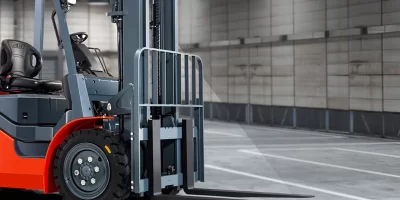




To choose a lead-acid forklift battery, match voltage, Ah capacity, tray size, weight, and charger. It must also deliver enough runtime to finish your hardest daily shift. Missing any specification costs you later in lost runtime, charger damage, or poor compartment fit. An underweight battery even reduces counterbalance, leaving your electric forklift unstable and unsafe.
Lead-acid remains the most common traction power source in many industrial warehouses. It costs less upfront than lithium-ion, and the technology is well understood. The trade-off is routine watering maintenance, slower charging, and shorter cycle life in heavy-duty use. This guide covers key buying specifications, charging and maintenance rules, and when to consider lithium-ion.

What Is a Lead-Acid Forklift Battery?
How Does a Lead-Acid Battery Produce Power?
Inside each cell sit lead-based plates soaked in a sulfuric acid electrolyte. During discharge, a chemical reaction between the plates and acid releases electrons. That electron flow creates the electrical current that drives your forklift. Charging the battery reverses this chemical reaction.
One lead-acid cell provides about 2 volts of nominal voltage. A traction battery connects many cells in series to reach the required system voltage. For example, a 48V battery is built from 24 cells.
Why Are Forklift Batteries So Heavy?
Lead is dense, and an industrial traction battery holds a lot of it. However, that heavy weight is not just a side effect. On many electric forklifts, the battery also acts as a critical counterweight. It keeps the truck stable when lifting heavy loads.
This counterweight role matters whenever you replace a battery. The forklift manufacturer sets a minimum and maximum battery weight for each model. A battery that is too light can make the truck tip more easily. This risk remains even when voltage and capacity look right on paper.
[Engineering Note] Never pick a replacement battery on voltage and Ah alone. Check the required weight range on the truck’s nameplate or in the manual. An underweight battery reduces counterbalance, creating a serious stability problem rather than a simple performance issue.
What Types of Lead-Acid Forklift Batteries Are Available?
Not all lead-acid designs behave the same in warehouse applications. Here is how the three main industrial options differ.
| Type | Construction | Maintenance | Typical use |
|---|---|---|---|
| Conventional flooded | Flat or standard plates, liquid electrolyte | Regular watering required | General-purpose, budget-focused fleets |
| Tubular-plate flooded | Positive plates built as tubes | Regular watering required | Daily deep-cycle industrial use |
| Thin-plate pure lead (TPPL) | Thin pure-lead plates, sealed design | Reduced; no routine watering on most designs | Applications where maintenance access is limited |
This table is a starting point, not a performance ranking. Tubular-plate batteries are common in heavy daily use because their plates handle deep cycling. TPPL designs can cut routine watering, but their charging and performance rules differ from flooded units. Always confirm those specific operating requirements with the battery manufacturer.
Follow one firm rule when sourcing a pack. Never substitute an automotive starter battery or generic sealed battery for an industrial traction battery. Starter batteries are built for short, high-current bursts. Forklifts need long, deep, repeated discharges across full shifts.
Which Lead Acid Forklift Battery Specifications Should You Check?
Battery Voltage: 24V, 36V, 48V, or 80V?
Common industrial battery voltages include 24V, 36V, 48V, and 80V. However, your forklift decides the required voltage, not you. System voltage must match what the forklift manufacturer specifies. The truck’s motor controller and charger are built around that exact figure.
Check the voltage on the truck’s data plate or the existing battery label. If the two numbers disagree, stop before ordering anything. Confirm the correct nominal voltage directly with the forklift manufacturer.
Battery Capacity: How Many Amp-Hours Do You Need?
Amp-hours (Ah) tell you how much electrical charge a battery can deliver. Think of Ah capacity as the size of your fuel tank. Real runtime still depends on load weight, discharge rate, ambient temperature, and battery age.
Be careful when comparing two forklift batteries by Ah alone. Capacity is rated under specific conditions, such as a 5-hour or 6-hour discharge rate. A battery quoted at a different discharge rate is not directly comparable. Always ask the supplier which rating basis they used.
A higher Ah number is not automatically better either. A larger battery might not fit inside the truck compartment. It may also fall outside the approved counterweight range for your forklift.
Battery Dimensions, Weight, and Compartment Fit
Length, width, and height determine whether the battery slides into the compartment. Next come smaller details like terminal position, cable routing, connector type, and mounting points. Even with the right voltage and Ah, the wrong cable reach makes a battery unusable.
Measure both the compartment and the old battery carefully. Note the exact plug type and cable length. Record the battery weight as well for your counterweight check.
How Does Battery Construction Affect Performance?
Internal construction directly affects daily warehouse performance. Tubular plates tolerate deep daily cycling better than standard flat plates. Sealed designs reduce watering labor but require strict charging profiles.
Treat general performance claims with care. Request the official specification sheet and cycle-life test basis rather than marketing claims. If a supplier cannot explain how cycle count was measured, do not rely on it.
How Do You Choose a Replacement Lead Acid Forklift Battery?
Start With the Forklift Make, Model, and Existing Battery Label
The fastest route to the right replacement is the data on your equipment. Record the forklift make, model, and serial number first. Then photograph the existing battery data label. That label usually lists nominal voltage, Ah capacity, weight, and the battery model.
If the label is worn or missing, measure the tray and check the forklift manual. Never guess specifications based on a similar-looking truck.

Match the Battery to Your Operating Duty Cycle
A battery built for single-shift work may struggle in a three-shift operation. Review your actual daily workload before selecting a capacity. Check operating hours per shift, load weights, shift count, and available charging windows.
A lead-acid forklift battery fits single-shift work with overnight charging very well. Multi-shift operations usually require a spare battery swap routine or a different battery chemistry. Flooded batteries need time to charge and cool before their next shift. Having a spare pack often keeps multi-shift trucks moving.
[Engineering Note] Do not size a battery to your average day. Size it to your hardest shift. Deeply discharging a lead-acid battery every shift shortens service life and causes early replacement.
Confirm Charger and Electrical Compatibility Before Ordering
The battery and industrial charger work together as one electrical system. Verify these four compatibility points before you place an order:
- Charger output voltage matches the battery’s nominal voltage.
- Charging current suits the battery’s amp-hour capacity.
- The charging profile matches the battery type (flooded, tubular, or TPPL).
- Connector type and cable polarity match your truck and charger.
A charger set for the wrong battery type can undercharge or overheat the pack. Either mistake shortens total battery life. If you keep an older charger, confirm it still suits the new replacement battery. Never assume an existing charger matches a new pack.
What Information Should You Send a Battery Supplier?
An accurate quote starts with clear technical information. Sharing complete details upfront reduces back-and-forth emails with your supplier.
| Item | What to provide |
|---|---|
| Forklift | Make, model, serial number |
| Existing battery | Model, nominal voltage, label photo |
| Size and weight | Compartment dimensions, required weight range |
| Capacity | Required Ah and rating basis, if known |
| Electrical | Connector type, current charger model |
| Operation | Shifts per day, workload, charging windows |
| Commercial | Budget, delivery location, timing |
Use this table as your pre-quote checklist. Sending even five of these items puts you ahead of most buyer inquiries.
Looking for a battery pack that fits your equipment?
Explore Product CatalogHow Much Does a Lead Acid Forklift Battery Cost?
What Determines the Purchase Price?
There is no single market price for an industrial traction battery. Quotes vary widely based on voltage, Ah capacity, plate construction, and tray size. Condition (new or reconditioned), warranty length, delivery, and included chargers or accessories also affect pricing.
Always compare quotes on an equal specification basis. A cheaper quote may offer lower Ah capacity, a shorter warranty, and no charger. That is not the same value as a higher quote that includes all three.
Why Is the Purchase Price Only Part of the Cost?
The upfront sticker price is only the first expense you see. Most operating costs show up over the following years. Total cost of ownership (TCO) includes:
- Initial purchase price and future battery replacement.
- Electricity consumption and charger energy efficiency.
- Watering, cleaning, and routine maintenance labor.
- Spare batteries and safe battery-swapping equipment.
- Chargers and a dedicated, ventilated charging area.
- Unplanned downtime when a forklift waits for a charge.
- End-of-life battery disposal or lead recycling.
A lead-acid forklift battery usually wins on upfront purchase cost. Lifetime cost depends on workload intensity, local labor rates, and how long you keep the truck. Do not trust any source—including ours—claiming one chemistry always delivers a lower TCO. Run the numbers using your own warehouse operating data.
How Should You Charge and Maintain a Lead-Acid Forklift Battery?
Understand Standard Charging, Opportunity Charging, and Equalization
Most lead-acid fleets rely on conventional charging. The battery receives a full charge after the shift, then rests to cool down. You will often see “8 hours charging plus 8 hours cooling” quoted as a standard routine. Treat that schedule as a common example, not a universal rule for every battery.
Opportunity charging means topping up the battery during short shift breaks. Fast charging pushes higher current to shorten charging wait times. Neither method suits every lead-acid battery design. Done improperly, both raise internal heat and wear out the lead plates faster.
Equalization is a deliberate extended charge that balances voltage and specific gravity across all cells. Run an equalization charge only when the battery manufacturer recommends it. Stick strictly to the frequency specified in the battery manual.
[Engineering Note] Always follow the battery manufacturer’s charging instructions rather than a generic internet schedule. Overcharging boils off electrolyte and heats the plates. Undercharging allows lead sulfate crystals to build up on the plates. Both mistakes cut battery service life.

When Should You Add Water to a Flooded Forklift Battery?
Flooded batteries lose water during charging, and the plates must stay covered by electrolyte. However, there is no universal watering schedule. Watering frequency depends on battery design, charging habits, and ambient warehouse temperature.
Always follow your battery manufacturer’s watering procedure. Add distilled or approved water after charging—not before—because rising electrolyte can overflow during a charge. Do not underfill or overfill the cells. Low levels expose the plates, while overfilling spills acid and corrodes the battery tray.
Sealed and TPPL batteries do not need routine watering. Never open a sealed unit unless the manufacturer’s manual explicitly instructs you to.
What Routine Inspections Help Prevent Premature Failure?
A quick routine inspection catches most battery problems early. Check these key areas regularly:
- Terminals and cables for corrosion, loose connections, or damaged insulation.
- The battery case and tray for cracks, bulges, or acid leaks.
- Electrolyte level and clarity inside flooded battery cells.
- Top-of-battery cleanliness, since acid residue and dirt create electrical leakage paths.
- Charging behavior, such as unusual heat or cycles that fail to complete.
Keep a simple maintenance log for each battery. A gradual drop in runtime across several weeks reveals far more than one rough shift.
What Safety Precautions Are Essential?
Charging a lead-acid battery releases flammable hydrogen gas. Always charge batteries in a well-ventilated area. Keep sparks and open flames away, and prohibit smoking near the charging station.
Because the electrolyte contains sulfuric acid, wear eye protection, acid-resistant gloves, and protective clothing during handling or watering. Keep an eyewash station and an acid spill kit ready nearby. Use rated lifting equipment whenever moving heavy traction batteries.
For regulatory guidance, review OSHA’s standards on electrical power sources for powered industrial trucks. Always follow your local workplace safety rules and the manufacturer’s documentation.
How Long Does a Lead-Acid Forklift Battery Last?
What Factors Affect Battery Service Life?
Industry estimates often cite 1,000 to 1,500 charge-discharge cycles for a lead-acid forklift battery. Treat that range as a rough general estimate, not a performance promise. Actual service life depends on:
- Battery design and internal plate construction.
- Depth of discharge (DoD) during each shift.
- Charging discipline and routine watering quality.
- Ambient operating and charging temperatures.
- Daily workload and shift duty cycle.
Cycles, calendar years, and truck operating hours measure service life differently. Under heavy multi-shift use, a battery reaches its cycle limit in far fewer calendar years. Review the warranty terms carefully to see how the manufacturer defines service life.
What Are the Signs That a Battery Needs Replacement?
Common warning signs include shorter shift runtime and excessive heat during charging. You may also notice trouble reaching a full charge. Visible damage like case cracks, cell swelling, or heavy terminal corrosion also points to wear.
Still, do not blame the battery too quickly. A faulty charger, heavier loads, or loose cables can cause the exact same symptoms. Inspect the charger and electrical connections first, then load-test the battery.
Lead Acid vs. Lithium-Ion Forklift Batteries: Which Is Right for Your Operation?
When Does a Lead Acid Forklift Battery Make Sense?
Lead-acid is a strong choice when your upfront equipment budget is tight, and workloads stay predictable. It works well when trucks sit idle long enough for a full charge and cooldown. Having an existing charging room and maintenance routine makes it even more practical for single-shift fleets.
However, you do give up convenience. You lose faster charging, low-maintenance operation, and flexible opportunity charging during short breaks.
When Should You Consider a Lithium-Ion Battery System?
Lithium-ion makes sense for high-utilization fleets running multiple daily shifts. It also fits warehouses with frequent break-time charging windows or high watering and swap labor costs. If trucks sit waiting for batteries to charge and cool, reduced downtime can justify the higher upfront price.
What you give up is the lower initial purchase cost. Depending on your forklift, you may also face extra ballast weight and integration work. Lithium-ion is a poor fit if your truck needs costly counterweight or interface modifications. Light-duty fleets may also never recover the higher purchase price.
What Must Be Checked Before Replacing Lead-Acid With Lithium-Ion?
Converting a forklift is more complex than swapping one battery box for another. Before you decide, verify every item in the table below.
| Check | Why it matters |
|---|---|
| System voltage | Must match the forklift’s electrical requirements |
| Size and weight | Lithium is much lighter, so counterweight may need to be added |
| Truck interface | Connectors, mounting, and truck communication |
| Charger | Must match the chemistry and the battery’s charging profile |
| BMS | Provides monitoring and protection for the lithium cells |
| OEM approval | Some trucks require manufacturer sign-off |
| Full-system cost | Battery, charger, integration, warranty, and support |
Overlooking any row in that table can stop a conversion project. Treat each requirement as a mandatory engineering gate, not a wish list.
The Battery Management System (BMS) deserves special attention here. It monitors cell voltage, current, and temperature to protect the lithium pack. However, a BMS cannot make an incompatible forklift or charger safe. Reliable protection depends on the entire power system being engineered to work together.
This is where AYAA TECH can help. We build Smart BMS units and custom battery packs. Our SOC (State of Charge) algorithm compensates for ambient temperature and keeps estimation error at 5% or less. That gives your team remaining runtime numbers they can actually plan around.
Heat management is the other major factor in lithium battery packs. We space MOSFETs and sampling resistors evenly and apply quality thermal pads or gel. Where enclosure space allows, we add aluminum or copper structures to move heat away. We always evaluate whether lithium suits your specific truck application by application, rather than assuming.

How Can You Find a Battery and Charger That Fit Your Forklift?
Choose a Supplier That Can Evaluate the Complete Power System
A battery that looks right on paper can still fail in the warehouse. It must work seamlessly with your charger, forklift, and onboard control electronics. Choose a supplier that asks about the complete system, not just a part number.
Request a Quote With the Right Technical Information
Send the technical details from the checklist above when requesting a quote. Include your forklift model, existing battery label, compartment dimensions, weight range, connector, charger, and shift pattern. If an unusual compartment or interface prevents a standard fit, a custom pack may be the better route. AYAA can review your pack and BMS requirements together to confirm what is practical.
Standard batteries don’t fit your truck? Let’s design one that does.
Request a Custom Battery SolutionFinal Checklist Before Buying a Lead-Acid Forklift Battery
- Nominal voltage matches the forklift manufacturer’s specification.
- Amp-hour capacity is confirmed along with its rated discharge-hour basis.
- Dimensions and total weight fit the compartment and the truck’s required counterweight range.
- Connectors and charger profile are compatible with the specific battery type.
- Duty cycle and charging schedules are realistic, including spare batteries for multi-shift fleets.
- Maintenance labor and total operating cost have been compared alongside the purchase price.
- Safety equipment, warranty terms, delivery, and technical support are clear before you commit.
The best battery is neither the biggest nor the cheapest option. It is the one that meets your truck’s technical specifications and your daily shift needs. Most importantly, it delivers reliable power at a lifetime cost your operation can accept.
FAQ
1. What Size Battery Is Best for a Forklift?
“Size” covers four specifications at once: nominal voltage, Ah capacity, physical dimensions, and weight. The best battery matches your forklift manufacturer’s requirements across all four metrics. It must also deliver enough runtime to finish your hardest shift. Start by checking the truck’s data plate and the existing battery label.
2. What Type of Acid Is Used in a Lead-Acid Forklift Battery?
Sulfuric acid diluted in water forms the liquid electrolyte. In flooded batteries, this electrolyte is hazardous and must be kept at the proper level. Always wear eye protection, acid-resistant gloves, and protective clothing during battery maintenance. Follow your manufacturer’s handling and acid spill procedures strictly.
3. How Long Should a Lead Acid Forklift Battery Last?
Commonly quoted figures run around 1,000 to 1,500 charge-discharge cycles. However, that figure is an indicative range rather than a guarantee. Actual lifespan depends on battery design, depth of discharge, charging practice, temperature, and workload. Always check the warranty terms and the manufacturer’s cycle-life test basis.
4. How Much Does a New Lead Acid Forklift Battery Cost?
Pricing varies by voltage, Ah capacity, plate construction, tray size, and warranty length. Costs also depend on whether a charger, accessories, or freight delivery are included. Compare supplier quotes using identical technical specifications. Evaluate total cost of ownership over the battery’s lifespan, not just the initial price tag.
5. How Often Should You Water a Lead Acid Forklift Battery?
Only flooded lead-acid batteries require routine watering. The watering schedule depends on battery design, charging method, and warehouse temperature. Always follow the battery manufacturer’s specific watering instructions. Sealed and TPPL designs generally should never be opened for watering.
6. Can You Replace a Lead Acid Forklift Battery With a Lithium-Ion Battery?
Often yes, but conversion requires more than a simple drop-in swap. You must verify system voltage, counterweight requirements, compartment fit, charger compatibility, and BMS integration. You also need to check OEM approval rules for your specific truck. Work through the conversion table above before making a decision.
7. Are Lead Acid Forklift Batteries Becoming Obsolete?
No, they remain widely used across industrial warehouses. A lead-acid forklift battery still suits single-shift, budget-conscious operations with predictable overnight charging windows. Lithium-ion offers clear advantages under heavy, multi-shift duty cycles. The right choice depends on your daily workload and total operating costs, not industry trends.


