










Why a Smart Battery Charger Must Include BMS
Everything now depends on effective lithium battery technology as the world’s electrification speeds up, including 드론, e-bikes, scooters, energy-storage packs, forklifts, AGVs, and power banks.
The smart battery charger is the unsung hero of this ecosystem.
Instead of “pushing electricity blindly,” a new generation of chargers senses, determines, calculates, and protects.
However, many people ignore an important piece of technology:
Without a Battery Management System (BMS), a smart battery charger is not truly “smart.”
Without BMS, charging lithium-ion and LiFePO4 cells can result in thermal runaway, swelling, cell imbalance, and a shorter lifespan.

What Defines a Smart Battery Charger? Core Parameters Explained
A smart battery charger is defined by four measurable parameters:
| Core Parameter | What It Means | 왜 중요한가 |
|---|---|---|
| Input Voltage (AC) | Power source (commonly AC 110V / AC 220V) | Global compatibility & charging locations |
| Output Voltage (DC) | Matching the battery pack’s rated voltage (e.g., 12V / 24V / 48V / 52V / 72V) | Incorrect voltage → battery damage |
| Maximum Output Power (W) | The highest wattage the charger delivers | Directly affects charging time |
| Maximum Charging Current (A) | How much current flows into the battery during charging | Higher current = faster charge but more heat |
Input Voltage Explained: What Does AC 110V vs. AC 220V Actually Mean?
AC 110V → used in USA, Canada, Japan
AC 220V → used in EU, China, Australia, India, most of Asia
A smart battery charger needs to make it clear if dual-input is supported.
The ideal specification is a wide voltage input of 100–240V that enables worldwide use without the need for adapters or transformers.
Deep Dive – Understanding AC 110V & 220V and Their Impact
➤ What is AC Power?
Wall outlets all across the world use alternating current, which is energy whose direction alternates periodically.
➤ Why Do Countries Use Different Voltage?
Historical infrastructure decisions created two global standards:
U.S. adopted 110V for safety
Europe adopted 220V for efficiency → higher voltage delivers more watts with less current
➤ How Does AC Voltage Affect a Smart Battery Charger?
| Condition | Impact |
|---|---|
| Low input voltage | Charger loses power → slower charging |
| High voltage | Higher wattage achievable → fast charging |
| Voltage mismatch | Heat, sparks, fuse burn, product failure |
➤ How To Select the Right Charger for Voltage?
✔ Prefer wide-range input smart battery charger (100-240V)
✔ Ensure plug type matches region
✔ Check UL / CE / FCC / PSE safety certification
✔ Avoid travel transformers unless absolutely required
Relationship Between Maximum Output Power and Charging Current
To truly understand charger performance, you must internalize one formula:
Power (W) = Voltage (V) × Current (A)
When Does Power Matter?
For high-cell-count (S) packs:
48V eBike lithium pack
52V energy storage battery
72V drone packs
96V forklift systems
Higher voltage x high power → less charging time.
Example:
A 52V 20Ah battery charged by a 200W charger
200W ÷ 52V = 3.84A charging current
Full charge ≈ 20Ah ÷ 3.84A ≈ 5.2 hours
When Does Current Matter?
Large capacity, low voltage packs:
Power bank 1S configuration
Medical device portable batteries
DIY home-energy systems
High current (A) speeds up charging but increases:
⚠ heat inside cells
⚠ aging rate
⚠ fire risk if unprotected
Where Does BMS Come Into This Equation?
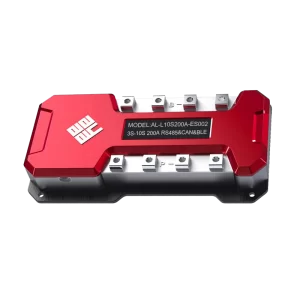
The battery pack’s brain is called a BMS (Battery Management System).
It interacts with the intelligent battery charger to:
| BMS Function | Impact |
|---|---|
| 세포 균형 조절 | Ensures each cell receives equal charge |
| Over-current & short-circuit protection | Prevents meltdown |
| 온도 모니터링 | Stops charging if overheating |
| SOC / SOH estimation | Calculates State of Charge & Health |
| Smart communication (CANBUS / SMBUS / UART) | Enables real-time control & system monitoring |
Without BMS, a smart battery charger cannot:
detect overheating
prevent over-charging
adjust charging current dynamically
maximize battery life
Consequently, a smart battery charger needs to have a BMS or be able to connect with one externally.
How Do Smart Chargers Communicate with BMS?
Modern smart systems use:
CANBUS → vehicles, drones, robotics
SMBUS / I2C → laptops, medical devices
UART / Bluetooth → scooters, DIY solar packs
APP / Cloud → remote fleet monitoring
Example Workflow
Battery pack reports SOC = 80%
BMS sends command → reduce current for slow-charge
Charger automatically lowers current from 10A → 2A
Battery reaches 100% with zero stress
This is “intelligent charging logic”
This is why a smart battery charger must include BMS
What Technology Should a Smart Battery Charger Have?
Core Technical Features
| Technology | Why Needed |
|---|---|
| Balanced charging | Prevents uneven cells / swelling |
| Multi-stage charging | CC-CV algorithm improves battery life |
| Heat-dissipation design | Ensures long-term stable operation |
| Smart DC conversion | Improves efficiency & reduces energy loss |
| Communication with BMS | Enables real-time dynamic power control |
Functional Features Needed
| 기능 | Business Value |
|---|---|
| Multi-voltage battery compatibility | Reduces SKU inventory |
| LCD / digital display | Transparent charging information |
| Portable design | Field charging, service maintenance |
| Wireless APP | Remote fleet diagnostics |
| UL / CE safety certification | Mandatory for mass-market sales |
Practical Selection Guide – How Should Businesses Choose?
✔ First define battery specs
(voltage / S count / capacity Ah)
✔ Calculate required wattage
Battery size (Wh) ÷ desired hours of charge
✔ Match charging current
(max recommended charge rate = 0.5C unless otherwise specified)
✔ Ensure smart battery charger includes BMS or can read BMS signals
✔ Choose wide-input (100-240V) for global business deployment
✔ Choose tiny chargers for personal gadgets and high-capacity units for electric vehicles.
Case Use Scenarios – BMS + Smart Chargers Deliver Real Value
▪ Fleet eBike Rental Companies
Smart charger + BMS → automated temperature shut-off, longer battery life → reduces warranty cost.
▪ Drone Manufacturing
Balancing + CANBUS communication prevents mid-air shutdown → protects brand reputation.
▪ Home Solar Energy Storage
Smart slow charge during low-tariff hours → lower electricity bills.
▪ Medical Device Power Backup
BMS ensures zero-fault tolerance for patient-critical equipment.
Smart Battery Charger Must Include BMS – The Strategic Insight
A smart battery charger is only truly smart when it:
Communicates with BMS
Controls voltage and current dynamically
Prevents thermal and over-charge risks
Extends battery lifecycle and ROI
Supports multi-region voltage & certifications
Enables business-grade reliability
Ayaa Technology offers engineering, customization, and manufacturing support for worldwide lithium-battery applications to businesses looking for OEM/ODM battery solutions, smart battery charger development, or BMS-integrated systems.
자주 묻는 질문
Q1:What does a smart battery charger do?
A1:Using mains power, a smart battery charger enables a user to maintain and recharge the battery in their car.
Smart chargers are designed to recondition, recharge, and then maintain different battery types, in contrast to conventional battery chargers.
Q2:Can you leave a smart battery charger on all the time?
A2:It is possible to leave a smart charger connected all night.
LiFePO4, NMC, LCO, LMO, LTO, solid-state, and lithium metal packs may all be safely charged with smart chargers, which also prevent overcharging.
Q3:Are smart EV chargers worth it?
A3:Smart EV chargers, in contrast to conventional chargers, are cloud-connected, enabling you to effectively monitor and manage your energy consumption.
These chargers, sometimes referred to as “communicating units,” are environmentally benign and contribute to cost savings while protecting the resources of our planet.
Q4:Can you overcharge a car battery with a smart charger?
A5:They have a number of extra functions and offer numerous charging stages for more effective charging, which prolongs the life of a battery.
Additionally, when the battery is full, they will convert to a trickle charge, eliminating the possibility of overcharging and damaging your battery.
Q5:What is the 80 20 rule for charging batteries?
A5:The 20/80 charging rule recommends not charging lithium-ion batteries (phones, EVs) above 80% and below 20% in order to reduce stress, maintain electrode health, and significantly extend the battery’s lifespan.
This rule is still beneficial even though it is less significant with today’s batteries and software.
When the battery is fully charged to 100% or drained to 0%, especially during the last 20% of charging, its chemistry is strained; however, when it is held in the medium, it stays healthier for a longer period of time.
문의하기
최신 뉴스
- Active Balancing: How It Works, Topologies, and Trade-Offs | 2026 – AYAA
- Why Active Balancing BMS Is Becoming the New Standard for High-Performance Lithium Battery Systems
- Top 5 LFP BMS Brands Compared: Which One Is Right for You?
- 21 Smart BMS Features: Key Functions & Capabilities | 2026 – AYAA
- BMS 연결 다이어그램 이해: MOSFET 제어부터 셀 밸런싱까지
공유
뉴스 추천
-
-

-
-
-
BMS 연결 다이어그램 이해: MOSFET 제어부터 셀 밸런싱까지
08/05/2026


