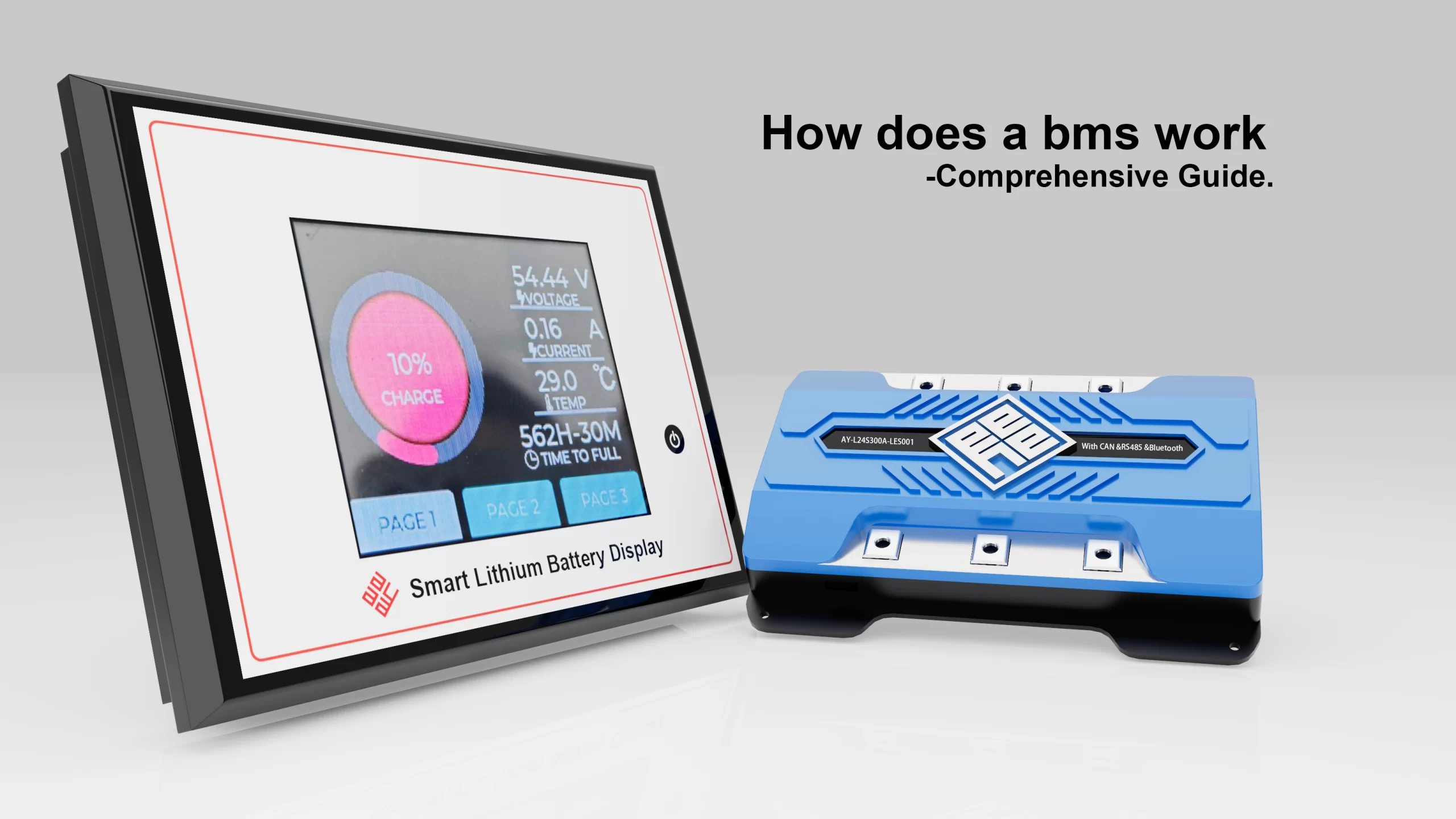








LiFePO4 Battery BMS Selection Guide: What to Look for in 24V Battery Systems
One thing is evident as lithium iron phosphate (LiFePO4) technology gains popularity in energy storage, electric mobility, marine systems, キャンピングカー, solar installations, and industrial power applications: a battery is only as good as the system that controls it.
Although LiFePO4 cells are renowned for their extended cycle life, safety, and stability, these benefits can only be fully realized when combined with a lifepo4 battery bms that is appropriately constructed.
This is particularly true for 24V systems, where a closely controlled design of several cells is required.
Compared to lower-voltage systems, a 24-volt リン酸鉄リチウム電池 offers greater power and efficiency, but it also adds more complexity.
As system voltage and capacity rise, cell balance, voltage monitoring, current management, and thermal protection become increasingly important.

LiFePO4 Battery Management System Overview
Why is a dedicated BMS essential for LiFePO4 batteries?
Although LiFePO4 batteries are frequently referred to be “safer” than other lithium chemistries, safety is not a given.
Extremes in temperature, overvoltage, undervoltage, and overcurrent can still harm cells or reduce their lifespan.
The battery system’s control center is a lifepo4 battery BMS.
It makes sure that every cell in the battery pack functions effectively, enforces safe operating limits, and continuously checks electrical and thermal data.
Because several cells are connected in series in a 24V system, this synchronization is crucial.
What Is a LiFePO4 BMS?
What does a LiFePO4 BMS actually do?
An electronic system created especially to control lithium iron phosphate battery packs is called a LiFePO4 battery BMS.
Its primary duties consist of:
Monitoring individual cell voltages
Controlling charge and discharge current
Protecting against overcharge and over-discharge
Managing temperature limits
Balancing cells to prevent imbalance
The BMS makes sure that every cell in a 24 volt lifepo4 battery stays within safe voltage ranges, preventing weak cells from depressing the entire pack.
Why can’t LiFePO4 batteries operate safely without a BMS?
Without a BMS, even a stable chemistry like LiFePO4 is vulnerable to:
Uneven cell aging
Capacity loss due to deep discharge
Overcharging during prolonged charging cycles
Thermal stress under high load
The BMS is what transforms a collection of cells into a reliable energy system.
Key Components and Functions of a LiFePO4 BMS

How does voltage monitoring protect the battery?
One of a lifepo4 battery BMS’s most crucial features is voltage monitoring.
Every LiFePO4 cell has a limited voltage window in which to function.
Degradation speeds up and failure risk rises when this range is exceeded.
To guarantee consistent performance across the pack, individual cell voltages in a 24 volt lifepo4 battery BMS are continuously monitored.
Why is current control critical in 24V systems?
increased power output is frequently made possible by increased system voltage.
Nevertheless, high current can still cause internal components to become stressed and produce heat.
By limiting charge and discharge current to acceptable levels, the BMS safeguards the battery and any attached devices.
How does temperature monitoring improve reliability?
Internal resistance, long-term deterioration, and the rate of chemical reactions are all impacted by temperature.
Temperature sensors are used by a high-quality BMS to dynamically modify operational restrictions, which is crucial in outdoor or high-capacity installations.
What role does cell balancing play?
One of the main reasons for early battery failure is cell imbalance.
To prevent any one cell from being overstressed, the BMS balances cell voltages.
Effective balancing is essential for long-term dependability in 24V systems.
Advantages of LiFePO4 BMS over Other Lithium-Ion Battery BMS
Why is LiFePO4 chemistry easier to manage?
Compared to many other lithium chemistries, LiFePO4 cells feature a flatter voltage curve and more thermal stability.
As a result, the BMS can function with larger safety margins.
How does LiFePO4 BMS improve cycle life?
A LiFePO4-specific BMS can assist in achieving thousands of cycles without appreciable capacity loss by enforcing conservative voltage restrictions and limiting deep discharge.
Why is safety more predictable?
LiFePO4 is far less prone to thermal runaway than cobalt-based lithium chemistries.
A well-configured BMS lowers risk even more, making it appropriate for industrial, mobile, and residential applications.
Understanding LiFePO4 BMS Configuration
How are cells arranged in a 24V LiFePO4 battery?
Eight cells, each with a nominal voltage of about 3.2V, are usually connected in series to form a 24V LiFePO4 battery.
This particular setup must be supported by the BMS’s design.
Why do voltage and capacity options matter?
The battery pack’s voltage and capacity must coincide with the BMS.
While big systems raise costs without providing benefits, undersized BMS units may restrict performance.
How important is proper wiring and connection?
BMS failure is frequently caused by improper wiring.
Accurate sensing is ensured by proper connections, which also stop false alarms and uneven balancing.
Installing and Setting Up a LiFePO4 BMS
Where should the BMS be installed?
The BMS should be installed in a location that:
Allows adequate ventilation
Minimizes vibration
Protects against moisture and dust
Placement also has an impact on signal accuracy and wiring length in a 24 volt lifepo4 battery system.
How should batteries and wiring be connected?
Connections must adhere according to the wiring schematic provided by the manufacturer.
Temperature sensors, power wires, and balance leads must all be securely fastened and routed.
Why is programming and configuration important?
Many modern BMS units are programmable. Proper configuration ensures:
Correct voltage thresholds
Accurate current limits
Appropriate temperature protection
How does integration with other systems improve performance?
The BMS allows for more intelligent power regulation and system-level optimization whether combined with inverters, chargers, or energy management systems.
The Importance of LiFePO4 BMS in Lithium-Ion Batteries
How does a BMS improve efficiency?
The BMS guarantees more usable energy every cycle by reducing energy loss from imbalance, resistance, and overheating.
Why does optimized performance depend on BMS control?
System stress is decreased and connected device performance is enhanced by stable voltage and regulated current delivery.
How does BMS extend battery lifecycle?
A battery’s cycle life is influenced by more than just its chemistry.
A well-thought-out lifepo4 battery BMS shields the battery from factors that lead to premature aging.
Choosing the Best BMS for You
What specifications should you prioritize?
Key selection criteria include:
Supported voltage and cell count
Continuous and peak current ratings
Cell balancing method
Communication capabilities
Environmental protection rating
Why is 24V compatibility non-negotiable?
For series-connected cells, a 24 volt Lifepo4 battery BMS needs to be specifically made.
Inaccurate monitoring and risky operation may arise from using an incompatible BMS.
How do communication features add value?
Real-time monitoring and diagnostics are made possible by advanced BMS systems’ Bluetooth, CAN, or RS485 connection capabilities.
Making the Most of Your BMS
How can efficiency and battery life be maximized?
The best long-term outcomes are obtained when intelligent BMS control is used in conjunction with operating within approved voltage and temperature ranges.
How should alarms and faults be handled?
Early warning signs are called alarms.
Ignoring them frequently results in irreparable harm.
These notifications are provided by the BMS so that quick remedial action can be taken.
Why is regular maintenance still important?
Periodic inspections guarantee electrical integrity, sensor accuracy, and adequate ventilation even with automation.
When should you consider upgrading your LiFePO4 BMS?
Upgrading makes sense when:
System capacity increases
Power demands grow
Monitoring and communication needs expand
An upgraded BMS often delivers immediate performance and safety benefits.
Why the Right LiFePO4 BMS Defines Safety, Performance, and Long-Term Value in 24V Systems
Although a LiFePO4 battery has good chemistry, chemistry by itself cannot provide dependability.
The Ayaa BMS becomes the real deciding factor in 24V systems, when electrical needs and complexity rise.
An appropriately chosen and set lifepo4 battery BMS defines the system’s performance over time, from cell balancing and thermal protection to efficiency improvement and lifecycle extension.
Selecting the Ayaa BMS is the cornerstone of secure, effective, and long-lasting energy storage; it is not an add-on choice.
よくある質問
Q1:Do LiFePO4 batteries need BMS?
A1:Yes, even though LiFePO4 batteries are safer than other lithium types, a Battery Management System (BMS) is essential to prevent overcharging, overdischarging, and overcurrent, ensuring cell balance, safety, and maximizing battery lifespan; neglecting it runs the risk of irreversible damage, reduced capacity, or even fire.
Q2:What is the 80 20 rule for lithium batteries?
A2:In order to greatly increase battery longevity by lowering chemical stress and deterioration, the 80/20 rule for lithium batteries suggests that you maintain the charge level between 20% and 80% for everyday use, avoiding deep discharges (below 20%) and extended full charges (above 80%).
Q3:BMSをリセットしないとどうなりますか?
A3:BMS(バッテリー管理システム)の故障によりバッテリーが過熱すると、熱暴走によって爆発する可能性があります。.
これは、あなたの車に修復不可能な損傷を与えるだけでなく、あなた自身や他の人々に危害を加える可能性があります。.
In addition to impairing engine performance, an overheated automobile battery can release smoke and unpleasant sulfur odors.
Q4:How to wake up BMS on a lithium battery?
A4:A compatible lithium charger (often with a recovery mode) or a brief connection in parallel with another charged battery, which sends a signal that permits it to accept a proper charge again, are two common ways to awaken a sleeping lithium battery BMS (Battery Management System) by triggering its protection circuit with a small voltage or current.
Always use the proper voltage and take safety precautions.
Q5:BMSなしでLiFePO4を充電できますか?
A5:LiFePO4 batteries may overheat or overcharge without warning in the absence of a BMS, which could result in damage or unplanned failures.
It is crucial to make sure these batteries are not subjected to excessive heat and are fully charged.
お問い合わせ
最新ニュース
- Why Does a 9 Volt Battery Drop Voltage Under Load? 2026 – AYAA
- AGM Battery vs Standard Battery: Key Differences: 2026 – AYAA
- How to Safely Configure a Bat-BMS App Manual? 2026
- Understanding Battery Symbolism: A Complete Guide for Engineers and Designers
- Lithium vs. Lead-Acid Golf Cart Batteries: 10-Year Cost Analysis
共有
ニュースおすすめ
-

BMS接続図の理解:MOSFET制御からセルバランシングまで
08/19/2025 -
リチウム鉄リン酸 BMS ブランド トップ 5 比較: あなたに最適なのはどれ?
05/16/2025 -
スマートBMSの仕組み-総合ガイド。
03/11/2025 -
なぜ従来の電力源ではなく太陽エネルギー・システムを選ぶのか?
03/31/2025 -