What Is Smart BMS & How It Works on Forklift Battery
9464
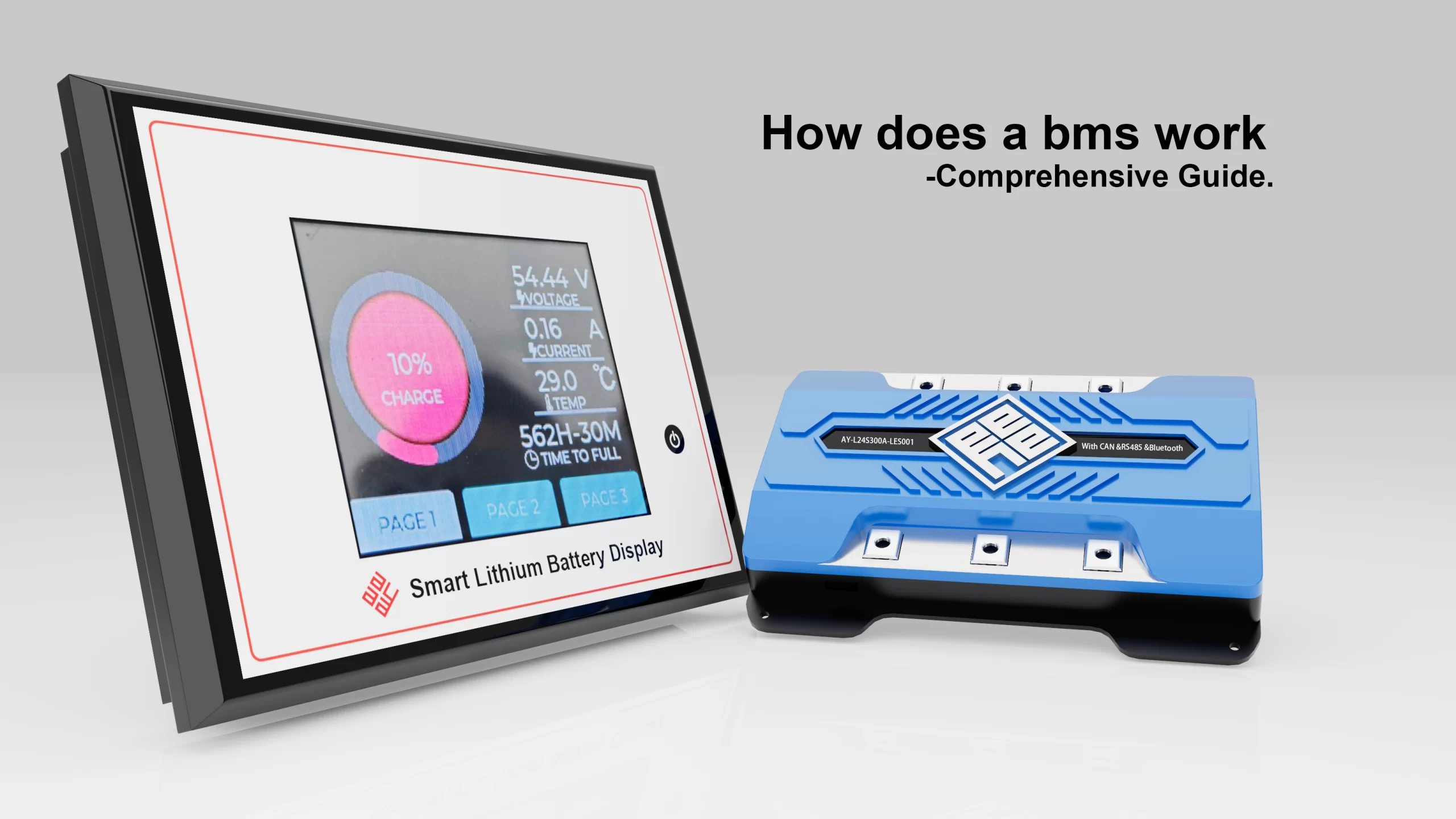
A Battery Management System (BMS) is the electronic control center of a battery pack. It monitors voltage, current, temperature, and battery status in real time. Modern BMS technology helps prevent overcharge, over-discharge, overheating, and cell imbalance, making battery systems safer and more reliable.
For a forklift battery, the BMS plays an even more important role. Electric forklifts operate under heavy loads, long working hours, and frequent charging cycles. Without an effective battery management system, battery capacity can drop quickly, maintenance costs increase, and unexpected downtime may occur. A Smart BMS helps forklift operators improve battery runtime, extend battery life, and reduce maintenance requirements.
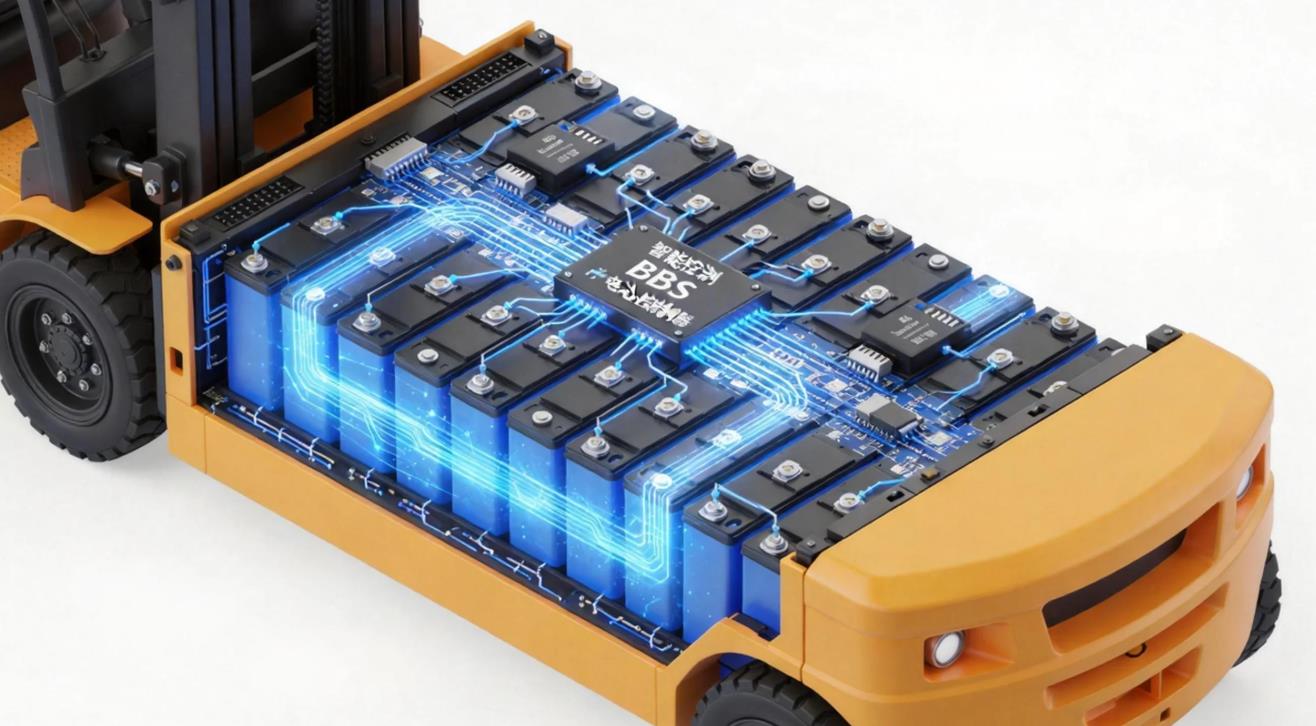
Forklift battery with Smart BMS system
What Is a Smart BMS?
The earliest battery management systems were relatively simple. They mainly provided:
·Voltage monitoring
·Basic protection
·Simple fault alarms
As battery systems became larger and more complex, traditional BMS designs could not keep up. This was especially true for electric forklifts and other handling equipment. Today, Smart BMS technology includes:
·Real-time battery monitoring system
·Active balancing
·State of Charge (SOC) calculation
·Battery diagnostics
·Battery analytics
·CAN Bus communication
·Cloud-based battery data monitoring
·Battery telemetry
·Predictive maintenance
A Smart BMS will collect battery data and provide operators with a complete picture of battery health.
Forklift battery Smart BMS monitoring system
1.1 Core Functions of Smart Battery Management System
Fonction
But
Cell Voltage Monitoring
Prevent cell imbalance
Temperature Monitoring
Prevent overheating
Overcharge Protection
Protect battery life
Over-discharge Protection
Prevent capacity loss
Équilibrage actif
Improve pack consistency
SOC Calculation
Accurate remaining capacity
Battery Analytics
Support maintenance decisions
Interface de communication
Connect the charger and vehicle systems
1.2 What Happens When a Forklift Battery Has No Smart BMS?
Without a Smart BMS, several problems can occur:
·Reduced battery capacity
·Shorter battery runtime
·Faster battery aging
·Unplanned battery replacement
·Safety risks
·Unexpected forklift shutdowns
·Increased maintenance costs
For warehouse forklift fleets, even a single battery failure can disrupt operations and reduce productivity.
Forklift Battery Industry Trends: From Traditional Batteries to Smart BMS
For decades, lead-acid batteries dominated the forklift industry.
Traditional lead-acid batteries have some natural protection characteristics:
·Self-limiting charging behavior
·Lower sensitivity to cell voltage differences
·Lower hardware cost
Because of these characteristics, early forklift battery systems often operated without a dedicated battery management system.
However, modern forklift battery packs contain many batteries connected in series.
This creates the well-known “weakest cell effect.”
When one battery becomes weaker than the others:
·Overall battery capacity drops
·Charging efficiency decreases
·Runtime becomes inconsistent
·Battery life shortens
As a result, Smart BMS solutions are becoming standard in both lead-acid and lithium forklift battery systems.
The shift is even faster in:
·Electric forklift fleets
·Automated warehouses
·AGVs
·Electric material handling equipment
Industrial truck applications
Many new Lithium forklift batteries and LiFePO4 forklift battery systems now integrate intelligent BMS technology as a standard feature.
Common Forklift Battery Problems and How Smart BMS Solves Them
Smart BMS improves forklift battery performance
3.1 Overcharge and Over-discharge
Overcharging can cause:
·Plate corrosion
·Excessive gas generation
·Water loss
Over-discharging can lead to:
·Permanent capacity loss
·Increased internal resistance
·Reduced battery life
A Smart BMS automatically disconnects charging or discharging when safety limits are reached.
3.2 High Temperature
Forklift batteries generate significant heat during charging and operation.
Excessive temperature can:
·Reduce battery capacity
·Accelerate aging
·Increase failure risk
A battery protection system keeps monitoring temperature and triggers alarms or protective actions.
3.3 Cell Imbalance
In multi-series battery packs, small differences between cells gradually increase.
Active balancing helps:
·Improve consistency
·Increase usable battery capacity
·Extend service life
3.4 Water Maintenance for Lead-Acid Batteries
Lead-acid forklift batteries require regular distilled water replenishment.
A Smart BMS can:
·Monitor water levels
·Send maintenance reminders
·Reduce human error
3.5 Sulfation Prevention
Long periods of storage or insufficient charging can cause sulfation.
Smart charging algorithms and balancing functions help reduce voltage differences and slow capacity degradation.
3.6 Accurate SOC Estimation
SOC is one of the most important battery parameters.
Accurate SOC allows operators to:
·Predict battery runtime
·Schedule charging
·Avoid deep discharge
AYAA Smart BMS solutions can achieve SOC accuracy ≤3%, while many conventional systems remain around ≤5%.
Common Forklift Types and Typical Battery Configurations
Forklift Type
Typical Voltage
Typical LiFePO4 Series
Hand Pallet Truck
24V
8S
Low Lift Pallet Truck
24V
8S
High Lift Stacker
24V-36V
8S-12S
Reach Truck
48V
15S-16S
Warehouse Forklift
48V
15S-16S
Counterbalance Forklift
48V-80V
16S-26S
Heavy Duty Lift Truck
80V
25S-26S
Automated Industrial Truck
24V-48V
8S-16S
Forklift batteries commonly operate at 24V, 36V, 48V, and 80V, depending on vehicle size and load requirements.
Why AYAA ES-001 Is Ideal for Many Forklift Battery Packs
A typical 48V warehouse forklift uses a 15S or 16S LiFePO4 battery pack.
This configuration falls perfectly within the ES-001 operating range.
For fleet operators, ES-001 offers:
·Improved battery capacity utilization
·Reduced battery replacement frequency
·Better battery monitoring system visibility
·Longer forklift battery service life
·Lower maintenance costs
It is particularly suitable for:
·Warehouse forklift fleets
·Electric forklift manufacturers
·Material handling equipment OEMs
·Lithium forklift battery integrators
Conclusion
Forklift batteries are becoming smarter, more connected, and more data-driven.
Whether you use traditional deep-cycle batteries or modern Li-ion forklift batteries, a Smart BMS is critical. It supports safety, reliability, and operational efficiency.
By combining advanced battery analytics, active balancing, battery telemetry, and accurate SOC estimates, Smart BMS technology helps operators maximize battery runtime. It also extends battery life.
AYAA ES-001 is an ideal forklift battery management solution. It supports 24V, 36V, 48V, and many 72V forklift batteries.
If your project needs special voltage ranges, communication protocols, or custom battery monitoring, AYAA offers custom BMS services. These services support industrial and motive power battery applications.
Ready to Upgrade Your Forklift Battery Management System?
Contact AYAA today to get a complete Smart BMS solution for your forklift battery pack.
FAQ
What happens if a BMS fails?
If a BMS fails, the battery pack can no longer accurately monitor voltage, temperature, current, or cell balance. This may result in unexpected power loss, reduced battery life, charging issues, or safety risks. In large forklift battery systems, a failed BMS can eventually lead to equipment downtime and costly battery damage.
What does the BMS module do?
A BMS module continuously monitors battery conditions and protects the battery pack from unsafe operating conditions. It balances cells, calculates SOC, manages charge and discharge, and helps the battery perform consistently over its life.
How to test a BMS module?
Engineers typically test a BMS using battery simulators that emulate cell voltage, current, and temperature conditions. By creating different operating scenarios, they can verify protection functions, balancing performance, communication systems, and overall battery management accuracy.