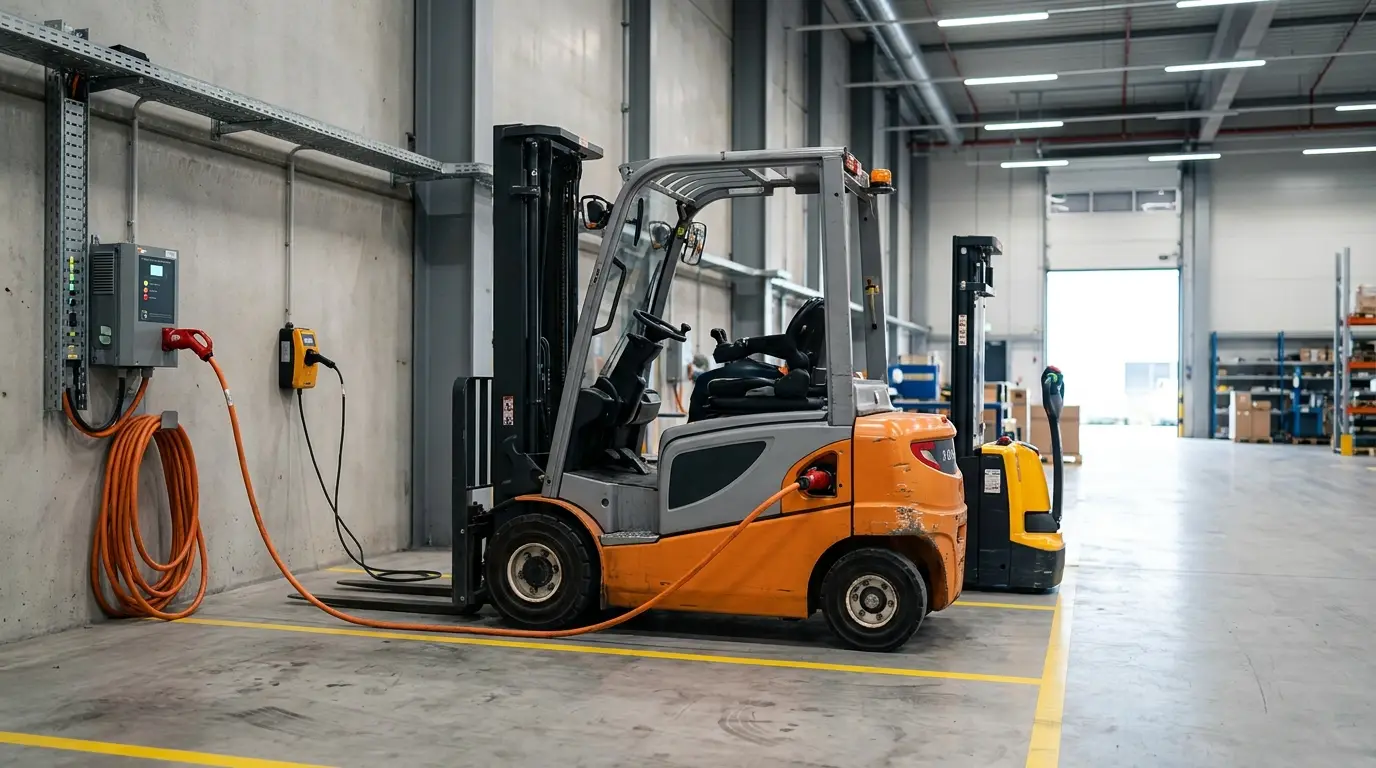









To set up a batterie de chariot élévateur charging station, designate a safe area, configure dedicated traffic routes, install chemistry-specific ventilation, add emergency wash and fire equipment, and protect chargers with physical barriers.
Every site setup depends on battery chemistry, charging workflows, and maintenance requirements. While lead-acid systems require active hydrogen ventilation and acid neutralization provisions, lithium-ion packs demand strict thermal monitoring and matched battery management systems (BMS).
This guide outlines the critical steps to design, operate, and maintain a fully compliant electric forklift charging facility.

What Should You Assess Before Planning a Charging Area?
Identify the Battery Chemistry and Charging Workflow
Start with your battery chemistry. Lead-acid batteries release hydrogen while charging. They also contain corrosive liquid electrolyte.
In contrast, lithium-ion battery packs function differently. Next, define where operators charge the trucks.
Do batteries stay inside the forklift? Or do workers remove, swap, and service them? Each workflow shifts your ventilation, spill, and emergency requirements.
Consider Fleet Size, Shifts, and Charging Patterns
Count how many forklifts charge at the same time. Identify when your daily charging windows open. You should also track how often operators swap batteries.
Always leave space for future fleet expansion. A station built only for today quickly causes bottlenecks. You can finalize specific charger models later.
How Do You Choose a Safe Location for a Forklift Battery Charging Station?
Keep the Area Away from Traffic and Ignition Hazards
OSHA requires charging facilities in designated areas. Select a spot away from main travel aisles. Keep chargers away from welding, grinding, and open flames.
A designated area does not always require a separate room. However, it must remain clearly defined and controlled. The space must suit the hazards present.
Maintain Access for Vehicles, Workers, and Emergency Response
Forklifts must enter and exit easily without awkward backing. Drivers should never reverse into blind intersections.
Technicians need safe access to charger plugs and controls. Emergency responders also require clear paths to all exits. Keep eyewash stations and fire extinguishers unobstructed. Never store pallets or loose cables on the floor.
How Should You Plan the Charging Area Layout?

Separate Vehicle and Pedestrian Routes
Map your operational traffic flow first. Plan where forklifts drive, park, and exit. Designate dedicated walkways for pedestrians nearby.
A one-way traffic loop works best. It prevents drivers from backing out blindly. Mark every pedestrian walkway clearly with floor paint. Keep personnel connecting cables away from vehicle lanes.
Always plan for peak shift changes.
Allow Working Space Around Forklifts and Equipment
Every parked forklift needs ample working room. Technicians need space for visual checks and cable connection.
If you swap batteries, leave space for handling equipment. Emergency teams must also fit easily into the bay. Clearance needs vary by vehicle size and charger style. Always test your layout clearances with a real truck.
Position Chargers, Cables, and Battery-Handling Equipment Safely
Mount chargers within easy reach of parking spots. Operators should never stretch charging cables across pedestrian aisles.
Keep charging cables off the floor to prevent drive-overs. Store connectors high and dry to prevent liquid damage.
If removing batteries, reserve space for heavy-duty stands. Provide cranes, hoists, or transfer carts for safe movement.
What Ventilation Does a Forklift Battery Charging Area Need?
Manage Hydrogen Risks During Lead-Acid Battery Charging
Charging flooded lead-acid batteries releases flammable hydrogen gas. Hydrogen becomes an explosion hazard when it accumulates.
Because hydrogen is lighter than air, it rises quickly. It pockets under ceilings and in unventilated structural pockets. Proper mechanical ventilation disperses this gas safely outdoors.
Engineering Note: Closed corners and low-ceiling alcoves are dangerous charging spots. Hydrogen pockets rapidly where air does not circulate.
Determine Ventilation Requirements for the Specific Installation
OSHA mandates adequate ventilation to disperse battery gasses. A 1976 OSHA interpretation references the lower explosive limit (LEL). Hydrogen reaches its LEL at 4.1% in air.
This 4.1% concentration marks an ignition threshold, not a target. Maintain air concentrations well below 1% for safety.
Required airflow depends on fleet count and charge rates. Enclosure volume and local fire codes also dictate ventilation rates. Hire a qualified engineer to calculate ventilation CFM. Install continuous hydrogen gas detectors where risk assessments recommend them.
Account for Lithium-Ion Battery Risks
Lithium-ion batteries do not emit off-gas during routine charging. They also eliminate periodic cell watering tasks.
This simplifies daily operational demands considerably. However, you must still follow manufacturer guidelines carefully. Monitor ambient temperatures and guard against thermal runaway events.
Ensure the battery management system (BMS) matches the charger. AYAA TECH treats the battery pack, BMS, and charger as a single integrated system.
Planning Lithium Forklift Charging? Get the Battery and BMS Match Right.
Explore Product CatalogWhat Safety Equipment and Personnel Protection Are Needed?
Provide Task-Appropriate PPE and Emergency Washing Facilities
Liquid electrolyte poses severe acid-burn hazards to skin and eyes. Provide chemical aprons, face shields, goggles, and rubber gloves.
Position plumbed eyewashes and emergency showers within quick reach. OSHA standards 1910.132 et 1910.151(c) govern personal protection and corrosive exposure.
OSHA’s eTool specifies accessible flushing water, neutralizing agents, and eyewash stations. Dedicated charging-only bays require fewer wash units than battery servicing rooms.
Prepare for Spills, Fires, and Ignition Hazards
Safety regulations require facilities for flushing and neutralizing spilled acid. You must also supply suitable fire protection nearby.
Prohibit smoking strictly throughout the entire charging zone. Take precautions against open flames, grinding sparks, and electrical arcing. Keep tools away from exposed, uncovered battery terminals.
Deploy acid spill kits and proper fire extinguishers based on hazards.
Engineering Note: Always pour acid into water, never water into acid. The reverse reaction spatters concentrated corrosive acid violently.
Train Personnel and Make Emergency Procedures Accessible
Allow only trained, authorized employees to service or charge batteries. Ensure operators know how to use eyewashes and spill kits.
Train staff on operating fire extinguishers and reporting emergencies. OSHA’s eTool highlights the need for quick emergency communications.
Post concise operating instructions directly at every charging stall. Maintain detailed safety procedures in your standard operating manual.
How Can You Protect Charging Equipment from Forklift Impacts?

Protect Vulnerable Equipment with Suitable Barriers
OSHA mandates protecting charging equipment from truck impact damage. However, the standard does not mandate a specific barrier type.
Heavy steel bollards, guardrails, and concrete curbs work effectively. Place barriers where forklifts turn, maneuver, or park. Prioritize areas with past vehicle scrape or dent damage.
Prevent Cable Damage and Unsafe Battery Handling
Hang charging cables safely outside vehicle wheel paths. Promptly replace connectors that show cracks, burns, or loose pins.
Always park the forklift and set the parking brake before charging. Secure the truck completely before connecting charger leads.
When lifting heavy batteries, use approved hoists and spreader bars. Never use improvised chains or unrated lifting equipment.
Which Safety Requirements Apply to a Forklift Battery Charging Station?
Understand OSHA Requirements for Battery Charging
In the U.S., OSHA standard 29 CFR 1910.178(g) serves as the primary benchmark. It mandates designated charging locations and adequate acid neutralization supplies.
The rule also requires impact protection, ventilation, and fire control. In addition, it governs parking brakes and battery-handling spreaders. The OSHA eTool provides helpful practical guidance alongside the standard.
Understand How the Work Performed Affects Requirements
OSHA directive STD 01-11-004 clarifies charging-only bays. It exempts areas where workers perform no maintenance from 1910.178(g)(2).
This applies only when batteries stay in trucks and no electrolyte is exposed. However, all remaining provisions of 1910.178(g) continue to apply.
Engineering Note: Treat this directive as a specific clarification, not a broad exemption. Once operators open vent caps, add water, or handle acid, all servicing rules apply immediately.
Check Other Applicable Rules and Manufacturer Instructions
Corrosive protection and washing facilities follow OSHA 1910.132 and 1910.151(c). Follow National Electrical Code (NFPA 70) and NFPA fire standards.
Always obey the operating manuals provided by battery and charger makers. Distinguish among mandatory legal codes, government guidance, and internal risk assessments. International facilities should check their respective national safety regulations.
How Should You Operate and Maintain the Charging Area?
Inspect Charging Equipment and Safety Provisions Regularly
Walk and audit the charging station on a routine schedule. Check power cables, plugs, and housings for signs of damage.
Inspect battery casings for leaks, swelling, or cracked cell jars. Verify that bollards and safety guardrails remain securely anchored.
Confirm eyewash stations, fire extinguishers, and spill kits remain accessible and inspected.
Keep Procedures, Training, and Records Up to Date
Enforce one standardized charging protocol across all operational shifts. Maintain an updated log of certified, trained charging operators.
Record equipment inspections, safety drills, and minor damage incidents. Review recurring issues, such as pinched cables, during monthly safety meetings. Use these incident patterns to refine your bay layout promptly.
Forklift Battery Charging Station Setup Checklist
- Identify battery chemistry and charging workflow
- Establish a designated charging area and mark vehicle and walkway routes
- Verify clearances around trucks, chargers, and emergency paths
- Engineer mechanical ventilation and supply fire protection units
- Provide required PPE, emergency eyewashes, and acid spill kits
- Install steel bollards to protect chargers and cables
- Supply hoists or roller stands for battery transfers
- Review OSHA standards, fire codes, and equipment manuals
- Post standard operating instructions and emergency response protocols
Note: This checklist supports planning and does not replace a comprehensive on-site engineering evaluation.
Conclusion — Plan the Charging Area Around Its Actual Risks
Approach your project in clear, logical phases. First, identify your battery chemistry and daily charging workflow. Then, pick a location separated from main warehouse traffic.
Layout the space so forklifts, cables, and personnel never interfere. Next, install proper ventilation, safety gear, and heavy physical barriers. Finally, verify compliance against OSHA standards and manufacturer rules. A well-designed charging station protects your workers and keeps your fleet running efficiently.
Need a Custom Pack or BMS for Your Forklift Fleet?
Request a Custom Battery SolutionFAQ
What Are the Requirements for a Forklift Battery Charging Station?
Under OSHA 1910.178(g), battery installations require a designated area. Facilities must provide ventilation, fire protection, and impact barriers. You must also supply acid neutralization materials where corrosive liquids exist. Local electrical and building codes enforce additional installation guidelines.
Does a Forklift Battery Charging Station Need to Be in a Separate Room?
Not necessarily. OSHA mandates a designated area, but not an enclosed room. Your layout depends on gas emissions and facility fire risks. Lead-acid maintenance may require a dedicated room, whereas plug-in lithium bays often do not.
What Ventilation Is Required for Forklift Battery Charging?
OSHA mandates adequate ventilation to prevent hydrogen buildup from gassing cells. The agency does not define a universal CFM airflow rate. Ventilation capacity depends on battery count and charging velocity. Have an HVAC engineer evaluate your charging bay requirements.
What Safety Equipment Should Be Available in a Charging Area?
Supply appropriate fire extinguishers, no-smoking notices, and chemical PPE. Provide plumbed eyewash stations and acid neutralizing spill kits. Maintain reliable emergency communications near the charging bays. Charging-only lithium zones may require fewer chemical safety provisions.
How Do You Charge a Forklift Battery Safely?
Park the forklift in the bay and set the parking brake firmly. Inspect all cables and electrical connectors for visible wear or damage. Connect the charger leads according to manufacturer instructions. Keep open flames, sparks, and metal tools away from battery tops.
Is Quick Charging or Opportunity Charging Safe for Forklift Batteries?
Safety depends directly on your battery chemistry and charger compatibility. Some advanced lithium-ion and thin-plate pure lead batteries support opportunity charging. Other flooded lead-acid batteries will overheat and degrade quickly. Always follow battery manufacturer guidelines before adopting fast-charging protocols.
How Much Does It Cost to Set Up a Forklift Battery Charging Station?
Total investment depends on electrical capacity, ventilation ducting, and barrier installations. Equipment choices, fleet size, and battery handling gear also affect overall costs. Because site demands vary widely, obtain itemized quotes tailored to your facility.