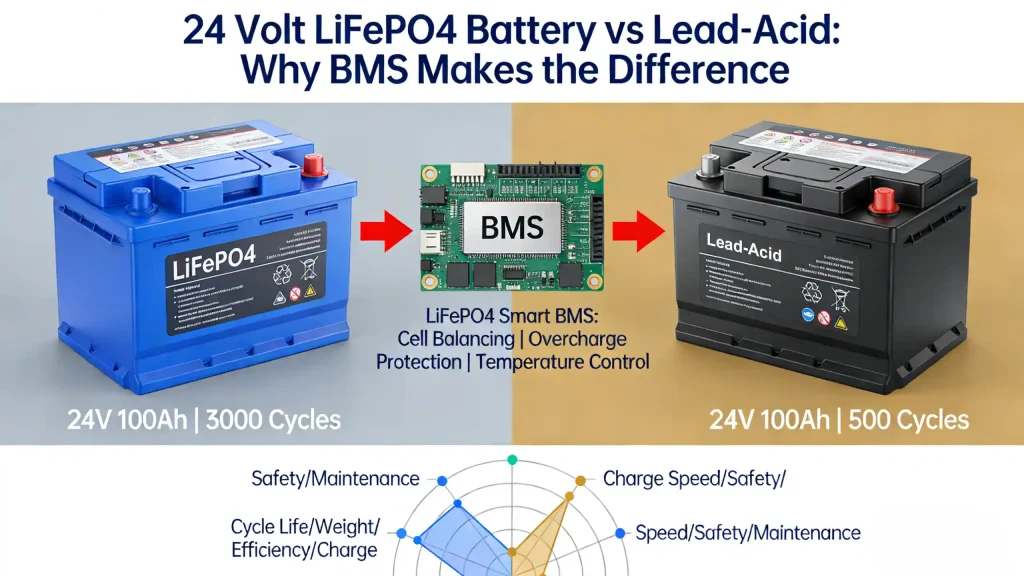
Batterie LiFePO4 24 volts vs batterie au plomb-acide : pourquoi le BMS fait toute la différence
1203
Batterie LiFePO4 24 volts vs batterie au plomb-acide : pourquoi le BMS fait toute la différence
Over the past ten years, battery technology has advanced quickly.
Lithium iron phosphate (LiFePO4) batteries are now a more effective, durable, and secure alternative to lead-acid batteries, which dominated stockage d'énergie for more than a century.
For solar systems, voitures électriques, marine applications, and industrial equipment, the 24 volt LiFePO4 battery has gained popularity.
However, a 24 volt LiFePO4 battery’s Battery Management System (BMS) plays a major role in its actual performance, longevity, and safety.
In order to prevent overcharge, overdischarge, and thermal damage, the BMS keeps an eye on cell voltage, current, temperature, and balance.
Conversely, conventional lead-acid batteries are more susceptible to abuse and premature failure due to their lack of electrical protection.
What Is a 24V Battery?
How does a 24 volt battery work?
Cells placed in series to provide a nominal voltage of 24V make up a 24 volt battery.
While lead-acid batteries use two 12V lead-acid units or series-connected 2V cells to reach the same voltage, LiFePO4 systems usually use eight cells at 3.2V each.
The amount of power that can be provided effectively depends on voltage.
When paired with a 24 volt LiFePO4 battery BMS that precisely controls each cell, increased voltage in 24 volt systems enables lower current at the same power, decreasing heat loss and increasing efficiency.
How Many Cycles Can a 24V LiFePO4 Battery Provide?
Why is cycle life important?
The number of full cycles of charging and discharging that a battery can provide before its capacity falls below a usable level is known as its cycle life.
Compared to average lead-acid performance, a 24 volt LiFePO4 battery can accomplish 2000–5000 cycles.
How does BMS extend cycle life?
La batterie LiFePO4 BMS manages:
Depth of discharge (preventing deep cycles that reduce capacity)
Charge voltage limits (avoiding overcharging)
Temperature thresholds (preventing heat-related degradation)
Cell balancing (ensuring uniform aging across cells)
Even a premium LiFePO4 pack may deteriorate more quickly than anticipated in the absence of BMS control.
How to Maintain a 24V Lithium Battery
What maintenance practices improve performance?
Regular voltage checks: The BMS constantly monitors each cell to prevent imbalance.
Temperature management: Steer clear of high heat exposure; if the temperature rises over acceptable thresholds, the BMS will inform you or restrict current.
Partial discharge operation: Battery life is extended with shallow cycles.
Recommended discharge limits may be enforced by the BMS.
Periodic inspection: Wiring, connectors, and enclosure integrity must be checked regularly.
Lead-acid batteries need more frequent voltage monitoring, equalization charges, and electrolyte topping, all of which are mostly automated by a LiFePO4 BMS.
What Is the Difference Between a 24V Lithium Battery and a 24V Lead-Acid Battery?
How does energy density compare?
24 volt LiFePO4 battery: High energy density allows for more stored energy in a smaller, lighter package.
24V lead-acid battery: Low energy density means heavier, bulkier units.
Why does weight matter?
Because LiFePO4 packs are 50–70% lighter, they put less stress on cars, trailers, and mounting structures.
Because lead-acid systems are heavier, they require strengthened supports and limit mobility.
How does cycle life differ?
Lead-acid batteries normally last 300–500 cycles, but LiFePO4 batteries can offer thousands.
By carefully controlling charge and discharge, a 24 volt LiFePO4 battery BMS further optimizes cycles.
How about efficiency?
Lead-acid batteries normally run at 70–80%, losing a lot of energy as heat, but lithium batteries maintain 90–95% charge/discharge efficiency.
By lowering internal resistance and avoiding overcurrent situations, the BMS maximizes efficiency.
What about environmental and safety considerations?
Particularly under BMS control, LiFePO4 chemistry is non-toxic, thermally stable, and less vulnerable to thermal runaway.
Lead-acid batteries provide disposal and safety issues because they contain corrosive acid and dangerous lead.
Which Applications Use 24V LiFePO4 Batteries?
Where are LiFePO4 batteries preferred?
Solar energy storage: Provides stable voltage, deep cycling, and long-term reliability.
Electric vehicles (EVs): Light weight, high efficiency, and long cycle life improve performance.
Marine and RV systems: Reduced weight and maintenance-free operation are advantageous.
Industrial equipment: Reliable high-current output and extended service life.
Temperature-based protection for sensitive environments
Cell balancing for extended lifecycle
Communication with chargers, inverters, and monitoring systems
LiFePO4 batteries may still operate without a BMS, but their longevity, safety, and efficiency would be seriously jeopardized.
What Is the Function of the BMS in a 24V LiFePO4 Battery?
Why is voltage management critical?
Every LiFePO4 cell has a limited voltage range in which to function.
The BMS maintains cell integrity by preventing undervoltage during discharge and overvoltage while charging.
How does current control protect the system?
In order to minimize overheating, thermal stress, and damage to linked equipment, the BMS restricts both charge and discharge currents.
How does temperature monitoring improve battery life?
In the event that the battery surpasses safe temperature levels, the BMS employs sensors to modify current limitations or initiate shutdown.
For high-power or outdoor applications, this is crucial.
Why is cell balancing important?
Certain cells may age more quickly in an unbalanced environment, decreasing the pack’s overall capacity.
By balancing cell voltages, the BMS ensures consistent performance and extends lifespan.
Can LiFePO4 Batteries Be Fully Charged and Stored?
What is the best storage practice?
Partial state of charge: Storing at 50–60% state of charge reduces chemical stress.
Contrôle de la température: Store in a cool, dry place to minimize degradation.
Periodic monitoring: The BMS can maintain safe voltage levels during long-term storage.
LiFePO4 batteries with a BMS require less maintenance during storage than lead-acid batteries, which call for trickle charging and careful electrolyte management.
Why the 24 Volt LiFePO4 Battery with BMS Is the Superior Choice Over Lead-Acid
Although LiFePO4 batteries and 24V lead-acid batteries may both provide power for comparable applications, the BMS converts LiFePO4 chemistry into a long-lasting, safe system.
Important benefits include:
Durée de vie prolongée thanks to controlled depth-of-discharge
Higher energy efficiency with reduced heat loss
Enhanced safety via voltage, current, and temperature monitoring
Lower maintenance requirements
Weight and space savings for mobile or compact applications
To put it briefly, the BMS is what makes a difference. Even the most sophisticated LiFePO4 chemistry cannot provide dependable, consistent performance without it.
Why a 24 Volt LiFePO4 Battery with BMS Outperforms Lead-Acid
Compared to conventional lead-acid systems, a 24 volt LiFePO4 battery offers better energy density, a longer cycle life, and lower weight.
However, the Battery Management System (BMS) is solely responsible for its actual performance, longevity, and safety.
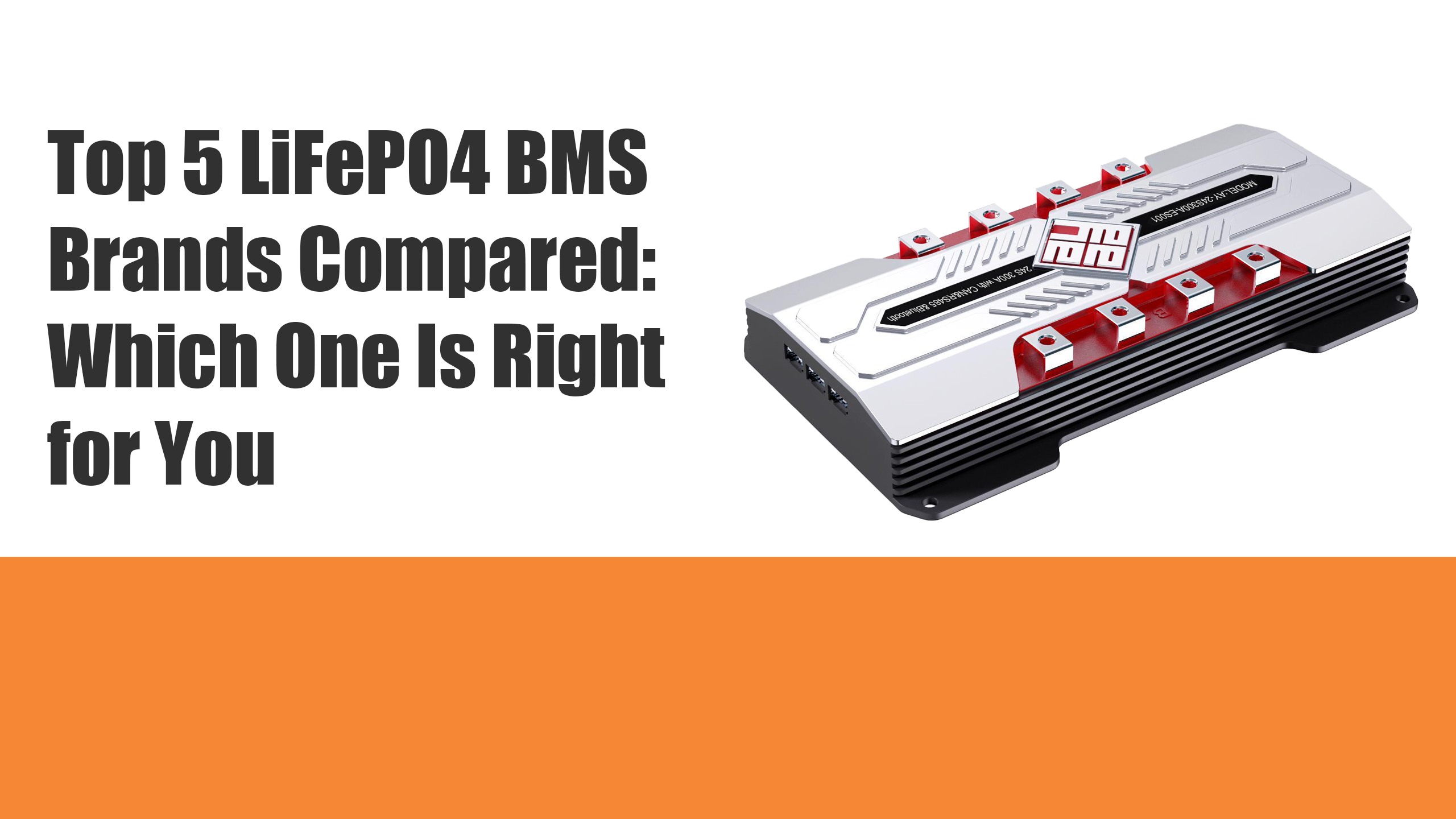
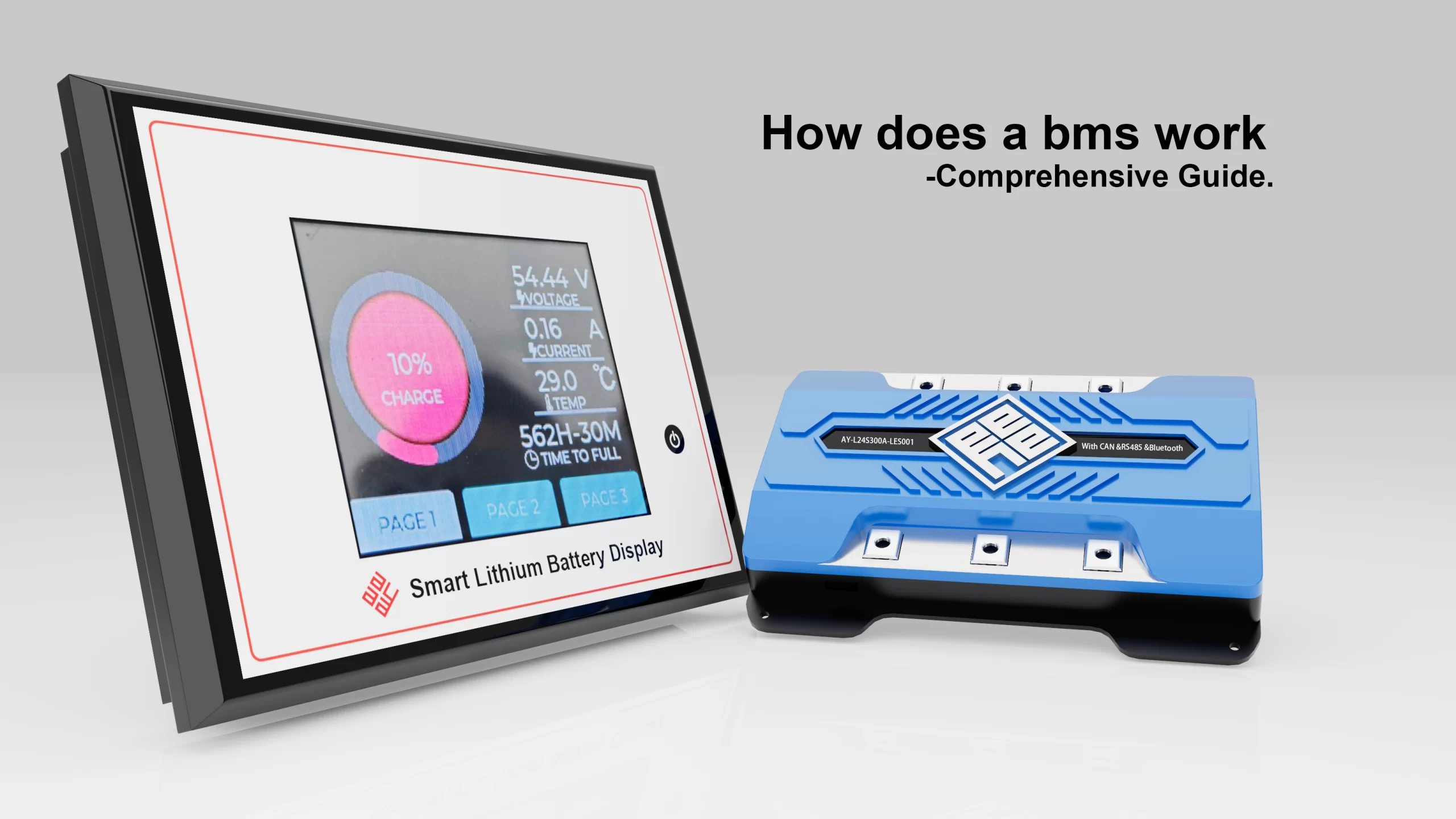
In order to prevent overcharge, overdischarge, and thermal stress, the Ayaa Technology smart BMS keeps an eye on voltage, current, temperature, and cell balance.
In challenging applications, such as solar storage, electric vehicles, and marine and industrial systems, it maximizes efficiency, prolongs lifecycle, and permits safe operation.
LiFePO4 is the obvious choice for contemporary energy storage solutions because it combines a reliable lifepo4 battery bms with a 24 volt system, giving users predictable performance, low maintenance, and long-term value.
FAQ
Q1:How long will a 24V 200Ah lithium battery last?
A2:LiFePO4 is safer than lithium-ion because it has a longer lifespan and more thermal stability, which makes it perfect for extended use.
Lithium-ion may be less expensive at first and require less maintenance, but there are concerns due to its tendency to overheat.
Q3:How long does a 24V lithium battery last?
A3:Depending on capacity (Ah), load (watts/amps), and conditions, a 24V lithium battery’s runtime can range from hours to a full day on a single charge for devices like trolling motors or ride-ons.
With proper usage, such as avoiding extreme temperatures and overcharging, its overall lifespan is thousands of cycles (years), far exceeding lead-acid batteries.
Q4:Is it bad to keep LiFePO4 batteries fully charged?
A4:A fully charged LiFePO4 battery can be stored.
If you wish to keep these batteries for a longer period of time, it is advised that they be fully charged.
The self-discharge rate of these batteries is often extremely low.
Q5:Is there a better battery than LiFePO4?
A5:Compared to LiFePO4 batteries, lithium-ion batteries have a higher energy density, allowing them to store more energy in a given space.
They are therefore better suited for use in lighter, smaller EVs.