12V 100Ah LiFePO4: Why Smart BMS Is the Key to Safety and Performance
3000
12V 100Ah LiFePO4: Why Smart BMS Is the Key to Safety and Performance
The Rise of the 12V 100Ah LiFePO4 Battery
The 12V 100Ah LiFePO4 (Lithium Iron Phosphate) battery has established itself as a standard for high-performance stockage d'énergiein the area of modern sophisticated energy solutions. In comparison to conventional lead-acid and lithium-ion chemistries, this battery has certain advantages, particularly when used in conjunction with an intelligent Battery Management System (BMS). The 12V 100Ah LiFePO4 battery offers unparalleled efficiency, lifespan, and safety whether it is utilized in backup power stations, solar power systems, RVs, or maritime applications.
However, employing a high-capacity lithium battery alone is no longer sufficient as user expectations rise and energy demands become more sophisticated. The whole potential of these batteries is unlocked by the integration of a smart BMS, which guarantees optimum performance, security, and long-term durability.
What Makes the 12V 100Ah LiFePO4 Battery Stand Out?
Lithium iron phosphate cells configured to give 12 volts with a total capacity of 100 ampere-hours make up the 12V 100Ah LiFePO4 battery. LiFePO4 has advantages over other lithium chemistries:
Longer cycle life: Over 2000–5000 cycles depending on use.
High thermal stability: Safer under high temperatures.
Sortie de tension stable: Reliable power for sensitive electronics.
Conception légère: Up to 60% lighter than lead-acid equivalents.
Even these admirable qualities, however, need supervision. This is where the intelligent BMS comes in, managing, keeping an eye on, and safeguarding the battery pack during each stage of use.
The Role of Smart BMS in 12V 100Ah LiFePO4 Systems
A smart BMS is more than just a passive security board. It is a clever controller that interacts with and controls the battery’s internal environment continuously. A 12V 100Ah LiFePO4 system’s smart BMS carries out a number of crucial functions:
Équilibrage cellulaire: Equalizes charge across cells to extend cycle life.
Overvoltage/undervoltage protection: Prevents damage from improper charge/discharge levels.
Régulation thermique: Stops operation during unsafe temperature ranges.
Short-circuit and overcurrent protection: Shields the battery and external systems from electrical faults.
State-of-charge (SOC) and state-of-health (SOH) monitoring: Tracks capacity and aging status.
The BMS is an essential part of both home and commercial energy systems because of these features, which guarantee that your 12V 100Ah LiFePO4 battery will continue to be dependable and safe for many years of use.
Application Scenarios for 12V 100Ah LiFePO4 with Smart BMS
Off-grid solar systems: Reliable energy storage for homes or cabins.
Recreational vehicles (camping-cars): Lightweight and stable power for long trips.
Marine power systems: Vibration-resistant and safe in harsh environments.
Telecom backup: Supports long-duration standby with minimal degradation.
Portable power stations: Enables high-discharge, fast-charging performance.
In each instance, the intelligent BMS improves safety and optimizes useful capacity, assisting in maintaining steady voltage and averting gradual performance degradation.
Smart BMS and Thermal Management in LiFePO4 Batteries
One major issue with high-capacity batteries, such as the 12V 100Ah LiFePO4, is thermal regulation. Temperature variations can shorten longevity, induce swelling, or even lead to thermal runaway if they are not properly controlled. A smart BMS mitigates this by:
Monitoring temperature sensors on each cell group.
Disabling charging/discharging when outside safe thresholds (usually between 0°C and 60°C).
Enabling heating circuits or thermal alarms in advanced systems.
These characteristics are particularly crucial for distant or mobile applications when manual oversight is not feasible.
Communication and Integration Capabilities
The CAN, RS485, or UART protocols are frequently supported by modern smart BMS devices, enabling them to interface with external systems like:
For a 12V 100Ah LiFePO4 battery system to operate dependably, predictive maintenance, remote troubleshooting, and performance adjustment are made possible by this real-time data communication.
Economic and Environmental Value
Despite having higher initial costs than lead-acid or unmanaged lithium alternatives, 12V 100Ah LiFePO4 batteries with smart BMSs have definite long-term financial benefits:
From an environmental aspect, LiFePO4 chemistry is more stable, contains no cobalt, and offers improved recyclability. When combined with longevity aided by BMS, this makes it a more sustainable and environmentally friendly energy option.
How to Choose the Right 12V 100Ah LiFePO4 System
The following should always be taken into account when choosing a 12V 100Ah LiFePO4 battery:
BMS quality and features: Look for protection, communication, and balancing capabilities.
Voltage consistency: Essential for sensitive electronics.
Current rating: Ensure it matches your application’s draw.
Temperature range: Verify compatibility with your climate.
Certification: UL, CE, or UN38.3 for safety assurance.
Features: Durable PCB structure, compact design, ideal for modular power banks
3. AY-LS20S90A-H150
Plage de tension: 16S–20S
Courant maximal: 90A
Communication: CAN
Features: Compatible with high-discharge applications, supports parallel connections
Based on the scale and control requirements of the application, these BMS models can be used with a variety of 12V 100Ah LiFePO4 system configurations.
Comparison Table
Model
Cell Range
Courant maximal
Communication
Key Advantages
AY-L24S300A-ES001
7S–24S
300A
CAN, RS485, UART
Full-featured, industrial-grade, versatile range
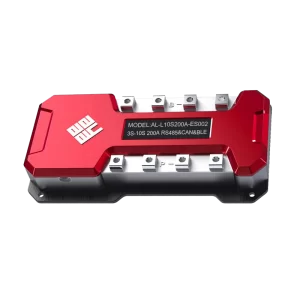
AY-L10S200A-ES002
4S–10S
200A
CAN, UART, RS485
Compact and efficient for light-duty applications
AY-LS20S90A-H150
16S–20S
90A
CAN
High compatibility, ideal for large-scale systems
Future Trends in LiFePO4 Batteries with Smart BMS
From electric mobility to grid storage, the need for safe, environmentally friendly, and highly efficient energy storage solutions is increasing across industries. LiFePO4 batteries with Smart BMS are well-positioned to spearhead the next wave of innovation in this field. The future of this technology is being shaped by a number of significant themes that are advancing intelligent integration and performance limits.
Integration with AI-based monitoring platforms
Cloud BMS solutions for industrial energy storage
Wireless BMS for modular system design
Increased focus on cybersecurity in BMS communication
Nano-coating and material advances to increase thermal tolerance
The need for more intelligent BMS solutions will only grow as energy storage systems get more complicated. A 12V 100Ah LiFePO4 battery is converted from a static power source into a self-regulating, flexible energy module by a clever BMS.
FAQ
Q:How long will a 12V 100Ah LiFePO4 battery last?
A:A 100Ah LiFePO4 battery can run for 30 minutes or five days, depending on the load. A 20W device could run for about 50 hours, whereas a 2,000W device would barely last for around 30 minutes.
Q:Which is better, LiFePO4 or Lithium battery?
A:The particular application and priorities will determine whether LiFePO4 (Lithium Iron Phosphate) or another lithium-ion battery is the “better” option. While competing lithium-ion chemistries offer higher energy density for applications requiring more compact and powerful batteries, LiFePO4 excels in safety, lifespan, and performance under challenging conditions.
Q:How long to charge 12V 100Ah LiFePO4 battery?
A:Theoretically, a 100Ah battery can be charged from empty to full in around 10 hours using a 10-amp charger. However, practical considerations like charging current, charger efficiency, and stage of charge can extend this to 12–14 hours (or with a quicker charger, reduce it to 5 hours).
Q:Can you leave LiFePO4 plugged in all the time?
A:Yes, leaving a LiFePO4 (lithium iron phosphate) battery on the charger is normally safe. LiFePO4 batteries are safer to be plugged into a charger for longer periods of time since they are less likely to overcharge and experience thermal runaway than some other battery types, such lead-acid batteries.
Q:Can I overcharge my LiFePO4 battery?
A:In order to avoid overcharging, which might reduce the battery’s lifespan, it is crucial to remember that the voltage should not be higher than 3.65 volts per cell when charging a LiFePO4 battery.
Q:Does cold damage LiFePO4 batteries?
A:There can be serious repercussions when LiFePO4 batteries are operated in extremely cold or hot temperatures. Severe cold can increase the risk of thermal runaway and cause irreparable damage to battery components.
Conclusion
When combined with an intelligent BMS, a 12V 100Ah LiFePO4 battery is an alluring option for secure, dependable, and effective energy storage. Using a smart BMS guarantees that you get the most out of your battery investment, whether you’re creating a strong off-grid solar system or powering a recreational setup.
Our cutting-edge range of smart BMS modules can assist you in creating an intelligent and future-proof energy infrastructure, whether you’re looking to upgrade your lithium energy system or need professional BMS integration.