- Industries

Home Backup & Garden BMS
View More >Electric Forklift BMS
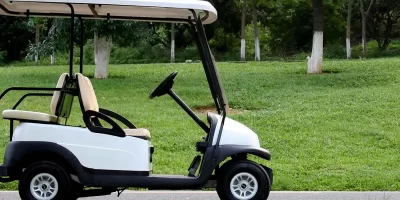
View More >Golf Cart BMS
View More >Electric Two-wheeler BMS
View More >Aviation & UAV BMS
View More >BMS For Power Tools
View More >Medical Equipment BMS
View More >




Home About Us EVENTS & NEWS How to Choose the Best 48 Volt Golf Cart Batteries
Choosing the best 48 volt golf cart batteries is one of the most important decisions you can make when upgrading or replacing your golf cart’s power system.
The need for durability, efficiency, and intelligent battery management has increased dramatically as more consumers switch from conventional lead-acid to sophisticated lithium solutions.
Whether they are golf cart owners, fleet managers, RV owners, or light-EV operators, modern consumers want batteries that operate consistently, last longer, charge more quickly, and weigh less.
Lithium golf cart batteries—more especially, 48 volt lithium golf cart batteries—stand out in this situation.
They provide unparalleled power stability, safety, and long-term value because to their sophisticated LiFePO4 chemistry and clever Battery Management Systems (BMS).
However, a number of aspects must be considered when selecting a 48V system, including longevity, BMS features, performance ratings, charging efficiency, ambient conditions, and overall value.

The market for 48 volt golf cart batteries is changing due to the emergence of 48 V LiFePO4 systems.
However, what precisely is causing the change?
Why are users moving away from lead-acid batteries?
Lead-acid batteries require a lot of care, are heavy, take a long time to charge, and quickly degrade with frequent usage.
They frequently need equalization, venting, and watering fees.
How does LiFePO4 chemistry offer superior performance?
LiFePO4 cells deliver:
Longer cycle life (up to 3,000+ cycles)
Higher energy efficiency
Faster charging speeds
Better voltage stability under load
No maintenance requirements
Lighter weight
This results in improved acceleration, increased range, and a more pleasurable ride for golf carts.
The BMS of each premium pair of 48 volt golf cart batteries is crucial.
The battery’s “brain,” the BMS, is in charge of safeguarding the cells, maximizing their functionality, and averting hazardous malfunctions.
Let’s dissect why this is significant.
What Smart Protection Features Should a Good BMS Include?
The best 48 volt lithium golf cart batteries available today depend on a sophisticated BMS with several security levels.
But what characteristics are crucial?
1. Overcharge Protection
keeps the battery from being charged above safe voltage thresholds, safeguarding the battery pack and charger.
2. Over-Discharge Protection
Stops the pack from draining to dangerously low voltages, which can damage lithium cells.
3. Overcurrent and Short-Circuit Protection
Detects abnormal current spikes and shuts down output to prevent component failure or fire risks.
4. Temperature Protection
keeps an eye on the cell’s temperature in real time to prevent thermal runaway, freezing, or overheating.
Together, these safeguards greatly increase the lifespan of lithium golf cart batteries compared to conventional battery designs.
Protection is insufficient on its own. By controlling cell health, a top-notch BMS also guarantees reliable functioning.
Battery Balancing
The long-term viability of 48 volt lithium golf cart batteries depends on balancing, which equalizes the voltage across all cells.
Even charging, more reliable power, and a slower rate of aging are all benefits of balanced cells.
Optimized Performance
The BMS regulates power output to ensure:
Smooth acceleration
Stable voltage
Maximum usable capacity
State Estimation
A smart BMS provides accurate readings of:
State of Charge (SoC) – how much energy remains
State of Health (SoH) – the overall condition of the battery pack
Without accurate SoC/SoH, users risk damaging the battery or misjudging range.
Communication and Fault Diagnosis
Advanced systems offer:
UART/RS485/CAN protocols
Real-time monitoring
Fault alarms and event logs
This level of intelligence ensures safer, more efficient battery usage.
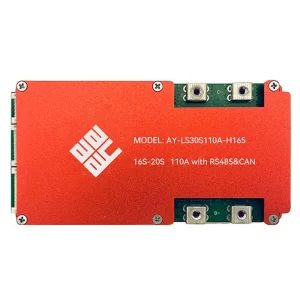
One of the most cutting-edge options for consumers looking for superior quality and dependability is the AY-LS20S110A-H165 (16S–20S).
It is specifically made for 48 volt golf cart batteries and other 48V LiFePO4 applications, and it is made to be both durable and versatile.
What makes the AY-LS20S110A-H165 a standout choice?
1. Wide Application Compatibility
Supports:
Golf carts
AGVs
Low-speed EVs
Energy storage systems
Industrial equipment
2. Broad Operating Voltage Range
Its 16S–20S configuration makes it highly adaptable for varying lithium pack designs.
3. Intelligent Monitoring
Features include:
Real-time voltage monitoring
Accurate current detection
Temperature sensors
Communication protocols for external devices
4. Advanced Protection Circuitry
Included are all of the main safeguards, such as short circuit, overcharge, and overdischarge.
This BMS increases the longevity, safety, and dependability of 48 volt lithium golf cart batteries.
Many consumers question if switching to 48 volt golf cart batteries is worthwhile.
When long-term value is taken into account, the solution becomes evident.
How does lifespan affect cost?
LiFePO4 batteries can last up to 10 years, reducing replacement cycles dramatically.
Do they require less maintenance?
Yes. Unlike lead-acid batteries, lithium systems require:
No watering
No corrosion cleaning
No equalization charging
This saves time, labor, and money.
Are they environmentally friendly?
Absolutely:
Longer lifespan means fewer discarded batteries
LiFePO4 contains no harmful heavy metals
Higher charging efficiency reduces energy waste
How does the BMS add value?
A high-quality BMS ensures:
Fewer battery replacements
Better range consistency
Safer operation
For golf cart owners, LiFePO4 systems collectively provide one of the best returns on investment.
While 48 volt golf cart batteries are most commonly associated with carts, the same 48V LiFePO4 packs are used in many other industries.
Which applications benefit most?
1. Utility Vehicles & Maintenance Carts
Better range and quick charging improve fleet efficiency.
2. RV House Battery Systems
LiFePO4 systems are lighter, safer, and last longer.
3. Marine Systems
Stable voltage & vibration resistance make them ideal for electric boats.
4. Solar Energy Storage
48V is the standard for small-to-mid-scale home solar systems.
5. Industrial Mobility
Floor scrubbers, pallet trucks, and AGVs use similar 48V setups.
This versatility adds to the value proposition of 48 volt lithium golf cart batteries.
It’s important to consider factors other than price when choosing a battery.
These are the most crucial inquiries to make before making a purchase.
1. What Is Your Budget vs. Long-Term Value?
Cheaper batteries may lack:
High-cycle cells
Quality BMS protection
Reliable assembly
Good communication features
A premium battery is a long-term investment.
2. What Range and Power Output Do You Need?
If you use your cart for work, drive in steep terrain, or carry passengers frequently, get a battery with:
Higher continuous discharge capability
Strong peak power output
Efficient cell balancing
This ensures smoother acceleration and lasting performance.
3. How Important Is Maintenance?
LiFePO4 batteries require almost no maintenance, which is ideal for:
Golf courses
Rental fleets
Industrial operators
RV and marine users
If low maintenance is a priority, lithium is the clear choice.
4. How Fast Do You Need to Recharge?
Many 48 volt lithium golf cart batteries can:
Fully charge in 2–4 hours
Support regenerative braking (with compatible systems)
Work with smart chargers for optimized charging curves
Faster charging = more uptime.
5. What Is the Environmental Impact?
LiFePO4 systems offer:
Up to 98% charge efficiency
Lower carbon footprint
No acid or fumes
If sustainability is a factor, LiFePO4 is the best choice on the market.
Performance, safety, longevity, and long-term financial worth must all be taken into consideration when choosing the best 48 volt golf cart batteries.
Superior power, quicker charging, longer lifespans, and safer operation are all provided by contemporary lithium golf cart batteries with an Ayaa Technology smart BMS.
The most stable, effective, and dependable performance is guaranteed by 48 volt lithium golf cart batteries with smart features, particularly those that use cutting-edge technology like the AY-LS20S110A-H165.
Investing in a high-end LiFePO4 system with Ayaa Technology smart BMS will yield both short-term and long-term benefits, regardless of whether you use your cart for work, play, transit, or commercial operations.
Q1:How much does it cost to replace 48 volt golf cart batteries?
A1:Replacing 48V golf cart batteries typically costs $400–$1,600 for conventional flooded lead-acid, $800–$2,800 for mid-range AGM, and $1,800–$4,000+ for high-performance lithium (LiFePO4).
Despite its high initial costs, lithium offers long-term savings.
The battery type, capacity (Ah), and whether you change to a lithium system that needs a new charger—for example, Luxe Electric Car—all have a significant impact on the final cost.
Q2:How long should 48 volt golf cart batteries last?
A2:The lifespans of 48-volt golf cart batteries, which are usually lithium or lead-acid, vary: With proper maintenance, lead-acid batteries can last four to six years, whereas lithium batteries can last eight to ten years or longer.
Personal carts typically outlast fleet carts, but longevity is mostly dependent on usage (terrain, distance), maintenance (water levels for lead-acid, proper charging for both), and battery quality.
Q3:How many batteries do I need for a 48 volt golf cart?
A3:Eight six-volt batteries, six eight-volt batteries, or four twelve-volt batteries are required if you have a 48-volt cart.
Although they are less prevalent, 72-volt batteries are still accessible.
Remember that the battery will charge more quickly if you use a higher voltage battery.
Q4:Can you put 4 12 volt batteries in a 48 volt golf cart?
A4:It is possible to utilize four 12V batteries in a 48V golf cart by connecting them in series, which raises the voltage to 48V.
However, because 12V batteries often have lower amp-hour capacity and performance can be worse.
This design frequently results in reduced range and longevity compared to the original system (normally six 8V batteries).
Q5:Is it better to get new or used golf cart batteries?
A5:guarantee Options: A one-year guarantee is provided by certain sellers.
It might be something to think about if the seller is local.
Used Golf Cart Batteries: Due to previous use, some used batteries may still be functional but have a shorter lifespan.
Contact Us