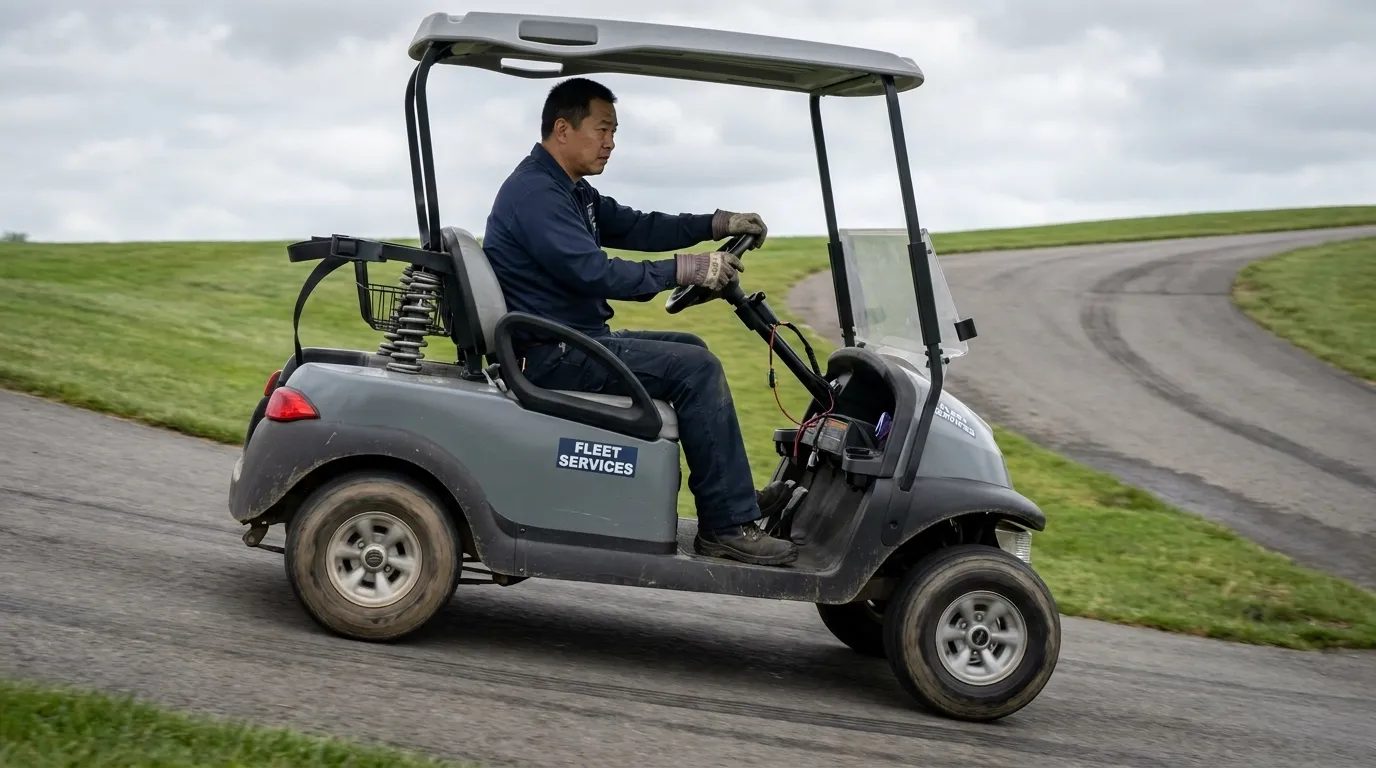





A golf cart BMS monitors cells, regulates current, balances drift, and cuts power. A lithium golf cart battery relies on multiple series-connected cells that degrade rapidly without real-time oversight. Acting as the electronic control unit, a golf cart battery management system keeps the pack operating within strict safety thresholds during steep hill climbs and rapid acceleration. It safeguards the battery against overcharging, deep discharge, sub-zero charging damage, and short circuits, ensuring cell longevity and preventing sudden vehicle stall-outs.

What Is a Golf Cart BMS and Why Is It Essential?
Understanding what a golf cart BMS is comes down to control and safety. The BMS is an internal circuit board inside the battery case. It sits directly between the lithium cells and the vehicle wiring harness.
So, why do lithium golf cart batteries need a BMS? Lead-acid batteries tolerate voltage sag and mild overcharging. Lithium cells do not. A single overcharged cell can vent or enter thermal runaway. An over-discharged cell suffers irreversible internal damage.
The BMS acts as an active gatekeeper. It measures every cell and controls the power switches. It decides when power flows and when the pack must shut down.
Engineering Note: Pack-level voltage readings hide failing cells. A 48V pack can show 51V while one dead cell sits at 1.0V. Cell-level monitoring is mandatory to prevent cell reversal.
What Does a Golf Cart BMS Do? 6 Core Functions
Driving an electric cart puts heavy mechanical and electrical stress on lithium cells. Steep paths demand high current. Rough turf causes physical shock.
A rugged lithium golf cart battery BMS performs six specific jobs to keep your vehicle running safely.
1. Individual Cell Voltage Monitoring
The BMS samples the voltage of every series cell several times per second. Dedicated analog sensing chips read these values with millivolt accuracy.
Total pack voltage hides localized cell defects. In a 16-cell LiFePO4 pack, fifteen healthy cells can mask one collapsing cell. By tracking individual channels, the system catches weak cells before permanent chemical damage occurs.
2. Overcharge Protection
The BMS cuts off incoming power the moment any single cell hits its limit. For LiFePO4 chemistry, that limit is usually 3.65V per cell.
Lithium cells cannot absorb excess energy once fully saturated. If a charger fails to shut off, the electrolyte oxidizes and releases gas. The BMS opens its power switches to protect the cell structure.
3. Deep-Discharge Prevention
The system stops discharge when the lowest cell drops to its cut-off limit, typically 2.50V. This protects cells from falling into reverse polarity under heavy loads.
Golf carts pull heavy burst currents when climbing steep grades. High current causes instant voltage sag across the cells. If a weak cell sags below the safe floor, the BMS cuts the load. This preserves the remaining cycle life of the pack.
4. Overcurrent and Short-Circuit Protection
Traction motors pull brutal currents. Cruising on flat ground draws only 50A to 80A. Punching the pedal uphill can surge to 400A.
The BMS uses two protection layers:
- Overcurrent Protection (OCP): Allows brief 3- to 5-second motor acceleration surges without tripping.
- Short-Circuit Protection (SCP): Hardware comparators trip in under 200 microseconds if motor controllers short out.
Fast action prevents melted wiring harnesses and equipment fires.
5. Temperature Monitoring and Sub-Zero Cutoff
Thermal sensors monitor heat at the cells and power switches. If the pack gets too hot under direct summer sun, the BMS stops discharge.
Cold-weather protection is even more critical for fleet operators.
Engineering Note: Never charge lithium iron phosphate cells below 0°C (32°F). Sub-zero charging causes solid lithium plating on the anode, destroying capacity and creating internal short circuits.
High continuous current also creates internal board heat. AYAA TECH addresses this by uniformly distributing key heat sources, such as power MOSFETs and current sense shunts, across the board. The design pairs them with premium thermal silicone pads, thermal gels, and high-conductivity aluminum or copper heat sinks to pull heat away from the cells.
6. Cell Balancing
No two battery cells are identical. Over time, small differences in internal resistance cause cell voltages to drift apart.
The BMS uses balance resistors to bleed tiny amounts of energy from high-voltage cells during charging. This keeps capacity synchronized across the string. Balancing ensures one full cell does not cut your charge cycle short while other cells remain half empty.

Need Fleet-Proven 48V & 72V Golf Cart BMS Solutions?
Explore AYAA TECH Product CatalogHow Does a Golf Cart BMS Work Under Real Driving Loads?

Understanding how a golf cart BMS works requires looking at real vehicle dynamics. Unlike stationary setups, golf carts face wild load swings and rough vibration.
The system runs a continuous control loop:
High-speed sensors measure voltage, current, and temperature.
The onboard processor compares readings against firmware limits.
If values stay normal, power flows. If limits are breached, gate drivers open the power switches.
This loop repeats hundreds of times each second. It turns a raw group of cells into a dependable power system.
Golf Cart BMS Protection vs. Stationary Energy Storage
Engineers must recognize that mobile vehicle packs differ from stationary storage banks. Installing a generic storage protection board in a golf cart causes constant field failures.
Stationary grid-tied systems and commercial peak shaving installations deliver smooth, predictable power. They optimize strictly for high energy density and long stationary cycle life. In contrast, vehicle packs face violent mechanical shock, dusty trays, and severe motor current spikes.
The table below contrasts these distinct engineering environments:
| Operating Parameter | Stationary Storage BMS (Grid-Tied / Peak Shaving) | Golf Cart Traction BMS |
|---|---|---|
| Load Profile | Steady charge and discharge rates | Sudden spikes up to 5x continuous load |
| Mechanical Shock | Minimal (fixed indoor racks) | Constant vibration from turf and cart paths |
| Regenerative Braking | None (one-way energy delivery) | High-voltage reverse inductive energy spikes |
| Inrush Handling | Low initial capacitor bank demands | Large motor controller inrush currents |
As the comparison shows, vehicle systems demand far tougher transient handling. Without targeted golf cart BMS protection, regenerative braking spikes can punch straight through standard switching components.

What Happens When BMS Design Fails?
Poorly engineered BMS units lead to immediate headaches in the field. False trips are the most common complaint. Drivers stall out on hills because the overcurrent threshold lacks proper timing delay.
Worse, cheap boards rely on simple voltage tables to guess capacity. Because LiFePO4 discharge curves are exceptionally flat, voltage alone cannot tell you remaining run time. Drivers get stranded with a dead cart that showed 30% capacity minutes earlier.
AYAA TECH solves this by pairing current integration with active drift correction. This keeps our State of Charge (SOC) algorithm error margin to ≤ 5%. Drivers and fleet managers get dependable range numbers under changing loads.
Need a Custom BMS Architecture for Your Vehicle Platform?
Consult a Battery ArchitectTechnical FAQ
This shutdown usually stems from voltage sag or overcurrent limits. Uphill driving draws peak currents three to four times higher than flat cruising. If an individual cell has higher internal resistance, its voltage sags sharply under load. When that cell drops below 2.50V, the BMS cuts power to prevent cell reversal.
No. The external charger controls charging current and voltage using a dedicated charging profile. The BMS acts as a secondary safety switch. It monitors individual cells and opens the charging circuit if any cell crosses 3.65V. In advanced setups, the BMS can command the charger over the CAN bus to taper current dynamically.
A BMS can fail open or fail short. If control logic fails open, the cart will not drive or charge. If power MOSFETs overheat, they can weld into a short circuit. The cart still drives, but the battery loses all overcharge protection during the next plug-in cycle.
Cold weather ruins cells only if you charge them below freezing. Discharging a LiFePO4 pack at -10°C (14°F) is generally safe, but charging below 0°C (32°F) plates metallic lithium onto the anode. A quality BMS must include a low-temperature charge cutoff to prevent permanent battery failure.