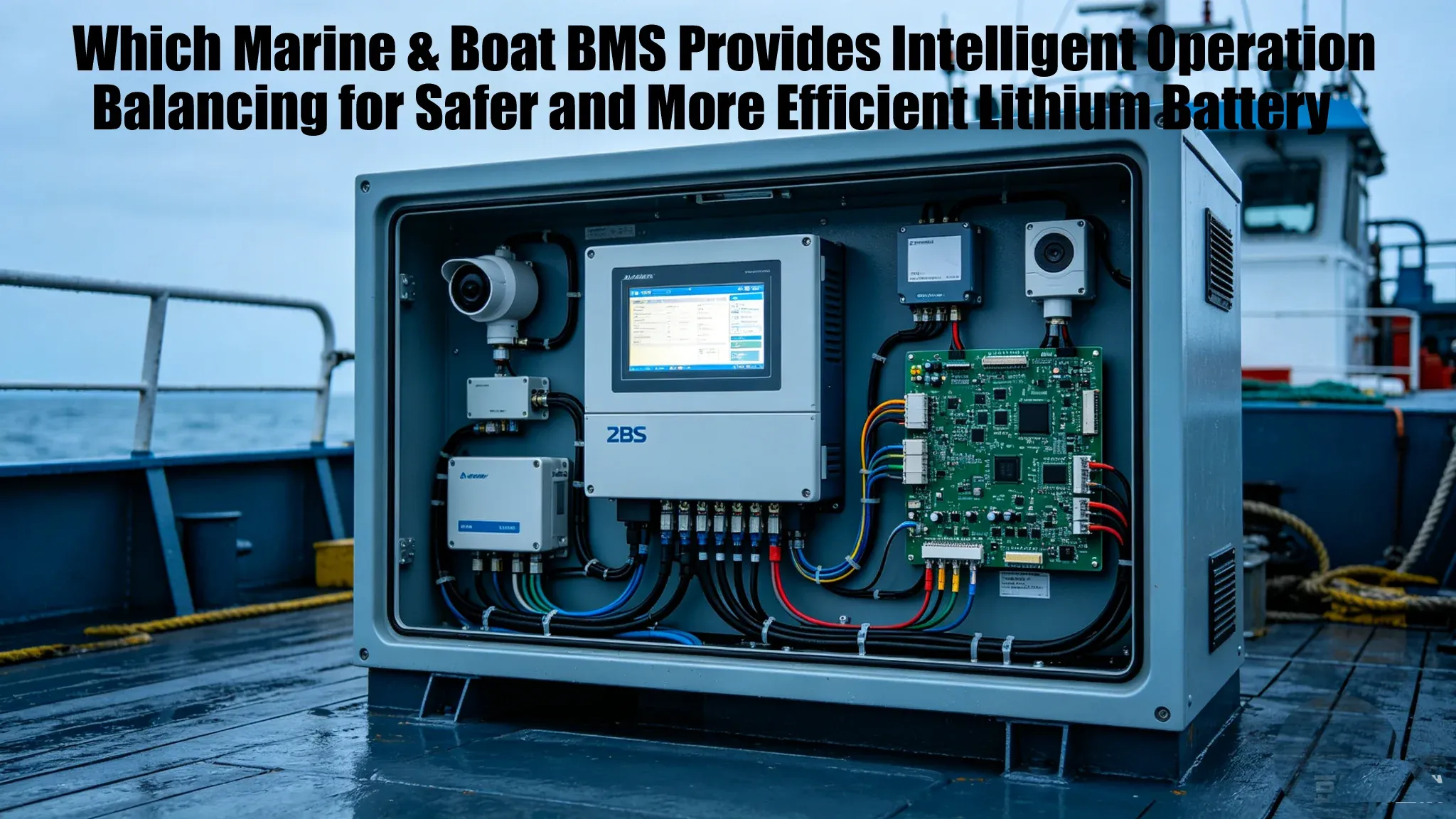
CasaSobre nósEVENTOS E NOTÍCIASWhich Marine & Boat BMS Provides Intelligent Balancing for Safer and More Efficient Lithium Battery Operation?
Which Marine & Boat BMS Provides Intelligent Balancing for Safer and More Efficient Lithium Battery Operation?
113
A Marinha e Barco BMS with intelligent balancing provides safer and more efficient lithium battery operation by continuously managing cell voltage consistency, thermal stability, and charge-discharge control across marine energy systems. A high-quality Marine BMS ensures that lithium batteries used in boats and vessels operate within safe limits while maximizing energy utilization and preventing failures caused by imbalance or overloading in harsh marine environments.
This topic focuses on figuring out how a Marine Battery Management System incorporates intelligent balancing to improve lithium-powered boats’ efficiency and safety. Through real-time monitoring, communication protocols, and adaptive balancing techniques, a contemporary boat BMS maximizes performance in addition to providing protection against electrical malfunctions. Smart Marine BMS solutions are becoming crucial for yachts, electric boats, and offshore energy systems as marine electrification grows.
Why is intelligent balancing essential in marine lithium battery systems?
Intelligent balancing is essential because marine lithium batteries operate under fluctuating loads, vibration, and environmental stress. Without proper balancing, cells within a Marine & Boat BMS system can degrade unevenly, leading to reduced capacity and potential safety risks.
A Marine Battery Management System uses balancing algorithms to equalize voltage differences between cells. This ensures stable energy output, improves charging efficiency, and extends battery cycle life, especially in long-duration marine operations.
How does a Marine BMS improve operational safety?
A Marine BMS improves safety by continuously monitoring electrical and thermal conditions in real time. It detects abnormal voltage spikes, overheating, and current overload situations before they become critical failures.
The Boat Battery Management System acts as a protective layer that disconnects or limits power flow when unsafe conditions are detected. This prevents battery damage and ensures vessel safety in unpredictable marine environments.
Marine environments expose battery systems to saltwater corrosion, humidity, mechanical vibration, and temperature variation. These factors significantly increase the risk of performance degradation if not properly managed.
To address these challenges, a Smart Marine BMS integrates protective sealing, corrosion-resistant materials, and adaptive control logic. This allows stable performance even during long voyages or offshore operations.
Marine & Boat BMS vs UAV Battery Management Systems comparison
Different battery management systems are designed for distinct applications. The following comparison highlights key differences between Marine & Boat BMS systems and UAV BMS technologies.
Parâmetro
Marinha e Barco BMS
Consumer UAV BMS
Industrial UAV BMS
Faixa de tensão
12V–800V
7.4V–58.8V
22V–400V
Capacidade atual
50A–1000A
5A–120A
50A–800A
Waterproof Level
IP67–IP68
IP54
IP65
Comunicação
CAN, RS485
UART
CAN, UART
Balancing Type
Intelligent active balancing
Passive balancing
equilíbrio semi-ativo
Marine Corrosion Protection
Sim
Não
Não
Operating Environment
Saltwater, humidity, vibration
Air only
Industrial air environments
Aplicação
Boats, yachts, marine systems
drones de consumo
Inspection UAVs
What role does real-time monitoring play in Marine Battery Management Systems?
Real-time monitoring allows Marine Battery Management System platforms to continuously track voltage, current, temperature, and SOC status during operation. This ensures early detection of anomalies that could affect performance.
By integrating monitoring functions, Marine BMS solutions provide operators with actionable data, improving decision-making during marine missions and reducing the risk of unexpected system failures.
How does intelligent balancing extend battery lifespan?
Intelligent balancing ensures that all cells in a Boat BMS system discharge and charge evenly. This reduces stress on individual cells and prevents premature degradation caused by imbalance.
The Marine Battery Management System continuously adjusts energy distribution, ensuring that weak cells are supported and strong cells are not overburdened, thereby extending overall battery lifespan significantly.
Key features of a Smart Marine BMS
A Smart Marine BMS includes multiple advanced features designed for marine reliability and efficiency.
High-precision voltage and temperature monitoring
Intelligent active and passive balancing control
CAN bus and RS485 communication integration
Waterproof and corrosion-resistant design
SOC and SOH estimation algorithms
Real-time fault detection and protection mechanisms
These features ensure stable operation across different marine applications and conditions.
Why is communication critical in Marine BMS systems?
Communication is critical because it enables data exchange between the battery system and vessel control systems. Without it, operators cannot accurately monitor battery health or performance.
A Boat Battery Management System typically uses CAN bus or RS485 communication to transmit real-time battery data. This enhances system transparency and improves operational control in marine environments.
Energy efficiency optimization in marine applications
Energy efficiency is a key requirement for modern marine vessels, especially electric boats and hybrid systems. A Marine & Boat BMS optimizes energy flow by reducing unnecessary losses and ensuring balanced load distribution.
This results in improved cruising range, reduced charging frequency, and better overall energy utilization during long marine missions.
What safety mechanisms are integrated into Marine BMS systems?
Safety is a core function of all Marine BMS solutions. Multiple protection layers are integrated to ensure reliable operation under extreme conditions.
Proteção contra sobrecarga
Proteção contra descarga excessiva
Short circuit protection
Proteção contra sobrecorrente
Prevenção de fuga térmica
Water ingress protection
These mechanisms ensure that the system remains stable even in harsh marine environments.
Marine Battery Management System applications in real-world vessels
Marine Battery Management Systems are widely used across various vessel types, including electric boats, hybrid yachts, ferries, fishing vessels, and offshore platforms.
These systems ensure that lithium batteries deliver stable energy output under continuous load conditions, making them essential for modern marine electrification projects.
Why is Smart Marine BMS important for electric boats?
Electric boats rely heavily on battery efficiency and safety. A Smart Marine BMS ensures that energy is distributed efficiently and that battery systems remain stable under varying load conditions.
Without a reliable Boat BMS, electric propulsion systems may suffer from instability, reduced efficiency, or safety risks during operation.
Thermal management in Marine & Boat BMS systems
Thermal management is critical because lithium batteries generate heat during charging and discharging cycles. If not controlled, excessive heat can lead to performance degradation or safety hazards.
A Marine Battery Management System uses temperature sensors and control algorithms to maintain optimal thermal conditions across all battery cells.
How does Marine BMS support predictive maintenance?
Predictive maintenance allows operators to identify potential battery issues before they become critical failures. This is achieved through continuous data analysis of voltage trends, temperature behavior, and cycle history.
The Boat Battery Management System uses these insights to alert operators about potential degradation, improving maintenance planning and reducing downtime.
Advantages of intelligent balancing in marine energy systems
Intelligent balancing provides several operational advantages for marine lithium battery systems.
Improved cell consistency
Increased energy efficiency
Enhanced safety performance
Extended battery cycle life
Reduced maintenance requirements
Better load distribution during operation
These advantages make intelligent balancing a fundamental feature in modern Marine BMS design.
Future trends in Marine Battery Management Systems
The future of Marine Battery Management System technology is moving toward greater intelligence, automation, and connectivity. Artificial intelligence and cloud-based monitoring systems are becoming more common in advanced Smart Marine BMS solutions.
These advancements will enable real-time fleet-level monitoring, predictive analytics, and autonomous energy optimization for marine vessels.
Perguntas frequentes
Q1: What is a Marine & Boat BMS?
A1: A Marine & Boat BMS (Battery Management System) is an intelligent control system designed to monitor, protect, and optimize lithium battery packs used in boats, yachts, and marine energy systems. It ensures safe and efficient operation in harsh marine environments.
Q2: Why is a Marine BMS important for boats?
A2: A Marine BMS is important because it prevents battery failures caused by overcharging, deep discharge, overheating, and cell imbalance. It also improves safety, extends battery lifespan, and ensures stable power delivery during marine operations.
Q3: How does a Boat BMS improve battery safety?
A3: A Boat BMS continuously monitors voltage, current, and temperature. When abnormal conditions are detected, it automatically triggers protection mechanisms such as disconnecting the load or limiting charging to prevent damage or hazards.
Q4: What is intelligent balancing in Marine Battery Management Systems?
A4: Intelligent balancing is a function in a Marine Battery Management System that equalizes voltage differences between battery cells. This ensures consistent performance, improves efficiency, and extends overall battery lifespan.
Q5: Can Marine BMS work in saltwater and humid environments?
A5: Yes. A Smart Marine BMSis designed with waterproof protection (IP67/IP68), corrosion-resistant materials, and sealed electronics to operate reliably in saltwater, high humidity, and marine conditions.
Conclusão
A Marine & Boat BMS that provides intelligent balancing plays a critical role in ensuring safer and more efficient lithium battery operation in marine environments. By combining real-time monitoring, intelligent energy distribution, and advanced protection mechanisms, Marine BMS and Boat BMS technologies significantly improve performance, safety, and battery lifespan. As marine electrification continues to grow, Smart Marine BMS systems will remain essential for supporting reliable and efficient energy management in modern boats and marine applications.
For futher interesting in Ayaatech’s Smart drone bms (4S-32) , you can send email to [email protected] for more information. For more details, please check out these related articles.
FABRICANTE OEM/ODM CERTIFICADO
O poder que você deseja, A integridade que você precisa.
BMS personalizado para baterias de lítio
Soluções BMS inteligentes de alto desempenho para armazenamento de energia, veículos elétricos, robótica e drones.
✔ Alta eficiência e balanceamento ativo
✔ Monitoramento e proteção inteligentes
✔ Certificações Globais
✔ Personalizável para qualquer aplicação
1500+
Clientes
Mais de 30 mil
Unidades/Mês
20+
Anos de experiência.
Obtenha sua solução BMS personalizada.
⚡ Nossos engenheiros respondem em até 12 horas
✔ Consultoria gratuita para projeto de BMS
✔ Resposta rápida e preços competitivos