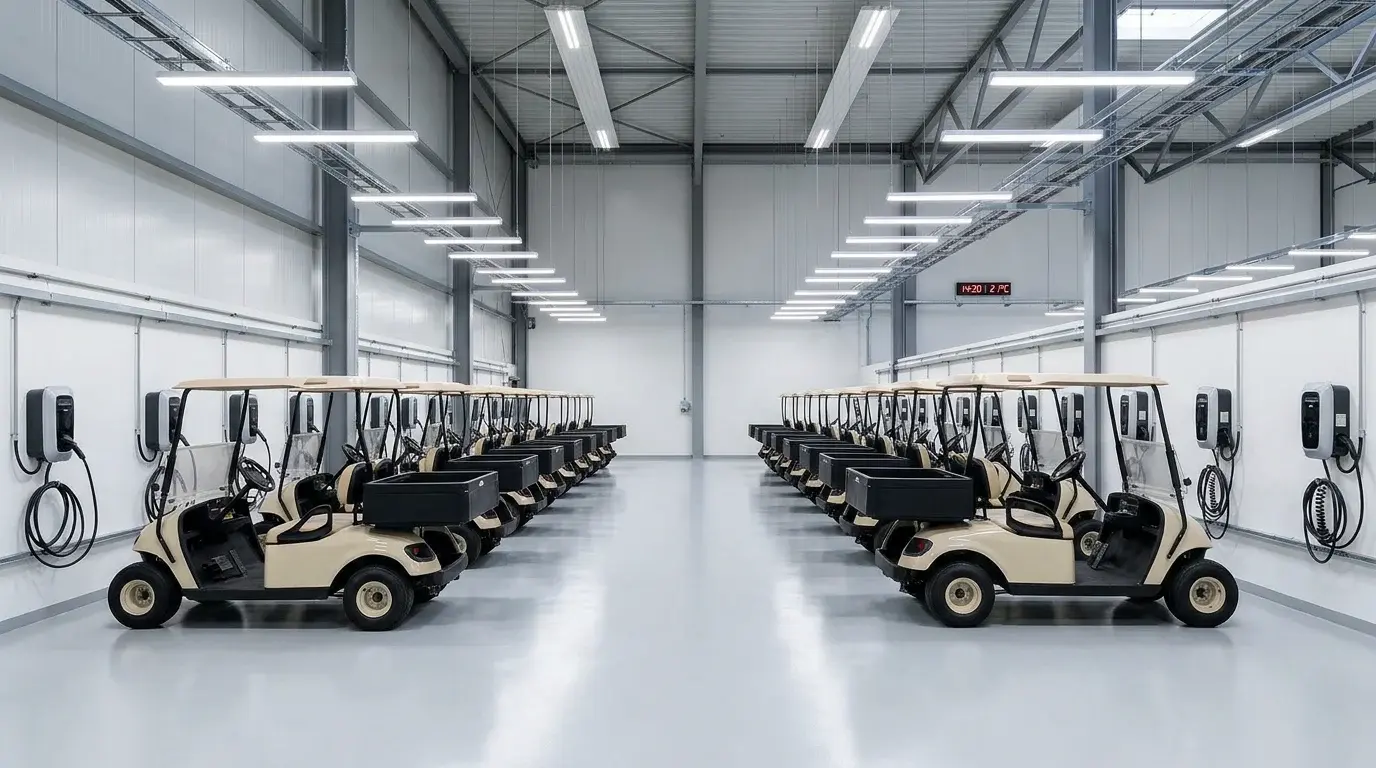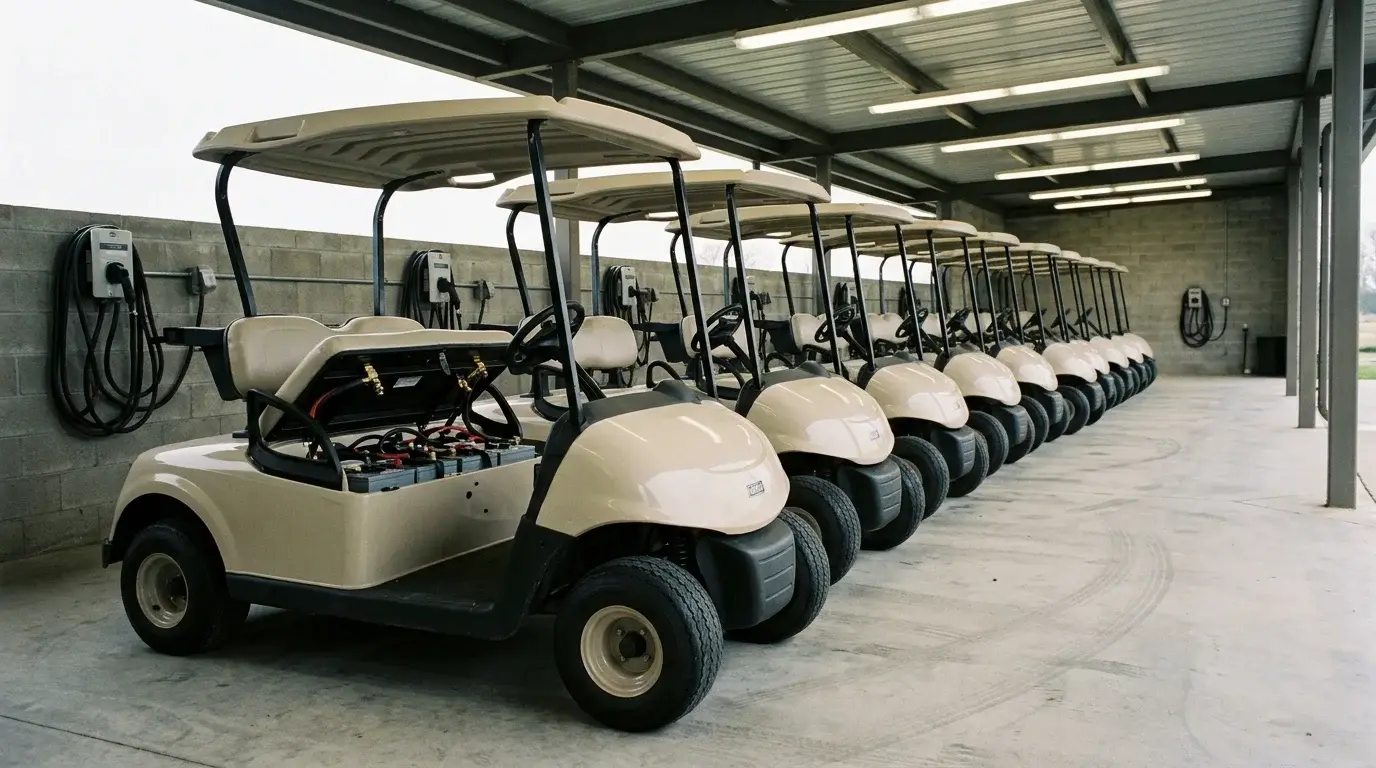






To choose the right lithium golf cart battery, match a 48V (51.2V 16S) 105Ah LiFePO4 pack with a 200A BMS. This setup covers 35–45 real-world miles per charge. It also supports over 3,500 full cycles on standard Club Car, EZ-GO, or Yamaha platforms.
Selecting the wrong configuration leads to common field failures. An incorrect cell count trips motor controllers into limp mode. An undersized BMS cuts power abruptly on steep grades.
Installing a bare pack without an isolated 12V DC converter also creates risks. It can destroy factory accessories and trigger over-voltage charger faults.
This guide provides the exact engineering steps to choose the right lithium golf cart battery. You will learn voltage selection, peak-current sizing, and essential safety requirements.

Step 1: Match Powertrain Voltage and Real-World Capacity
First, inspect your existing lead-acid bank. Six 8V or four 12V batteries indicate a 48V system. Six 6V batteries indicate a 36V system.
Never cross voltage classes without upgrading other components. You must swap the motor, controller, solenoid, and harness. While 36V setups exist in older fleets, 48V remains the modern standard.
The 15S (48V) vs. 16S (51.2V) Architecture Trap
Buying an under-spec cell string is a common procurement error. LiFePO4 cells carry a 3.2V nominal rating.
A 15-cell build (15S) delivers 48V nominal. It charges to 54.75V and cuts off near 40.5V. A 16-cell build (16S) delivers 51.2V nominal. It charges to 58.4V and cuts off near 42.6V.
Budget brands prefer 15S builds to cut cell costs. However, a 15S pack drops voltage quickly below 35% capacity. Standard Curtis and Navitas controllers expect flat lead-acid discharge curves. They misread this drop as a dead pack. This triggers the Low Voltage Cutoff (LVC) and causes unexpected limp mode.
For commercial fleets, a 16S build is essential. It keeps operating voltage above controller cutoffs across 90% of the cycle.
【Engineering Note】 Check the controller’s programmed LVC setting before filing a warranty claim. Curtis controllers often default to an LVC between 38V and 42V. A 15S pack crosses this line under heavy acceleration when half-depleted. Adjusting controller settings or switching to a 16S pack fixes the issue.
Sizing Amp-Hours (Ah) for Daily Operations
Never base fleet schedules on maximum brochure claims. Real payloads and hill grades pull continuous amperage. Utility boxes and wet turf also reduce total range.
The table below outlines real-world expectations. These numbers reflect a two-passenger cart on mixed turf:
| Pack Capacity | Realistic Range | Recommended Fleet Duty Cycle |
|---|---|---|
| 60Ah | 18–25 miles | Light community security, short resort loops |
| 100Ah – 105Ah | 35–45 miles | Standard full-day rental, 36 holes, maintenance carts |
| 135Ah – 160Ah | 50–65+ miles | Multi-passenger shuttles, steep mountain courses |
A 105Ah pack offers the best balance of range and weight. It also fits standard battery trays cleanly. Moving to 135Ah+ adds physical height. This extra height can hit OEM seat pods on Club Car Precedents.
Step 2: Match the Lithium Golf Cart Battery BMS to Controller Demand
A lithium golf cart battery is only as capable as its BMS. Budget hardware usually fails during steep hill climbs.
Starting a loaded cart requires an instant surge called inrush current. A stock 48V motor with a Curtis controller pulls 300A to 350A. This spike lasts for 1 to 2 seconds.
Upgraded motors with Navitas 600A controllers demand even more power. That initial draw can surge past 500A to 650A.
If the BMS peak rating sits below this spike, protection trips immediately. Power cuts out, the solenoid drops, and the cart stalls on the hill.

Essential BMS Current Metrics
Always check three specific ratings on supplier datasheets:
- Continuous Discharge Current: Must sit at 150A to 200A minimum for commercial fleets.
- Peak Discharge Current: Must handle 400A to 600A for 3 to 10 seconds during acceleration.
- Trip Delay Time: The response window before MOSFET switches disconnect. Overly sensitive firmware causes constant nuisance tripping.
The Regenerative Braking Hazard
Downhill driving turns the electric motor into a generator. It sends high-amperage regenerative current back into the battery.
If the pack sits near full charge, this surge raises cell voltage. It can quickly exceed the over-voltage protection (OVP) ceiling.
Cheap BMS units disconnect the charge circuit completely when this happens. The cart instantly loses electrical dynamic braking. This forces manual drum brakes to bear the entire load. The resulting voltage spike can also damage controller input capacitors.
【Engineering Note】 On hilly courses running AC motors, source batteries with coordinated regen tolerances. You can also install external braking ballast resistors. Never deploy a pack that handles regen OVP by dropping the main DC bus.
Step 3: Turnkey Conversion Kits vs. Bare Batteries

Buying standalone batteries creates hidden labor costs and warranty headaches. A field-ready commercial kit must include three key elements:
- Chassis-Matched Brackets: Club Car, EZ-GO, and Yamaha use different tray shapes. Proper kits supply powder-coated steel brackets using factory bolt holes. This prevents terminal fatigue and busbar vibration damage.
- Matched Industrial Lithium Charger: Lead-acid chargers apply high-voltage equalization pulses above 60V. These pulses confuse lithium protection circuits. Always use a charger operating on a strict Constant Current / Constant Voltage (CCCV) profile.
- Digital Coulomb-Counting Meter: Voltage-based gauges cannot track LiFePO4 due to its flat discharge curve. An amp-hour integrating shunt provides true capacity figures.
Em AYAA TECH, our smart BMS platforms integrate dynamic state-of-charge (SOC) algorithms. They compensate for ambient temperature shifts and cell internal impedance. This keeps the SOC error rate to ≤5%. Operators gain reliable runtime visibility under all working conditions.
The 12V Auxiliary Supply
Original 48V lead-acid systems powered 12V lights by tapping across two batteries. A single 48V pack eliminates those mid-string tap points.
Connecting 12V accessories directly to a 48V pack will destroy them. In accordance with SAE J2344 electrical vehicle safety guidelines, every installation requires an isolated 48V-to-12V DC-DC converter.
Non-isolated converters share a common ground between traction and accessory circuits. This design creates ground loops, radio noise, and frame corrosion. Wire the converter trigger through the key switch to eliminate overnight parasitic draw.
Looking to Upgrade Your Fleet or Engineering a Custom Platform?
Explore AYAA TECH Product Catalog →Step 4: Non-Negotiable Safety and Build Standards
Before signing a purchase order, audit these four technical specifications:
- IP67 Enclosure Rating: Grounds crews wash battery bays with high-pressure water hoses. Carts also drive through standing water daily. Certified to the IEC 60529 IP code, an IP67 rating ensures immersion protection up to 1 meter for 30 minutes. Verify the seal covers cable glands, not just the outer box.
- Low-Temperature Charge Inhibit: LiFePO4 discharges safely down to -20°C (-4°F). However, experimental research on lithium plating under subzero operation proves that charging below 0°C (32°F) causes permanent metallic deposition on the anodes. This destroys capacity and creates short-circuit risks. Choose a BMS with cold-charge cutoffs or internal heating pads.
- Grade-A Prismatic Cells: Heavy-duty prismatic cells from makers like EVE or CATL are ideal. They require far fewer internal interconnects than small cylindrical cells. Fewer connection points mean lower resistance and greater durability against path vibration.
- Thermal Architecture: Sustained high discharge generates serious heat across BMS MOSFETs and current shunts.

To guarantee reliability, AYAA TECH optimizes thermal dissipation through a balanced component layout. We place MOSFETs and sampling resistors evenly across the board. Critical heat paths are coupled using high-conductivity thermal pads or gels. Aviation-grade aluminum and copper heat sinks then pull heat safely away from the cells.
Are Lithium Golf Cart Batteries Worth It? Pros and Cons for Fleets
For most commercial operations, a lithium golf cart battery upgrade delivers a clear ROI. Fleets typically break even within 2.5 to 3.5 years. Savings come from eliminating routine maintenance labor, reducing utility bills, and avoiding frequent replacements.
Still, sound engineering requires weighing real-world trade-offs:
The Real-World Pros
- 70%+ Weight Reduction: Dropping 270 lbs per cart extends suspension, bushing, and brake life. Lighter carts also minimize turf compaction on wet mornings.
- Fast and Opportunity Charging: Lithium charges from 20% to 100% in 2.5 to 4 hours without memory issues. Crews can top off carts during lunch breaks to increase daily vehicle use.
- Consistent Torque: Lead-acid loses voltage and speed as the day wears on. LiFePO4 delivers steady voltage through 90% of its discharge. Carts climb hills with full power all day long.
- 10-Year Service Life: Delivering 3,500 to 5,000 cycles, a commercial pack outlasts three sets of lead-acid batteries.
The Engineering Cons and Trade-offs
- Higher Initial CapEx: Upfront costs are roughly 2x to 3x higher than flooded lead-acid sets. This requires disciplined capital budgeting.
- Zero Cold Charging Tolerance: Charging below freezing ruins unprotected cells. Facilities without heated storage must invest in self-heating packs.
- Abrupt Shutdown Cliff: Lead-acid carts slow down visibly as batteries die. Lithium runs at full speed until the BMS limit trips, cutting power instantly. Operators must learn to read digital meters.
- Mandatory Peripheral Hardware: Conversions require budgeting for dedicated CCCV chargers and chassis-specific brackets. You also need isolated 12V converters.
【Engineering Note】 Avoid lithium in unheated, sub-zero storage facilities staffed by high-turnover seasonal crews. In these environments, cold-charging rules are easily overlooked. Also, avoid installing premium lithium packs in 15-year-old carts with rusted frames. Lithium rewards well-maintained, high-utilization fleets, but exposes weak vehicle wiring.
Solving a Complex Integration or Custom Voltage Challenge?
Consult an AYAA TECH Battery Architect →Perguntas frequentes
Can I use my existing lead-acid charger on a new lithium battery?
No. Lead-acid chargers use equalization cycles that spike past 60V. They also use float stages designed to stop lead plate sulfation. These voltage spikes trip lithium BMS protection circuits and can damage sensitive electronics. Always use a charger programmed with a lithium Constant Current / Constant Voltage (CCCV) profile.
What is the difference between one 48V battery and four 12V lithium batteries in series?
A single 48V pack uses one centralized BMS to monitor all 16 cells together. In a 12V series string, each battery relies on an independent BMS. Over time, slight cell differences cause these separate batteries to drift out of balance. When one 12V unit hits its low-voltage limit, it shuts down the entire cart. A single 48V pack eliminates this failure point.
Why does my golf cart cut out while driving uphill with a full lithium battery?
This issue is almost always caused by BMS over-current protection (OCP) tripping under high inrush current. Accelerating uphill demands sudden current spikes of 400A to 500A+. If your BMS is only rated for 200A or 300A peaks, it treats the climb as a short circuit and cuts power. Fix this by choosing a battery with a 400A–600A peak rating, or reduce controller acceleration ramp rates.
How many miles does a 48V 105Ah battery realistically deliver?
Under standard conditions, expect 35 to 45 miles of range. This assumes a two-passenger cart driving on paved paths and fairways. Lifted suspensions, aggressive off-road tires, and utility cargo boxes increase power draw. These configurations reduce total range to roughly 25 to 32 miles.
Do lithium golf cart batteries require regular scheduled maintenance?
No. You never need to check electrolyte levels, add distilled water, or clean acid corrosion. The internal BMS balances cells automatically during charging cycles. Simply keep terminals clean and properly torqued. Charge the pack to roughly 50% SOC before placing it into seasonal storage.
Is it safe to store and charge a lithium battery in an unheated garage during winter?
Storage and discharge are safe down to -20°C (-4°F). However, charging below 0°C (32°F) is strictly prohibited. Sub-zero charging causes permanent lithium plating, rapid capacity loss, and short-circuit hazards. If you store carts in unheated buildings, select a battery with cold-charge cutoffs or internal heating pads.
What engineering documentation should I demand before placing a bulk fleet order?
Require proof of Grade-A cell sourcing with batch impedance data. Ask for the complete BMS datasheet detailing peak current and I-t trip curves. You should also demand verified IP67 test reports. Finally, request UL 2271 ou UL 1973 safety documentation and UN 38.3 transport certificates.