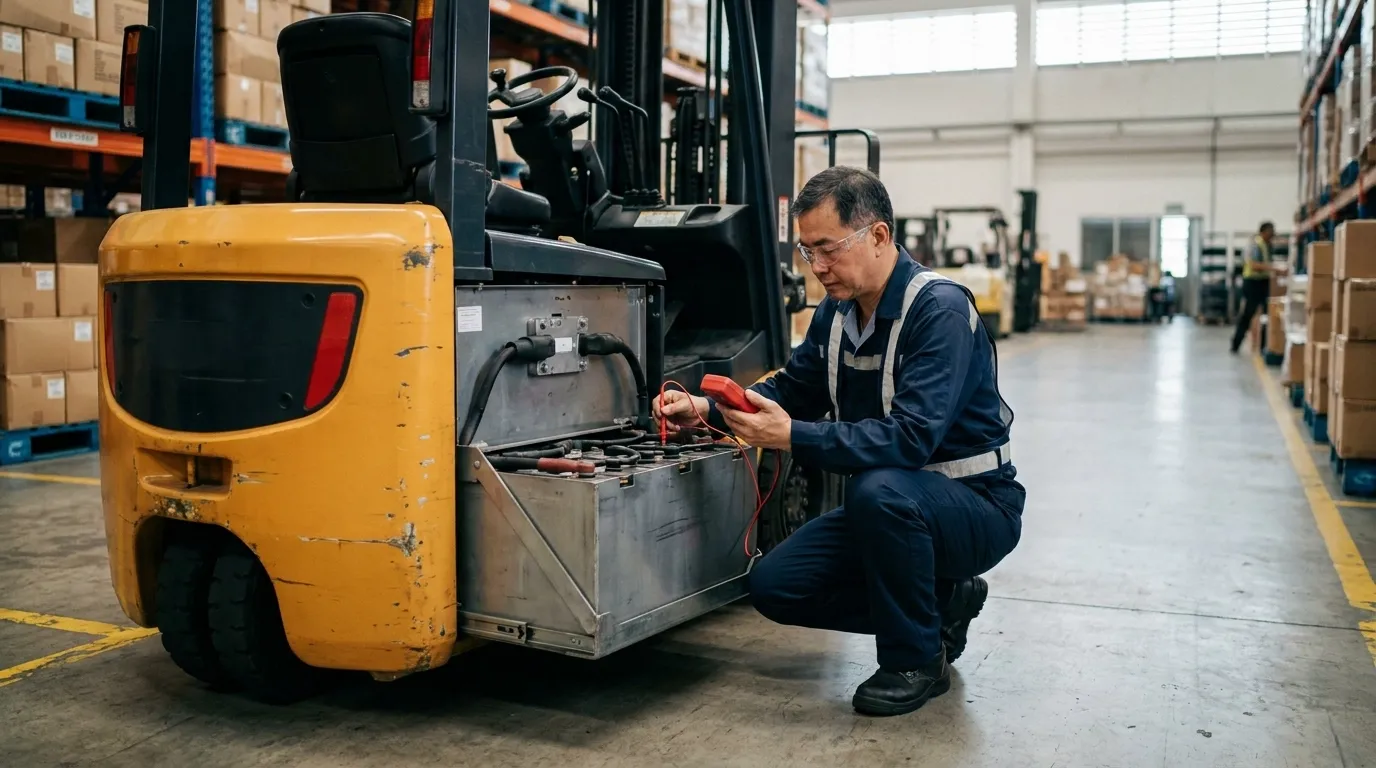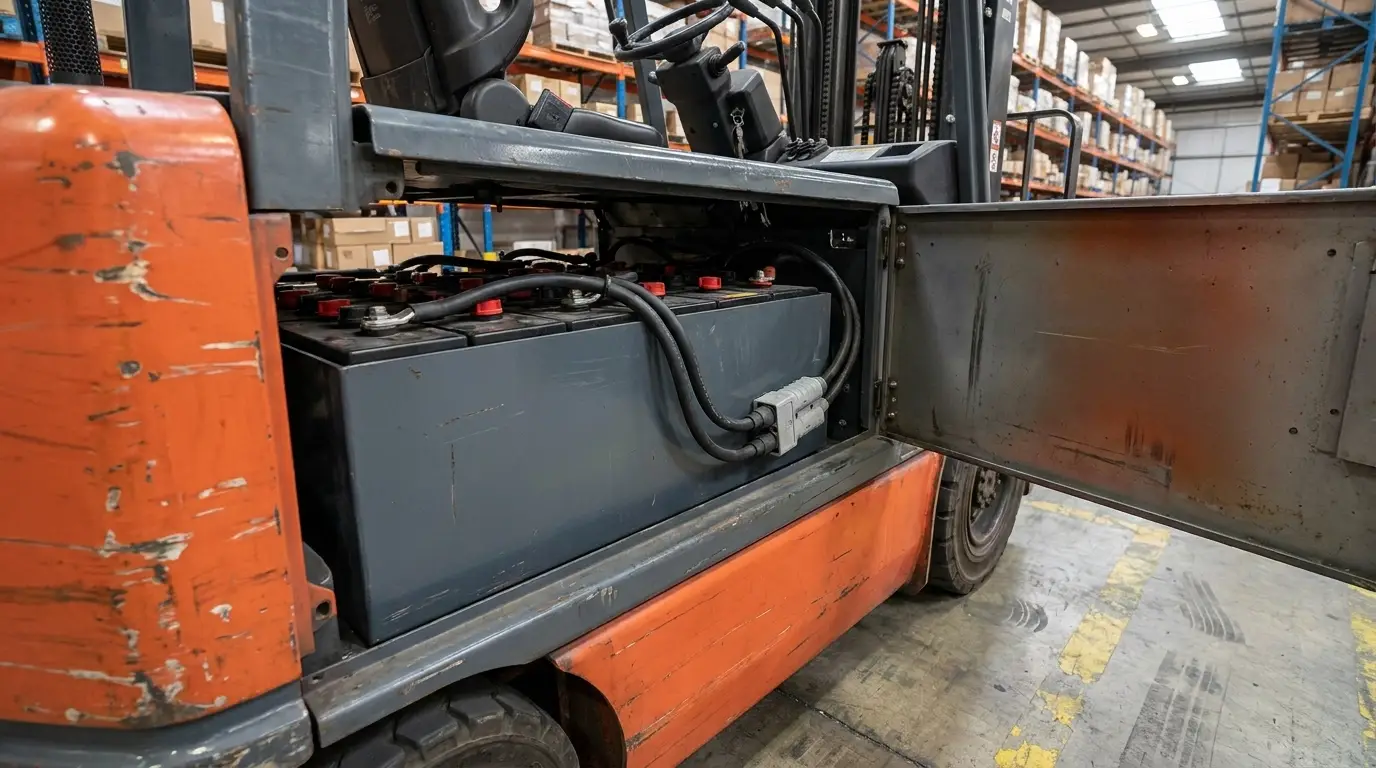







Standard forklift battery voltage is typically 24V, 36V, 48V, or 80V, set by equipment duty class. Small pallet jacks sit at the low end. Heavy-duty counterbalance trucks sit at the high end. There is no single universal standard. The correct voltage matches what your forklift electrical system requires, as defined by the manufacturer.
It also helps to separate three key terms. Voltage is the electrical potential of the system. Amp-hour (Ah) capacity measures stored electrical charge. Usable energy and actual workload determine total runtime.
Lead-acid and lithium batteries can also be labeled differently on the same truck. For example, a 48V-class lithium pack often reads 51.2V. Below, we cover common voltage classes, cell configurations, voltage readings, and replacement fit.

Common Forklift Battery Voltage Classes by Equipment Type
The main voltage classes usually map directly to specific equipment categories. Treat this guide as a reference. Truck manufacturers frequently mix and match configurations based on chassis design.
| Tensão Nominal | Typical Applications |
|---|---|
| 24V | Electric pallet jacks, walkie stackers, light warehouse equipment |
| 36V | Selected order pickers, reach trucks, light electric handling units |
| 48V | Standard counterbalance forklifts, mid-size reach trucks |
| 72V | Specialized industrial equipment |
| 80V | Heavy-duty electric counterbalance forklifts |
As the table shows, voltage generally climbs with duty cycle. Heavier trucks that run longer shifts tend to use higher voltages. However, lifting capacity alone does not determine system voltage. Never guess the voltage from truck size.
Some machines sit outside this table. You may find 12V auxiliary systems for lights or controls. Certain heavy machines use 96V platforms. The forklift data plate and manual always provide the final word.
How Cell Configuration Determines Forklift Battery Voltage
How Series-Connected Cells Set Battery Voltage
A forklift battery contains multiple cells wired in series. Series wiring adds the voltages of each cell together. A conventional lead-acid traction cell delivers about 2V nominal. Therefore, the cell count determines the total pack voltage.
| Tensão Nominal | Approximate Lead-Acid Cells |
|---|---|
| 24V | 12 |
| 36V | 18 |
| 48V | 24 |
| 80V | 40 |
The standard voltage classes are not arbitrary numbers. They simply reflect round multiples of 2V lead-acid cells.
Why Lithium Forklift Batteries Have Different Voltage Ratings
Lithium batteries follow the same series logic. However, individual cell voltage depends on chemistry. A lithium iron phosphate (LiFePO4) cell is 3.2V nominal. Connecting 16 cells in series (16S) creates a 51.2V pack.
Makers often sell this 51.2V pack for 48V-class trucks. This setup works only if the truck controller accepts that operating window. A similar nominal voltage does not guarantee electrical compatibility. Always check the truck’s permitted voltage range.
Lithium packs also require a dedicated Battery Management System (BMS). The BMS monitors cell health and enforces critical protections. For a deeper chemistry comparison, read our guide on lithium-ion vs. lead-acid forklift batteries.

Nominal vs. Resting vs. Charging Voltage Explained
Understanding Nominal Voltage and Actual Battery Voltage
Nominal voltage is simply the system’s design label. It is the rated number used to categorize equipment, such as 48V. Your digital multimeter will rarely display this exact number.
Resting voltage is measured when the battery has no active load or charge. Loaded voltage is measured while the truck is operating. Terminal voltage under load typically drops below the resting level. State of charge, ambient temperature, and measurement methods all shift these readings.
A multimeter reading a few volts away from the label is normal. Acceptable readings depend entirely on when and how you test.
Why Is Charging Voltage Higher Than Nominal Voltage?
To push current into a battery, charging voltage must exceed current battery voltage. This electrical difference drives the charging process. As a result, charging voltage always exceeds nominal voltage.
How much higher depends on chemistry and charger profiles. Lead-acid and LiFePO4 batteries require entirely different charging curves. Even batteries within the same voltage class can have distinct cut-off limits.
Never charge a battery using generic online voltage figures. Always follow the manufacturer’s charging specifications. A standard 48V lead-acid charger will damage a 48V-class lithium pack. For details, consult our guide on choosing the right forklift battery charger.
How Battery Voltage Affects Forklift Power and Runtime
Voltage and Power Output
The core electrical relationship is P = V × I. Power equals voltage multiplied by current. At identical power demands, higher-voltage systems draw less current. Lower current allows thinner wiring and reduces resistive heat loss.
However, voltage alone does not decide lift capacity or speed. The traction motor, controller, hydraulics, and mechanical design matter equally. A higher-voltage forklift is not inherently stronger by default.
Voltage, Amp-Hour Capacity, and Runtime
Amp-hour (Ah) capacity measures stored electrical charge. Multiplying Ah by nominal voltage gives total stored energy:
For instance, a 48V 400Ah battery stores about 19,200 watt-hours.
Usable energy drives actual runtime. Workload intensity, duty cycles, operating temperature, and cell health all influence performance.
This fact dispels a common industry myth. Higher voltage does not automatically guarantee longer runtime. A high-voltage battery with low Ah stores less energy than a lower-voltage pack with high Ah. Always evaluate total watt-hours and actual workload.
Explore Our Smart BMS and Battery Pack Range
Explore Product CatalogHow to Find the Correct Forklift Battery Voltage
Check the Forklift Data Plate and Owner’s Manual
Always begin with the forklift’s data plate. It specifies the required battery voltage and key electrical limits. The manufacturer’s manual confirms these specifications. You can also contact the OEM using the model and serial number.
Next, verify the label on the installed battery. Never check the installed battery first. A previous owner may have installed an incorrect battery pack. The OEM data plate remains the only authoritative reference.
Verify Secondary Battery Compatibility Factors
Matching nominal voltage is only the first step. You must also evaluate several critical compatibility factors:
- Battery chemistry and operating voltage thresholds
- Rated Ah capacity for your shift requirements
- Battery compartment dimensions and tray clearances
- Minimum battery service weight for counterbalance stability
- Connector type, terminal polarity, and cable lengths
- Charger profile compatibility
- BMS communication protocols where integrated
Do not overlook battery weight. Lead-acid batteries serve as functional counterweights on forklifts. Installing a lighter lithium pack without ballast compromises truck stability and safety.
Lithium conversions require a BMS matched to the entire vehicle system. AYAA TECH provides customizable BMS solutions, such as the 7S–24S 300A BMS for forklift battery. This unit supports CAN, RS485, and UART interfaces. Selection must evaluate cell count, chemistry, current draw, protection thresholds, and communication protocols.

Troubleshooting Low Forklift Battery Voltage
Inspect Charging Status and Cable Connections
A single low voltage reading does not prove battery failure. The pack may simply be deeply discharged. It could also indicate a loose connection, aging cells, or an internal truck issue.
Always troubleshoot from simple issues to complex ones. First, ensure the battery completed a full charge cycle using a compatible charger. Then inspect all external cables, connectors, and terminals for corrosion or damage. High-resistance contacts often mimic battery failure.
When to Perform Individual Cell Testing
If performance issues persist, test individual cell voltages. A cell reading significantly lower than adjacent cells reveals a weak link. However, no universal number defines a failed cell across all chemistries.
Operating conditions, state of charge, and test methods alter baseline values. For detailed procedures, review our guide on how to test a forklift battery.
Industrial traction batteries carry severe electrical hazards. Always delegate internal pack testing and high-voltage repairs to certified technicians.
Need a Custom BMS for Your Forklift Battery System?
Request Custom Battery SolutionsPerguntas frequentes
Are Forklift Batteries 12V or 24V?
Neither voltage powers standard counterbalance forklifts. Pallet jacks and walkie stackers commonly use 24V systems. Counterbalance forklifts typically utilize 36V, 48V, or 80V batteries. Auxiliary systems like lights may run on 12V.
How Do I Know What Voltage My Forklift Needs?
Examine the truck’s data plate and owner’s manual. If you have doubts, verify specifications with the manufacturer using your serial number. Do not rely solely on the battery currently installed.
How Many Cells Are in a 48V Forklift Battery?
A 48V lead-acid battery contains 24 cells, each rated at 2V nominal. Lithium configurations differ. A 48V-class LiFePO4 battery typically uses 16 cells in series, totaling 51.2V nominal.
Why Does a 48V Lithium Forklift Battery Read 51.2V?
LiFePO4 cells have a nominal rating of 3.2V each. Connecting 16 cells in series yields 51.2V. Manufacturers market this configuration for 48V equipment. Always verify your truck accepts this voltage curve.
What Voltage Should a Fully Charged Forklift Battery Read?
Full-charge voltage depends on chemistry, ambient temperature, and charging profiles. Voltage readings also vary between charging and resting states. Always reference the battery manufacturer’s official charging manual.
Can I Use a Different-Voltage Battery or Charger in My Forklift?
No. Forklift drive motors and controllers are engineered for a specific voltage range. Mismatched voltages can destroy electronic components and cause severe safety hazards. Always match OEM specifications precisely.
Does a Higher-Voltage Forklift Battery Last Longer?
Not automatically. Working runtime depends on total usable energy (V × Ah), workload, and operating temperatures. A high-voltage pack with low Ah can deliver less runtime than a lower-voltage, high-capacity battery.