
- Industries

Home Backup & Garden BMS
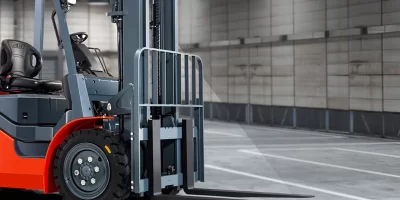
View More >Electric Forklift BMS
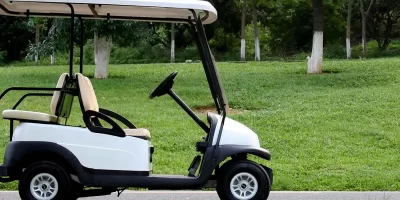
View More >Golf Cart BMS
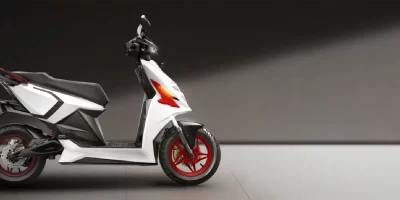
View More >Electric Two-wheeler BMS
View More >Aviation & UAV BMS
View More >BMS For Power Tools
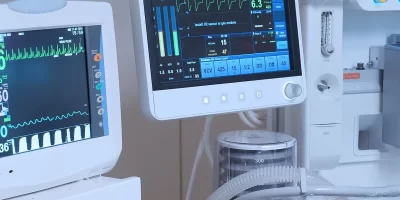
View More >Medical Equipment BMS
View More >






| LF | LI | |||
| Model Number | AY-L16S200A-ES003 (8S-16S) | |||
| Communication Interface | RS485/CAN/UART | |||
| Charging voltage | DC:25.6V~51.2V CC/CV(3.2V/Cell) 8s~16s | DC:33.6V~67.2V CC/CV(4.2V/Cell) 8s~16s | ||
| Maximal continuous charging current | 200A | |||
| Maximal continuous discharging current | 200A | |||
| Current consume in normal operation | ≤15mA | |||
| Current consume in sleep operation | ≤150uA | |||
| Balance voltage for single cell | 3.5±0.05V | 4.0±0.05V | ||
| Over charge detection voltage | 3.65±0.05V | 4.25±0.05V | ||
| Charge Over current detection current | 220±3A | |||
| Discharge Over current detection current 1 | 400±3A | |||
| Discharge Over current detection current 2 | 500±3A | |||
| Short Protection | YES | |||
| SOC | 5%~8% | |||
 | |
| Size | L206 * W162 * T30 mm |
| NTC | 10K |
| Temperature switch | / ℃(the batteries temperature) |
| Weak current switch | YES |
| Active balance | YES |
| Heater | YES |
| Braking Resistors | NO |
| Low temperature protection when charge | 0℃ | ||
| Release temperature( low temperature protection) | 5℃ | ||
| Over temperature protection when charge | 60℃ | ||
| Release temperature( over temperature protection) | 55℃ | ||
| Low temperature protection when discharge | -15℃ | ||
| Release temperature( low temperature protection) | -10℃ | ||
| Over temperature protection when discharge | 65℃ | ||
| Release temperature( over temperature protection) | 55℃ | ||
| Operating Temperature Range | -40~+85℃ | ||
| Storage Temperature Range | -40~+125℃ | ||
| LCD display screen | YES |
| LED light board | YES |
| Bluetooth mode | YES |
| 4G | YES |
| GPS | YES |
Custom Energy Storage BMS 8S–16S 200A with CAN, RS485, UART
Product Introduction
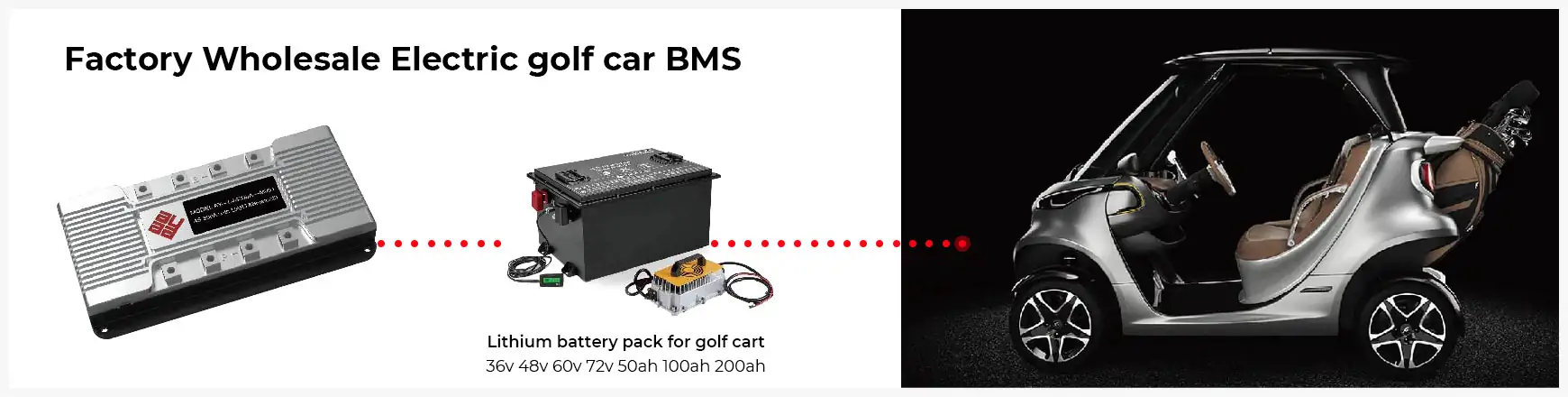
The 8S–16S 200A Smart BMS is made for energy storage and electric mobility battery systems used in industrial, golf cart, RV, and marine applications. It supports communication via CAN, RS485, and UART interfaces and controls battery performance by keeping an eye on voltage, current, temperature, and state of charge. This BMS is appropriate for both mobile and stationary energy storage systems since it permits variable configuration and integration into various battery pack types.
This intelligent BMS provides monitoring, communication, and programmable control features for energy storage and electric car systems.
For more information or technical support, feel free to contact us.

Allows for adaption to various voltage platforms used in rack-mounted batteries, maritime setups, and RV systems by supporting 8S to 16S battery packs. Because of its adaptability, it can be used for both stationary and mobile energy storage systems.
Inverters, car controllers, and monitoring systems can be connected via CAN, RS485, and UART interfaces. This enables system integration across several platforms and real-time data exchange.
Continuously monitors temperature, charge level, voltage, and current. Throughout operation, the technology gives customers continuous input so they can keep an eye on the battery’s condition.
Through firmware modifications, users can alter protection levels, communication settings, and current restrictions, making it flexible to meet various project needs.
Sustains steady battery performance throughout time by maintaining constant voltage levels across cells while charging and discharging.
Helps regulate battery functioning within predetermined bounds by providing control for overcharge, overdischarge, overcurrent, short circuit, and temperature situations.
When space minimization is needed, the structure can be installed in rack-mounted systems, car battery compartments, or maritime setups.
Stores battery performance information, including voltage history and charge cycles, to facilitate system assessment and maintenance scheduling.
Intended for use with a variety of energy storage and electric mobility systems, such as marine batteries, RVs, and forklifts.
A variety of energy storage and electric car systems that need battery control, communication, and monitoring can use the 8S–16S 200A Smart BMS.

Controls battery systems that are often charged and discharged in industrial material handling equipment.

For short-distance electric vehicles used in homes and businesses, it offers battery monitoring and control.

Supports onboard battery systems for auxiliary power supplies, appliances, and illumination.

Incorporates solar storage, telecom applications, and backup power into stationary energy storage systems.

Oversees the battery systems that boats employ for onboard electrical equipment and propulsion.


We are your dependable partner for scalable, intelligent, high-current BMS systems, regardless of whether your company manufactures electric cars, supplies battery packs, or integrates systems. We can power your next breakthrough.
We are well-positioned to understand the demands of the growing electric car and energy storage markets because to our more than 21 years of experience in battery management and power solutions.
Our committed R&D team never ceases pushing the boundaries of technology to bring smarter, safer, and more efficient products to market, whether it’s through integrated software platforms or creative BMS design.
To guarantee longevity, stability, and peak performance in practical applications like golf carts, motorcycles, forklifts, and energy storage systems, our BMS and power solutions are put through rigorous testing under demanding circumstances.
Form factors, wireless modules, communication protocols, and battery kinds are just a few of the customization possibilities we provide to suit your unique requirements.
Our technical staff is ready around-the-clock to assist you with setup, integration, and troubleshooting, from pre-sales guidance to post-purchase support.
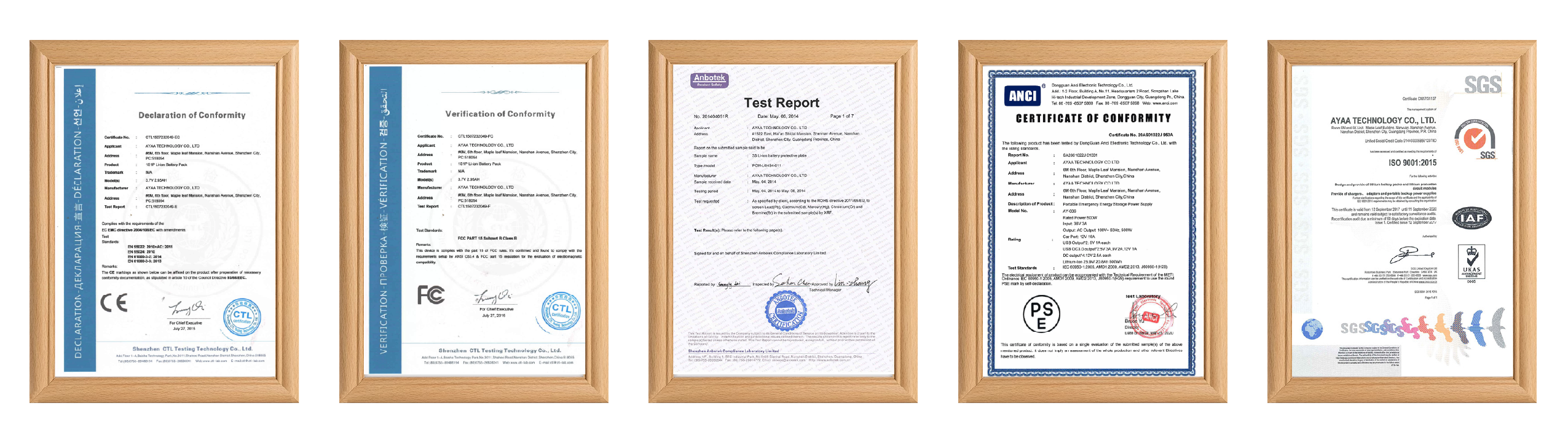
Every product we sell is of the best quality and safety since we closely follow international standards like CE, IEC62109, VDE, and CQC.
Our Certificates
FAQ:
Q:What is BMS for battery energy storage system?
A: Definition: A battery management system (BMS) is a piece of technology used to monitor a battery pack, which is a collection of battery cells electrically arranged in a row x column matrix, in order to deliver a specific range of voltage and current for a predetermined amount of time under anticipated load conditions.
Q:Is a marine RV battery lithium?
A: A common option for both marine and recreational vehicle applications, AYAA batteries are a form of sealed lead-acid battery that provides maintenance-free operation and superior vibration resistance compared to flooded lead-acid. Nonetheless, deep cycle lithium batteries are also frequently used in these applications.
Q:Does a lithium battery need a BMS?
A: To handle the complexities of numerous cells, multi-cell lithium battery packs—like those found in EVs, e-bikes, and solar storage systems—nearly always need a BMS. In multi-cell configurations, the lack of a BMS may result in safety hazards and shorter battery life.
Q:How much energy can BMS save?
A: Energy bills can be lowered by up to 15–35% with a well maintained BMS. To guarantee the best possible control of building services, an effective and regular maintenance schedule is essential.
Q:Is there a difference between a marine battery and an RV battery?
A: Deep-cycle marine batteries, on the other hand, are perfect for powering electronics and accessories because they are designed to provide steady, moderate power over time. RV batteries, on the other hand, are often deep-cycle and designed to last longer.
Q:Can I change my RV battery to lithium?
A: Replacing your old batteries is simple because they share the same connections as lead acid batteries. Therefore, RV lithium battery conversion is as easy as changing one cell for another if you already know what size battery you need.
Share


