- Industries

Home Backup & Garden BMS
View More >Electric Forklift BMS
View More >Golf Cart BMS
View More >Electric Two-wheeler BMS
View More >Aviation & UAV BMS
View More >BMS For Power Tools
View More >Medical Equipment BMS
View More >








Home About Us EVENTS & NEWS Lithium 12V RV Battery Advantages: How Smart BMS Features Transform Off-Grid RV Living
Selecting the best energy system is crucial for RV owners who want worry-free performance, long-lasting power, and full independence.
Additionally, the lithium 12V RV battery has swiftly emerged as the industry standard as more tourists switch from conventional power sources to more intelligent, long-lasting technology.
The transition to lithium—with sophisticated Battery Management Systems (BMS)—is changing the RV lifestyle from stressful to effortless, whether you’re off-grid camping, running high-demand appliances, or just want to get rid of the annoyances of outdated battery technology.

Lightweight and highly efficient, a lithium 12V RV battery is made to provide reliable performance for RV electrical systems. But what really sets it apart?
Why does a lithium 12V RV battery provide constant voltage?
Lithium batteries retain a constant voltage from nearly full to nearly empty, in contrast to lead-acid batteries that sag significantly under load.
This keeps your refrigerator cool, your lights bright, and your inverter operating without interruptions.
Is a lithium 12V RV battery more cost-effective long term?
Of course. Despite having a greater initial cost, it lasts three to five times longer than a standard RV battery, requires no maintenance, and operates more effectively, making it the most economical choice in the long run.
How does the wide availability of 12V lithium make replacements easy?
A lithium RV battery connects with existing RV electronics and requires fewer modifications because the majority of RVs are already built around 12V systems.
What about higher amp-hours through series and parallel connections?
More capacity, higher current output, and scalable power systems are made possible by lithium batteries, making them perfect for both modest weekend RVs and long-term off-grid travelers.
Although lithium enhances all RV configurations, the lithium 12V RV battery is particularly useful under specific circumstances.
Is it ideal for extended off-grid camping?
Yes, lithium excels in this situation.
It is considerably better than conventional RV battery solutions because of its longer cycles, deeper discharge capacity, and steady voltage.
Does performance improve over time instead of degrading?
Over the course of their lifetime, lithium batteries retain a high level of efficiency. Unlike lead-acid, they do not sulfate, lose capacity as rapidly, or struggle in partial-charge situations.
What about high-energy consumption needs?
High discharge rates make it considerably simpler to run AC units, induction cooktops, huge inverters, or several appliances at once using a lithium RV battery.
Does it maximize RV storage space?
Indeed. Lithium batteries have a significant benefit in RV buildouts since they are lightweight and small, offering greater power density while occupying less space.
Is it the economical choice for recreational campers?
Lithium is a long-term, worry-free option for users who don’t like the ongoing maintenance of lead-acid or who want a dependable power supply for sporadic travel.
Is installation simple and straightforward?
Upgrades from outdated lead-acid systems are simpler than many anticipate because the majority of 12V lithium batteries are plug-and-play.
Is lithium easier to replace?
Yes. Modern lithium models are designed to be modular and simple to remove, replace, or expand.
Does its lightweight profile improve mobility and fuel efficiency?
Lithium reduces battery weight by up to 70%, which enhances RV handling, eases the burden on suspension parts, and eventually saves fuel.
The Battery Management System is the core of any lithium 12V RV battery and the reason it functions better.
What core functions does a BMS provide?
Cell balancing ensures each cell charges and discharges evenly
Temperature monitoring prevents overheating or low-temp charging damage
Short-circuit and overcurrent protection guard the entire RV electrical system
Overcharge/over-discharge protection dramatically extends battery life
Communication protocols (CAN, UART, RS485 depending on model) enable smart monitoring
Put more simply, the BMS is the “brain” that maintains the longevity, strength, and safety of your lithium RV battery.
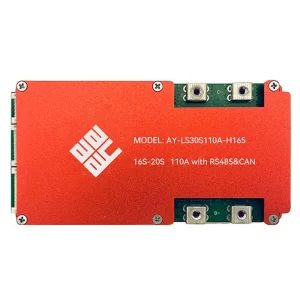
For those seeking top-tier protection and reliability, the AY-LS20S110A-H165 stands out.
What makes the material and design superior?
It provides outstanding thermal stability, improved cycle protection, and optimal energy output because it is constructed from premium protective components.
Which communication methods does it support?
This BMS allows intelligent communication based on configuration, which is perfect for RV owners who use digital displays to track their power consumption.
What is the supported voltage range?
It is designed for high-demand RV power systems that need reliable and secure performance, and it is compatible with 16S–20S lithium designs.
A high-end BMS might mean the difference between a perfect off-grid experience and expensive system failures in RV applications where safety and dependability are essential.
Step 1: Determine Your Battery Configuration
Decide whether to run a single 12V battery or connect multiple in parallel for higher capacity.
Step 2: Connect the Positive and Negative Terminals
Use high-quality cables to ensure stable current flow.
Step 3: Connect the Battery to the RV Electrical System
This typically includes the converter, solar charge controller, and inverter if present.
Step 4: Secure the Connections
Ensure all terminals are tight and insulated to prevent accidental shorts.
Step 5: Perform System Testing
Turn on lights and appliances to confirm the lithium 12V RV battery is supplying steady, consistent power.
Does it provide double the usable voltage and power stability?
Lithium delivers power more consistently, especially under load.
Does it last longer than traditional RV batteries?
Yes—by several years or even decades depending on usage.
Does it supply higher capacity in a smaller footprint?
Lithium wins by a large margin, offering more energy for less weight and fewer batteries.
Upgrading isn’t just about performance—it’s about transforming the entire RV lifestyle.
Do lithium batteries provide a longer lifespan?
Most lithium models last 3,000–5,000 cycles or more.
Is charging significantly faster?
Lithium cuts charging time dramatically—up to 4× faster than lead-acid.
Does the lighter weight improve RV efficiency?
With far less mass to haul, driving becomes smoother and more economical.
Is the energy density much higher?
You get more power from fewer batteries, freeing storage space.
Are maintenance needs nearly zero?
Clean and effective performance without topping up, venting, or sulfation.
The simplest way to make every RV journey safer, cozier, and more pleasurable is to upgrade the lithium.
The lithium 12V RV battery is the best option if you’re upgrading your RV power system for longer excursions, more appliances, improved safety, or a stress-free off-grid lifestyle.
Compared to conventional RV battery solutions, lithium offers a much better experience thanks to its higher charging speed, unparalleled lifespan, reduced weight, and intelligent BMS protection.
Selecting a premium lithium RV battery with an advanced BMS, such as the AY-LS20S110A-H165, guarantees optimal dependability, performance, and long-term value whether you camp infrequently or live in your RV full-time.
Ayaa Technology is still at the forefront of cutting-edge BMS innovation for lithium RV power systems, providing travelers with the efficiency, safety, and intelligence required for off-grid adventures of the future.
Q1:Can I just put a lithium battery in my RV?
A1:Yes, you can swap out your RV’s lead-acid battery for a lithium (LiFePO4) battery for one that is lighter, has a longer lifespan, and performs better.
However, you must make sure that your charging system (converter/solar controller) is compatible.
In order to fully and safely charge it, you may need upgrades like a DC-to-DC charger for motorhomes or an MPPT controller for solar, which could increase the initial cost.
Q2:How long will a 12V fridge run on a 100Ah lithium battery?
A2:Run Time = Battery Capacity / Fridge Amp-hours = 3.3 days (100Ah/30Ah/day).
Consequently, a 12V refrigerator can run on a 100Ah LiFePO4 lithium battery for roughly 3.3 days.
Q3:Is it worth switching to an RV lithium battery?
A3:Do lithium RV batteries justify the expense?
The answer is definitely yes for the majority of RVers, particularly those that boondock, depend on solar power, or want long-term value.
Compared to lead-acid, lithium has a longer lifespan, quicker charging, lower weight, and higher efficiency.
Q4:Do I need a special charger for lithium batteries in my RV?
A4:Strongly suggested.
A LiFePO4 battery charger is made especially to satisfy the particular voltage and current needs of LiFePO4 lithium batteries.
Q5:Do I need to change my RV converter for lithium batteries?
A5:Yes, even though some newer converters feature a switch or auto-detect for lithium, you usually need to replace or upgrade your RV converter for lithium batteries.
Because older lead-acid converters don’t offer the proper voltage (around 14.4V) for a full lithium charge and can even harm them.
A lithium-specific or dual-mode converter guarantees the best performance and safety, whereas an incompatible converter may not fully charge your lithium battery (leaving it at 80–90%) or may enter float mode at too low a voltage, drawing power from the battery even while plugged in.
Contact Us