- Industries

Home Backup & Garden BMS
View More >Electric Forklift BMS
View More >Golf Cart BMS
View More >Electric Two-wheeler BMS
View More >Aviation & UAV BMS
View More >BMS For Power Tools
View More >Medical Equipment BMS
View More >







Home About Us EVENTS & NEWS Boost EV Performance with a Wireless Battery Management System for Electric Vehicles
As the electric vehicle (EV) industry accelerates toward greater efficiency and intelligence, wireless battery management systems for electric vehicles (Wireless BMS) are emerging as a revolutionary solution.
These systems offer a smaller, more scalable, and more dependable framework for energy control, removing the drawbacks of conventional wired battery monitoring.
We present high-performance BMS solutions in depth and go into the fundamental design, operation, application scenarios, and real-world benefits of wireless battery management systems for electric cars.
An electric vehicle’s wireless battery management system is a sophisticated control system that uses wireless communication rather than conventional cable harnesses to manage EV battery packs.
It collects voltage, current, and temperature data in real time for every cell and sends it to a centralized controller via radio frequency.
A wireless BMS greatly decreases vehicle weight, improves airflow for thermal control, increases design freedom, and makes battery module assembly and maintenance easier by doing away with wires interconnections.
In electric vehicles, where performance, weight, and space are all important considerations, these traits are extremely advantageous.
A typical wireless battery management system for electric vehicles includes the following components:
● Wireless Sensor Nodes
Installed at the cell or module level, each node keeps an eye on temperature, voltage, and current.
By using wireless transmission, the nodes reduce the need for physical connections and possible sources of failure.
● Wireless Communication Module
The module makes use of unique RF technology, SmartMesh, and Zigbee protocols to guarantee low-latency, interference-resistant data transmission.
● Central Control Unit
To maximize charging, discharging, and cell balance, the controller compiles sensor data, calculates important battery metrics including State of Charge (SOC) and State of Health (SOH), and sends directives.
When combined, these elements improve the intelligence, durability, and deployment ease of the wireless battery management system for electric vehicles.
The following operational procedures are used by the electric vehicle’s wireless battery management system:
Data Acquisition: Each wireless sensor node collects cell-level data in real-time.
Data Transmission: Data is transmitted wirelessly to the central controller using a secure, high-reliability protocol.
Data Analysis: The controller runs algorithms to assess battery condition and performance.
Protective Response: If abnormal conditions (overvoltage, overcurrent, or overtemperature) are detected, the BMS will isolate faulty cells or adjust system operations to ensure safety.
This wireless, decentralized architecture improves the scalability and modularity of the system.
The wireless battery management system for electric vehicles has broad applicability, including:
● Electric Vehicles
By removing heavy wires, lowering weight, and improving safety, wireless BMS improves range and uses electricity more effectively.
● Energy Storage Systems
Wireless BMS facilitates intelligent energy dispatch and guarantees efficient battery balancing for grid-level or residential storage.
● Smart Grids
Wireless BMS facilitates load balancing and predictive maintenance by enabling real-time data sharing with grid infrastructure.

For large battery systems and electric cars, the AY-L24S300A-ES001 is a high-performance wireless battery management system. Important characteristics include:
Wide Voltage Support: Compatible with 7 to 24 series cells, ideal for medium- to high-capacity EV battery systems.
Parallel Design: Supports high-current parallel applications for increased flexibility.
Communication Protocols: Built-in CAN/RS485/UART for seamless system integration.
Intelligent Monitoring: Real-time status tracking ensures accurate SOC and SOH estimation, contributing to system longevity and safety.
Forklifts, industrial energy storage, and EV fleets can all benefit from its sturdy construction.
The AY-L10S200A-ES002, which is intended for portable systems and smaller EVs, provides:
Voltage Range: Supports 3S to 10S configurations with 200A peak discharge.
Advanced Materials: High-grade PCB and thermal-resistant components for stable performance.
Compact Design: Ideal for motorcycles, e-bikes, and low-voltage energy storage.
Communication Options: CAN and UART interfaces offer flexibility in data integration.
Without sacrificing performance, this solution integrates the advantages of wireless battery management systems for electric vehicles into small platforms.
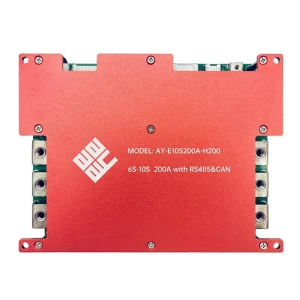
In the market for wireless battery management system for electric vehicles, the AY-LS10S200A-H200 (6S–10S) is unique because:
Parallel Support: Facilitates parallel battery strings for high-load applications.
Protocol Flexibility: Supports RS485, CAN, and UART to fit a wide range of platforms.
Smart Monitoring: Built-in intelligent algorithms ensure precise cell balancing and real-time anomaly detection.
Broad Application Range: Suitable for drones, AGVs, EV scooters, and hybrid power systems.
It is perfect for mobile or space-constrained systems that need dependable BMS because of its sophisticated control and tiny footprint.
| Model | Cell Support | Peak Current | Communication | Key Features |
|---|---|---|---|---|
| AY-L24S300A-ES001 | 7S–24S | 300A | CAN, RS485, UART | Parallel-ready, industrial-grade monitoring |
| AY-L10S200A-ES002 | 3S–10S | 200A | CAN, UART | Lightweight, compact, high durability |
| AY-LS10S200A-H200 | 6S–10S | 200A | RS485, CAN, UART | Intelligent monitoring, wide compatibility |
These electric car wireless battery management systems serve a variety of purposes, ranging from light personal transportation to energy storage at the industrial level.
Q:What is the battery management system for an electric vehicle?
A:An electronic system called a battery management system regulates and safeguards a rechargeable battery to ensure optimal performance, durability, and security.
The BMS creates essential information reports, supplementary data, and battery condition tracking.
Q:Do I need a battery management system?
A:Preventing deep discharge, overcharging, and overheating—all of which can result in battery failure or even present a fire hazard—requires a BMS.
Always look for a high-quality BMS when selecting a lithium battery for optimal performance and protection.
Q:What is the battery management system for a lithium ion battery?
A:A lithium-ion battery system requires a battery management system, or BMS.
This gadget controls each battery cell in real time, connects with other devices, calculates the state of charge, measures voltage and temperature, and more.
Smarter, more effective battery control is becoming more and more necessary as the demand for energy storage and electric vehicles rises globally.
Electric car wireless battery management systems are no longer a sci-fi fantasy; rather, they are a useful, tested technology that boosts efficiency, improves safety, and spurs innovation.
At the front of this development is Ayaa Technology.
We provide customized wireless BMS solutions that blend in perfectly with your design thanks to our years of experience and state-of-the-art R&D, whether you’re developing a utility-scale energy system or a personal EV.
Ready to upgrade your battery systems? Explore more at www.ayaatech.com or contact our engineering team for consultation.
Contact Us
Latest News
Share