- Industries

Home Backup & Garden BMS
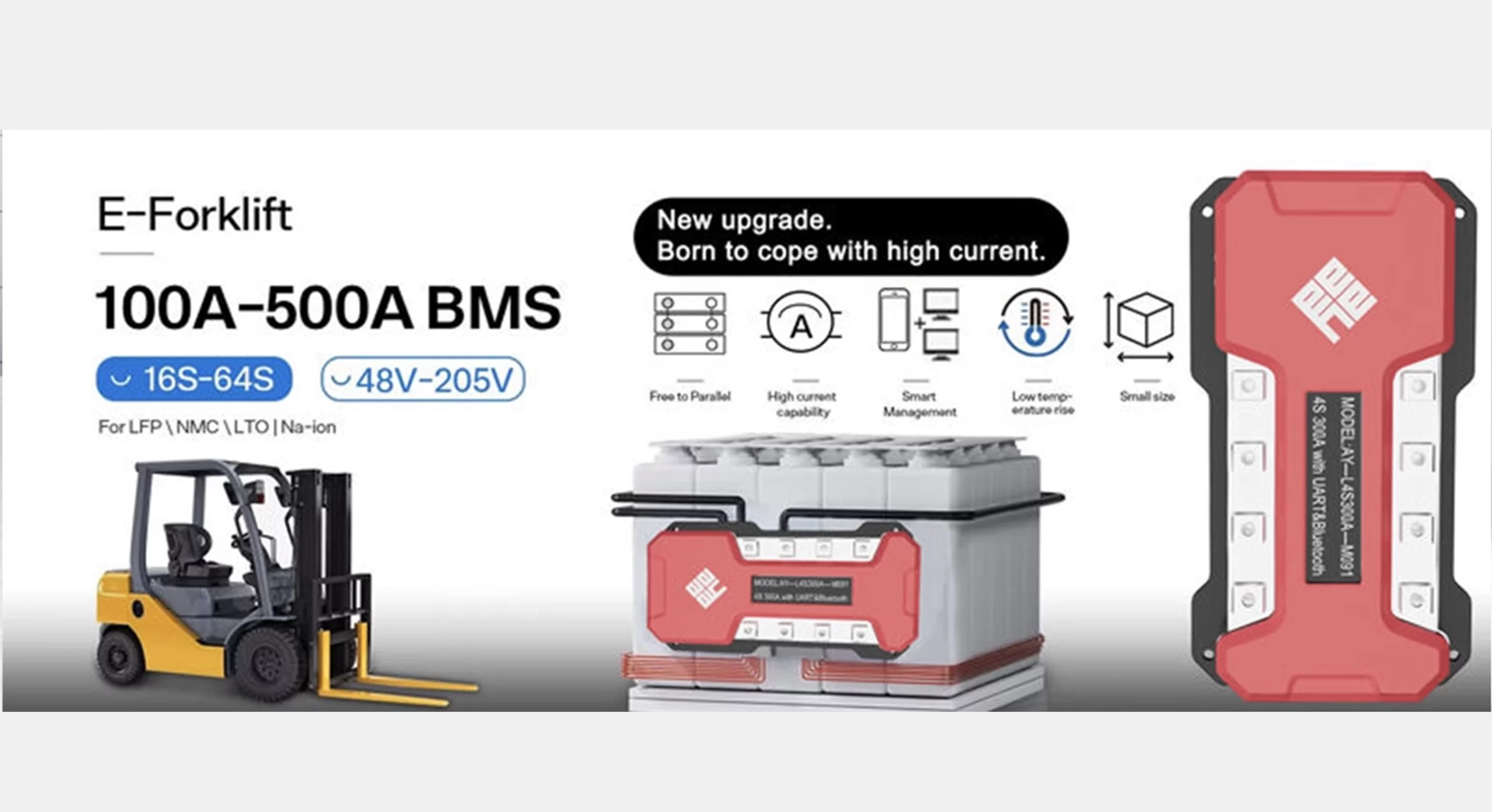
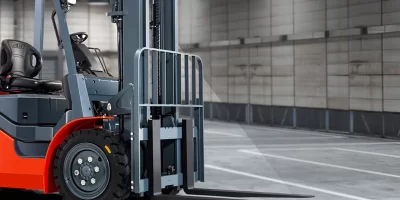
View More >Electric Forklift BMS
View More >Golf Cart BMS
View More >Electric Two-wheeler BMS
View More >Aviation & UAV BMS
View More >BMS For Power Tools
View More >Medical Equipment BMS
View More >

Home About Us EVENTS & NEWS 36 Volt Forklift Battery Buying Guide
Selecting the appropriate 36 volt forklift battery can significantly impact performance, uptime, and overall operating costs in today’s hectic warehouse and logistics settings.
Lifting capacity, runtime, and energy efficiency are all directly impacted by a high-quality battery.
Making the best investment requires knowing how a 36 volt forklift battery works and how its Battery Management System (BMS) improves safety and longevity, regardless of whether you operate a fleet of electric forklifts or a single lift truck.

Small to mid-sized electric forklifts used in manufacturing facilities, distribution centers, and retail warehouses are primarily powered by a 36 volt forklift battery.
For medium-duty material handling, these batteries are renowned for their reliable energy output.
36V lithium batteries have a number of clear advantages over conventional lead-acid batteries, including greater energy density, quicker charging, and less maintenance.
Even throughout long hours, their capacity to deliver a constant voltage guarantees dependable forklift functioning.
Performance and cost-effectiveness are determined by a number of criteria when choosing a 36 volt forklift battery:
Battery Type – Choose between lead-acid and lithium-ion.
Lithium-ion has a longer cycle life, is more efficient, and has a lower total cost of ownership.
Capacity (Ah Rating) – establishes runtime.
Longer shifts between recharges are possible with larger capacity batteries.
Voltage Compatibility – Ensure your forklift’s motor and electronics are designed for 36V input.
BMS Integration – BMS is used by modern lithium forklift batteries to control temperature, cell balance, and charging safety.
Environment – Extreme temperatures, humidity, and work shifts affect battery longevity.
Charging Infrastructure – The chosen battery chemistry should be compatible with fast charging stations or onboard chargers.
A sturdy 36 volt forklift battery usually consists of:
High Energy Density for extended operating hours
Fast Charging Capabilities that reduce downtime
Integrated BMS to protect cells from overcharge, over-discharge, and overheating
Rugged Enclosure Design to withstand vibration and mechanical stress
Temperature Sensors for safe operation in varied environments
Optional Communication Interfaces (CANBUS/SMBUS) to transmit real-time data to forklift controllers
Because of these characteristics, 36V lithium systems are more reliable than traditional battery solutions.
The “brain” of any contemporary 36 volt forklift battery is the Battery Management System (BMS).
To ensure ideal conditions, it continuously checks temperature, voltage, current, and individual cell balance.
Even the greatest lithium cells are susceptible to catastrophic failure or early aging in the absence of a functional BMS.
Here are the practical functions of a BMS:
Overcharge and Over-discharge Protection: Prevents damage and ensures each cell operates within its safe range.
Cell Balancing: Keeps voltage uniform across all cells to maximize usable capacity.
Temperature Regulation: Monitors and controls thermal conditions to avoid overheating.
Fault Detection and Alerts: Communicates with forklift systems to trigger warnings before serious issues occur.
Performance Optimization: Maintains energy efficiency across varying load conditions.
A 36 volt forklift battery may withstand thousands of cycles with little deterioration by using a top-notch BMS.
Lead-acid and lithium-ion are the two primary chemistries that power forklifts.
Although both are offered in 36V configurations, there are notable differences in their cost and performance characteristics.
| Feature | Lead-Acid | Lithium-Ion (LiFePO4 / LiPo) |
|---|---|---|
| Energy Efficiency | 70–80% | 95–98% |
| Cycle Life | 500–1000 | 3000–5000+ |
| Charging Time | 6–8 hours | 1–2 hours |
| Maintenance | High | Minimal |
| Weight | Heavy | Lightweight |
| Cost (Initial) | Low | Higher |
| Cost (Lifetime) | Higher (due to replacements) | Lower (longer lifespan) |
Lithium 36 volt forklift batteries are currently thought to be the better option in the majority of warehouse settings because of their better performance and less long-term expenses.

It’s important to comprehend the characteristics of your equipment as well as your operational requirements when selecting the greatest 36 volt forklift battery.
Think about these doable actions:
Evaluate Power Needs – Determine average runtime and power draw.
Check Forklift Compatibility – Ensure your forklift’s design supports lithium integration if upgrading from lead-acid.
Assess Budget and ROI – Lithium batteries are more expensive initially, but they provide superior returns due to their longer cycle life and lower maintenance requirements.
Consider Workload Cycles – Continuous use forklifts benefit most from lithium’s fast-charging capability.
Look for Smart BMS Integration – For enhanced monitoring, use batteries with BMS that offer Bluetooth or CANBUS interface.
A 36 volt forklift battery’s lifespan is influenced by a number of variables, including temperature regulation, maintenance, charging habits, and usage intensity.
Lithium-ion batteries: Typically last between 3,000–5,000 cycles (5–10 years).
Lead-acid batteries: Usually limited to around 1,000 cycles (2–3 years).
By guaranteeing appropriate charging and temperature management, regular monitoring via the BMS helps prolong battery life.
Capacity loss can also be avoided by using suitable chargers, cleaning frequently, and updating firmware on time.
Appropriate usage and upkeep Make sure your 36 volt forklift battery operates at its best:
Charge Regularly but avoid 100% charge unless needed for long shifts.
Avoid Deep Discharges below 20% state of charge.
Store Properly in a cool, dry area when not in use.
Inspect Connectors and Cables for corrosion or wear.
Use OEM-Approved Chargers compatible with BMS requirements.
Monitor Data via BMS software or connected displays.
Following these guidelines increases return on investment, minimizes risk, and decreases downtime.
Smart BMS technology is revolutionizing the way 36 volt forklift batteries function in contemporary industrial energy systems.
Real-time optimization is made possible by intelligent BMS solutions, which include predictive maintenance, performance analytics, and remote diagnostics.
In addition to improving safety, this guarantees steady power delivery, which is essential for automated warehouse settings and logistics hubs that depend on continuous operation.
The 36 volt forklift battery is still developing as the industry moves toward automation and sustainability.
More effective fleet management is now possible because to integrated BMS solutions, enhanced lithium chemistries, and modular configurations.
Companies who invest in these cutting-edge energy systems see quantifiable increases in operational resilience, productivity, and energy savings.
Ayaa Technology offers engineering know-how, safety-tested products, and worldwide support for electric industrial equipment for high-performance BMS and bespoke forklift battery solutions.
Q1:Can I use a 48V battery on a 36V motor?
A1:No, using a 48V battery on a 36V motor and controller system will probably harm the parts and pose a safety risk.
When the increased voltage is applied, the motor may overheat and the controller’s parts (such as capacitors and MOSFETs) may malfunction, which could result in catastrophic failure such as the motor or controller burning out.
Q2:How long will a 36 volt battery last?
A2:The lifespan of a 36V battery varies depending on its kind, but a typical lithium-ion battery has a calendar life of 2 to 7 years, or 500 to 5,000 charge cycles.
The battery’s chemistry (such as LiFePO4 against other lithium kinds), capacity, usage patterns, and upkeep all affect how long it lasts.
Q3:What is the life expectancy of a forklift battery?
A3:Depending on the battery type, usage, and upkeep, forklift batteries can last anywhere from five to ten years.
Lithium-ion batteries can live up to ten years, although lead-acid batteries normally last five years with the right maintenance.
Consistent watering (for lead-acid), avoiding severe temperatures, minimizing quick charging, and guaranteeing a complete cooling-down period between charging and operation are important factors influencing lifespan.
Q4:How many cells are in a 36V forklift battery?
A4:For any forklift make and model, a 36 volt battery is made up of 18 x 2 volt battery cells with capacities and sizes ranging from 150 ah to 1080 ah.
Q5:How to charge a 36V battery without a charger?
A5:Alternative power sources such as a solar panel, a universal power supply, or boosting from another battery can be used to charge a 36V battery without the need for a charger.
To avoid damage or fire threats, it is essential to balance the voltage and regulate the current.
A universal adjustable DC power supply is a dependable choice, but when making do, always use a multimeter and put safety first by keeping an eye on the voltage and temperature of the battery.
Contact Us