






Choose a lithium forklift battery by matching voltage, kWh capacity, peak current, and BMS setup. Start with the forklift nameplate to verify system voltage and minimum counterweight. Next, size capacity from real daily energy use rather than guesswork. Also confirm the pack can handle the peak current your lift and drive motors demand.
Then check your shift pattern, charging windows, operating temperature, and compartment dimensions. Finally, verify that the battery pack, BMS, charger, and truck controller communicate properly. A pack that fits the compartment can still fail if one of these steps is missed. This guide walks through each step in the order most buyers need it.

What Is a Lithium Forklift Battery, and What Does the System Include?
Lithium-Ion Chemistry Used in Forklift Batteries
“Lithium-ion” is a family name, not a single chemistry. Nickel-manganese-cobalt (NMC), lithium titanate (LTO), and lithium iron phosphate (LiFePO4, or LFP) all belong to it. In forklifts, LFP is the most common choice because it is thermally stable and handles frequent cycling well. Its nominal cell voltage is 3.2 V, so a 16-cell series string lands at 51.2 V.
LFP is not the best answer for every job, though. NMC packs more energy into the same weight and volume, which matters when space is tight. LTO charges very fast and tolerates cold well, but it costs more and stores less energy. So the chemistry should follow the duty cycle, not the other way around.
From Battery Cells to a Complete Forklift Power System
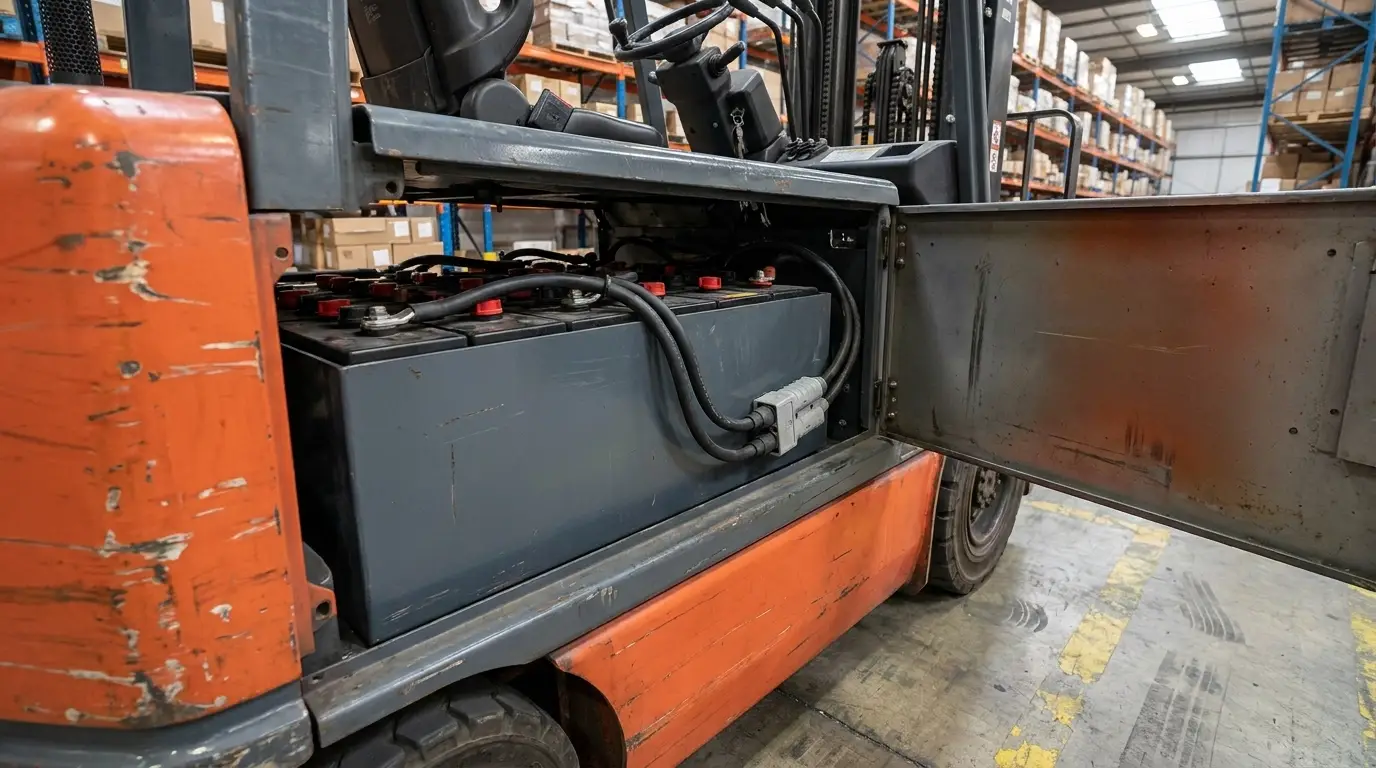
A lithium forklift battery is more than a box of cells. In many designs, cells are grouped into modules and wired into a pack. The pack adds busbars, fuses or contactors, a housing, and sensors. It also often includes a heating or cooling path.
The battery management system (BMS) watches the cells and controls what the pack can do. The charger supplies energy under rules that the BMS enforces. Meanwhile, the forklift controller expects a specific response when it asks for power.
Think of it as four parties in one conversation. If one speaks a different language, you get derated power or failed charges. In some cases, the truck will not start at all. That is why this guide treats the battery, BMS, charger, and forklift as one system.
Lithium vs. Lead-Acid Forklift Batteries: Which Is Better for Your Operation?
Lithium wins in many operations, but not in all. Here is how the two compare on the points that decide most purchases.
Charging Time and Opportunity Charging
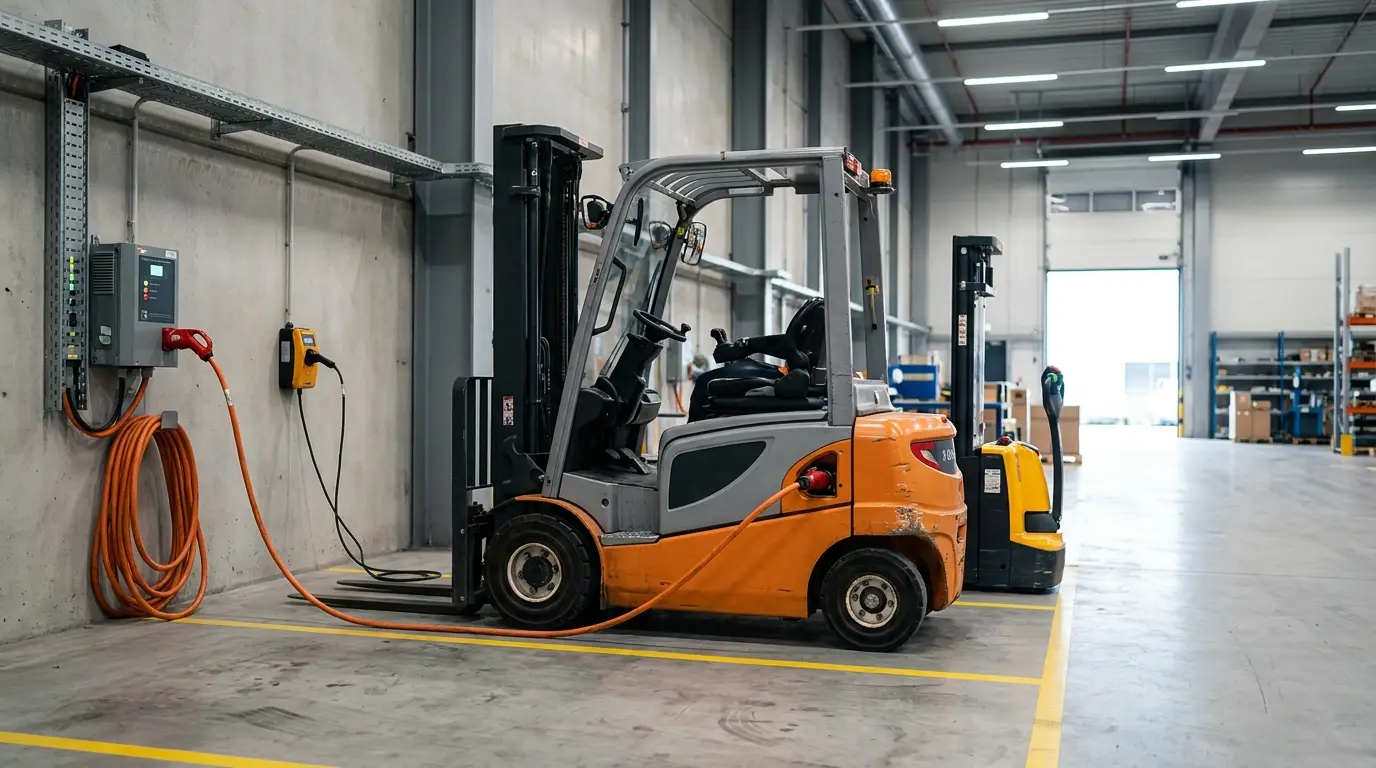
Lead-acid batteries need a long full charge, a cool-down rest, and frequent swaps between shifts. A lithium forklift battery accepts charge much more flexibly. Drivers can plug in during breaks, lunch, or shift changes without harming the pack. As a result, many sites remove the swap routine and the battery room completely.
Opportunity charging only works when the site setup supports it, though. You need chargers near work areas, enough site power, and a BMS built for partial charges. You also need drivers who actually plug in on schedule. If a site runs one shift with an overnight gap, this flexibility adds little value.
Maintenance, Runtime, and Cycle Life
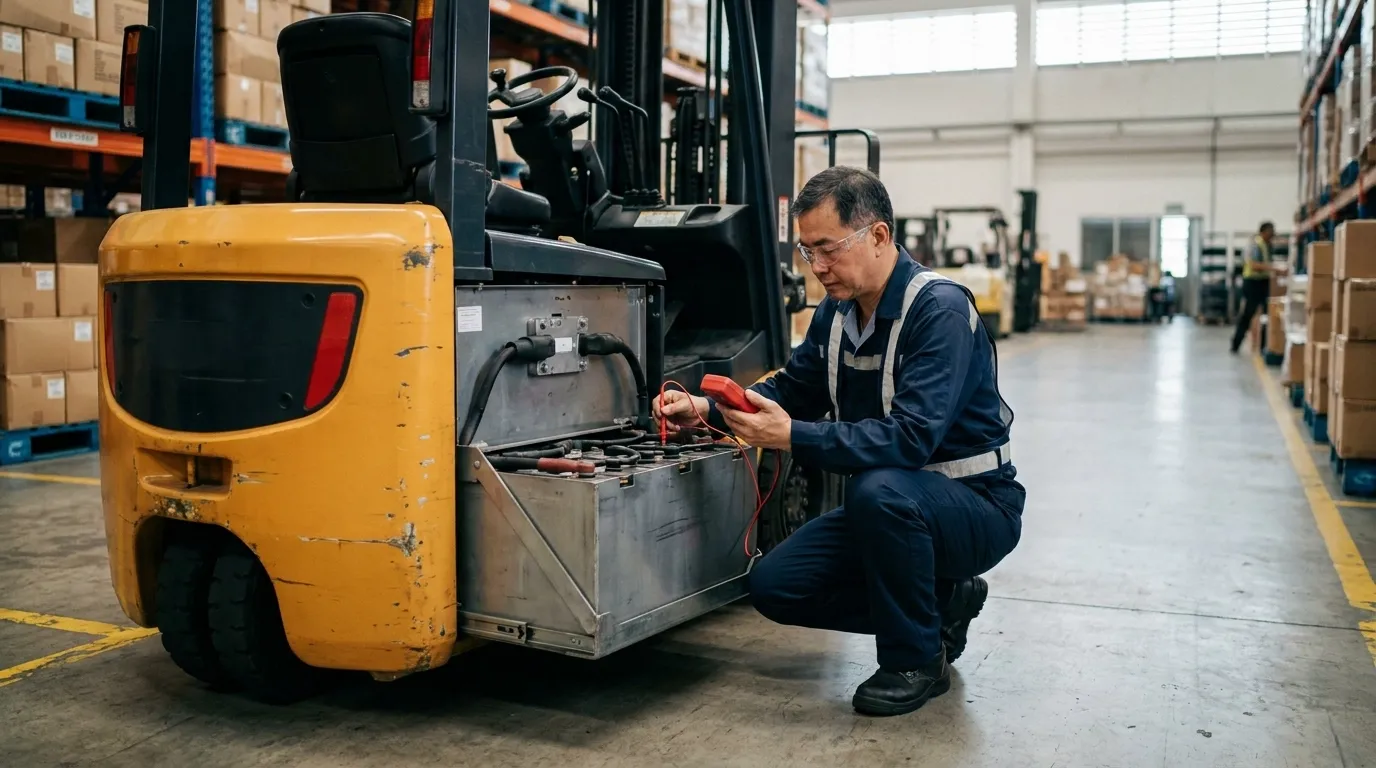
Lead-acid needs watering, equalizing, terminal cleaning, and ventilation. Lithium removes almost all of that routine work. “Maintenance-free” does not mean “inspection-free,” however. Connectors, cables, and fault logs still need regular checks.
Runtime behavior is also different. A lead-acid pack loses voltage as it drains, making the truck feel sluggish late in the shift. Lithium holds a steadier voltage and allows deeper discharge, making more rated energy usable. Even so, the nominal kWh on the label is higher than the usable kWh at work.
Be careful with cycle-life claims. A rated number means little without its test depth of discharge, charge rate, temperature, and end-of-life limit. Rated cycle life, real service life, and warranty period are three different things. Ask for all three numbers, along with the conditions behind each one.
Initial Cost vs. Total Cost of Ownership
Lithium costs more up front. That higher price is the main trade-off for buyers. Whether it pays you back depends on how hard the truck works.
| Cost factor | Lead-acid | Lithium |
|---|---|---|
| Purchase price | Lower | 더 높은 |
| Spare batteries and swap gear | Often needed in multi-shift sites | Usually not needed |
| Battery room and ventilation | Needed | Usually reduced |
| Watering and routine upkeep | Regular labor | 최소 |
| Charging efficiency | Lower | 더 높은 |
| Downtime for swaps | 예 | Little or none |
As the table shows, lithium shifts cost from running expenses into the purchase price. The more hours the truck runs, the faster that trade pays off. A two- or three-shift fleet can recover the upfront premium much faster. A single-shift truck that sits idle half the day will take much longer.
Weight, Space, and Operational Limitations
Lead-acid batteries are heavy, and that weight is not wasted. Many electric forklifts use the battery as a counterweight to stay stable while lifting. A lighter lithium pack can make the truck unsafe if nothing replaces the missing mass.

[Engineering Note] Never assume a lighter battery is a free upgrade. Check the minimum battery weight on the forklift nameplate or in the manual. If the lithium pack is lighter, the supplier must add ballast or confirm stability in writing. A truck that tips under load is a much bigger problem than a slow charger.
Physical packaging matters too. The compartment size, lifting points, and connector position all limit what will fit.
When Does a Lithium Forklift Battery Make the Most Sense?
High-Utilization Warehouses and Multi-Shift Operations
This is where a lithium forklift battery is strongest. When trucks run all day, every swap costs labor and every spare battery ties up cash. Opportunity charging lets one battery cover what used to take two. If your trucks rarely stop, start here.
Cold Storage and Temperature-Controlled Environments
Cold cuts the power any battery can deliver, but lithium handles it better than lead-acid. The main catch is charging. Charging unprotected lithium cells below freezing can cause permanent damage. A cold-store pack needs a BMS with low-temperature cutoff and, often, built-in cell heaters.
[Engineering Note] Low-temperature discharge and low-temperature charging are two different limits. A datasheet claiming operation at −20 °C may only cover discharging. Read the charge temperature range separately. Also ask what happens when a truck rolls from a freezer straight onto a charger.
Heavy Loads, Outdoor Work, and Demanding Duty Cycles
Heavy lifting, steep ramps, and hard acceleration pull large current in short bursts. The hydraulic pump and drive motor often draw power at the same time. The battery must handle both continuous current and those high peaks. High current also heats cells, busbars, and the BMS, requiring a matching thermal design.

At AYAA TECH, we design our Smart BMS with that heat in mind. We place MOSFETs and current-sense resistors evenly, so no single spot becomes a hot zone. Quality thermal pads or gel move heat into the housing, often aided by aluminum or copper spreaders. Good thermal design keeps protection limits from triggering early on a hard shift.
Single-Shift and Lower-Utilization Fleets
For a one-shift truck that charges overnight, lead-acid may still be the sensible choice. It costs less, and the existing overnight charging routine already works. Savings from opportunity charging and eliminated swaps never show up in single-shift work. Do not pay the lithium premium without running your fleet numbers first.
How Do You Choose the Right Voltage, Capacity, and Power Rating?
Match the Battery Voltage to the Forklift
Common forklift platforms run at 24 V, 36 V, 48 V, and 80 V. Use these numbers as a starting point only. The forklift nameplate and the manufacturer’s manual determine the real voltage requirement.
LFP packs use 3.2 V cells, so actual pack voltage differs slightly from lead-acid labels. For example, a “48 V” lithium pack is often 51.2 V nominal. It may also reach a higher peak charging voltage than the old lead-acid battery. Always confirm that your forklift controller accepts that full voltage range.
Calculate the Required Capacity in Ah and kWh
Capacity in amp-hours (Ah) measures how much charge the battery holds. Energy in kilowatt-hours (kWh) measures how much total work it can do. You can estimate nominal energy with this formula:
E (kWh) ≈ V × Ah ÷ 1000
A 51.2 V, 400 Ah pack holds about 20.48 kWh of nominal energy. Usable energy is lower due to discharge limits, operating temperature, and system efficiency.
Here is a sizing illustration, not a universal rule. Suppose a truck averages 3 kW over an 8-hour shift, using 24 kWh of work. Using 80% of the pack with some reserve requires roughly 30 kWh nominal. On a 51.2 V system, that equals about 600 Ah, though you should log your own truck’s draw.
[Engineering Note] Amp-hours alone do not tell you runtime. Two batteries with the same Ah but different voltages store different amounts of energy. Always compare packs in kWh first, then convert to Ah for your system voltage.
Energy reserve matters as well. Capacity fades with age and drops in the cold. Leave a safe margin instead of sizing to the exact edge of today’s shift.
Check Continuous and Peak Current Requirements
Capacity tells you how long the battery lasts. Current tells you whether it can do the job at all. Traction, lifting, acceleration, and the hydraulic pump all add up and often overlap.
Compare the pack’s continuous discharge rating against your sustained load. Then check its peak current rating and duration against your worst-case load, like climbing a ramp. A pack that meets your Ah target can still trip on peak current during a heavy lift.
Confirm Battery Dimensions, Weight, and Connectors
Measure the forklift compartment, not just the old battery. Check length, width, height, lifting points, restraints, and clearance for the hood or seat. Then confirm the connector type, polarity, cable length, and minimum counterweight requirement. Wrong polarity or a mismatched plug can quickly damage a controller.
How Do the Battery, BMS, and Charger Work Together?
Battery Pack Design and Cell Configuration
Cells connect in series to raise voltage and in parallel to raise capacity and current. A 16S LFP string reaches 51.2 V, while parallel strings like 16S4P boost capacity and current. This layout affects cell balancing, fault tolerance, and how the pack fits the compartment. Two packs with the same voltage and kWh can behave differently if their cell layouts differ.
BMS Monitoring, Protection, and Battery Data
The BMS reads every cell voltage, pack current, and multiple temperature points. Using these readings, it balances cells, limits current, and opens the circuit on a fault. It also reports live status data to the charger and the truck.
State of Charge (SOC) is the number drivers watch most, because it shows remaining runtime. SOC is hard to estimate because temperature changes how much energy a cell can deliver. AYAA TECH’s Smart BMS uses a temperature-compensated SOC algorithm with an error within 5%. That keeps the dashboard gauge reliable even in a cold aisle.
The BMS also logs faults and operating events. Those records help you see why a truck was derated on a busy afternoon.
Charger Compatibility and Charging Control
Matching nominal voltage is not enough. A lithium forklift battery needs a constant-current, constant-voltage profile matched to its chemistry and BMS limits. The charger must also follow BMS commands to reduce current when warm or stop when cold.
[Engineering Note] Never reuse a lead-acid charger on a lithium pack just because the voltage looks close. Lead-acid profiles include equalization and float stages that can overcharge lithium cells. Even a lithium charger from another brand may not follow your BMS commands. Confirm the charger model, charging profile, and control method with your battery supplier before ordering.
Communication Between the Battery and Forklift
Many systems use a CAN bus to share data, while others use relays or analog lines. Having CAN on both sides does not guarantee compatibility, however. Both devices must match on baud rate, message IDs, data format, timing, and timeout rules. A truck controller may require specific messages before it allows driving or charging.
Protocol customization often solves this mismatch. If the standard protocol differs, engineers can adapt the BMS firmware. Plan extra lead time for this step, since it requires engineering work before delivery.

Why a Complete Power System Needs Integration Testing
Datasheets alone do not catch interaction problems. Integration testing should check charging at low and high SOC, peak load response, and protection triggers. It should also verify communication loss handling, fault recovery, and real work cycles on the truck.
Some manufacturers publish how they approach system integration. For example, Yale’s technical material describes a BMS monitoring voltage, temperature, and current while communicating over CAN. It also notes functional testing before deployment. That is one brand’s design, not a universal rule, but it illustrates system-level thinking.
Need a Battery Pack and BMS That Fit Your Forklift Platform?
Explore Product CatalogWhat Safety Standards and Certifications Should You Check?
Verify the Standards Required for Your Market and Application
Safety standards are not interchangeable, and each has a defined scope. Here are the standards buyers meet most often.
| 기준 | What it covers | What it does not mean |
|---|---|---|
| IEC 62619:2022 | Safety requirements for secondary lithium cells and batteries in industrial use | Not automatically valid for every pack design; check the product scope |
| UL 2580 | Safety of batteries for electric vehicles, sometimes applied to industrial trucks | Check the exact certified scope and model |
| UN 38.3 | Transport testing for lithium batteries | Not a full product safety certification |
| CE marking | Declaration of conformity for the EU market | Not a specific battery test on its own |
In short, a single certificate does not make a whole system compliant. Request the actual certificate and check which model, components, and standard version it covers. Do not assume every lithium forklift battery needs all four credentials. The required set depends on where the battery is sold and used.
Evaluate Protection Functions and Operating Limits
A simple list of protections like overvoltage, overcurrent, short circuit, and over-temperature says little by itself. You need to ask about the exact trip limits and system behavior. At what current does it trip, and how fast? What temperature stops charging, and does the pack reset automatically or manually?
Also check insulation resistance, enclosure IP rating, and the diagnostic data from the BMS. Your site conditions, such as dust, washdowns, or heavy vibration, should drive these questions.
How Much Does a Lithium Forklift Battery Cost?
What Determines the Purchase Price?
No single price fits all packs. Key price drivers include voltage, usable kWh, current ratings, cell chemistry, and required certifications. Customization level and charger inclusion also change the final quote. A heated cold-storage pack with custom CAN costs more than a basic pack of the same kWh.
How to Compare Quotes From Different Suppliers
Two quotes only compare fairly when they cover the same scope. Compare usable kWh, continuous and peak current ratings, warranty terms, and test documentation. Also verify whether the price includes the charger, connectors, ballast, and CAN setup. A low quote that leaves out the charger and integration work often costs more overall.
Calculate the Total Cost of Ownership
Use your own fleet numbers to calculate total cost of ownership. Include purchase price, electricity, charging losses, watering and swap labor, spare packs, room space, downtime, and replacement. Compare both options over the same service period using realistic shift counts. Because guessed inputs produce guessed results, use logged data from real trucks whenever possible.
What Should You Confirm Before Ordering a Lithium Forklift Battery?
Run through this checklist with your supplier before you place an order:
- Forklift make, model, and nameplate specifications.
- Existing battery voltage, capacity, dimensions, and weight.
- Continuous and peak current requirements.
- Daily operating hours, shift pattern, and charging windows.
- Operating temperature and environmental conditions.
- Charger specifications and charging communication.
- Connector, vehicle-controller, and CAN requirements, where applicable.
- Certifications, testing documentation, warranty, and support.
- Customization scope and who handles battery, BMS, and charger integration.
If you can answer most of these points, you are ready for an accurate quote. If not, a short suitability review will save you from a costly mismatch. Send us your forklift model, current battery specs, operating conditions, and project requirements. Our team will help you define a power system that fits your fleet.
Facing an Integration Challenge or Non-Standard Forklift?
Request a Custom Battery Solution자주 묻는 질문
1. How much does a lithium forklift battery cost?
Price depends on voltage, usable energy, current rating, customization, and included accessories. Compare quotes on the same scope, and judge them by total cost of ownership rather than price alone.
2. How long does a lithium forklift battery last?
Service life varies with chemistry, depth of discharge, charge rate, and operating temperature. Ask for the rated cycle life with its test conditions, and keep that separate from the warranty period.
3. Is a lithium forklift battery better than a lead-acid battery?
For busy, multi-shift fleets, it often is. For single-shift trucks with time for an overnight charge, lead-acid can still make more financial sense.
4. What voltage and capacity do I need for my forklift?
Voltage comes from the forklift nameplate. Capacity comes from your real daily energy use in kWh, plus a margin for reserve and aging.
5. Can you opportunity-charge a lithium forklift battery during breaks?
Yes, when the battery and BMS are built for it and chargers are nearby. Cold temperatures can restrict charging, so always check the low-temperature charge limits.
6. Can I use my existing charger with a lithium forklift battery?
Usually not if it is a lead-acid charger. The charger must match the lithium profile and BMS control method, so confirm compatibility with your supplier.
7. Does a lithium forklift battery need to match the original battery’s weight?
It must at least meet the forklift’s minimum counterweight requirement. If the pack is lighter, ballast or another approved solution is needed to keep the truck stable.