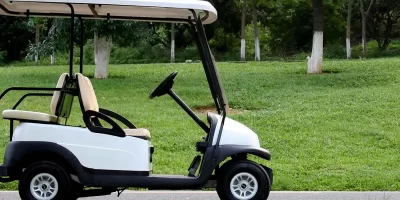




A golf cart battery won’t charge in cold weather because the BMS triggers low-temperature protection to prevent lithium plating. Sub-freezing temperatures slow electrochemical kinetics and sharply increase internal resistance. In lithium packs, forcing current into frozen cells causes metallic lithium to accumulate on the graphite anode, permanently stripping capacity and risking dendrite-induced short circuits. In lead-acid systems, cold electrolyte and seasonal storage drain pull pack voltage below the automatic charger’s minimum detection threshold. Discharging and charging operate on different electrochemical kinetics; your cart can safely drive in freezing conditions while the BMS strictly isolates the charging circuit until core cell temperatures rise into a safe operating window.

Why a Golf Cart Battery Won’t Charge in Cold Weather
Cold temperatures change battery physics. As ambient temperatures drop, liquid and gel electrolytes turn thick and sluggish. This sharp drop in ionic conductivity spikes charge-transfer resistance (Rct) across the cell plates.
Chemical reactions need thermal energy to proceed smoothly. In flooded lead-acid batteries, cold acid cannot diffuse into plate pores quickly. This limits the conversion of lead sulfate back into active sponge lead. The charger sees a false voltage spike and shuts down early.
In lithium cells, cold prevents ions from shedding their solvent coating. The ions stall at the boundary layer. They pile up on the negative electrode instead of sliding between graphite sheets.
The Critical Split: Driving vs. Charging
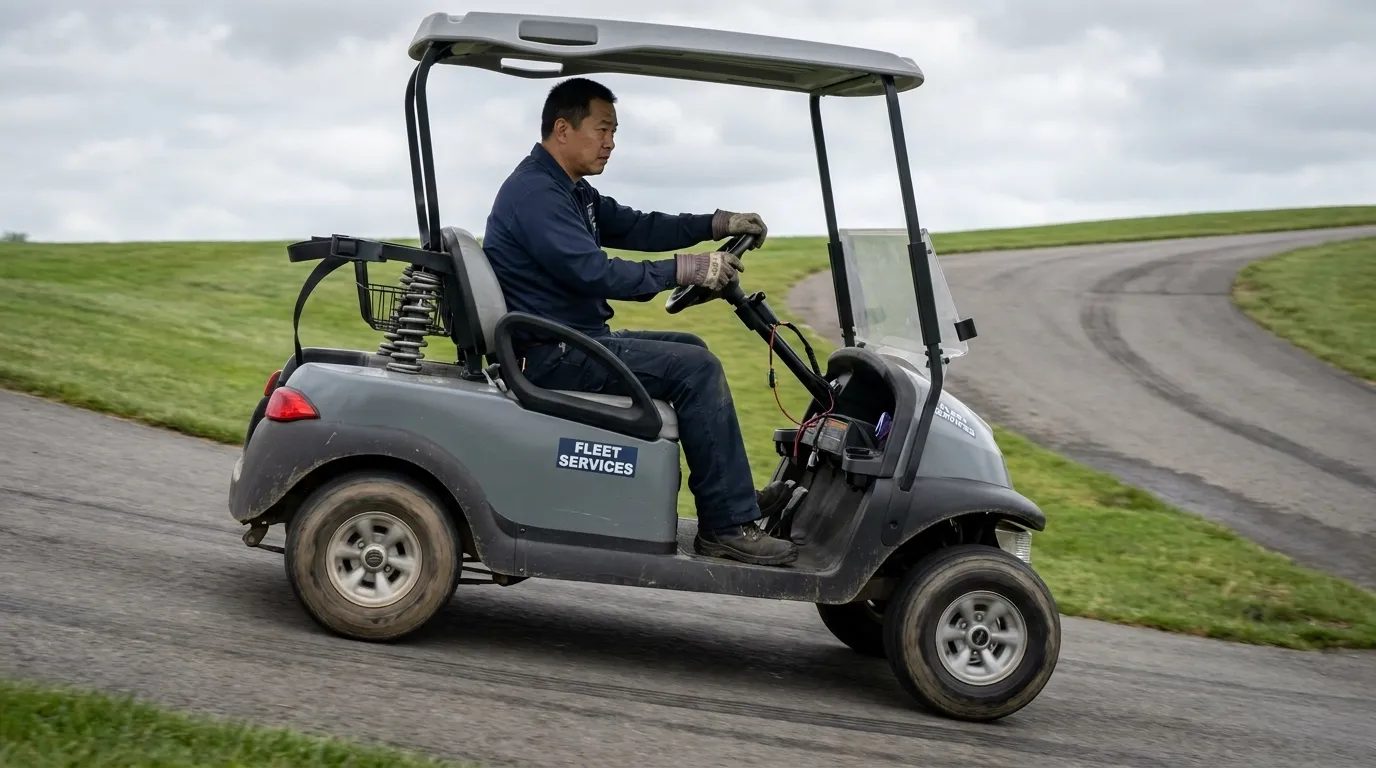
Driving and charging are not equal. Discharging is an exothermically assisted reaction that follows the natural thermodynamic gradient. A golf cart can safely run at 0°F (-18°C), though drivers will notice higher voltage sag and lower operational range.
Charging is an endothermic uphill climb. The charger must force ions into a constricted, cold crystal lattice. That stress damages frozen cells within minutes.
To help field technicians diagnose issues fast, the table below highlights how battery chemistries react across temperature zones:
| Operating Parameter | Flooded Lead-Acid | Standard LiFePO4 (Unheated) | Low-Temp Heated LiFePO4 |
|---|---|---|---|
| Minimum Safe Charge Temp | -4°F (-20°C) if 100% full | 32°F (0°C) strict limit | -4°F (-20°C) with pre-heat |
| Minimum Safe Drive Temp | -20°F (-29°C) | -4°F (-20°C) | -4°F (-20°C) |
| Low-Temp Cutoff Method | None (Charger dependent) | Hardware BMS charge cutoff | Automated heating state machine |
| Cold Failure Mode | Cracked case from frozen acid | Anode lithium plating | Lockout if heater power drops |
| Usable Energy at 20°F (-6°C) | 50% of rated capacity | 80% of rated capacity | 95% after pre-heating cycle |
As the data shows, discharge safety does not equal charge safety. A smart control system must block charge current even while the vehicle drives normally.
Can You Charge a Golf Cart Battery Below Freezing?
No. You cannot safely charge a standard lithium pack below freezing without an active heating system.
When you plug in an unheated pack below 32°F (0°C), the ions back up. They cannot penetrate the graphite anode. Instead, they accept electrons on the surface and convert into pure metallic lithium.

This surface coating is called lithium plating. It strips active lithium out of the electrolyte permanently. Your usable capacity drops instantly. Worse, that metallic layer grows microscopic spikes called dendrites.
Dendrites pierce the fragile plastic separator between the positive and negative plates. This triggers internal short circuits, excessive self-discharge, and eventual thermal runaway.
Engineering Note: Lithium plating rarely causes fire while the battery is still cold. The true danger is latent. Weeks later, when the cart runs over rough turf in warm spring weather, damaged separators give way, sparking sudden catastrophic cell failure.
Golf Cart Battery Charging Below 32 Degrees: What Happens Inside the Cell?
Temperature sets the physical limits of charge acceptance. Golf cart battery charging below 32 degrees Fahrenheit pushes the negative electrode past its safe operating window.
At normal room temperatures, graphite absorbs lithium ions smoothly. Below 32°F (0°C), the anode potential drops below 0 V vs. Li/Li+. Under these thermodynamic conditions, plating metallic lithium becomes easier for the current than normal intercalation.
Lead-acid batteries face mechanical destruction instead. A discharged 48V lead-acid pack is mostly water because the sulfate ions are trapped in the plates. Pure water freezes solid at 32°F (0°C), while diluted electrolyte can freeze at 19°F (-7°C).
Ice expands inside the battery case. It bends internal lead grids, flakes active paste off the plates, and splits the plastic shell. Trying to charge a frozen lead-acid battery boils the remaining core liquid around ice dams, venting explosive hydrogen gas.
Understanding Safe Lithium Golf Cart Battery Charging Temperature Limits
Every lithium cell comes with strict thermal limits set by its manufacturer. The standard lithium golf cart battery charging temperature range runs from 32°F to 113°F (0°C to 45°C).
Some industrial cells allow slow charging down to 14°F (-10°C). However, they require tiny charge rates, typically around 0.05C. That means a 100Ah battery can only accept 5 amps in the cold.
Standard golf cart chargers do not throttle current based on temperature. They blast 15A to 30A into the pack from start to finish. Because the charger cannot step down its current, the battery must enforce a complete shutdown at 32°F.
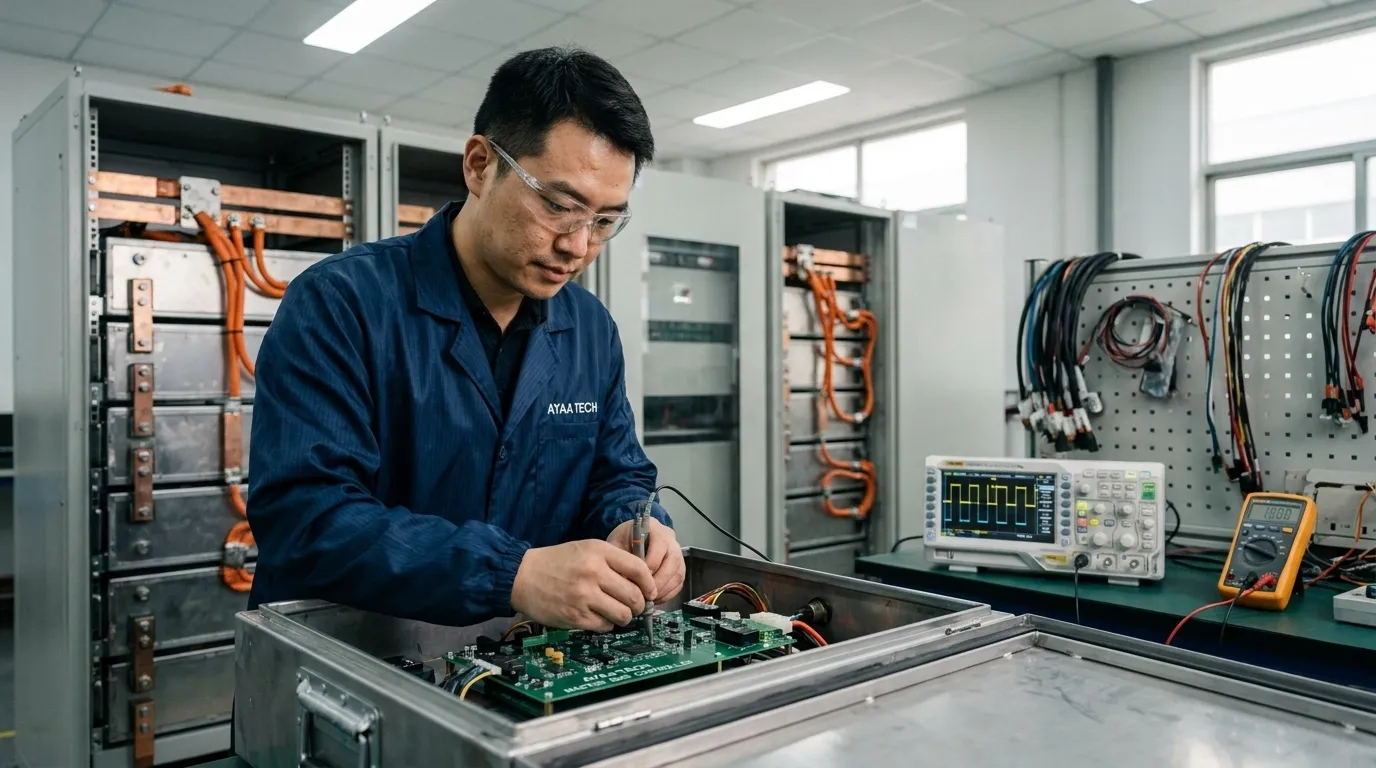
Cold environments also distort open-circuit voltage curves, making capacity tracking difficult. AYAA TECH eliminates this issue by coupling extended Kalman filter tracking with dynamic temperature compensation models, ensuring our State of Charge (SOC) estimation error stays ≤ 5% even through rapid sub-zero temperature swings.
Need High-Reliability Low-Temperature Power for Utility Fleets?
Explore AYAA TECH ProductsHow a Golf Cart Battery Low Temperature Cutoff Works
그만큼 golf cart battery low-temperature cutoff acts as an automatic safety switch. When internal sensors detect freezing conditions, the BMS cuts the charging line while keeping the vehicle operational.

Internal Negative Temperature Coefficient (NTC) sensors constantly monitor the pack. High-grade systems place these sensors directly on cell terminals and central busbars. When the core hits 32°F (0°C), the main processor shuts off gate drive voltage to the charging MOSFETs.
The discharge MOSFETs remain energized. The cart still runs. You can drive to shelter, load maintenance gear, or park inside.
To prevent relay chatter, the BMS relies on thermal hysteresis. If cutoff hits at 32°F, the system will not re-engage charging the moment sensors hit 33°F. It holds the charge port open until core temperatures reach 37.4°F to 41°F (3°C to 5°C).
Handling high currents through solid-state switches generates heat that must be moved away quickly. AYAA TECH manages power stage heat dissipation through the uniform layout of critical heat sources like power MOSFETs and shunt sampling resistors, bonded with high-grade thermal silicone interface pads or conductive gel, and backed by high-thermal-conductivity aluminum alloy heat spreaders.
Engineering Note: Never install a bypass resistor to trick cold temperature sensors. Forcing current into frozen lithium cells destroys cell cycle life and strips your safety certifications instantly.
Self-Heating vs. Standard Packs: When a Golf Cart Lithium Battery Won’t Charge Below Freezing
When a golf cart lithium battery won’t charge below freezing, an active heating system is the best answer. Integrated self-heating batteries use thin silicone or polyimide film heaters wrapped directly around the cells.
Never buy packs that run heaters off their own internal energy. If a cart sits in unheated storage at 15% charge, a battery-powered heater will drain the remaining power fast. This drops cell voltages below 1.5V, permanently bricking the pack.
Demand an AC-powered heating setup. When you plug the cart into the wall, the BMS directs incoming grid current straight to the heating pads first. The cells remain completely isolated.
Once the internal sensors confirm all cells exceed 41°F (5°C), the BMS shuts off the heating circuit. It pauses for five minutes to equalize internal heat, then closes the main charging switches. Safe charging begins automatically.
What to Do When a Lithium Golf Cart Battery Won’t Charge in Cold Weather
If your lithium golf cart battery won’t charge in cold weather, follow this straightforward diagnostic routine before replacing parts:
1. Read BMS Telemetry Codes
Connect your phone or diagnostic tool to the battery CAN bus, RS485 port, or Bluetooth link. Check the active alarm flags:
LTCO(Low-Temperature Charge Cutoff): Normal winter protection. The charger is fine, but the battery is too cold to accept current.UVP(Under-Voltage Protection): The cells dropped below safe minimum storage voltage.DIFF: Excessive cell imbalance caused by temperature differences across the string.
2. Check Pack Baseline Voltage
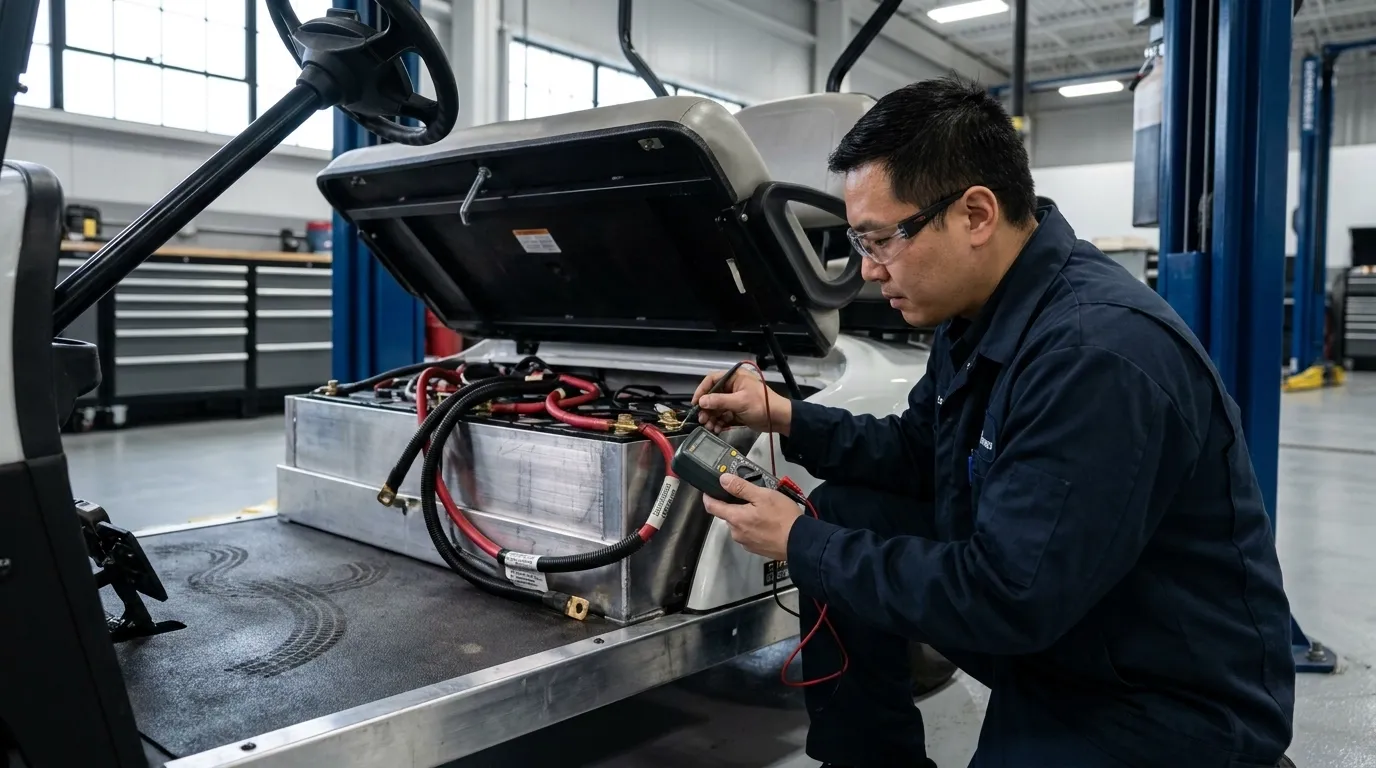
Grab a digital multimeter and measure across the main terminals. If your 48V lead-acid pack reads under 36V, standard automatic chargers will not kick on. The charger thinks no battery is attached.
For lithium packs, check if the reading is near zero volts. If so, the BMS is in deep protection mode. You must use a dedicated low-current wake-up charger to reset the protection circuit.
3. Allow Proper Thermal Soaking Time
Do not blast the battery case with a heat gun or space heater. Plastic cases warp, and uneven heat creates dangerous internal cell temperature deltas.
Move the cart into an enclosed room kept at 50°F (10°C) or higher. Be patient. A 100Ah lithium battery weighs roughly 35 kilograms. That dense mass takes 8 to 14 hours for ambient heat to soak from the outer case to the central cells.
4. Read the Charger Blink Sequence
Watch the charger status lights closely. When chargers click on for three seconds and shut down, they are completing self-diagnostics:
- Single Red Flash: Battery disconnected or open BMS relay.
- Double Red Flash: High internal resistance or cold sulfated plates.
- Solid Red: Charger thermal protection engaged.

Engineering Checklist: Specifying Cold-Climate BMS & Battery Packs
Fleet managers and hardware engineers should run through these mandatory checkpoints when sourcing cold-climate power systems under IEC 62619:
- Multi-Point Temperature Sensing: Never rely on a single board sensor. Demand four or more NTC probes placed directly against cell busbars and core center cells.
- Deep-Sleep Power Draw: Specify a total BMS quiescent draw below 50 μA. High idle consumption (5mA to 20mA) will drain packs to 0V during seasonal storage.
- Isolated Drive and Charge Paths: Ensure the battery uses dual-path switching. The cart must maintain motor drive capability even when cold weather locks out charging.
- Digital Charger Comms: Use CAN bus or RS485 communication protocols. The BMS should command charger output directly, adjusting current rates based on live core temperatures.
Just like stationary commercial peak-shaving systems and utility-scale grid-tied battery storage sites, mobile electric carts face severe cell stress during freezing weather. High energy density means nothing if cold charging destroys your cycle life. Proper BMS thermal engineering protects your investment for thousands of reliable cycles.
Need Custom Low-Temperature BMS Firmware or Complete Pack Assembly?
Consult a Battery ArchitectTechnical FAQ
Can you charge a golf cart battery below freezing if it has internal heaters?
Yes. You can charge an integrated self-heating pack below freezing, provided the heating pads run on external AC wall power. The BMS holds the main battery terminals open while grid power warms the cells. Once internal sensors verify that core temperatures exceed 41°F (5°C), the BMS switches the current over to normal charging.
Why does my charger click on for three seconds and then turn off?
This usually indicates an open circuit or low-voltage lockout during the charger startup self-test. Modern high-frequency chargers check for a closed circuit and a baseline voltage before running. If the BMS opened its charge MOSFETs due to cold, or if lead-acid voltage dropped below 36V, the charger trips its safety timer and shuts off.
What is the maximum safe lithium golf cart battery charging temperature?
The upper charging limit for standard LiFePO4 cells is 113°F to 122°F (45°C to 50°C). Above this range, the solid electrolyte interphase (SEI) layer begins to break down, which degrades cycle life and accelerates gas generation. High-grade BMS platforms cut off charge current above 113°F.
Can I jump-start a cold lithium golf cart battery?
No. Never connect automotive jumper cables or a high-amp power supply to a locked-out lithium battery. If the pack shut down due to low temperatures, forcing current through it causes immediate lithium plating. If it shut down from deep discharge, an uncontrolled current surge risks internal short circuits and fires.
How does cold weather affect overall battery cycle life?
Cold weather does not harm cycle life if the battery is merely discharged or stored. LiFePO4 cells handle cold storage well with minimal capacity loss. However, charging an unheated pack below freezing can cut total cycle life by 80% within five to ten charge cycles due to irreversible lithium plating.
What causes a battery to brick during winter storage?
High BMS standby draw is the primary cause of dead winter batteries. Budget management boards draw 10mA to 20mA continuously to run Bluetooth radios and active microcontrollers. Over five months of storage, that draw pulls 70Ah out of the pack, crashing cell voltages to zero and destroying the active chemistry.