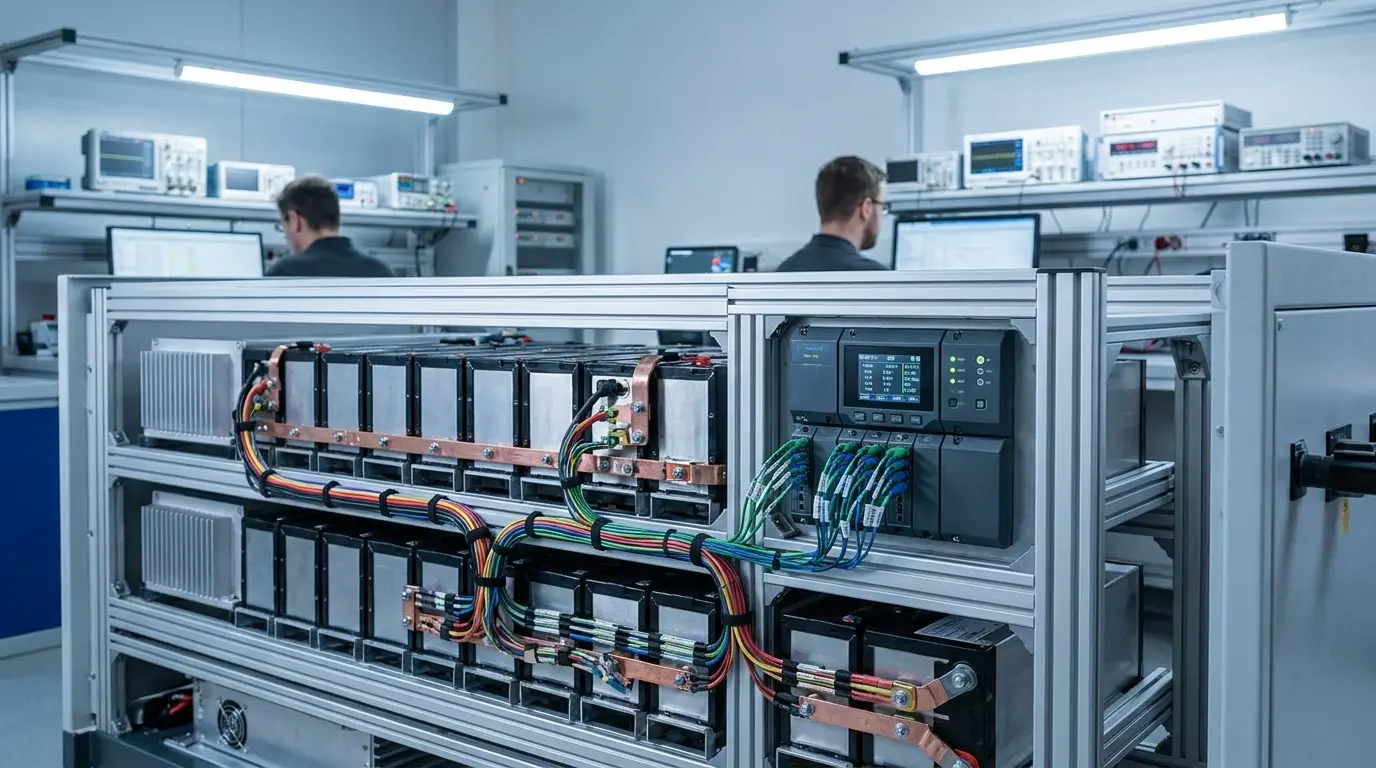









State of Energy (SOE) tracks the usable watt-hours remaining in a battery system. Unlike State of Charge (SOC), which counts amp-hours, State of Energy accounts for real-time voltage drops under load. Voltage sags under heavy power draws. Because of this, SOC often overestimates true runtime.
Knowing your exact State of Energy (SOE) prevents unexpected system shutdowns. It measures true usable energy (Eusable) against total capacity (Emax,usable).
Here is the standard formula for State of Energy (SOE):
Cold temperatures, high C-rates, and internal resistance cause severe voltage drops. These losses push cell voltage down to cut-off limits early. Measuring State of Energy (SOE) gives hardware engineers and procurement managers the exact energy metric needed for reliable field operations.

The Engineering Difference Between SOC and State of Energy (SOE)
Why Ampere-Hour Counting Fails Under Dynamic Voltage Drops
Amp-hour counting tracks electron volume. It completely ignores output voltage.
At low C-rates, cell voltage stays stable. But draw high current, and voltage sags fast. The amp-hour counter shows 25% charge left. Yet the system shuts down anyway. High energy density cells still suffer from this voltage drop under heavy load.
Battery chemistries react differently under load. LiFePO4 cells keep a flat voltage curve across most of their discharge cycle. NMC cells show a steeper voltage slope. Both chemistries suffer from polarization hysteresis. Tracking charge alone hides true power capacity.
Mathematical Power Integration vs Current Integration
Calculating State of Energy (SOE) requires tracking voltage and current together. The BMS calculates instantaneous power: P(t) = V(t) · I(t).
Static nominal ratings lie in field conditions. Real-time power integration adapts to changing loads and temperature drops.
The table below compares these two vital metrics for battery management systems (BMS).
| Metric | Stato di carica (SOC) | State of Energy (SOE) |
|---|---|---|
| Primary Unit | Ampere-hours (Ah) or % | Watt-hours (Wh) or % |
| Mathematical Input | Current integration: ∫ I dt | Power integration: ∫ (V · I) dt |
| Voltage Dependency | Ignores dynamic voltage drop | Tracks real-time terminal voltage V(t) |
| Impact of High Load | Linear (Ah count stays unchanged) | Drops rapidly due to I2Ri heat losses |
| Primary Use Case | Cell charge balancing | Exact runtime calculation & system shutdown rules |
SOC works well for internal cell balancing. However, State of Energy (SOE) is the only metric that measures real endurance. Relying only on SOC forces engineers to buy oversized battery packs to stay safe.
Physical Variables Driving State of Energy (SOE) Losses in the Field
Temperature Drops and Internal Resistance Spikes
Cold weather thickens electrolyte liquid. This slows ion movement and causes internal resistance (Ri) to spike.
At -20°C, internal resistance can jump 500%. Draw heavy current in cold weather, and terminal voltage collapses immediately. Chemical charge remains, but usable energy disappears.
High C-Rates and Polarization Risks
Heavy acceleration draws pulse currents. This creates concentration gradients near electrode surfaces.
Impedance climbs beyond static DC resistance. Terminal voltage drops during power spikes. An uncalibrated BMS interprets this drop as an empty cell. It triggers a false emergency cut-off.
Cell Mismatch and Pack Thermal Management
A battery pack is only as strong as its weakest cell. Pack energy output stops when the first cell hits minimum voltage.
Manufacturing variances and uneven heat cause cells to age differently. Center cells in a pack run hotter than outer cells. This heat difference accelerates internal resistance growth in those middle cells.
Uniform cooling prevents early cell degradation and reduces thermal runaway risks in high-density packs. AYAA TECH addresses thermal challenges through intelligent physical design across all PCM, BMS, and complete Battery Pack products. AYAA TECH arranges MOSFETs and current-sensing resistors for balanced heat spread. They use premium thermal silicone pads and gel. Where needed, AYAA TECH adds aluminum or copper heat sinks to maximize thermal transfer.

Need High-Reliability Battery Packs for Your Engineering Project?
[Explore Product Catalog]BMS Algorithms for Accurate State of Energy (SOE) Estimation
Model-Based Estimation: EKF vs. Energy Counting
As one of the most critical smart BMS features, accurate State of Energy (SOE) estimation prevents early cut-offs. Simple energy counting suffers from sensor drift over time. Small voltage errors accumulate into large State of Energy (SOE) errors.
Advanced BMS hardware uses Equivalent Circuit Models with Extended Kalman Filters (EKF). This combination filters out sensor noise and predicts open-circuit voltage accurately.
Algorithm accuracy dictates how close you can push a system to its physical limit. Typical market BMS boards suffer from estimation errors around 5%. AYAA TECH algorithms reduce SOC and State of Energy (SOE) errors to ≤ 3%. This precision lets engineers safely run smaller energy buffers, cutting system weight and cost.
Microcontroller Optimization and Hardware Integration
Full matrix math can overload low-power 32-bit ARM Cortex-M microcontrollers. Engineers solve this using two-dimensional lookup tables (LUTs) pre-loaded with temperature and voltage data.
These tables run alongside lightweight least-squares algorithms. This approach delivers fast calculations without draining MCU memory.
System integration should not delay your project timeline. AYAA TECH SmartBMS hardware connects seamlessly to all major open-source flight controllers and industrial CAN-bus networks. Whether you build grid-tied storage or industrial drones, plug-and-play compatibility removes integration headaches.

Procurement Strategy: Validating Vendor State of Energy (SOE) Claims
Nominal Energy vs Usable Field Energy
Datasheet numbers can mislead procurement teams. Factory specs measure nominal watt-hours under ideal conditions (25°C at 0.2C rate).
A 1000 Wh battery pack might yield only 720 Wh during a 2C load at 0°C. Buying based on nominal capacity leads to underpowered equipment in real field conditions.
Writing RFQ Specs for Industrial and Energy Storage Systems
Your Request for Quote (RFQ) must demand real-world performance data. Ask vendors for tested usable energy matrices across full temperature and C-rate ranges.
Whether sizing packs for peak shaving in grid-tied storage or long cycle life in industrial equipment, demand verified data at end-of-life (EOL) resistance targets.
Seeking Custom BMS or Battery Pack Engineering?
[Consult a Battery Architect]Frequently Asked Questions
Why does a battery showing 20% SOC shut down suddenly under load?
High discharge current creates a sudden voltage drop (I · Ri). This drop pushes cell voltage below the hardware cut-off threshold instantly. Chemical charge remains, but the usable State of Energy (SOE) drops too low to run the load.
How does cycle life aging affect maximum State of Energy (SOE)?
As batteries age, internal resistance grows and capacity fades. Higher resistance converts stored energy directly into waste heat. This loss reduces usable State of Energy (SOE) much faster than basic SOC capacity fade.
How much MCU processing power does State of Energy (SOE) estimation need?
Simple SOC counting takes very little MCU power. Calculating real-time State of Energy (SOE) requires continuous voltage sampling and multi-variable matrix lookups. Model-based algorithms usually increase BMS processing load by 2x to 3x.
Can passive cell balancing improve pack State of Energy (SOE)?
Passive balancing burns off excess charge as heat during charging. It aligns top-of-charge voltages across cells. However, it cannot equalize internal resistance differences, so cell voltage imbalance returns quickly during discharge.
Does the 80/20 Depth of Discharge rule help extend cycle life?
Yes. Keeping discharge between 20% and 80% SOC reduces mechanical stress on cell electrodes. It also avoids extreme polarization points. This practice slows internal resistance growth and maximizes cumulative State of Energy (SOE) output over time.
What shipping regulations apply to high energy density lithium battery packs?
International rules (UN3480 and UN3090) govern standalone lithium battery transport. Air freight regulations require shipping packs at or below 30% SOC. BMS controllers must accurately verify this level before shipping.
Need Technical Support or Integration Guidance?
[Contact Our Engineering Team]References
- IEEE Std 2030.2.1-2019: IEEE Guide for Design, Operation, and Integration of Battery Energy Storage Systems (BESS) Associated with Electric Power Systems.
- IEC 62619:2022: Secondary cells and batteries containing alkaline or other non-acid electrolytes – Safety requirements for secondary lithium cells and batteries for use in industrial applications.
- MathWorks Simulink Documentation: SOE Estimator (Energy Counting, Variable Energy Capacity) Block Implementation Guide.
- Chemistry Europe (ChemElectroChem): Understanding the Energy Potential of Lithium-Ion Batteries: State of Usable Energy Estimation (2023).
- ScienceDirect (Journal of Energy Storage): State of Charge and State of Energy Estimation Methods for Lithium-Ion Batteries under Dynamic Operating Conditions (2021).
- U.S. Department of Energy (DOE) Vehicle Technologies Office: Battery Test Manual for Electric Vehicles, Rev 3.