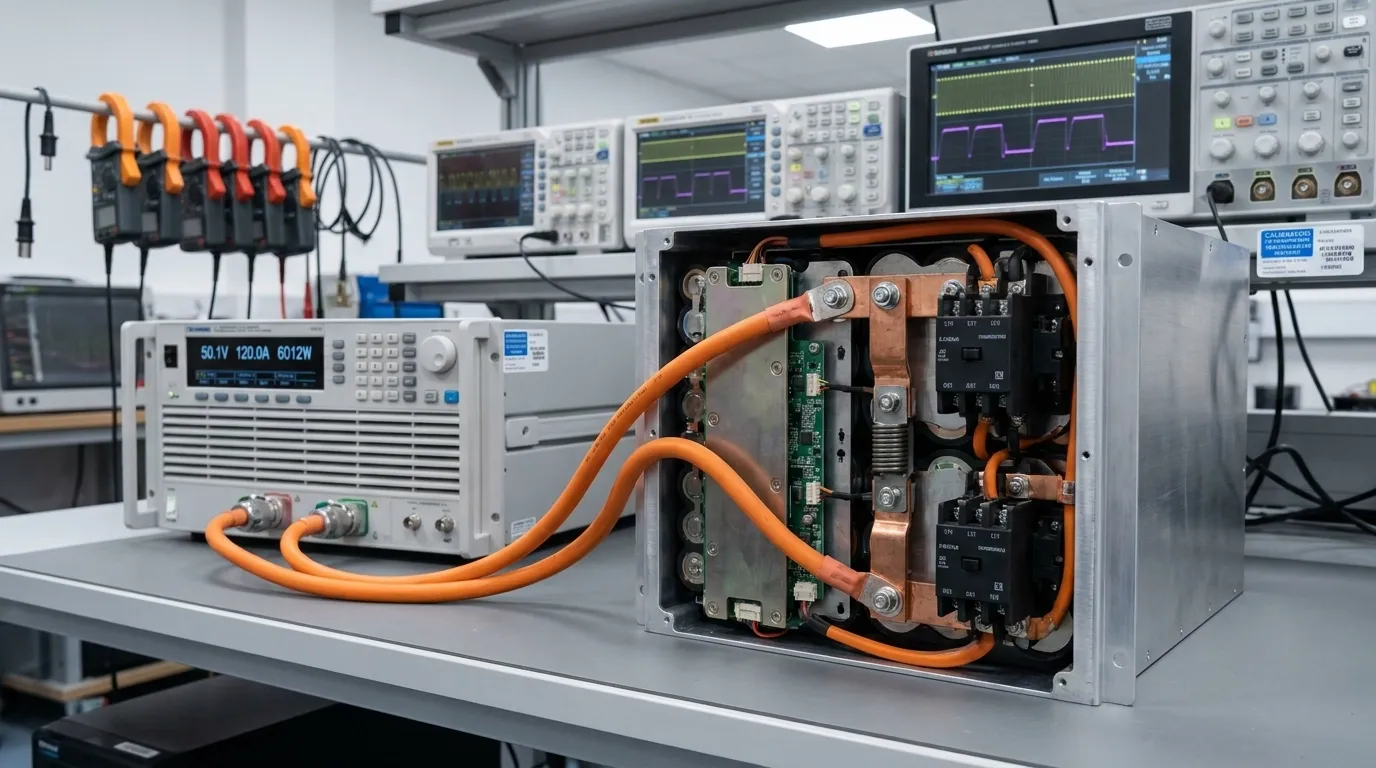
How to Build a 12V Lithium Ion Battery Pack for Reliable Power Systems
2269
How to Build a 12V Lithium Ion Battery Pack for Reliable Power Systems
The development of contemporary energy systems has changed how electricity is stored and used by both stationary and mobile equipment.
The 12V lithium ion battery pack is one of the most often used options available today because of its remarkable cycle life, lightweight construction, and high energy density.
Numerous applications, including solar systems, communication devices, medical equipment, robotics, and maritime electronics, are powered by these battery packs.
But it takes more than just putting a few cells in series to create a 12V lithium ion battery pack.
Maintaining safety and performance necessitates a thorough grasp of cell chemistry, wiring layouts, and—above all—an effective Battery Management System (BMS).
What Is a 12V Lithium Ion Battery Pack?
Depending on the nominal voltage of each cell, a 12V lithium-ion battery pack is usually made up of three or four lithium-ion cells connected in series (3S or 4S configuration).
The nominal voltage of a 3S pack, which consists of three cells connected in series, is typically 11.1V (3.7V per cell).
The nominal voltage of a 4S pack (four cells connected in series) is 14.8V, however because it is compatible with older 12V systems, it is sometimes branded as 12V.
These packs are frequently found in UPS backup units, lighting systems, portable electronics, and small electric cars.
Their low self-discharge rate, steady voltage output, and capacity to supply constant current over a range of loads are what make them appealing.
Understanding the Voltage Range of a 12V Lithium Ion Battery Pack
The actual operating voltage varies based on the charge status, even though the nominal voltage is usually 12V:
State
3S Pack Voltage
4S Pack Voltage
Fully Charged
12.6V
16,8 V
Nominal
11.1V
14,8 V
Fully Discharged
9.0V
12.0V
When constructing circuits and selecting compatible components, it is essential to comprehend these voltage ranges.
Because deep draining or overcharging can irreversibly harm the cells, a BMS is necessary to prevent dangerous voltage levels and guarantee that each cell operates within safe bounds.
What Makes Lithium Ion Different from Other 12V Battery Types?
1. 12V Lead-Acid Battery vs. 12V Lithium Ion Battery
Lead-acid batteries have shorter cycle lives (usually 300–500 cycles), are heavier, and are less efficient.
A 12V lithium ion battery pack, on the other hand, has a higher useful capacity and quicker charging because it can last up to 3000 cycles.
2. 12V LiPo (Lithium Polymer) vs. 12V Li-ion
LiPo batteries are lighter and employ a gel-like polymer electrolyte, but they are more vulnerable to mechanical damage and overcharging.
Higher energy density and more structural stability are provided by lithium-ion cells, such as NMC or LiFePO4.
3. 12V LiFePO4 (Lithium Iron Phosphate)
Because of its remarkable thermal and chemical resilience, this version is perfect for applications that require the highest level of safety, like industrial and medical systems.
How to Build a 12V Lithium Ion Battery Pack
It takes both electrical engineering expertise and precise construction to build a 12V lithium ion battery pack.
The essential steps are shown below:
1. Selecting the Battery Cells
Select premium cells from reliable producers (such as Samsung, Panasonic, or LG).
To prevent imbalance during charging and discharging, make sure that every cell has the same capacity, voltage, and internal resistance.
A typical configuration for a 12V pack is:
3S: 3 × 3.7V cells (nominal 11.1V)
4S: 4 × 3.2V LiFePO4 cells (nominal 12.8V)
2. Wiring and Configuration
Series connection increases voltage.
Parallel connection increases capacity (Ah).
A 4S2P configuration, for example, delivers 14.8V and doubles the capacity compared to a single 4S pack.
3. Integrating a Battery Management System (BMS)
Your 12V lithium ion battery pack’s “brain” is the BMS.
To guarantee safe operation, it continuously checks each cell’s voltage, current, and temperature.
Typical BMS architectures consist of:
ST Microcontroller (MCU) for logic control
Battery monitoring IC for voltage and current detection
MOSFETs for switching and current protection
NTC temperature sensors for thermal safety
Balancing circuits (active or passive) to equalize charge levels
Even a slight cell imbalance might result in overcharging, overheating, or deterioration in the absence of an appropriate BMS.
4. Spot Welding and Connections
To provide strong and low-resistance connections, nickel strips are spot-welded to the cell terminals.
Since soldering directly to lithium cells can harm internal chemistry, it is not advised.
5. Thermal Management and Enclosure
Place the pack inside a vibration-dampening, heat-resistant container.
If the pack will be subjected to high ambient temperatures or severe loads, add thermal pads or metal heat sinks.
6. Testing and Validation
Verify temperature behavior and voltage homogeneity by performing initial charge/discharge cycles under observation.
Verify that the BMS reacts appropriately to instances of overvoltage, undervoltage, and overcurrent.
How to Charge a 12V Lithium Ion Battery Pack Safely
One of the most important phases of a 12V lithium ion battery pack’s life is charging.
Adhere to these recommendations to guarantee longevity and safety:
Use a dedicated lithium-ion charger compatible with your pack configuration (3S or 4S).
Set charging current to 0.5C–1C of the pack’s capacity.
For example, a 4000mAh pack should charge at 2–4A.
Monitor temperature during charging—avoid charging above 45°C.
Stop charging when voltage reaches 12.6V (3S) or 16.8V (4S).
Never leave batteries unattended during charging, especially during the first cycle after assembly.
Charger Types for 12V Lithium Ion Batteries
Charger Type
Descripción
Recommended Use
CC/CV Charger
Constant Current / Constant Voltage – the standard for Li-ion packs
Most 12V systems
Smart Charger with BMS Communication
Uses CAN or UART to communicate with BMS
Industrial and EV packs
Balance Charger
Equalizes voltage across cells
Drone and RC battery packs
Solar Charger Controller (MPPT)
Integrates solar charging via DC input
Renewable energy systems
Where Are 12V Lithium Ion Battery Packs Used?
A variety of contemporary technologies are powered by the incredibly adaptable 12V lithium ion battery pack:
A well-designed BMS guarantees that the battery provides dependable energy, maintains ideal cell balance, and guards against overcurrent or short-circuit damage in each of these applications.
The Role of BMS in Ensuring Reliability and Longevity
The performance benefits of a 12V lithium ion battery pack with a sophisticated battery management system are substantial:
Función
Función de BMS
Protección contra sobretensiones
Evita la sobrecarga y la descarga excesiva.
Control de corriente
Limita las corrientes de carga y descarga a niveles seguros.
Monitoreo de temperatura
Evita el sobrecalentamiento y el descontrol térmico.
Equilibrio celular
Garantiza una distribución uniforme de la carga.
Comunicación
Proporciona datos en tiempo real a través de CAN, SMBus o Bluetooth.
By identifying abnormalities early and dynamically modifying operation, a BMS not only protects the battery but also increases efficiency, prolongs its lifespan, and lowers maintenance costs.
Maximizing the Potential of 12V Lithium Ion Battery Packs
The process of creating a 12V lithium ion battery pack combines electrical design, electrochemical research, and intelligent control systems.
Every stage affects how securely and effectively your power system operates, from choosing the appropriate cells and creating a balanced configuration to incorporating a reliable Battery Management System.
A well-designed 12V lithium ion battery pack provides unmatched dependability and long-term performance, whether you’re using it to power a medical gadget, a UAV, or a solar backup system.
Our specialty at Ayaa Technology is creating unique BMS and lithium battery solutions for use in energy, medicinal, and industrial settings.
To provide reliable energy systems all around the world, we integrate cutting-edge protection algorithms, real-time communication modules, and high-efficiency balancing circuits.
Preguntas frecuentes
Q1:What is the 80 20 rule for lithium batteries?
A1:For lithium batteries, the 80/20 rule suggests: For everyday use, charge up to 80%.
Q2:Which is better LiPo or li-ion battery pack?
A2:Li-ion is the best option if you want the maximum capacity for the weight (energy density).
Select Li-ion if safety is a top priority.
Q3:How long does a 12 volt lithium ion battery last?
A3:The average lifespan of a 12V lithium battery is 8–10 years, or 2,000–5,000+ charge cycles.
Q4:Is it bad to keep lithium batteries fully charged?
A4:Yes,Long-term full charging of lithium batteries can hasten deterioration and shorten their lifespan.
Q5:How long can a lithium battery sit unused?
A5:Unused lithium batteries can last anywhere from a few months to several years.