- Industries

Home Backup & Garden BMS
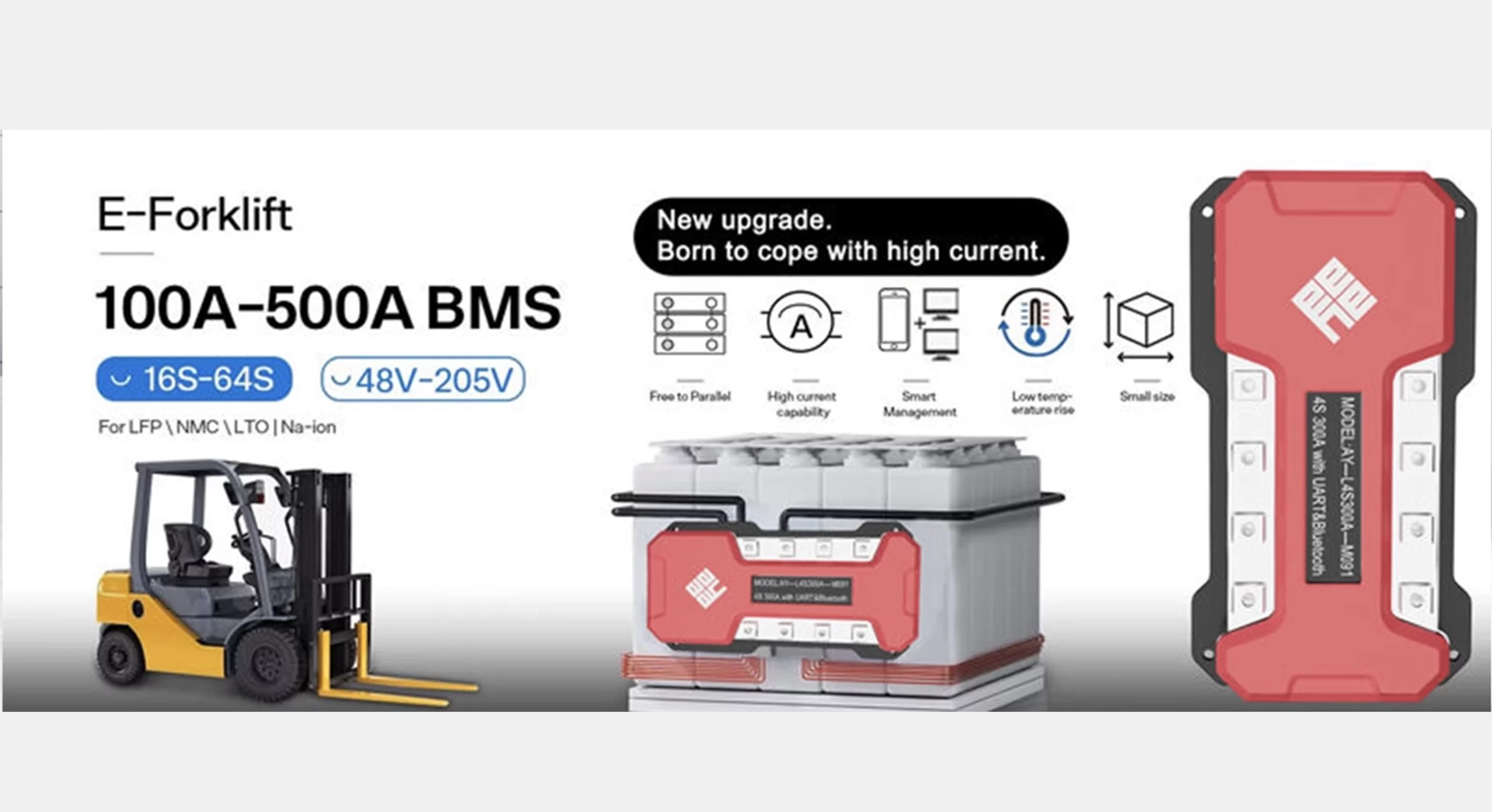
View More >Electric Forklift BMS
View More >Golf Cart BMS
View More >Electric Two-wheeler BMS
View More >Aviation & UAV BMS
View More >BMS For Power Tools
View More >Medical Equipment BMS
View More >






Home About Us EVENTS & NEWS Unlocking the Power of Electric Bike BMS for Modern E-Bike Innovation
An electric bike BMS (Battery Management System) is more than simply an accessory in the rapidly expanding e-mobility market of today.
It is the technological foundation that establishes whether your e-bike can provide long-lasting, dependable, and safe performance.
What is an Electric bike BMS?
An electric bicycle An electronic system called a BMS keeps an eye on, manages, and safeguards the rechargeable battery pack found in electric motorcycles.
It guarantees that every battery cell functions within safe bounds and that the battery pack as a whole functions effectively in a variety of scenarios.
The Limitations of Traditional E-Bikes Without Smart BMS
Without a contemporary electric bike BMS, traditional e-bikes are severely limited.
Basic protection boards that provide little real-time monitoring are used in many traditional systems.
This makes it easy for problems like cell imbalance, deep discharging, overcharging, and overheating to arise.
These issues not only reduce battery life but also endanger riders’ safety.
Advantages of a Modern Electric Bike BMS
The benefits of a well-designed electric bike BMS are revolutionary.
It offers accurate State of Charge (SOC) and State of Health (SOH) estimations, guards against electrical malfunctions, guarantees cell balancing for longer battery life, and frequently has clever features like wireless monitoring.
For today’s electric bike riders, this translates to more mileage, safer rides, and fewer unplanned battery failures.

A. Product Structure
A high-quality Electric bike BMS typically includes:
Voltage Sensors: These monitor the voltage of each cell in the battery pack.
Current Sensors: To detect charging and discharging currents in real time.
Temperature Sensors: Placed in different positions to prevent overheating or low-temperature performance loss.
Microcontroller Unit (MCU): The BMS’s brain that processes data and executes control commands.
Communication Module: Interfaces like CAN, UART, or Bluetooth to transmit real-time battery data to the e-bike display or a mobile app.
Balancing Circuit: Active or passive balancing circuits that equalize voltage differences among cells.
B. Working Principle
The Electric bike BMS works by continuously collecting data from voltage, current, and temperature sensors. It runs advanced algorithms to:
Estimate SOC and SOH to provide accurate range prediction.
Control charging and discharging operations to avoid overcharge, over-discharge, or short circuits.
Trigger protection mechanisms when detecting abnormal conditions.
Balance cells to ensure all cells age evenly and perform optimally.
When combined, these features allow an e-bike battery pack to safely provide its full energy, increase longevity, and require less maintenance.
An intelligent electric bicycle BMS is the brain that turns a simple e-bike battery pack into a smart, safe, and efficient energy system.
It is much more than simply a simple battery protector.
To see why a top-notch BMS is so important for any contemporary electric bike, let’s examine the main characteristics in more depth.
1. Advanced SOC and SOH Algorithms
The system’s capacity to precisely predict the battery’s State of Health (SOH) and State of Charge (SOC) is among its most crucial characteristics.
While SOH shows the battery pack’s long-term health and remaining lifespan, SOC tells the rider how much usable energy is left, much like a gasoline gauge.
Advanced algorithms, including as neural networks or Kalman filters, are used by sophisticated electric bike BMS units to precisely determine these states.
This guarantees that riders may more efficiently plan their charging and usage and helps avoid unplanned cutoffs during journeys.
2. Wireless Diagnostics and App Integration
Convenience and openness are expectations of modern riders.
These days, a lot of high-end electric bike BMS models come with Bluetooth or even more sophisticated wireless modules.
This enables riders to access real-time data, including temperature measurements, current flow, error logs, and cell voltage, by connecting the BMS to a specific smartphone app.
To provide customers with piece of mind and the opportunity to respond right away, some BMS apps even send out notifications in the event of an emergency, such as an unexpected voltage decrease or an overheated cell.
3. High Accuracy Sensing Components
A trustworthy BMS is built on accurate data.
High-precision temperature, voltage, and current sensors are part of high-end electric bike BMS hardware.
The microcontroller of the BMS receives real-time data continually from these sensors.
These parts are made to endure shocks, humidity, and large temperature swings that are common in outdoor riding in order to preserve long-term accuracy.
4. Smart Balancing Techniques
The performance of the entire battery pack can be negatively impacted by a single cell that is less charged.
Balance is therefore a crucial component.
Active or passive balance is provided by a strong electric bike BMS.
While active balancing redistributes energy between cells to increase overall efficiency and battery lifespan, passive balancing discharges surplus charge from higher-voltage cells as heat.
This guarantees that every watt-hour is used efficiently and maintains the harmony of all cells.
5. Active Thermal Management Integration
One silent killer of batteries is temperature.
Cutting-edge electric bicycle Thermal management techniques are frequently incorporated into BMS designs.
This includes real-time monitoring of cell temperatures and coordinating with cooling systems if the battery pack heats up during heavy use or fast charging.
Certain BMS devices can control current flow, activate fans, or activate liquid cooling to shield the cells from thermal runaway or deterioration.
In conclusion, these crucial characteristics clarify why a smart electric bike BMS is so necessary for e-bike operation that is dependable, safe, and efficient.
Modern electric bikes are safer, more durable, and easier to operate than ever before because to the BMS’s automated monitoring, balancing, protection, and reporting of battery conditions.
Thebike BMS is an essential component in:
City Commuter E-Bikes: To guarantee a greater daily range and reliable performance when cycling in an urban stop-and-go.
Off-Road E-Bikes: When rugged terrain necessitates strong battery protection against unexpected surges in current.
High-Performance E-Bikes: For maximum speed and acceleration, high-end models with high-output motors depend on exact energy management.
Shared E-Bike Fleets: A smart electric bike BMS guarantees dependable operation, remote diagnostics, and predictive maintenance for shared micromobility.
Challenges:
Electric bike BMS design still confronts difficulties despite its many benefits:
Making the switch to new solid-state cells or Li-ion or LiFePO4 batteries.
High performance and ultra-compact design are balanced.
Including cutting-edge AI capabilities while controlling expenses.
Future Trends:
Electric bike BMS has a bright future. We observe new tendencies such as:
AI-Enabled Predictive Maintenance: Predicting battery issues before they occur via data analytics.
Wireless BMS Architecture: Removing wiring harnesses to lighten the system and improve its adaptability.
Cloud-Based Monitoring: Fleet managers can keep an eye on big e-bike groupings from a distance.
Eco-Friendly Designs: Reduced energy footprints and more recyclable materials.
Q:What does BMS mean on an electric bike?
A:A battery management system (BMS) is a piece of technology used to monitor a battery pack.
Which is a collection of battery cells electrically arranged in a row x column matrix, in order to deliver a specific range of voltage and current for a predetermined amount of time under anticipated load conditions.
Q:Is BMS reliable?
A:To ensure dependable and effective functioning, the BMS keeps an eye on and controls a number of battery operation-related factors.
Users can prolong battery life and avoid battery failures by being aware of its function.
Q:Does a BMS charge the battery?
A:Undoubtedly, the BMS can manage the load and the battery charger at the same time.
This coordination is made possible by parts like BMS charging boards and circuits.
Our specialty at Shenzhen Ayaa Technology Co., Ltd. is creating state-of-the-art electric bike BMS systems that meet contemporary e-mobility requirements.
With decades of expertise in energy management, battery protection, and smart monitoring, we assist manufacturers and brands in creating electric bikes that are safer, more intelligent, and more effective.
The AYAA smart BMS portfolio includes many communication protocols (such as may, UART, and Bluetooth), innovative balancing techniques, different cell topologies, and firmware that may be customized for your particular use case.
We are prepared to support your idea with dependable technology and skilled engineering knowledge.
Whether you’re looking to improve the performance of your e-bike’s battery or create your own brand of intelligent electric bikes.
To find out how AYAA BMS can help you achieve the highest standards of e-bike efficiency, safety, and rider happiness, get in touch with us right now.
Contact Us