- Industries

Home Backup & Garden BMS
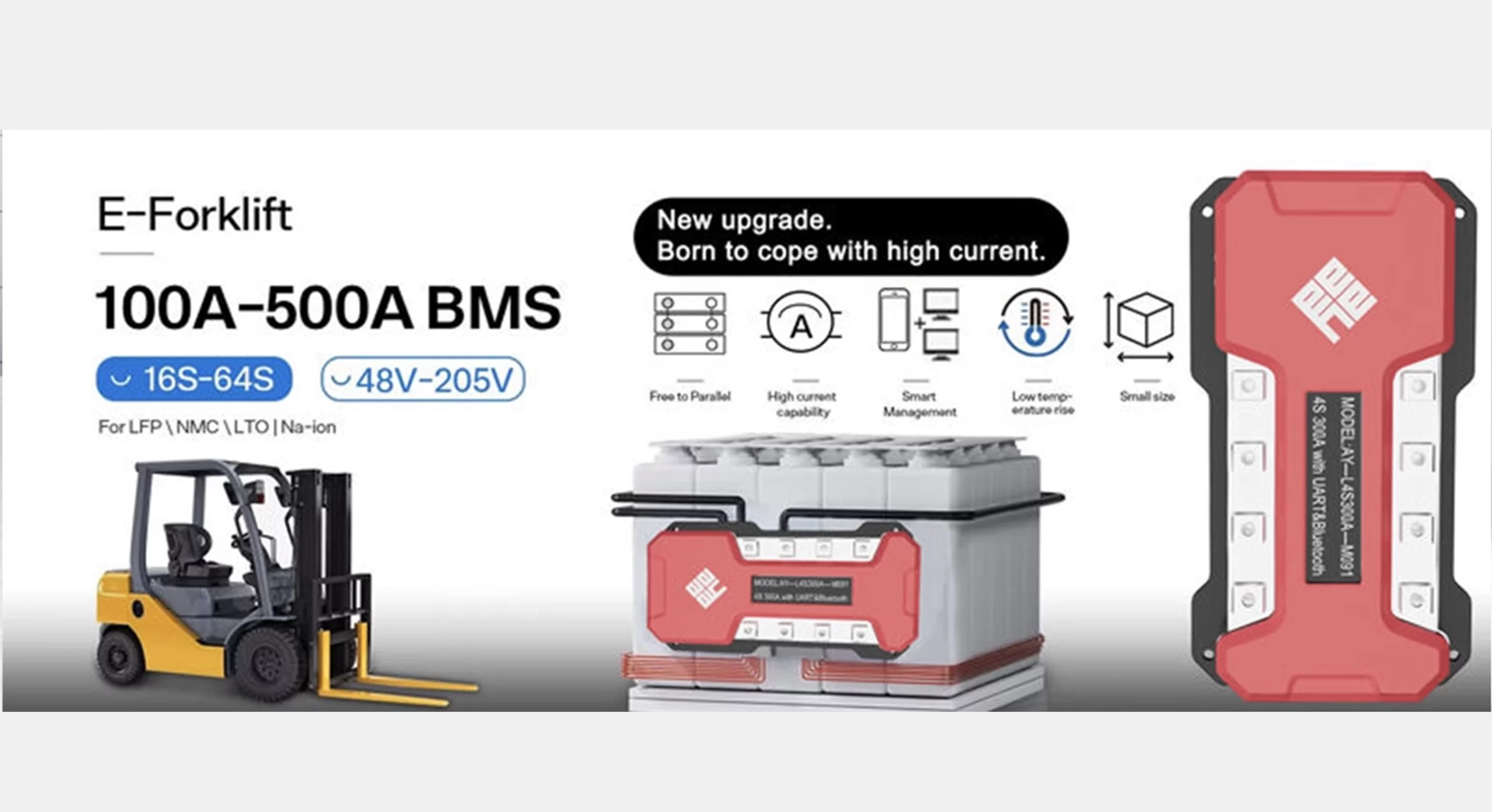
View More >Electric Forklift BMS
View More >Golf Cart BMS
View More >Electric Two-wheeler BMS
View More >Aviation & UAV BMS
View More >BMS For Power Tools
View More >Medical Equipment BMS
View More >








Home About Us EVENTS & NEWS Smart Equalizer in BMS: Unlocking Safer and Longer-Lasting Battery Performance
The Battery Management System (BMS) has emerged as the foundation of dependable power systems as the need for lithium-ion (Li-ion) and lithium iron phosphate (LiFePO4) batteries continues to increase across industries like electric vehicles, renewable energy storage, medical devices, and robots. A BMS guarantees that batteries run effectively, safely, and within the constraints of their design.
One of the most critical yet often overlooked components of modern BMS is the smart equalizer. Even the most sophisticated battery pack runs the risk of early aging, diminished capacity, or catastrophic failure in the absence of adequate cell balance. By cleverly controlling temperature, regulating cell voltages, and extending the life of the entire battery pack, the smart equalizer fills this gap.
We will discuss smart equalizers, their types, their importance in a BMS, how to choose one, and how they will influence safer, more intelligent energy storage in the future.

A smart equalizer in the context of a BMS is a specialized circuit or module designed to balance individual cells within a battery pack.Variations in voltage, state of charge (SOC), internal resistance, and temperature are inevitable because no two battery cells are exactly the same. The effectiveness and safety of the pack may be jeopardized by these imbalances.
The intelligent equalizer redistributes energy based on real-time cell state monitoring. It guarantees that the complete battery pack functions as a synchronized unit by avoiding overcharged or undercharged cells. This balance increases the pack’s useful capacity while simultaneously shielding it from harm.
Unlike traditional balancing circuits, a smart equalizer includes advanced algorithms and communication interfaces that allow the BMS to make predictive judgments, adapt to varied operating conditions, and maintain balance with improved accuracy.
The smart equalizer’s function goes beyond simple cell balancing. Among its primary duties are:
1. Voltage Monitoring
Battery safety relies heavily on precise cell voltage measurement. Every cell’s voltage levels are regularly checked by the smart equalizer, which highlights any differences. By doing this, hazardous over-voltage or under-voltage situations are avoided.
2. State of Charge (SOC) Management
All cells’ SOC levels can be estimated and balanced by a BMS with a smart equalizer. This is crucial since inconsistent SOC results in decreased pack capacity and inconsistent performance.
3. Temperature Management
Variations in pack temperature can hasten aging or result in thermal runaway. By preventing hot areas that impair performance, the smart equalizer helps disperse thermal stress more evenly.
4. Protection Against Overcharging and Over-Discharging
The smart equalizer makes sure that no cell goes over safe charging or discharging thresholds by controlling energy flow at the cell level. This increases battery efficiency during charge cycles while also protecting it.
5. Optimization of Charging and Discharging
The flow of energy into and out of the pack is optimized with the aid of intelligent equalizers. In demanding applications, this enhances usable capacity, reduces energy loss, and facilitates reliable power delivery.
Similar to an automobile without an alignment system, a BMS without a smart equalization is functional but eventually unsafe and inefficient. Let’s examine the reasons why intelligent equalizers are essential:
Battery Safety – Prevents dangerous imbalances that could cause overheating, fire, or explosions.
Extended Battery Life – Keeps cells at similar health levels, reducing stress and prolonging cycle life.
Improved Performance – Delivers stable voltage output and maximizes usable capacity.
Optimized Charging/Discharging – Ensures all cells charge and discharge evenly, preventing early degradation.
In essence, the smart equalizer serves as a protector, making sure that each cell makes a reasonable contribution to the battery’s total performance without creating a weak point.
Passive equalization and active equalization are the two primary equalization technique types utilized in BMS. Although both can be used as intelligent equalizers, their functions and applications are different.
Passive Equalization
Higher-voltage cells’ surplus energy is released as heat by passive equalizers. This approach is easier, less expensive, and appropriate for smaller packs where efficiency is not as important.
Active Equalization
Higher-voltage cells’ excess energy is transferred to lower-voltage cells using active equalizers. This approach is better for high-capacity battery systems, saves energy waste, and is more efficient.
Comparison Table: Passive vs. Active Smart Equalizer
| Feature | Passive Smart Equalizer | Active Smart Equalizer |
|---|---|---|
| System Setup | Simple, resistors-based | Complex, includes inductors/capacitors |
| Efficiency | Lower (energy wasted as heat) | Higher (energy redistributed) |
| Cost | Low | Higher |
| Complexity | Easy to implement | Advanced design required |
| Suitable Applications | Small packs, consumer electronics | EVs, energy storage, industrial batteries |
| Thermal Management | Generates extra heat | Minimal heat generation |

Your application, financial constraints, and performance objectives will all influence your choice of smart equalizer. These are the things to think about:
1. Application Type
Because of their excellent efficiency, active equalizers are typically the best option for renewable energy storage and electric vehicles.
Passive equalizers might work well for tiny devices or applications with limited resources.
2. Battery Life and Warranty
Advanced smart equalizer systems usually have longer lifespans and longer warranties, which lowers the overall cost of ownership.
3. BMS Functions
Make that the smart equalizer is compatible with communication protocols like Bluetooth, SMBUS, or CANBUS so that remote updates and monitoring are possible.
4. Size and Weight
Lightweight systems are required for applications like drones and medical equipment, which could affect your decision between passive and active equalizers.
The smart equalizer is essential to many different sectors:
Electric Vehicles (EVs) – Ensures balanced charge/discharge across large battery packs, boosting driving range and safety.
Energy Storage Systems (ESS) – Maximizes storage efficiency and extends system life, critical for renewable energy integration.
Medical Equipment – Provides safe, reliable power where consistent performance is a matter of life and death.
Robotics and Drones – Optimizes energy distribution for longer operational cycles without performance drops.
Consumer Electronics – Keeps devices running longer with improved battery stability.
Q:What is the difference between BMS and active equalizer?
A:A BMS extends the life of your valuable battery by controlling and monitoring it at the cell level, disconnecting the entire battery in the event of an overvoltage or undervoltage. Your batteries are simply balanced by an active balancer, which transfers energy from a higher-voltage cell to a lower-voltage cell.
Q:What does smart bms mean?
A:For contemporary batteries, a battery management system (smart BMS) is more than just an add-on. It prolongs battery life and is necessary for safe and efficient use. A BMS helps the battery function properly and maintains it safe. It accomplishes this by continuously monitoring its voltage, current, temperature, and charge level.
Q:What is the BMS setting?
A:BMS overcharge protection is a common battery management system protective option for lithium-ion batteries. If the voltage increases over the maximum safe level, the overcharge safety feature of a lithium battery will activate and prevent any current from entering or exiting the battery.
Q:What is the best BMS for LiFePO4?
A:AYAA Smart BMS
Q:What are the three types of BMS?
A:There are three main categories of BMS architectures:
Small, single-board BMS.
Distributed BMS.
Large, centralized BMS.
In contemporary BMS, the smart equalizer is now a necessary element rather than an optional one. The smart equalizer unlocks the full potential of energy storage technology, from assuring safe operation in essential systems to prolonging the lifespan of Li-ion and LiFePO4 batteries.
When picking a BMS, selecting one with a reliable smart equalizer should be a priority. Whether you are creating energy solutions for electric vehicles, medical equipment, or renewable energy storage, the proper smart equalizer can make the difference between a safe, efficient, and long-lasting system and one prone to failure.
If you’re searching for a sophisticated BMS solution with intelligent equalization technology, Ayaa Technology offers customized systems made for a range of global applications. Ayaa’s decades of experience guarantee longer-lasting, safer, and more intelligent battery performance.
Contact Us