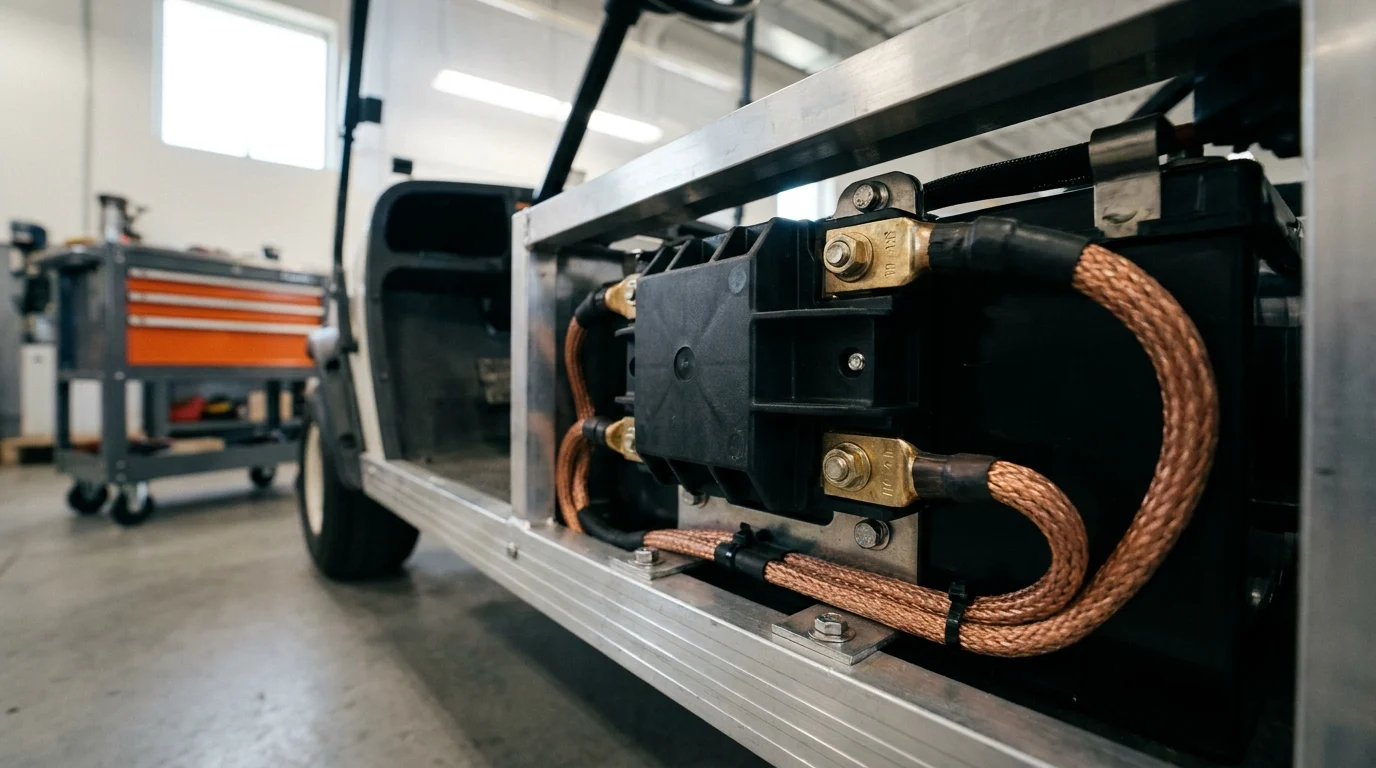







The best golf cart battery for your fleet matches motor voltage, sustains peak amps, and cuts TCO. Commercial fleets need reliable daily power. For multi-round operations, 48V LiFePO4 packs deliver the lowest cost per operating hour. They eliminate weekly watering labor and shed roughly 300 pounds of dead weight.
These advanced cells run for thousands of cycles before dropping to 80% capacity. Lead-acid packs still suit low-hour seasonal operations, but high-demand facilities face real operational risks. Missing critical technical details leads to stranded carts, blown fuses, and voided insurance policies. Buyers must evaluate BMS surge limits, regenerative braking, electrical panels, and safety standards.

Determining Voltage and Capacity for Your Golf Cart Battery Setup
Getting voltage and capacity right is the first step in fleet battery procurement. Incorrect ratings make carts run sluggishly or throw continuous fault codes. In worst cases, improper sizing cuts power entirely during routine jobs.
Matching Pack Voltage to Motor Controller Limits (36V, 48V, 72V)
Most commercial utility vehicles run on 36V or 48V drivetrains. Newer light utility vehicles often move to 72V systems for higher speed and torque. Older fleets still feature 36V setups originally built with six 6V batteries. Modern fleets standardize on 48V systems using six 8V or four 12V units.
Heavy utility haulers require 72V configurations to handle heavy equipment and cargo. Always verify that your motor controller can handle the voltage of modern batteries. A 48V lead-acid system swings between 42V empty and 50.9V fully charged. In contrast, a 48V lithium pack maintains a steady output above 50V across most cycles.
Engineering Note: Never wire off-the-shelf 12V lithium batteries in series to build a 48V pack. Each unit runs its own internal BMS. If one BMS trips, it creates an arc that damages other electronics. Commercial fleets require a dedicated 48V golf cart battery pack with a centralized master BMS.
Sizing Amp-Hour (Ah) Capacity for Multi-Shift Duty Cycles
Capacity directly dictates run time. However, higher capacity increases cell weight and hardware expense. Sizing must reflect your daily operating schedule and fleet payload demands.
Packs between 60Ah and 105Ah suit standard passenger carts running 18 to 36 holes daily. Larger 150Ah to 200Ah capacities are essential for utility beds carrying heavy tools.
Drivers need reliable data to prevent sudden shutdowns on the course. Voltage meters fail with lithium because the discharge curve remains flat. At AYAA TECH, our Smart BMS calculates State of Charge (SOC) by tracking ambient temperature shifts. This keeps error rates at or below 5%, ensuring accurate range and return-to-base estimates.
Comparing Golf Cart Battery Chemistries for Commercial Fleets
Choosing between flooded lead-acid, AGM, and LiFePO4 involves real financial trade-offs. Procurement teams must weigh initial purchase savings against long-term maintenance labor. The table below compares these chemistries across a typical 30-cart commercial fleet over eight years.
| Specification / Factor | Flooded Lead-Acid (FLA) | Absorbed Glass Mat (AGM) | Lithium Iron Phosphate (LiFePO4) |
|---|---|---|---|
| Initial Cost (per 48V cart set) | $1,100 – $1,600 | $1,800 – $2,300 | $1,600 – $2,800 (with charger) |
| Cycle Life (@ 80% DoD) | 500 – 800 cycles | 600 – 900 cycles | 3,500 – 5,000+ cycles |
| Typical Lifespan in Fleet Use | 2 to 3.5 years | 3 to 4 years | 8 to 10 years |
| Battery Weight (48V set) | ~380 – 420 lbs | ~390 – 430 lbs | ~90 – 125 lbs |
| Routine Maintenance | High (Bi-weekly watering, acid cleaning) | Low (Terminal checks, cable torque) | Zero (Sealed, automatic cell balancing) |
| Round-Trip Energy Efficiency | 70% – 75% | 75% – 80% | 95% – 98% |
Lead-acid batteries reduce immediate capital expenses on day one. However, they demand continuous maintenance and frequent replacements over time. Modern lithium systems eliminate those recurring maintenance costs.
Upfront Capex vs. Lifecycle Total Cost of Ownership (TCO)
Facilities with brief operating seasons may favor lead-acid systems. In low-use settings, lead-acid cells age out from calendar decay before lithium repays its premium. Busy commercial resorts and private clubs experience the opposite financial outcome. Active fleets achieve a 30% to 45% reduction in overall TCO by switching to lithium.
A single industrial LiFePO4 pack outlasts three consecutive sets of lead-acid units. Lithium cells also lose practically no power to heat during recharge cycles. These efficiency gains lower monthly utility bills across commercial properties.
Maintenance Overhead and Labor Allocation
Maintaining flooded lead-acid batteries demands dedicated manual labor. Technicians must inspect fluid levels, add distilled water, and scrub terminal corrosion every two weeks. Neglecting these steps in hot weather ruins battery plates within weeks.
Fully sealed lithium units require zero fluid maintenance. Transitioning to lithium saves approximately 100 labor hours per season on a 40-cart fleet. Grounds crews can refocus their time on preventative maintenance and cart uptime.
Engineering Compatibility: Sizing for Continuous and Peak Current
Many conversion failures occur when buyers treat a battery like a simple fuel tank. Sizing voltage and capacity is meaningless if current draw is ignored. Your pack must supply the sudden current spikes demanded by commercial motors.
Preventing BMS Tripping on Gradients and Heavy Payloads

A 48V cart draws between 45A and 75A while cruising on level turf. Starting on a steep grade with passengers causes an immediate current spike. Inrush currents frequently surge past 400A during heavy hill climbs.
Budget lithium kits use internal switches rated for low continuous current. When a cart hits a hill, the BMS trips its over-current protection. The battery shuts off to protect itself, stranding the cart on the fairway.
Engineering Note: Commercial utility carts need high continuous discharge ratings between 150A and 200A. Peak current tolerances must reach 450A to 600A for at least 5 seconds. Anything less causes repeated stalling and high warranty costs on steep terrain.
Handling Regenerative Braking Voltage Surges
Commercial electric carts use motor braking to control downhill speed. This regenerative process pushes reverse current back into the battery wiring. Lead-acid cells absorb these transient spikes with little difficulty.
A fully charged lithium pack cannot easily absorb unexpected voltage spikes. The surge trips the over-voltage protection circuit inside the BMS. When power cuts, automatic parking brakes can lock instantly and cause dangerous skidding. Your system design must include managed charge limits or dynamic braking resistors.
Need Fleet-Ready Battery Packs Built for Heavy Commercial Duty?
Explore AYAA TECH Commercial Battery Packs & Smart BMSFacility Infrastructure and Operational Integration
Upgrading a fleet requires more than replacing the battery trays. Managers must also examine charging rooms and fleet tracking hardware.
Charging Station Sizing and Thermal Management
Charging dozens of carts simultaneously places heavy demand on facility electrical panels. Fast charging cuts downtime, but high charge rates generate concentrated internal heat. Effective heat dissipation protects both the charger and the battery electronics.

At AYAA TECH, our Battery Pack and BMS hardware uses spaced layouts for heat-generating MOSFETs. We position current-sensing shunt resistors away from sensitive logic circuits. High-grade thermal silicone pads and conductive gels pull heat away from active components. Aluminum alloy sinks and copper busbars maintain cool operating temperatures during fast charges.
Battery Telemetry and Centralized Fleet Monitoring
Consumer batteries rely on basic smartphone Bluetooth connections. Checking fifty carts one by one with a phone app wastes valuable technician hours. Enterprise operations require centralized data collection.

Commercial systems should feature native CAN-bus support for CANopen أو SAE J1939 protocols. This architecture transmits charge levels, cell voltages, and fault codes to GPS tracking systems. Fleet supervisors receive real-time dashboard alerts before vehicles run out of power on the course.
Commercial Safety Standards and Warranty Terms
Commercial battery procurement carries unique operational and legal liabilities. Uncertified batteries create fire risks that can void facility insurance policies.
Essential Safety Certifications for Commercial Insurance
Raw cell certifications do not guarantee pack-level safety. Standards like UN38.3 only certify that cells are safe for transport. Commercial insurers require pack-level safety ratings such as UL 2271.
UL 2271 tests the complete pack enclosure, BMS wiring, and thermal containment systems. Units undergo vibration, impact, water immersion, and electrical stress evaluations. Sourcing certified packs protects your facilities against denied liability claims.
Evaluating Commercial Fleet Warranty Terms
Consumer warranties often contain fine-print exclusions for fleet use. Commercial agreements must explicitly cover multi-shift operation and frequent recharging schedules. Ensure your contract includes clear capacity retention metrics over the warranty period. Verify that regional replacement parts and technical support are readily available.
Need Tailored Pack Dimensions, Custom Voltages, or Specific CAN Protocols?
Consult an AYAA Fleet Battery ArchitectFrequently Asked Questions About Golf Cart Battery Selection
How many years do commercial golf cart batteries typically last?
Commercial flooded lead-acid batteries last between 2 and 4 years. They typically deliver 500 to 800 cycles before plate sulfation ruins performance. In contrast, commercial LiFePO4 systems run for 7 to 10 years. A quality lithium pack delivers 3,500 to 5,000 cycles under daily fleet usage.
What is the average cost to replace or convert golf cart batteries?
Replacing a 48V fleet with new lead-acid batteries costs $1,100 to $1,600 per cart. Upgrading to an integrated 48V lithium golf cart battery system costs $1,600 to $2,800. That initial package includes the battery pack, matching charger, and mounting hardware. Fleet operations recover this extra investment within 24 to 36 months through labor savings.
Can you mix different battery brands, chemistries, or ages in one cart?
Never mix batteries of different brands, chemistries, or ages within a single cart. Mismatched lead-acid batteries have uneven internal resistance, which can cause rapid overcharging and cell failure. For lithium systems, never parallel-connect packs without engineered busbars and communicating BMS units. Unbalanced lithium connections cause excessive circulating currents that trip safety circuits or ignite cells.