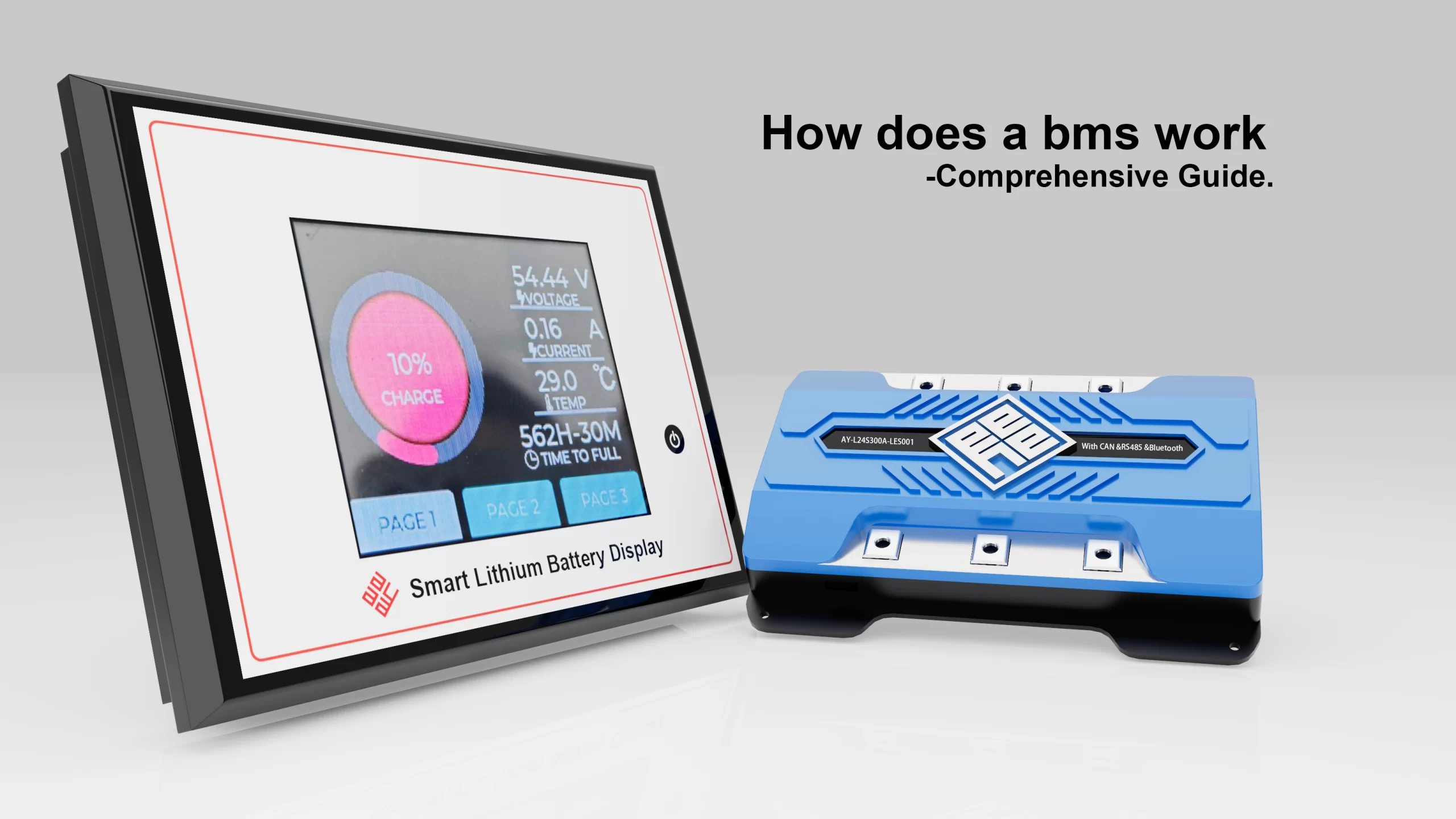
Battery Management System Working Principle and Its Role in Safe Battery Use
5660
Battery Management System Working Principle and Its Role in Safe Battery Use
Smarter battery monitoring solutions are critical as the demand for lithium-ion batteries rises globally across industries like electric vehicles (Veículos Elétricos), renewable energy storage, and portable devices.
O Sistema de Gerenciamento de Bateria (BMS) is at the center of this development.
Understanding the battery management system working principle is crucial for ensuring safety, longevity, and optimal performance of modern battery-powered technologies.
1. Understanding the Battery Management System Working Principle
Monitoring and regulating battery cells to avoid damage, improve safety, and optimize battery efficiency is the foundation of the battery management system’s operation.
By continuously monitoring vital indicators including voltage, current, temperature, and general health, a BMS is an advanced electronic control unit that makes sure batteries run within their specified specifications.
In the energy storage sector, the battery management system’s operation is crucial because:
Preventing overcharging and over-discharging
Monitoring battery health and performance
Extending battery lifespan through balanced charging
Ensuring thermal regulation for safety
Facilitating communication with external systems (e.g., EV controllers)
In addition to protecting individual battery cells, the battery management system’s operation allows precise data analytics for real-time control and predictive maintenance.
2. The Structure and Core Components Behind the Battery Management System Working Principle
Examining a battery management system’s structural arrangement is crucial to fully comprehending its operating principle.
Usually, it consists of both software and hardware elements intended for communication, control, and sensing.
A. Hardware Components
Voltage Sensors: Continuously monitor each cell’s voltage to prevent overcharge or over-discharge.
Current Sensors: Measure incoming and outgoing currents to detect potential short circuits or overcurrent conditions.
Temperature Sensors: Monitor cell temperature to trigger cooling or shutdown mechanisms if thresholds are exceeded.
Microcontroller Unit (MCU): Acts as the system’s brain, executing algorithms based on collected data.
Balancing Circuit: Ensures uniform voltage levels across cells to prevent imbalances that degrade performance.
Communication Interface: Facilitates data exchange with external controllers via CAN, UART, or RS485 protocols.
B. Software Algorithms
The operation of the battery management system is largely dependent on real-time data processing:
SOC (State of Charge): Estimates the remaining charge in the battery.
SOH (State of Health): Reflects the aging and degradation level of battery cells.
SOP (State of Power): Determines how much power can be safely drawn from or delivered to the battery.
The program makes sure that these projections are converted into useful outputs, such controlling charging voltage or setting off alerts.
3. Detailed Battery Management System Working Process
Examining the battery management system’s sequential processes is necessary to comprehend its operating principle.
This is how a BMS normally operates:
1. Data Acquisition
Sensors collect vital parameters including voltage, current, and temperature from each cell.
2. State Estimation
The BMS software analyzes this data to estimate SOC, SOH, and SOP, providing real-time battery condition information.
3. Charging/Discharging Control
Based on these estimations, the system optimizes charging or discharging rates to ensure safety and prolong lifespan.
4. Thermal Regulation
The BMS activates cooling or heating mechanisms if cell temperatures deviate from safe operating ranges.
5. Protection Management
To avoid risks, the system isolates the problematic component or cuts the battery if any anomalies are found, such as overcurrent or overheating.
The battery management system’s operating concept guarantees the battery pack’s safe and effective operation during these phases.
4. Application Scenarios for Battery Management Systems
The battery management system’s broad uses in a variety of industries demonstrate how important its operating principle is:
A. Electric Vehicles (EVs)
The BMS controls regenerative braking, controls power distribution, and shields the battery pack from severe driving circumstances in EVs.
B. Energy Storage Systems
By overseeing massive lithium battery storage facilities, BMS contributes to energy grid stabilization and maximizes the use of renewable resources.
C. Consumer Electronics
Compact BMS units are necessary for devices like laptops and smartphones to operate safely and have longer battery lives.
D. Industrial Robotics and Drones
BMS is essential for intelligent battery management and safe power distribution in autonomous robots and drones.
The battery management system’s operating philosophy supports user safety and economical energy use in each of these areas.
5. Technical Advantages of BMS and Quality Considerations
There are several technological benefits to the battery management system’s operation, including:
High Precision Monitoring: Achieved via advanced sensors and algorithms for accurate battery state estimation.
Smart Control: Real-time adjustments to ensure optimal performance and energy savings.
Gestão Térmica: Prevents cell degradation due to temperature fluctuations.
Built-in Safety Mechanisms: Protect against thermal runaway, short circuits, and over-voltage.
Quality and Maintenance Tips
To ensure the battery management system works effectively:
Calibrate sensors regularly.
Use high-reliability components.
Avoid extreme environmental conditions.
Update firmware to incorporate the latest algorithms.
These procedures guarantee that the battery management system’s operating principle is stable and effective throughout the duration of the product’s lifecycle.
6. Future Trends in Battery Management System Working Principle
The functioning principle of battery management systems is evolving along with battery advances.
Important trends for the future include:
Wireless BMS: Reduces wiring complexity and enhances flexibility, especially in EVs.
Artificial Intelligence: Enables predictive analytics for failure prevention and efficiency optimization.
Cloud-Integrated BMS: Allows remote monitoring and updates, making energy systems smarter and more connected.
Modular Architectures: Improves scalability and simplifies maintenance in large systems.
These innovations will redefine how battery systems are managed, reinforcing the centrality of the battery management system working principle.
7. Why Choose Ayaa Technology for Advanced BMS Solutions?
With its highly customized BMS solutions that represent the most sophisticated comprehension of the battery management system operating principle, Ayaa Technology is at the forefront of battery innovation.
Our solutions are designed to satisfy strict safety, efficiency, and communication criteria thanks to our global expertise in EVs, energy storage, and industrial applications.
Whether you need real-time monitoring, temperature control, or smart balancing, Ayaa’s BMS platforms work in unison with your systems to provide peak performance.
Perguntas frequentes
Q:How does a battery management system work?
A:A battery management system uses components like capacitors and inductors to transfer charge from high-SOC cells to low-SOC cells.
In this instance, energy is transferred across the battery pack’s various cells.
An example of the battery cell balancing technique using switched capacitors.
Q:What is the basic working principle of a battery?
A:An apparatus that stores chemical energy and transforms it into electrical energy is called a battery.
Electrons go from one substance (electrode) to another via an external circuit as part of the chemical reactions in a battery.
An electric current that can be used to do work is produced by the movement of electrons.
Q:What is the key function of BMS?
A:Safety and protection, cell balancing, status monitoring, thermal management system, data collecting, and energy management system are a few of the BMS’s primary duties.
Conclusão
Anyone dealing with energy storage, electric mobility, or smart gadgets needs to understand the basic operation of battery management systems.
The BMS is a vital component that facilitates safety, performance, and sustainability as power systems become increasingly sophisticated and intelligent.
Businesses can stay ahead of the curve, guarantee product reliability, and realize the full potential of their battery systems by collaborating with reputable BMS providers like Ayaa Technology.