



What Makes a 48V Forklift Battery More Efficient Than Traditional Lead-Acid Packs?
Fast-growing e-commerce operations, industrial manufacturing, and warehouse logistics have all been revolutionized by electric forklifts.
The power system inside the forklift is more crucial than ever since these industries seek more productivity, reduced downtime, and enhanced energy economy.
The 48v forklift battery, which is based on lithium-ion technology, has quickly become the go-to option in this transition, displacing decades-old lead-acid packs that find it difficult to fulfill contemporary efficiency standards.

The Critical Role of 48V Forklift Batteries and Their Evolution
The battery in an electric 지게차 is much more than just a source of power.
It has a direct impact on lifespan cost, equipment safety, and operating efficiency.
The battery of a forklift affects:
Lifting power and speed
Acceleration and braking response
Continuous operating time
Overall energy costs
Workspace safety and uptime
Operator productivity
Forklift fleets can operate longer, perform better under load, and adjust to fast-paced industrial conditions with the aid of a high-performance 48v forklift battery.
What Challenges Do Traditional Lead-Acid Forklift Batteries Face?
Although lead-acid batteries have been used extensively for more than a century, they have a number of drawbacks that interfere with the high-demand workflow of today:
Slow charging times—typically 6 to 10 hours
Heavy weight that limits efficiency and maneuverability
Low energy density leading to shorter runtime
Frequent maintenance such as watering and cleaning
High heat generation reducing performance
Shorter cycle life, especially with deep discharges
Lead-acid packs result in needless downtime and long-term inefficiencies for warehouses operating numerous shifts or conditions needing continuous operation.
Why Has the 48V Lithium Forklift Battery Become Popular?
Lead-acid batteries cannot meet the needs of modern logistics, automation, robots, and fast-moving warehouse operations.
Lithium-based 48v forklift battery technology shines in this situation:
Up to 3× higher energy density
4× longer cycle life
2–5× faster charging
Opportunity charging without damaging the battery
Zero daily maintenance
Stable performance even at high currents
Clean and environmentally friendly
The 48V lithium forklift battery has emerged as the industry standard for forklift fleets worldwide when combined with a sophisticated BMS (Battery Management System).
Core Advantages of a 48V Forklift Battery
We must examine a number of technical advancements that have a direct impact on forklift operating on a daily basis in order to comprehend this.
1. Higher Energy Density for Longer Run Time
Compared to a lead-acid unit, a 48V forklift battery holds a lot more energy per kilogram.
This leads to:
Longer operation between charges
Better support for multi-shift operations
Fewer charging cycles
Reduced energy consumption
Additionally, forklifts with high energy density operate for longer periods of time and spend less time idle at charging stations.
2. Higher Discharge Efficiency Reduces Energy Loss
The amount of stored energy that is truly useful is represented by discharge efficiency.
Lead-acid efficiency: 70%–80%
Lithium 48V efficiency: 95%+
This indicates that a 48V lithium forklift battery gives the motors more power with far less loss, leading to:
Stronger lifting force
Stable performance even at lower voltage
Better response under heavy loads
Lower operating costs over time
3. Fast Charging Greatly Improves Workflow
One of the main causes of forklift downtime is charging.
Nevertheless, 48V lithium batteries are compatible with:
1–2 hour fast charging
Opportunistic or break charging
Cold-charging without damage
The battery can be charged at any time, even at lunch, shift breaks, or slow work periods, and there is no need for a cooling period.
This significantly boosts fleet availability and daily output.
4. Lightweight Design Enhances Performance
The weight of a 48V lithium forklift battery is only one-third that of a comparable lead-acid battery.
There are several advantages to losing weight:
Lower energy consumption
Better acceleration
Reduced stress on forklift components
Easier installation and replacement
Improved maneuverability
Forklifts can operate more effectively in a range of industrial settings thanks to lightweight solutions.
Economic and Environmental Benefits of a 48V Forklift Battery with BMS
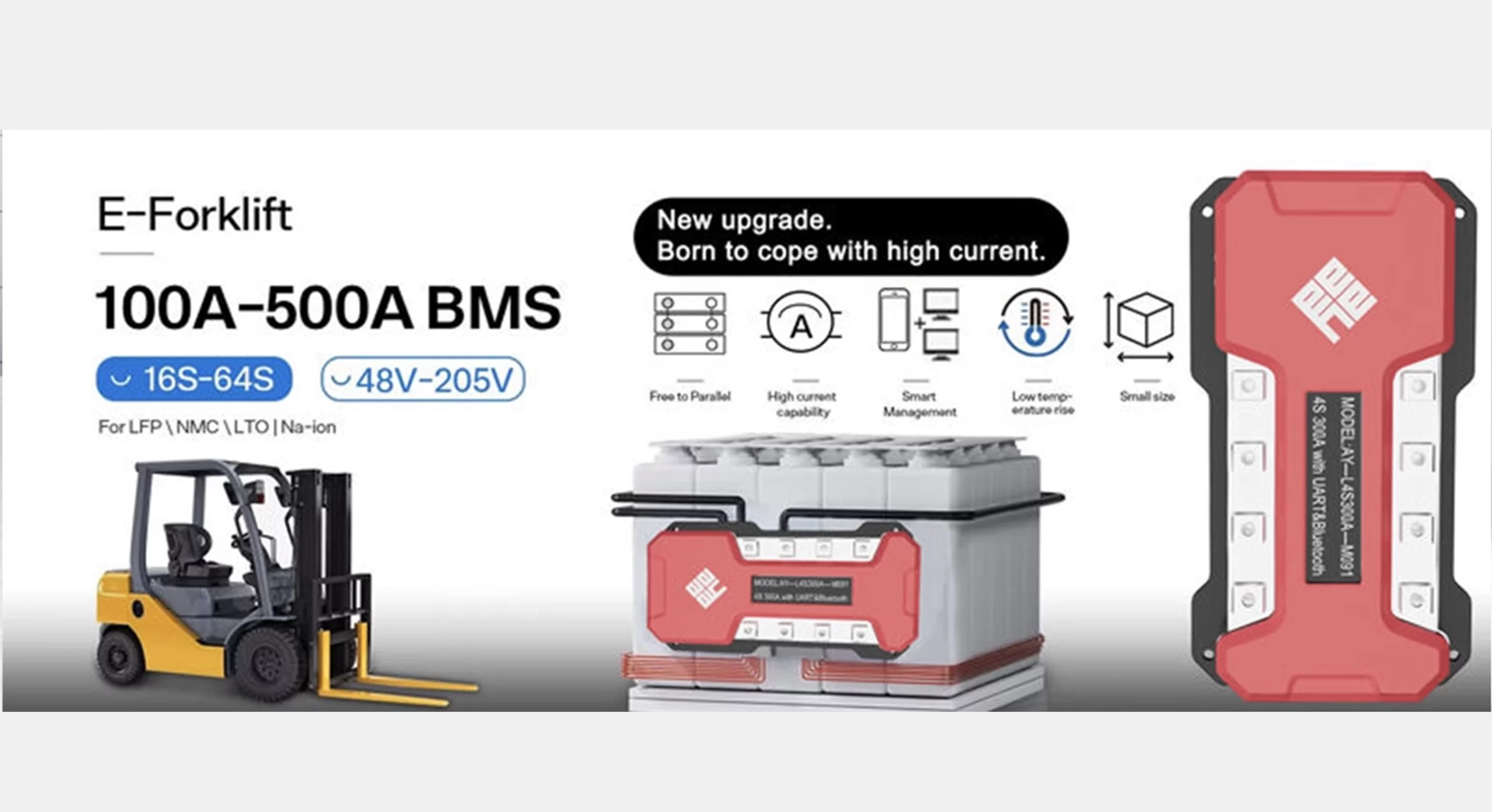
One of the most important parts of a 48v forklift battery is the Battery Management System (BMS).
It actively keeps an eye on and controls every crucial aspect:
Overcharge/over-discharge protection
Short-circuit protection
Current and voltage regulation
온도 조절
세포 균형 조절
Real-time SOC/SOH estimation
Communication via CAN/RS485
Economic advantages include:
Reduced downtime
Longer battery life
Lower maintenance cost
Improved energy efficiency
Environmental advantages include:
No acid or toxic lead pollution
Higher recyclability
Lower carbon emissions
Less waste over the battery lifespan
Every safe, robust, and high-performing 48V forklift battery is built on a well-designed BMS.
How to Choose the Right 48V Forklift Battery?
The demands placed on a forklift battery vary depending on the type of workplace:
Are you running 24/7 multi-shift operations?
Do forklifts lift heavy loads frequently?
Does the site allow opportunity charging?
Are operations carried out in extreme temperatures?
Is high-speed movement required indoors or outdoors?
A thorough assessment guarantees that you choose the best 48v forklift battery for longevity and performance.

Which Operational Needs Should You Consider Before Purchasing?
Every business has distinct requirements:
Warehouse & Logistics
Prioritize fast charging and high cycle life.
Manufacturing Plants
Require stable power output and long run time.
Cold Storage Facilities
Need cold-temperature-resistant BMS and cells.
Outdoor Construction Sites
Emphasis on thermal stability and durability.
Optimizing expenses and extending equipment life can be achieved by selecting a 48V battery that is compatible with your surroundings.
What Should You Look For in a High-Quality 48V BMS?
The battery’s long-term performance is determined by a dependable BMS.
Important characteristics to search for:
Accurate SOC algorithm
Precise temperature monitoring
Active or passive cell balancing
CAN/RS485/SMBus communication
Cloud monitoring compatibility
UL/CE/UN38.3 certifications
Over-current and short-circuit protection
Make sure the BMS satisfies your performance, safety, and communication requirements before choosing a 48v forklift battery.
How to Use and Maintain a 48V Forklift Battery Correctly?
Lithium batteries require little upkeep, but long-term performance can be ensured by adhering to best practices:
Best Practices:
Use recommended chargers
Charge during short breaks when possible
Avoid extreme temperature operation
Keep the battery clean and dry
Regularly inspect terminals and cables
Use BMS reports to monitor health
Avoid These Behaviors:
Using mismatched or cheap chargers
Deep discharging frequently
Leaving the battery fully charged for long periods
Operating under severe heat without monitoring
When used properly, a 48v forklift battery can last at least five to eight years.
Market Outlook and Industry Applications of 48V Forklift Batteries
48V forklift batteries will continue to rule the industry as industrial automation and global electrification pick up speed.
Important tendencies in development include:
More intelligent BMS platforms
IoT integration and cloud monitoring
Higher energy density cells
Advanced thermal control
Lighter and more compact structural design
Broader use in AGV/AMR autonomous logistics vehicles
Which Industries Benefit the Most from 48V Forklift Batteries?
These days, 48V lithium forklift batteries are frequently utilized in:
Warehousing and distribution centers
Food, medical, and pharmaceutical industries
Heavy-duty manufacturing plants
Cold-chain and refrigeration facilities
Ports and container yards
E-commerce logistics hubs
The transition from lead-acid to 48v forklift battery systems will only quicken as efficiency requirements rise.
Why a 48V Forklift Battery Is the Smart Choice for High-Efficiency Industrial Operations
Higher energy density, improved discharge efficiency, quicker charging, less maintenance, and a longer lifespan are all provided by a 48V lithium forklift battery, which is backed by an advanced BMS that guarantees stability and safety.
Adopting a contemporary 48V battery system is now more than just an update for companies looking to lower operating costs, increase sustainability, and boost productivity—it’s a strategic advantage.
AYAA Technology provides expert BMS R&D capabilities, strong quality control, and industry-specific modification to satisfy various forklift and industrial energy requirements if you’re looking for a high-performance 48v forklift battery backed by cutting-edge BMS technology.
자주 묻는 질문
Q1:How long will a 48 volt battery last?
A1:The longevity of a 48-volt battery varies greatly depending on its type and usage, although lead-acid batteries normally last 4–6 years, whereas lithium-ion batteries often last 8–10 years or 3,000–5,000 cycles.
The battery’s load, temperature, charge cycles, and maintenance all affect how long it lasts.
Q2:How many hours does a 48V 20Ah battery last?
A2:3.84 hours.
Q3:What is a group 48 battery equivalent to?
A3:The European H6 (or DIN H6) size, which is frequently used as a substitute for numerous American and European automobiles, is comparable to a Group 48 battery.
While a Group 48 can directly replace a Group 47 in some vehicles, such as the second generation Hyundai Veloster, other comparable or interchangeable sizes include LN3 and, in certain situations, the slightly smaller Group 47.
Q4:Can I use a car battery for a forklift?
A4:You may transport a dead electric forklift using a series of car batteries.
But keep in mind that you should only utilize the car battery method to carry the forklift to a charging station.
Don’t play forklift basketball, powerlift a load, or utilize automobile batteries.
Q5:Is a group 27 battery better than a group 24?
A5:Compared to the group 24 battery, the group 27 battery has a higher output current.
Therefore, heavy commercial and industrial equipment is the target market for the group 27 battery.
Because of their increased capacity, they also last longer and produce more power.
문의하기
최신 뉴스
- How does Smart Active Balancer BMS improve efficiency and performance of high voltage battery packs?
- 드론의 안전, 신뢰성 및 비행 성능 향상을 위해 맞춤형 드론 BMS가 필수적인 이유는 무엇일까요?
- 해양 RV 에너지 저장 장치 BMS 중 배터리 보호 및 실시간 모니터링 기능을 제공하는 제품은 무엇입니까?
- 전기 오토바이 BMS(배터리 관리 시스템)가 과충전 및 과열 위험을 방지하는 데 중요한 이유는 무엇입니까?
- 골프 카트 BMS는 리튬 배터리의 안전성과 신뢰성을 어떻게 향상시키나요?
공유
뉴스 추천
-

BMS 연결 다이어그램 이해: MOSFET 제어부터 셀 밸런싱까지
08/19/2025 -
인산철 리튬 BMS 상위 5개 브랜드 비교: 당신에게 맞는 것은?
05/16/2025 -
스마트 BMS 작동 방식 - 종합 가이드.
03/11/2025 -
전통적인 에너지원 대신 태양광 에너지 시스템을 선택하는 이유는 무엇인가요?
03/31/2025 -
배터리 관리 시스템은 지게차 성능을 어떻게 향상시키는가
01/16/2025