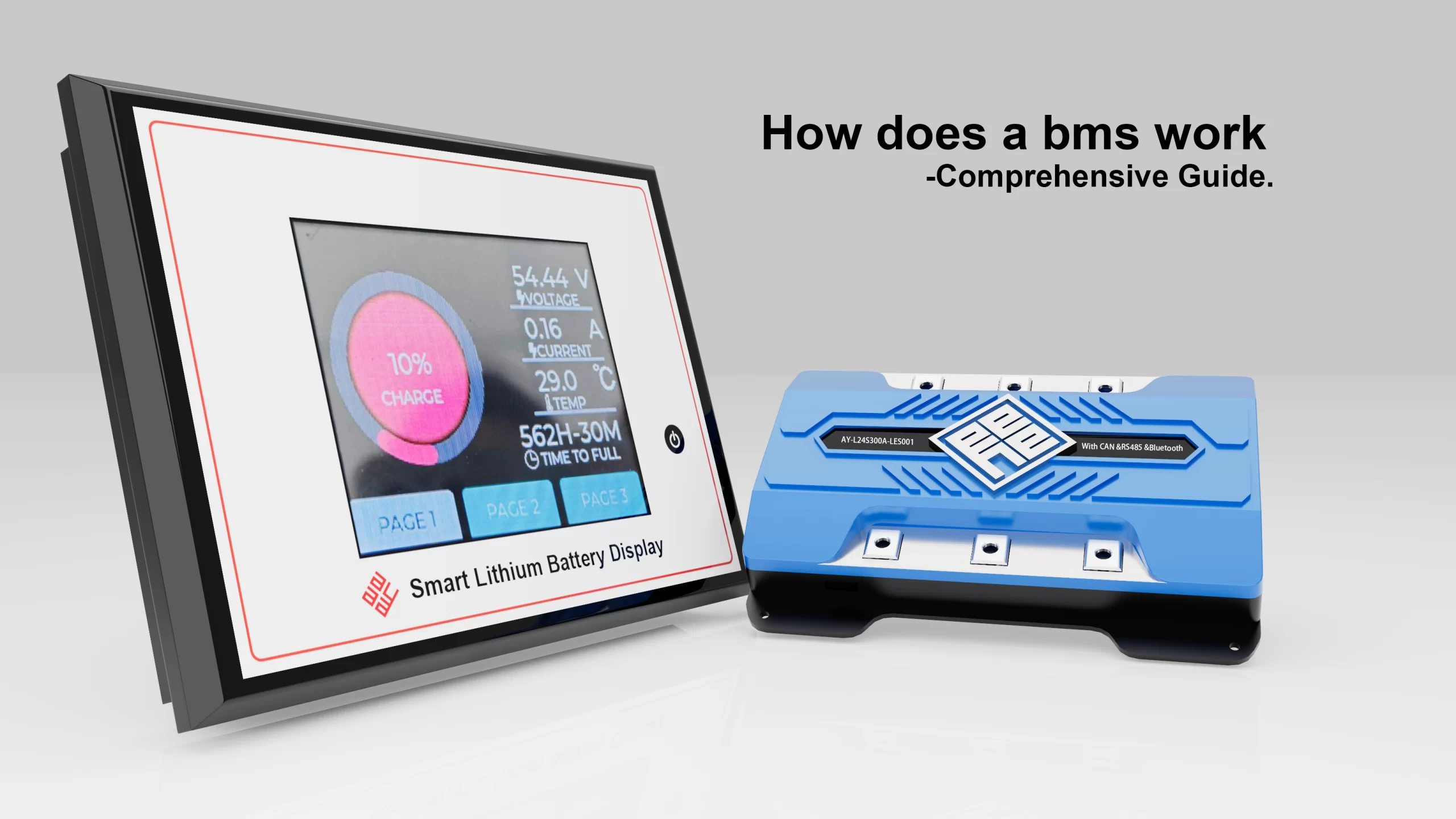
What is BMS for Lithium Batteries? A Complete Guide to Battery Management
3264
What is BMS for Lithium Batteries? A Complete Guide to Battery Management
Lithium batteries are the industry leader in energy storage today, found in everything from computers and smartphones to electric cars and renewable energy sources. Their long lifespan, lightweight design, and high energy density make them the go-to option for a wide range of applications. But lithium batteries also present particular difficulties that call for close observation and management. A BMS for lithium batteries is useful in this situation.
The battery’s brain is a Battery Management System (BMS), which is more than just an accessory. It prolongs the battery pack’s total life, maximizes performance, and assures safety. This article will explain the definition of a BMS for Lithium batteries, its operation, its importance, and how it shields you and your loved ones from possible risks.
1. What is a BMS for Lithium Batteries?
An electronic system called a BMS for lithium batteries is made to keep an eye on and manage a lithium battery pack’s performance. Lithium batteries are more susceptible to short circuits, deep discharge, overcharging, and extreme temperatures than Blei-Säure batteries. By balancing performance and safety, a BMS makes sure that each individual cell in a pack stays within safe operating limits.
Fundamentally, a BMS carries out three essential functions:
Monitoring – Tracking voltage, current, and temperature across all cells.
Protection – Preventing unsafe conditions like overvoltage, undervoltage, overcurrent, and overheating.
Ausbalancieren – Ensuring all cells in a series or parallel connection remain equalized to avoid uneven aging.
In the absence of a BMS for lithium batteries, even a premium battery pack may malfunction too soon or, in the worst situations, explode or catch fire.
2. What is the Role of a Battery Management System?
A BMS is responsible for more than just monitoring. It acts as the battery pack’s protector, safeguarding the devices it powers as well as the individuals who depend on it.
Key roles include:
Voltage Regulation – Preventing overcharging and deep discharging.
Wärmemanagement – Monitoring cell temperatures to avoid overheating.
Load Management – Regulating current output for stable performance.
Data Communication – Sending real-time performance data to controllers or external devices via CANBUS, SMBUS, or Bluetooth.
Safety Protocols – Instantly disconnecting the pack during critical fault conditions.
Through the integration of a BMS for lithium batteries, producers and consumers may guarantee dependability in a variety of applications, from solar storage systems and medical equipment to golf carts and e-bikes.
3. How Does a BMS for Lithium Batteries Work?
Consider a BMS for lithium batteries as a central nervous system to comprehend its operation. BMSs transfer data between battery cells and the device they power, just like nerves do throughout the human body.
Step-by-Step Operation:
Cell Monitoring – Sensors collect data on voltage, temperature, and current.
Processing – A microcontroller analyzes the data to determine the state of charge (SOC) and state of health (SOH).
Ausbalancieren – If one cell charges faster than others, the BMS redistributes energy to maintain balance.
Protection Activation – If unsafe conditions are detected, the BMS disconnects the charging or discharging circuit.
Kommunikation – The BMS sends diagnostic information to external systems for tracking and control.
This clever procedure minimizes dangers while guaranteeing lithium batteries provide reliable performance.
4. Why is BMS for Lithium Batteries Important?
It is impossible to exaggerate the significance of a BMS for lithium batteries. Although lithium battery cells are strong, they can be harsh if not used properly. If improperly cared for, they may rapidly deteriorate or become hazardous.
Reasons why a BMS is essential:
Sicherheit – Prevents catastrophic failures like thermal runaway.
Longevity – Extends battery life by ensuring optimal charging and discharging cycles.
Performance – Delivers consistent power output without sudden drops.
Kosteneffizienz – Protects your investment by reducing the need for frequent replacements.
A lithium battery without a BMS is essentially as strong but dangerous as a car without brakes.
5. Protections Provided by a BMS for Lithium Batteries
A BMS’s defense systems are among its most important features. These are the main safeguards offered by a BMS for lithium batteries:
a. Overvoltage and Undervoltage Protection
Overvoltage can damage cells and shorten their lifespan.
Undervoltage can cause irreversible chemical reactions inside the battery.
The BMS prevents both by shutting down charging or discharging when voltage exceeds safe limits.
b. Extreme Temperature Protection
Lithium batteries are sensitive to heat and cold.
A BMS prevents charging when it’s too hot or too cold, protecting cells from permanent damage.
c. Short-Circuit Protection
A short circuit can cause immediate overheating and potential fire.
The BMS disconnects the circuit instantly when a short is detected.
A BMS for lithium batteries increases the safety and dependability of the energy storage system by providing various safeguards.
6. Ensuring Safety for Your Battery and Family
Safety is the main justification for using a BMS for lithium batteries, above performance and longevity. Having a trustworthy BMS adds an essential layer of protection for your home, place of employment, or car, especially in light of the recent news about lithium battery fires.
For Elektrofahrzeuge, it prevents sudden breakdowns or hazards on the road.
For home solar storage, it ensures safe charging and discharging cycles every day.
For portable electronics, it reduces the risk of overheating in compact designs.
A BMS protects your family and property in addition to the battery by averting mishaps before they occur.
7. Real-World Applications of BMS for Lithium Batteries
Numerous businesses employ a BMS for lithium batteries, including:
Electric Vehicles (Elektrofahrzeuge): Ensures safe, efficient energy delivery for long driving ranges.
Energy Storage Systems (ESS): Balances charging cycles in renewable energy setups like solar and wind.
Medical Devices: Provides consistent and safe power for critical life-support equipment.
Industrial Machinery: Powers forklifts, robots, and drones with stable performance.
Consumer Electronics: From laptops to smartphones, every lithium battery has a BMS inside.
These uses demonstrate why a lithium battery pack cannot be considered complete without a BMS.
8. Choosing the Right BMS for Lithium Batteries
Take into account the following when choosing a BMS for lithium batteries:
Spannungskompatibilität: Match the BMS with your battery pack (e.g., 12V, 24V, 48V, 16S).
Current Capacity: Ensure it supports the maximum charging and discharging current.
Communication Needs: Choose CANBUS, SMBUS, or Bluetooth depending on your monitoring requirements.
Balancing Type: Decide between passive (simple, affordable) or active (efficient, advanced) balancing.
Application Requirements: Consider whether it’s for EVs, home storage, or portable electronics.
Making the correct decision guarantees that you can securely get the most out of your lithium batteries.
9. Future of BMS for Lithium Batteries
The future of BMS for lithium batteries is bright as technology advances. Among the developments are:
AI-Driven BMS: Predictive algorithms for smarter energy use.
Wireless BMS: Eliminating complex wiring in large systems.
Advanced Cooling Integration: Smarter thermal management for high-energy packs.
Scalable BMS Solutions: Designed for modular and expandable battery packs.
These developments will improve energy storage systems’ dependability, efficiency, and safety even more.
FAQ
Q:What is BMS in lithium battery?
A:In order to maintain safety, optimal performance, and a longer lifespan, a lithium battery’s electronic “brain”—the Battery Management System (BMS)—manages voltage, current, and temperature, guards against overcharging and overdischarging, and prevents short circuits. Additionally, it distributes the charge evenly throughout the cells and can exchange information with other systems to supply operational data.
F: Welches ist das beste BMS für LiFePO4?
A:AYAA Smart BMS.
F: Welche drei Arten von BMS gibt es?
A:There are three main categories of BMS architectures:
Small, single-board BMS.
Distributed BMS.
Large, centralized BMS.
Q:How to check if BMS is working?
A:You can use a multimeter to measure the voltage on the battery cells and BMS terminals to verify correct cell balancing, look for error codes or system alerts, and examine the physical state of the BMS components and wiring for any indications of damage in order to determine whether a Battery Management System (BMS) is operational. A functional BMS will transmit pertinent data, avoid overcharging or overdischarging, and appropriately balance the voltages of individual cells.
F: Kann ich eine Lithiumbatterie ohne BMS betreiben?
A:Batteries’ chemical makeup makes them susceptible to temperature fluctuations and overcharging or discharging. Generally speaking, all battery types—with one exception—cannot operate properly without a BMS and rapidly deteriorate after a few complete charging cycles.
Schlussfolgerung
A BMS is not just an add-on—it is a necessity. A BMS serves as the control center of any lithium battery system, avoiding overvoltage and overheating, prolonging battery life, and guaranteeing user safety. The BMS guarantees that your battery investment stays secure, effective, and long-lasting whether you’re using it to power an electric car, a solar storage device, or regular gadgets.
Our specialty at Ayaa Technology is cutting-edge BMS solutions for lithium batteries that are made to satisfy the demands of businesses all over the world. Our solutions make sure your batteries operate at their peak efficiency by combining safety, dependability, and state-of-the-art innovation. Get in touch with us right now to find out how our BMS solutions help safeguard your batteries and the people who rely on them.