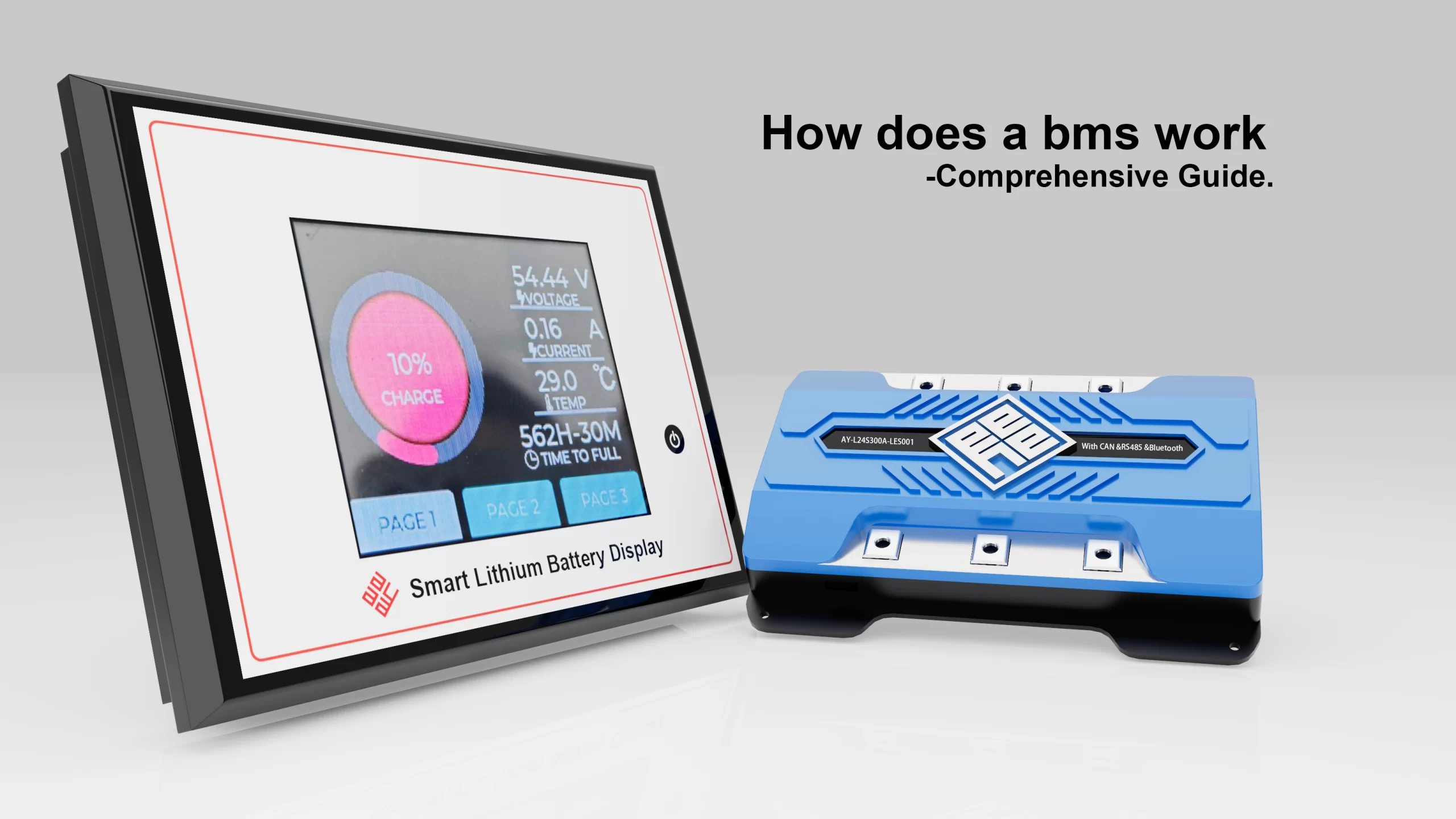
Understanding the BMS System: Core Functions and Battery Safety
2972
Understanding the BMS System: Core Functions and Battery Safety
From energy storage devices to electric vehicles (Elektrofahrzeuge), a battery management system, or BMS system, is a crucial part of contemporary battery-powered products. Its main objective is to safeguard, monitor, and enhance battery performance in order to guarantee longevity and safety. Customers and engineers seeking dependable and effective energy solutions must comprehend the function of a BMS system as lithium-ion and LiFePO4 batteries proliferate.
A well-designed BMS system is essential to any contemporary energy storage or electric mobility application since it reduces battery failure, extends cycle life, and guarantees peak performance.
What Is a BMS System?
An integrated electronic system known as a BMS system oversees a rechargeable battery by keeping an eye on its condition, managing the charging and discharging procedure, and making sure the battery runs within safe bounds.
A BMS system’s primary features include:
Spannungsüberwachung – Continuously checks the voltage of each cell in the battery pack to prevent overcharging or deep discharge.
Current Measurement – Tracks charge and discharge currents to avoid overcurrent conditions.
Temperaturregelung – Ensures cells operate within safe thermal ranges to prevent overheating or thermal runaway.
State Estimation – Determines the battery’s State of Charge (SOC) and State of Health (SOH) to provide accurate information about remaining capacity and longevity.
Ausbalancieren – Ensures all cells maintain similar voltage levels for consistent performance and extended cycle life.
Kommunikation – Provides data via CAN, SMBus, or Bluetooth for real-time monitoring and integration with external devices.
A BMS system protects batteries against circumstances that can result in decreased performance, a shorter lifespan, or safety risks by controlling these parameters.
Importance of a BMS System in Lithium-Ion Batteries
Due to their high energy density, lithium-ion batteries are susceptible to thermal stress, undervoltage, and overvoltage. A single poorly managed cell could endanger the entire battery pack in the absence of a BMS system. A BMS system is necessary for the following main reasons:
Sicherheit – Protects against overcharging, over-discharging, short circuits, and thermal runaway.
Extended Lifespan – Maintains balanced cells and safe operating conditions to maximize cycle life.
Leistungsoptimierung – Ensures consistent voltage and current output for reliable device operation.
Fault Diagnosis – Detects early signs of battery degradation or failure, reducing downtime and maintenance costs.
These characteristics make a BMS system essential for industrial battery systems, stationary energy storage, and electric vehicles.
Key Components of a BMS System
A BMS system consists of numerous important components working together:
Voltage Monitoring Circuit: Measures the voltage of each cell or module, ensuring it stays within safe limits.
Current Sensor Module: Tracks charging and discharging currents to prevent overcurrent conditions.
Temperature Sensor & Thermal Management Unit: Detects overheating and regulates cooling systems.
Microcontroller Unit (MCU) and Integrated Circuits (ICs): Execute control algorithms and communicate with other devices.
Power MOSFETs or Switches: Control charge/discharge paths and provide protective cut-offs.
Every part is essential to preserving the effectiveness and safety of a BMS system, guaranteeing that batteries operate at their best for the duration of their lives.
BMS System Architectures
The battery pack’s complexity and application determine how a BMS system is designed. Typical architectures consist of:
Centralized BMS: A single controller manages the entire battery pack, suitable for small to medium battery systems.
Modular/Distributed BMS: Multiple modules monitor segments of the battery pack, ideal for large EVs or grid-scale storage.
Master/Slave BMS: Combines centralized control with distributed monitoring for scalability and redundancy.
Selecting the appropriate BMS system architecture is essential for striking a balance between dependability, cost, and efficiency.
BMS System Development: Materials and Methods
The materials and electronic components used in the development of a BMS system must be carefully chosen:
Micro controllers (MCU) and ICs for intelligent monitoring and control.
Kommunikationsprotokolle like CAN, SMBus, or Modbus for seamless integration.
Power MOSFETs to handle high currents safely.
Thermal sensors and protection circuits to prevent overheating.
By paying attention to these specifics, the BMS system can effectively manage battery packs in a variety of load and environmental scenarios.
Battery Protection Mechanisms in a BMS System
A strong BMS system includes several security tiers:
Overvoltage and Undervoltage Protection: Prevents cells from exceeding safe voltage thresholds.
Overcurrent and Short-Circuit Protection: Stops excessive currents that can damage cells or wiring.
Thermal Management & Fault Prevention: Uses sensors and active cooling to mitigate overheating risks.
These safeguards are particularly important for LiFePO4 and high-capacity Li-ion battery systems.
Capacity Management and Cell Balancing
Advanced methods are used by a BMS to maximize battery longevity and capacity:
Passive Balancing: Uses resistors to dissipate excess energy from higher-voltage cells as heat.
Active Balancing: Redistributes energy from stronger cells to weaker ones, improving efficiency.
State of Charge (SOC) and State of Health (SOH) Estimation: Provides accurate information on remaining energy and battery condition.
Appropriate monitoring and balance minimize cell deterioration and optimize energy use.
Emerging Trends in BMS Systems
In order to satisfy the needs of contemporary applications, the BMS market is changing quickly:
Smart BMS Systems: Bluetooth or Wi-Fi-enabled units provide real-time monitoring.
AI-Assisted Diagnostics: Predict battery failures before they occur.
Integration with Renewable Energy Systems: Coordinate storage and energy flow for optimal efficiency.
High-Precision Thermal and Voltage Sensing: Enhances safety and performance under extreme conditions.
These developments highlight how important a BMS is to next-generation energy solutions.
FAQ
F: Welche drei Arten von BMS gibt es?
A:There are three main categories of BMS architectures:
Small, single-board BMS.
Distributed BMS.
Large, centralized BMS.
Q:How does a BMS work?
A:An electronic device called a battery management system (BMS) controls a rechargeable battery to guarantee its effective and safe operation. To extend battery life and guard against damage, it controls charging and discharging procedures and keeps an eye on a number of battery metrics, including voltage, current, and temperature.
Q:How to check bms system?
A:Measurement of cell, module, and pack voltage, current, and temperature as well as confirmation of the battery’s and the cell supervisory circuits’ (CSCs’) operational performance, including both static and dynamic accuracy, are necessary to guarantee the best possible performance of a battery management system (BMS).
Q:Do you really need a BMS?
A:Incorrect charging/discharging circumstances and cell imbalance can cause a battery’s lifespan to drop by 50% or more in the absence of a BMS. For these batteries to reach their maximum lifespan potential, the BMS is necessary. In order to maintain battery longevity, the BMS checks and balances everything inside.
Q:What are the three main functions of BMS?
A:Battery Management Systems (BMS) are necessary for battery packs to operate at their peak efficiency. They accomplish this by carrying out a variety of duties, including reporting, balancing, protecting, and monitoring.
Schlussfolgerung
The foundation of battery performance, safety, and efficiency is a BMS. It guarantees the safe and dependable operation of batteries by monitoring voltage, current, cell balancing, and thermal management. Selecting the appropriate BMS system is crucial to extending battery life and preserving operational effectiveness, whether for EVs, energy storage devices, or industrial applications.
For contemporary lithium-ion and LiFePO4 battery applications, investing in a top-notch BMS like the AYAA Smart BMS ensures strong protection, accurate monitoring, and easy integration, making it a reliable option for both engineers and customers.